Retro Television Reviews: Lookwell 1.1 “The Pilot”


Welcome to Retro Television Reviews, a feature where we review some of our favorite and least favorite shows of the past!  On Thursdays, I will be reviewing Lookwell, which aired on NBC in 1991.  The entire show is currently streaming on YouTube!
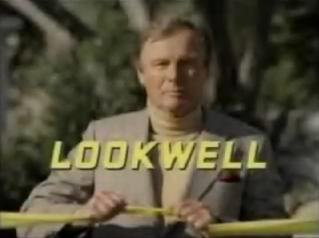
Adam West is an actor who solves crimes …. kind of.

Episode 1.1 “Lookwell”

(Dir by E.W. Swackhamer, originally aired on July 28th, 1991)

Ty Lookwell (Adam West) was once the biggest star in Hollywood.

Well, maybe not the biggest star.  But, in the 70s, he did have his own cop show.  It was called …. BanacekMannix?  No, that’s not it.  Oh …. BRANNIGAN!  Ty Lookwell starred on a show called Brannigan and he was even given his own honorary police badge in 1972.  It was presented to him at a ceremony in Television City.

However, nearly 20 years later, things have changed.  Brannigan is no longer on the air and Ty Lookwell has been reduced to wearing a wig and a leather jacket in an attempt to get a role in a revival of Happy Days.  (He not only doesn’t get the role but he doesn’t even get to audition.)  When he returns to his home, he is informed that his favorite hairspray has been discontinued (“Those fools!”) and that all the messages on his machine are for his nephew.  Kevin Costner calls looking for Lookwell’s nephew.  Francis Ford Coppola calls for Lookwell’s nephew and leaves a message in which he promises to call back.  No one calls for Ty Lookwell.

Lookwell, however, still has a steady gig teaching an acting class and his students not only look up to him  but also help him out whenever he decides that there’s a crime he has to solve.  This apparently happens frequently as Lookwell takes his honorary badge very seriously.

“Remember how we talked about how you don’t have to come around here?” Detective Kennery (Ron Frazier) asks Lookwell at one point.

The pilot follows Lookwell as he investigates a series of car thefts.  Helping him out is his favorite student, Jason (played by future director Todd Field).  Lookwell’s investigative techniques are not particularly complicated.  He puts on a disguise and attempts to go undercover.  It never quite works, largely because everyone that Lookwell meets is smarter than Lookwell.  Lookwell’s attempt to disguise himself as a Grand Prix racer fails because the security guard takes one look at him and sees that he’s obviously not a Grand Prix racer.  His attempt to conduct a stakeout on a fancy diner is nearly thwarted by his bizarre decision to disguise himself as a hobo.  His attempt to go undercover at a garage is thwarted by the other mechanics misunderstanding his leading questions.

(“Who beat you up, Mr. Lookwell?” his students ask at the start of class.)

As the investigation continues, Jason wonders if they’re just wasting time.

“You do not waste time,” Lookwell corrects him, “Time wastes you.”

Lookwell was written by Conan O’Brian and Robert Smigel, long before either one of them became famous, and the humor is definitely the humor of a generation who grew up watching network television, especially the cop shows of the 70s and the 80s.  While the dialogue is clever and definitely funny, it’s really Adam West who makes the pilot work.  West delivers all of his line with such conviction and confidence that it doesn’t matter that he only plays a peripheral role in solving the case and, in fact, usually makes things worse for everyone involved.  As played by West, Lookwell is so confident in his abilities and so blithely unaware of his limitations that it’s hard not to admire his spirit.

Unfortunately, the spirit was not admired by NBC and Lookwell only aired once.  But it has since developed a cult following.  Adam West described it as being his favorite of the various shows that he did.  I enjoyed the pilot, though I do think the premise was perhaps a bit too thin to support an actual series.  (It would have made a great recurring SNL bit, though.)  Thanks to YouTube, everyone can now watch what NBC passed up.
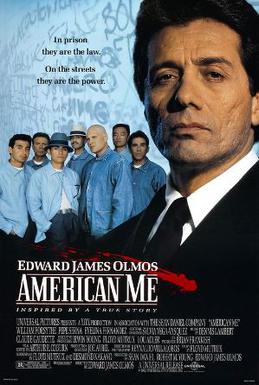
Film Review: American Me (1992, directed by Edward James Olmos)


American Me tells the story of Montoya Santana (Edward James Olmos).  Conceived during the Zoot Suit Riots of the 1940s, Santana is first arrested when he’s just 14 years old.  It’s only a breaking-and-entering charge but, on his first night in juvenile hall, Santana is raped by another inmate.  When Santana retaliates by murdering his rapist, his fate is set.  As soon as he’s 18, he’s transferred to Folsom Prison but, by that time, he and his friend J.D. (William Forsythe) have already formed what will become La Eme, the Mexican Mafia.  Running things from their cells, Santana and J.D. not only control the prison’s drug trade but they also keep an eye on who, from their old neighborhood, is going to be joining them behind bars.  Santana establishes early on that the punishment for any sign of weakness or disloyalty is death.

When Santana is finally released from prison, he finds that the world has changed since he was first incarcerated.  La Eme has become powerful both inside and outside of prison and nearly everyone in Santana’s old neighborhood looks up to him.  But Santana, himself, is lost.  In prison, Santana was feared and respected but, on the outside, he’s a 34 year-old man who has never had a job or a relationship.  He’s never even learned how to drive.

After meeting and falling in love with Julie (Evelina Fernandez) and seeing firsthand the damage that the drug trade is doing to his community, Santana starts to have second thoughts about La Eme.  But, according to the rules that he previously established, trying to leave La Eme is punishable by death.

American Me is a classic gangster film and I’m always surprised that it doesn’t have a bigger following than it does.  Along with starring in the film, Olmos made his directorial debut with American Me and he provides an unflinchingly brutal look at the drug trade and the violence that goes along with it.  Olmos was allowed to film inside Folsom Prison and even used actual prisoners are extras, bringing a touch of neorealist verisimilitude to the prison scenes. Early on, there’s a sequence that follows a baggie of heroin from one orifice to another until it finally reaches it destination in the prison.  It leaves you with no doubt that if people are willing to go through that much trouble to get drugs, it’s going to take something more than just zero tolerance laws to dissuade them.

Once Santana is released, Olmos does a good job, as both an actor and director, of showing just how lost he is.  In prison, Santana was in charge and feared but, when dealing with people in the real world, he’s just as awkward as he was when he was a teenager on his way to juvenile hall.  Olmos gives a tightly-wound, subtle performance as a man who is as much a prisoner of his outlook as he is of the state of California.

The men who served as the real-life inspiration for Olmos’s film were reportedly outraged by American Me.  They weren’t upset by the film’s portrayal of the drug trade or their callous disregard for the members of their community.  Instead, the film’s crime was suggesting that their organization was founded by someone who had been previously raped in prison.  (That Santana subsequently killed his rapist made no difference.)  Three people associated with the Mexican Mafia, all of whom has served as consultants to American Me, were subsequently murdered in the days immediately following the release of the film.

As for Edward James Olmos, he has remained busy as an actor.  One generation got know him on Miami Vice and then the next came to know him from Battlestar Galactica.  He’s subsequently directed four other films.  For me, his strongest work, as both an actor and a director, remains American Me.

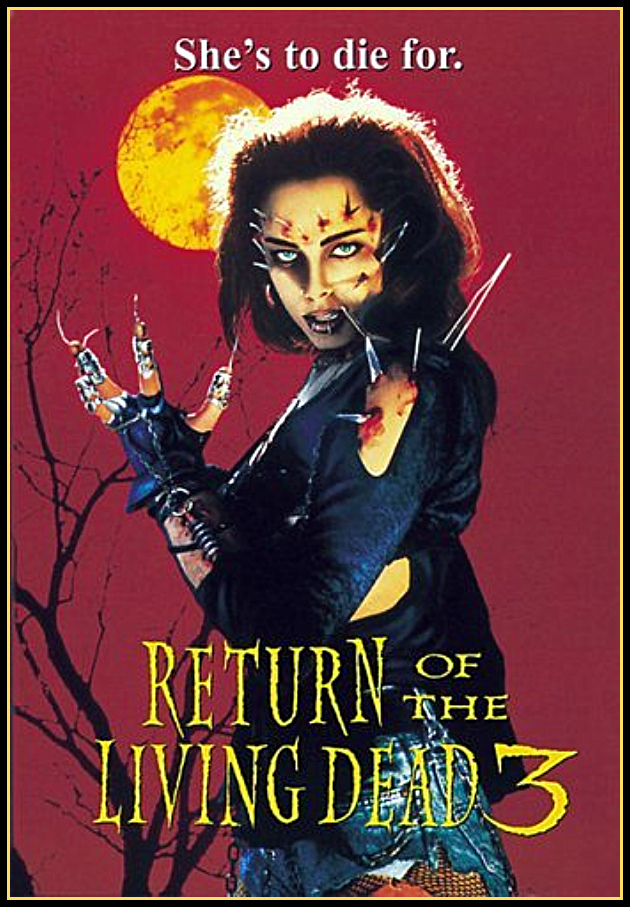
Quickie Review: Return of the Living Dead 3 (dir. by Brian Yuzna)


In 1993 horror fans were greeted with the release of Return of the Living Dead 3. This third film in the Return of the Living Dead series produced by John Russo ends up being a very good zombie movie and actually has genuine horror that the second film lacked. What ROTLDIII, its writers and directors seem to have left behind was the comedy side of the series which made them cult-classics to begin with.

Taking up directing duty this time around was genre-veteran Brian Yuzna (Beyond Re-Animator) who films this third entry purely on a horror standpoint. This film is serious horror from start to finish. This time around the military is still trying to find a way to use 2-4-5 Trioxin as a way to create zombie soldiers, but ones that could be easily controlled by them. To say that this project hasn’t met with success is an understatement. But it’s the story of the son of the military project director and his girlfriend who dominate the film’s plot. As portrayed by J. Trevor Edmond and Melinda Clarke, these two star-crossed lovers find themselves enmeshed with the dark secret of the project being held in secret. Son soon uses the Trioxin gas to try and ressurect his girlfriend who gets killed early on during an accident. What he gets instead is an undead girlfriend whose hunger for live brains (for some reason the zombies in this ROTLD sequel also feed on other bodily parts) can only be controlled when she causes herself bodily pain through extreme forms of piercing. The rest of the film deals with the father trying to save his son not just from himself and his undead girlfriend but from the hordes of escaped zombies in the facility.

The horror in the film was actually pretty good and this was helped a lot by the gore effects work which surpasses anything the first two films in the series had. The acting was decent enough with Melinda Clarke as the zombified girlfriend putting on a sexy, albeit creepy performance. If it wasn’t for the brain and flesh-eating she sure would’ve made for quite a poster girl for teenage boys.

In the end, Return of the Living Dead 3 continues the series admirably. Despite not having much humor and comedy in the film, this third film in the series more than makes up for it with high levels of gore and a definite sense of horror the first two didn’t much have not to mention a bit of romance which seemed to work.