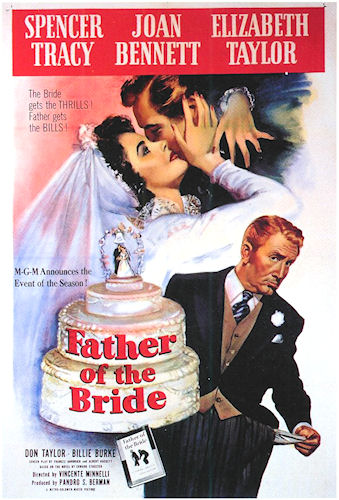
Lisa Watches An Oscar Nominee: Father of the Bride (dir by Vincente Minnelli)


FatheroftheBride1950

After I watched King Solomon’s Mines, I watched yet another 1950 best picture nominee, Father of the Bride.

In Father of the Bride, Spencer Tracy plays a lawyer named Stanley Banks.  As you might expect of any character played by Spencer Tracy, Stanley Banks is a no-nonsense type of guy.  He’s set in his ways and not particularly enthusiastic about the idea of change.  Stanley has worked hard to get a good job and a nice house in the suburbs.  He loves his wife, Ellie (Joan Bennett) and is a firm but good father to his two boys, Tommy (Russ Tamblyn) and Ben (Tom Irish).  If Stanley does have a soft spot, it’s for his daughter, Kay (17 year-old Elizabeth Taylor).  Stanley admits that he’s always given Kay everything that she’s ever wanted and that she is his favorite of all his children.

However, Kay has been acting strangely as of late.  She just seems to be so happy!  Stanley can tell that she’s in love, though he has no idea with whom.  (He is, however, happy that it’s probably not the bespectacled political radical who Kay apparently dated at some point in the past.)  Finally, during an otherwise typical family dinner, Kay announces that not only is she in love but she’s also engaged to be married!

His name is Buckley (Don Taylor, who would later direct Escape From The Planet of the Apes and Damien: Omen II) and, at first, Kay refuses to even introduce him to her parents.  Eventually, however, Stanley does meet Buckley and he’s happy to discover that not only does Buckley come from a wealthy family but he also owns a small business of his own.

However, just because Buckley is the perfect 1950 man, that doesn’t mean that the wedding is going to be easy.  As a befuddled Stanley watches, the wedding grows more and more elaborate (not to mention, expensive!).  All of the expected complications ensue: Buckley and Kay have a fight, a wedding planner makes things difficult, and Stanley does not immediately get along with Buckley’s parents.  But, for the most part, Father of the Bride is about Stanley struggling to accept that his daughter has grown up and is ready to start a life of her own.

Father of the Bride is a sweet little comedy, though it seems a bit out-of-place as a best picture nominee.  It’s definitely a film of its time.  For all of the scenes of Stanley worrying about the extravagance of modern weddings, there’s not a subversive moment to be found in Father of the Bride.  (One can only imagine what Nicholas Ray or Douglas Sirk would have done with the material.)

Fortunately, this is also a Spencer Tracy film and whatever gravitas that the film may have comes from Tracy’s honest and straight forward performance.  Tracy never begs for laughs but he gets them anyway, because of the honesty that he brings to the character.  Perhaps his best moment comes after Buckley and Kay have had a fight.  After comforting his daughter, Stanley discovers that Buckley is at the front door.  At first, the protective Stanley tells Buckley that Kay doesn’t want to see him.  Suddenly, Kay comes running down stairs and embraces Buckley.  Between sobs and kisses, Buckley and Kay dramatically swear to each other that they will never fight again.  The camera pans over to Stanley, standing a little to the side and listening.  At first, Stanley seems befuddled by how overdramatic the two of them are acting over a relatively minor fight but there’s also just a hint of sadness in Stanley’s eyes as he realizes that his daughter truly has moved on.

Father of the Bride was nominated for best picture but it lost to the far more subversive All About Eve.

Embracing the Melodrama Part II #25: West Side Story (dir by Robert Wise and Jerome Robbins)


West_Side_Story_poster

Nearly two weeks ago, I started on something that I call Embracing the Melodrama, Part II.  For the next month or so, I will be reviewing, in chronological order, 126 examples of cinematic melodrama.  I started things off by reviewing the 1927 classic Sunrise and now, 24 reviews later, we’re ready to start in on one of my favorite decades, the 1960s!

And what better way to start the 60s than be taking a look at the 1961 best picture winner, West Side Story?

Being a lifelong dancer, I have to admit that I’ve lost track of how many times I’ve seen West Side Story.  If you love to dance, this is one of those films that you simply have to see.  Of the various musicals that have won best picture, West Side Story is arguably the best.  Based on a hit Broadway show (which was itself rather famously based on William Shakespeare’s Romeo and Juliet), West Side Story was co-directed by the great choreographer Jerome Robbins and it features some of the greatest dance numbers ever filmed.  If you don’t get excited while watching the Sharks and the Shark Girls arguing about America, then there’s really no hope for you.  Tonight Quintet, Somewhere, A Boy Like That, Maria … even Gee, Officer Krupke, has there ever been another musical score that just leaves you wanting to sing as much as West Side Story does?

(I mean, I’ll be the first admit that I absolutely love the theme song from Santa Claus Conquers The Martians but it can’t even compare to West Side Story!)

What’s funny is that, in between viewings of the film, I always seem to forget just how good West Side Story actually is.  (Fortunately, this also means that I’m pleasantly surprised every time I watch the movie.)  In theory, this is an easy film to joke about.  It tells the story of street gangs who are apparently just as good at dancing as they are at fighting.  The all-white Jets snap their fingers and tell us that when you’re a jet, you’re the best.  The Puerto Rican Sharks are moving in on the Jets’s territory.  The two leaders of the gangs — Riff (Russ Tamblyn) and Bernardo (George Chakiris) — want to settle thing with a “rumble.”  And it’s easy for contemporary audiences to laugh because “rumble” is such an old-fashioned way of saying things that it’s now one of those terms that’s only used when one is trying to be ironic or snarky.

(For instance, I was with some friends at the movies and the people sitting behind us kept talking.  One of my friends told them to shut up.  One of the loud people replied that we were the ones who need to shut up.  As the insults escalated, I finally said, “Y’all — do we really have to have a rumble right now?”  Unfortunately, everyone was too busy arguing to appreciate my pitch perfect delivery.)

Riff’s best friend is Tony (Richard Beymer).  Tony was a co-founder of the Jets but now, he wants to move on from the gang.  He meets a girl named Maria (Natalie Wood) and the two of them fall in love.  However, Maria is Bernardo’s younger sister.  Her best friend, Anita (Rita Moreno), is Bernardo’s girlfriend.  Loving Tony, in other words, is prohibido.

And, since West Side Story is based on Romeo and Juliet, you can probably guess to what type of tragedy all of this leads.

Now, before I heap too much praise of West Side Story, I do need to admit that, in the role of Tony, Richard Beymer does not exactly radiate charisma.  He’s handsome enough but you never quite buy that he was former member of the Jets.  Since Tony’s singing voice was dubbed by Jimmy Bryant, you do believe everything that he sings.  But otherwise, Richard Beymer comes across as being stiff and rather awkward.

And it doesn’t help, of course, that he’s acting opposite Russ Tamblyn who, in the role of Riff, is a whirlwind of unstoppable energy.  Tamblyn is the one who you remember at the end of the film, followed by George Chakiris.  Compared to those two, Richard Beymer’s performance is just dull.

Fortunately, there’s Maria (played by Natalie Wood with Marni Nixon doing the singing).  Natalie Wood is one of my favorite of the classic Hollywood actresses.  She’s certainly one of the actresses with whom I most idenitfy.  With Richard Beymer sleepwalking through the role of Tony, it falls on Natalie to provide some true emotion to the film’s love story and that’s exactly what she does.  Every time I see West Side Story, I want to be Natalie Wood and I want to have a best friend like Rita Moreno and I want to meet someone like Riff…

Sorry, Tony.

West Side Story is one of the best musicals ever made.  If you’re not dancing and then crying and then dancing while crying as you watch West Side Story, then you’re doing it wrong.

http://www.youtube.com/watch?v=yA_aFprGzyc

Embracing The Melodrama #13: Peyton Place (dir by Mark Robson)


Poster - Peyton Place_04

“Just remember: men can see much better than they can think. Believe me, a low-cut neckline does more for a girl’s future than the entire Britannica encyclopedia.” — Betty (Terry Moore), speaking the truth in Peyton Place (1957)

Sex!  Sin!  Secrets!  Scandal!  It’s just another day in the life of Peyton Place, the most sordid little town this side of Kings Row!  It’s also the setting of the 1957 best picture nominee, Peyton Place.

Peyton Place is a seemingly idyllic little village in New England.  The town is divided by railroad tracks and how your fellow townspeople views you literally depends on which side of the tracks you live on.  As the film itself shows us, the right side of tracks features pretty houses and primly dressed starlets.  The wrong side of the tracks features shacks and a bunch of people who look like the ancestors of the cast of Winter’s Bone.  The difference in appearance is not particularly subtle (but then again, the same thing could be said for the entire film) but, regardless of which side of the tracks live on, chances are that you’re keeping a few secrets from the rest of the town.

On the right side of the tracks, you can find Constance McKenzie (played by Lana Turner, who is just about as convincing as a New England matron as you would expect a glamorous Hollywood star to be), a dress shop owner who is so prim and proper that she literally flies into a rage when she comes across her daughter kissing a boy.  Could it be the Constance’s repression is the result of her once having been a rich man’s mistress?  And will the new high school principal, the progressive and rather dull Mr. Rossi (Lee Phillips), still love her despite her sordid past?

Constance’s daughter is Allison (Diane Varsi) and poor Allison just can not understand why her mother is so overprotective.  Will Allison ever find true love with the painfully shy Norman Page (Russ Tamblyn) or will she be forced to settle for someone like the rich and irresponsible Rodney Harrington (Barry Coe)?

Rodney, for his part, is in love with Betty (Terry Moore), a girl from the wrong sides of the tracks.  Rodney’s father (Leon Ames) is the richest man in town and makes it clear that he will not allow his son to marry someone with a “reputation.”  Will Rodney get a chance to redeem himself by going off to fight in World War II?

And what will happen when Rodney and Betty go skinny dipping and are spotted by a local town gossip who promptly mistakes them for Norman and Allison?  Reputations are at stake here!

Meanwhile, over on the bad side of the tracks, Lucas Cross (Arthur Kennedy) sits in his shack and drinks and thinks about how the world has failed him.  His long-suffering wife (Betty Field) works as housekeeper for the McKenzie family.  Meanwhile, his abused daughter Selena (Hope Lange, giving the film’s best performance) is Allison’s best friend.  When Lucas’s attempt to rape Selena leads to a violent death, the sins and hypocrisy of Peyton Place are revealed to everyone.

Peyton Place is a big, long  movie, full of overdramatic characters, overheated dialogue, and over-the-top plotting and, for that reason, I absolutely love it!  Apparently, the film was quite controversial in its day and the scenes where Arthur Kennedy attacks Hope Lange still have the power to disturb.  However, the main reason why I enjoy Petyon Place is because anything that could happen in Peyton Place does happen in Peyton Place.

Seriously, how can you not love a film this sordid and melodramatic?