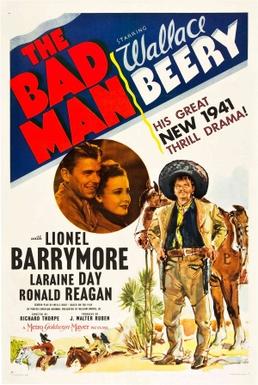
The Bad Man (1941, directed by Richard Thorpe)


Gil Jones (Ronald Reagan) lives on a ranch with his cantankerous uncle, Henry (Lionel Barrymore).  After their cattle are stolen by the notorious bandit Pancho Lopez (Wallace Beery), Gil and Henry are faced with the prospect of losing their ranch.  Banker Jasper Hardy (Henry Travers) wants to foreclose on Henry and take over the ranch but a businessman named Morgan Pell (Tom Conway) shows up and offers to pay the then-huge sum of $20,000 for the land.  Accompanying Morgan is his wife, Lucia (Laraine Day).  Lucia was Gil’s childhood love and Morgan fears that Lucia still loves Gil more than him.  Also in the mix is Gil’s comic relief best friend (Chill Wills), who has a crush on Hardy’s daughter (Nydia Westman).  Negotiations are interrupted when the flamboyant Lopez and his men return to the ranch and take everyone, but Gil, hostage.

This sepia-toned film is based on a stage play, one that had already been filmed twice.  It was Ronald Reagan’s first film for MGM and, when Reagan was running for President, he quipped that if he could survive acting opposite Wallace Beery and Lionel Barrymore than he could survive negotiating with Leonid Brezhnev.  The role of Gil is a typical Ronald Reagan role.  He’s good-natured and dependable and a little boring.  Because he once saved Lopez’s life, Lopez is willing to help him out with his problems.  Reagan is not bad in the role but he is overshadowed by Barrymore and Beery, two veteran actors who chew the scenery with gusto here.  Berry speaks in an exaggerated and not at all convincing Mexican accent while Barrymore bellows all of his lines.  Gil has so many different people yelling at him that it’s impossible not to feel sorry for him.  Morgan has ulterior motives for offering to buy the land and Tom Conway is a convincing villain.  Lopez helps out Gil and her uncle, saving not only their land but also plotting to bring Gil and Lucia back together.  It’s a stage bound mix of drama and comedy that doesn’t really work, though Beery and Barrymore are amusing and Ronald Reagan shows why he was cast in so many best friend roles.

Whether you’ll enjoy it will probably depend on how you feel about the cast because they’re really the only reason to watch.  If you’re a fan of Barrymore, Beery, or Reagan the film might work for you.  If you’re not, this stagey 70-minute western is probably not for you.

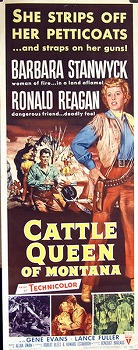
Cattle Queen of Montana (1954, directed by Allan Dwan)


Pop Jones (Morris Ankurm) and his daughter Sierra Nevada (Barbara Stanwyck) leave their ranch in Texas and head up to Montana to take over some land that Pop has inherited.  Evil Tom McCord (Gene Evans) wants the land for himself and conspires with a member of the local Blackfoot tribe, Natchakoa (Tony Caruso), to take it over.  After a surprise attack leaves Pop dead, Sierra is nursed back to health by Colorados (Lance Fuller), the son of the Blackfoot chief.  Sierra tries to reclaim her land from McCord, with the eventual help of the mysterious gunslinger Farrell (Ronald Reagan).

There are a lot of reasons why this B-western doesn’t really work, a huge one of them being that Barbara Stanwyck was several years too old to be playing Morris Ankrum’s innocent daughter.  The biggest problem though was casting Ronald Reagan as a mysterious gunslinger.  Farrell is a character who is supposed to keep us guessing.  We’re not supposed to know if he’s a good guy or a bad guy.  But as soon as Ronald Reagan shows up and starts to speak, we know everything we need to know about Farrell.  There was nothing enigmatic or even dangerous about Ronald Reagan’s screen persona.  He came across as being more open and honest as just about any other actor from Hollywood’s Golden Age.  For the role of Farrell, it appears that he went a day without shaving and he tried not to smile while on-camera but he’s still good old dependable Ronald Reagan.  That pleasantness and lack of danger may have kept him from becoming an enduring movie star but it did serve him very well when he moved into the political arena.

Cattle Queen of Montana was one of the 200 westerns that Allan Dwan directed over his long career.  It’s not one of his more interesting films, though he does manage a few good action sequences.  A far better Dwan/Reagan collaboration was Tennessee’s Partner, which was released four years after this film.

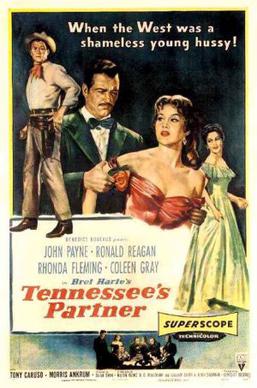
Tennessee’s Partner (1955, directed by Allan Dwan)


Tennesse (John Payne) is an old west gambler who co-owns a saloon (and bordello) with Elizabeth Farnham (Rhonda Fleming).  When Tennessee is ambushed after a poker game, he’s saved by a local man who goes by the name of Cowpoke (Ronald Reagan).  Tennessee and Cowpoke become fast friends but when Tennessee realizes that Cowpoke is about to marry a golddigger (Coleen Gray), Tennessee puts the woman on the next boat out of town.  Cowpoke vows to get vengeance but Tennessee has bigger things to worry about.  Rival businessman Turner (Tony Caruso) has framed Tennessee for the murder of a local prospector, Grubstake McNiven (Chubby Johnson).

Very loosely based on a short story by Bret Harte, Tennessee’s Partner has surprisingly high production values for a B-western.  Director Allan Dwan started his career in the 1910s and directed over 200 westerns.  He knew how to keep the action moving.  Tennessee’s Partner is also the only film that old friends John Payne and Ronald Reagan made together.  Reagan, whose days as a major studio leading man had ended by the time he made this film, gives one of his better performances in the role of the simple but honest Cowpoke and shows the likability that he was later able to translate into a political career.  Reagan could be a stiff actor but his naturally amiable manner made him perfect for best friend and sidekick roles, like in this movie.  Payne also gives a good performance as the gambler with a moral code.  However, the best thing about the film is Rhonda Fleming, giving a tough and sexy performance as Elizabeth.  Because this film came out in 1955, it couldn’t really come out and say that Elizabeth was a madam and the saloon was a bordello but Fleming’s performance and a few lines of innuendo left little doubt about what was actually going on upstairs from the bar.  Keep an eye out for Angie Dickinson, playing one of Elizabeth’s girls.

The performance elevate Tennessee’s Partner, making it a B-western that can be enjoyed even by people who aren’t necessarily into westerns.

Scenes That I Love: Ronald Reagan in Kings Row


Today’s scene that I love features future President Ronald Reagan, giving what he considered to be his best performance in 1942’s Kings Row.  He liked one of the lines in this scene so much that he used it as the title for autobiography.

On what would have been Ronald Reagan’s 114th birthday, here is today’s scene that I love.


10 Oscar Snubs From the 1940s


Ah, the 40s! For most of the decade, the world was at war and the Academy’s nominations reflected that fact. The best picture lineups alternated between patriotic films that encouraged the battle against evil and darker films that contemplated both the mistakes of the past and what threats might be waiting in the future.  With the Academy being even more aware than usual that films and awards could be used to send a message, the snubs continued.

1940: John Carradine Is Not Nominated For The Grapes of Wrath

John Carradine’s first credited film appearance was in 1930 but Carradine himself claimed that he had appeared as an uncredited extra in over 70 films before getting that first credit.  Carradine would continue to work until his death 58 years later.  John Carradine did so many films that he was still appearing in new releases in the 90s, years after his death.  He appeared in over 234 films and in countless television shows.  He was a favorite of not only Fred Olen Ray’s but also John Ford’s.

Unfortunately, Carradine was never nominated for an Oscar, despite the fact that he did appear in some classic films.  (He also appeared in a lot of B-movies, which is perhaps one reason why the Academy was hesitant to honor him.)  Personally, I think Carradine most deserved a nomination for playing “Pastor” Jim Casy in John Ford’s The Grapes of Wrath.  Carradine is ideally cast as the former preacher turned labor activist.  When he’s alive, he gives the Joads hope.  When he dies, both the Joads and the audience start to realize how difficult things are truly going to be.

1942: Ronald Reagan Is Not Nominated For Best Supporting Actor For Kings Row

Kings Row is an enjoyably over-the-top small town melodrama and future President Ronald Reagan is fantastic in the film, with his natural optimism providing a nice contrast to the truly terrible things that happen to him and his loved ones over the course of the film.  Reagan was not nominated for this performance, the one that both he and the most of the critics agreed was his best, but he should have been.

1943: Hangmen Also Die Is Not Nominated For Best Picture

Fritz Lang’s anti-Nazi classic was not nominated for Best Picture and only received two nominations (for Sound and Score).  That year, the Best Picture winner was another anti-Nazi classic, Casablanca.

1943: Shadow Of A Doubt Is Ignored

Today, it is recognized as one of Hitchcock’s best but, in 1943, Shadow of a Doubt couldn’t even score a nomination for Joseph Cotten’s wonderfully diabolical turn as Uncle Charlie.  One gets the feeling that the film’s satirical jibes at small town America and its theme of evil hiding behind a normal façade were not what the Academy was looking for at the height of World War II.  It’s a shame because, in many ways, Cotten’s Uncle Charlie was the perfect symbol of the enemy that the Allies were fighting.

1944: Tallulah Bankhead In Not Nominated For Best Actress For Lifeboat

Unlike Shadow of a Doubt, Hitchcock’s Lifeboat received several Oscar nominations.  However, Tallulah Bankhead was not nominated for Best Actress.  Perhaps the Academy was scared of what she might say if she won.

1944: Fred MacMurray and Edward G. Robinson Are Not Nominated For Double Indemnity

For all the nominations that this classic noir received, somehow neither Fred MacMurray nor Edward G. Robinson were nominated for their roles.  Both actors are brilliantly cast against type in this film.  MacMurray uses his trademark casual glibness to portray Walter Neff as being an arrogant man who is hardly as clever as he thinks that he is.  Meanwhile, Robinson’s more introspective performance leaves you with little doubt that, if anyone can solve this case, it’s him.  While Barbara Stanwyck was (rightfully) nominated, it’s had to believe that both MacMurray and Robinson were snubbed.

1946: Thomas Mitchell and Lionel Barrymore Are Not Nominated For Best Supporting Actor For It’s A Wonderful Life

As wonderful as James Stewart and Donna Reed are, it just wouldn’t be Bedford Falls without Uncle Billy and Mr. Potter!  Thomas Mitchell breaks your heart in the scene where he tries to remember what he did with the lost money.  And, for audiences who had just lived through the Great Depression, Lionel Barrymore represented every businessman who cared more about money than people.  It’s impossible to imagine the film without them …. or without Henry Travers, for that matter!  Seriously, very few films have received three best supporting actor nominations but It’s A Wonderful Life deserved to be one of them.

1948: Humphrey Bogart Is Not Nominated For Best Actor For The Treasure of the Sierra Madre

The Treasure of the Sierra Madre received four Oscar nominations.  Somehow, not one of those nominations was not for Humphrey Bogart.

1948 and 1949: Red River, Fort Apache, and She Wore A Yellow Ribbon Are Not Nominated For Best Picture

The public may have loved Westerns but the Academy largely shied away from them, with a few notable exceptions.  Howard Hawks’s Red River and John Ford’s Fort Apache and She Wore A Yellow Ribbon are today all recognized as being classic Hollywood films.  However, the Academy, then at the height of its bias towards “genre” films, didn’t honor any of them.

1949: James Cagney Is Not Nominated For Best Actor For White Heat

“Top of the world, ma!”  Maybe so, but not top of the Oscars.  The Academy was always more interested in honoring Cagney for being a song-and-dance man than for honoring him for his iconic gangster roles.

Agree?  Disagree?  Do you have an Oscar snub that you think is even worse than the 10 listed here?  Let us know in the comments!

Up next: Get ready to hate the commies and to love Ike because the 50s are coming!

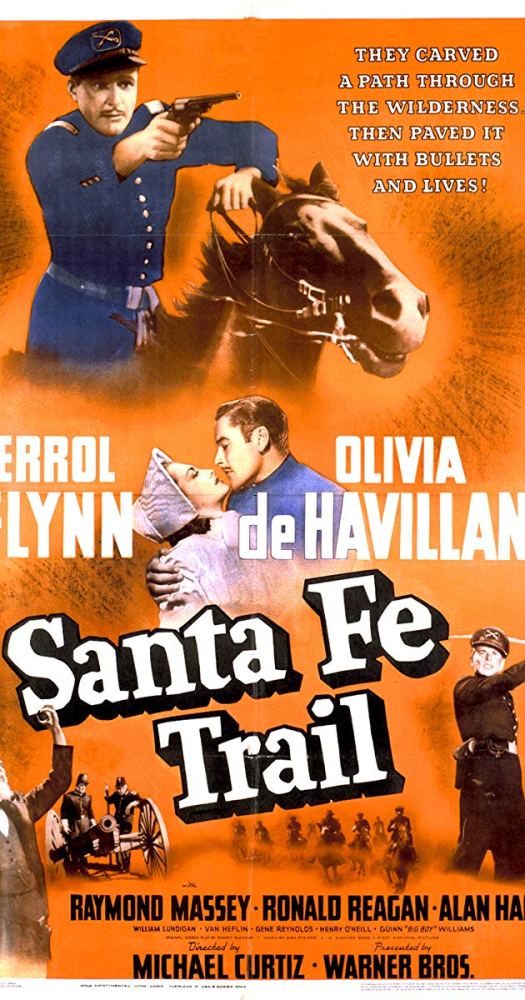
Hollywood History Lesson: Errol Flynn in SANTA FE TRAIL (Warner Brothers 1940)


gary loggins's avatarcracked rear viewer

A movie lover could get pretty spoiled living on a steady diet of Errol Flynn/Warner Brothers epics from the 30’s and 40’s. You’ve got Flynn, the personification of the classic “movie star”, performing heroic feats and romancing his leading lady (usually Olivia de Havilland ). A historical setting   serving as the backdrop to move the story along, expertly directed by Michael Curtiz or Raoul Walsh, a cast full of Hollywood’s greatest character actors, a majestic music score (mainly Max Steiner , but there were others equally as talented), action, drama, humor, conflict… what more could a film fan ask for?

SANTA FE TRAIL has all this and more, an energetic pre-Civil War tale guaranteed to hold your interest for its 110 minutes no matter which side of the Mason-Dixon Line you live on. It’s characters are drawn from history, but historic accuracy be damned… these films were all about…

View original post 774 more words

A Movie A Day #222: Secret Service of the Air (1939, directed by Noel M. Smith)


When a secret service agent’s investigation into a supposed counterfeiting ring instead leads to him discovering a plot to smuggle illegal aliens into the United States via airplanes, the agent ends up plummeting several hundred miles to his death.  Realizing that they need someone who can go undercover and infiltrate the smuggling ring, the Secret Service recruits Lt. Brass Bancroft (Ronald Reagan).  Bancroft is a war hero who is now a commercial airline pilot.  He is also good with his fists, has an innate sense of right and wrong, and a sidekick named Gabby (Eddie Foy Jr., giving a very broad performance as the movie’s comic relief).  But before Brass can win the trust of the smugglers, he will have to establish a firm cover story and that means allowing himself to be arrested on fake charges.  In order to save the day, Brass will have to first survive prison.
If Secret Service of the Air is remembered today, it is because it featured future President Ronald Reagan in an early starring role.  In the role of Brass Bancroft, Reagan gives a performance that can be best described as being amiable.  He may not be anyone’s idea of a good actor but he is likable, a trait that served him well when, 26 years later, he ran for governor of California.  As for the rest of the movie, it was obviously cheaply made but it is also only an hour long, which means that there is rarely time for a dull moment.  It plays out like as serial, with a new cliffhanger ever few minutes.  Though Reagan was dismissive in the film in his autobiography, Secret Service of the Air was enough of an unexpected success that he would play Brass Bancroft is two sequels.

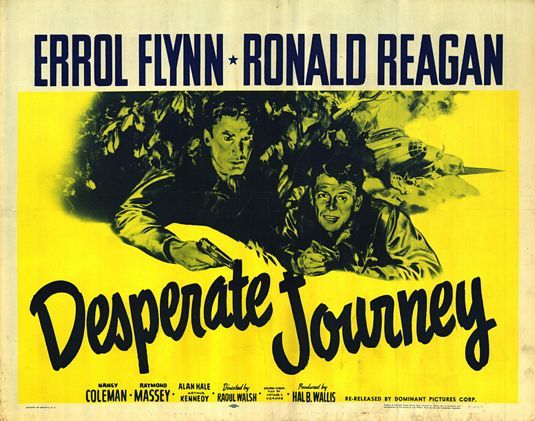
Happy Birthday Errol Flynn: DESPERATE JOURNEY (Warner Brothers 1942)


gary loggins's avatarcracked rear viewer

desp1

The actor known for his “wicked, wicked ways”, Errol Flynn was born June 20, 1909 in Hobart, Australia. The dashing Flynn skyrocketed to fame with a series of swashbuckling exploits: CAPTAIN BLOOD , THE SEA HAWK, and most notably THE ADVENTURES OF ROBIN HOOD. He was also featured in some of the great Westerns of the era (THEY DIED WITH THEIR BOOTS ON, SANTA FE TRAIL). Like all stalwart screen heroes, during the 1940’s Flynn made a number of wartime propaganda films to boost morale for the masses. One of these was DESPERATE JOURNEY, a totally improbable but highly exciting action yarn from the two-fisted, one-eyed Raoul Walsh, director of such macho fare as THE ROARING TWENTIES, HIGH SIERRA, and WHITE HEAT.

desp2

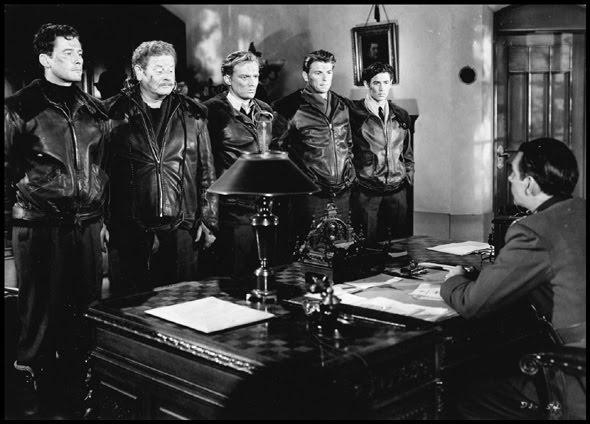
An RAF bomber squad is sent on a dangerous mission behind enemy lines to take out a train depot. They accomplish the task, but are shot down by Nazi heavy artillery. Forced to…

View original post 795 more words

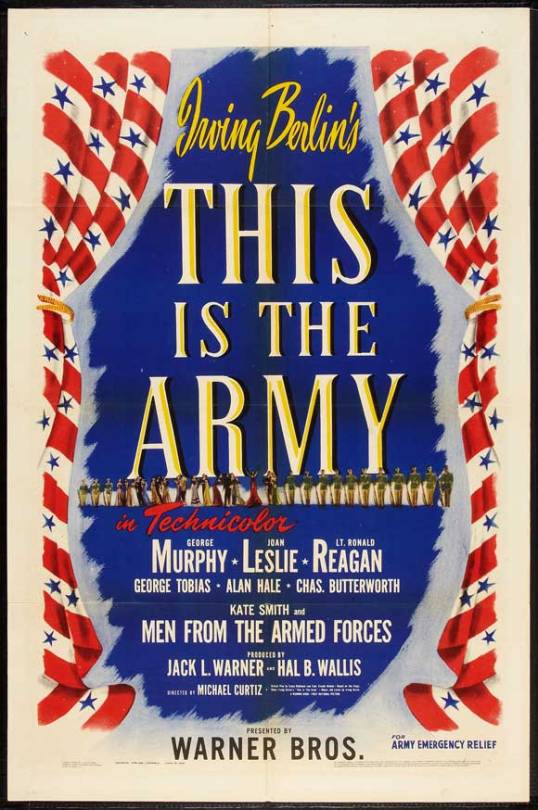
The Fabulous Forties #34: This Is The Army (dir by Michael Curtiz)


Titapos

The 34th film in Mill Creek’s Fabulous Forties box set is the 1943 musical, This is The Army.

This Is The Army is based on a Broadway musical that was specifically conceived and written by Irving Berlin as a way to boost wartime morale.  The show, which was a collection of patriotic songs and comedic skits, was performed by members of the U.S. Army.  The film version starts with dancer Jerry Jones (George Murphy) being drafted at the start of World War I and putting together an all-army revue called Yip Yip Yaphank.  (Interestingly enough, this was also the name of a real-life show that Irving Berlin put together during World War I.)  The show is a big hit and, when the soldiers in the cast receive their orders to head to France, they literally march off the stage and out the theater.  It’s actually a pretty rousing scene but it’s almost immediately followed by a very sad one, in which we learn that only three members of the cast survived the war.  Jerry Jones is shot in the leg and when he returns home, the former dancer now walks with a cane.

Twenty-five years later, another world war has broken out.  Jerry’s son, Johnny (Ronald Reagan), has joined the army.  Johnny is ordered to put together another revue, in the style of Yip Yip Yaphank.  At first, Johnny is reluctant but orders are orders.  Soon, Johnny and the cast of This Is The Army are touring the U.S. and even performing in front of President Roosevelt (played by Jack Young, though, from a historical perspective, wouldn’t it be neat if President Roosevelt had appeared as himself in a film with Ronald Reagan?).  Along the way, Eileen (Joan Leslie) tries to convince Johnny to marry her even though Johnny wants to wait until the war is over.

It’s really not much of a plot but then again, the film is about showcasing the musical performances.  The soldiers sing.  The soldiers dance.  The soldiers tell jokes and imitate people who were famous in 1943.  There are several scenes that attempt to wring laughs from soldiers dressed up like women.  What’s interesting is that, at a time when the army was still segregated, the performances in This Is The Army feature both white and black soldiers.  Irving Berlin apparently demanded that black soldiers be allowed to appear in both the stage show and the film and, as a result, the unit that performed This Is The Army was, for a time, the only integrated unit in the U.S. Army.

Of course, that makes it even odder that there’s an extended sequence in which white soldiers perform while wearing blackface and standing on a set that’s been designed to resemble a pre-Civil War plantation.  It’s a scene that pops out of nowhere and then it keeps going and going and going and I could only stare at the screen in shocked horror as it played out.  It’s an odd contradiction that the same Irving Berlin who demanded that black soldiers be honored on stage and screen was also apparently the same Irving Berlin was put a minstrel show sketch into the middle of This Is The Army. 

Interestingly enough, George Murphy later retired from acting and was elected to the U.S. Senate in 1964.  Murphy’s success inspired his co-star, Ronald Reagan, to run for governor.  If Murphy had never been a senator, Reagan would probably never have been a president.  Both Reagan and Murphy give likable performances in This Is The Army and it’s easy to see how that likability, while it may not have often translated into great acting, did eventually lead to political success.

This Is The Army is a time capsule film, one that is mostly interesting as a view into the psyche of 1940s America.  The humor is often corny and the storyline is predictable but there’s also a very sad subtext to the film.  Since both the film and the stage show were performed by actual enlisted men, you watch with the knowledge that some of the men singing and joking on stage won’t return from the war.  Often times, during the performances, we see random people in the audience crying as they realize the same thing.  Even in an otherwise light-hearted film, the sobering realities of life during wartime are right beneath the surface.

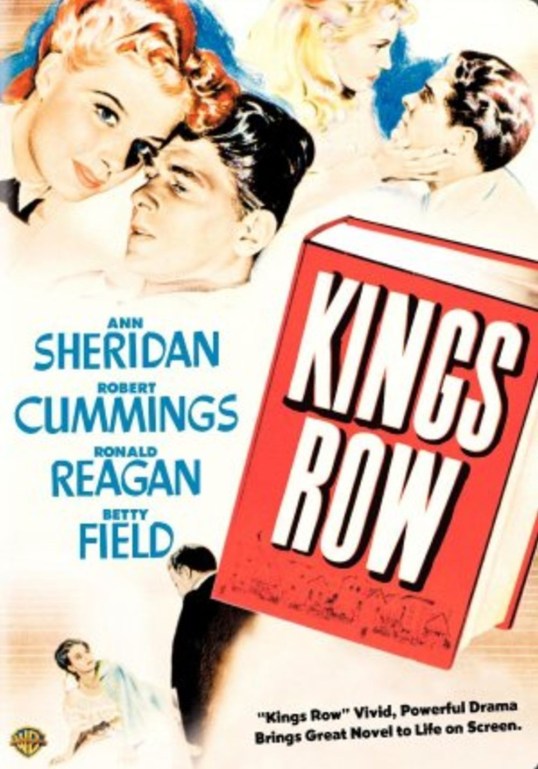
Embracing the Melodrama #9: Kings Row (dir by Sam Wood)


Kings Row“Where’s the rest of me!?” — Drake McHugh (Ronald Reagan), upon waking up to discover that his legs have been amputated, in Kings Row (1942)

It is with that line that the 1942 best picture nominee Kings Row earns its place in film history.  The formerly carefree and rich Drake had lost all of his money due to a crooked banker.  However, instead of feeling for himself, Drake got a job working for the railroad and finally started to show that he was capable of acting like a mature, responsible adult.  However, when Drake was injured in a boxcar accident, he had the misfortune to be taken to the sadistic Dr. Gordon (Charles Coburn).  Gordon felt that it was his duty to punish those who he considered to be wicked and that’s exactly how he felt about about Drake.  So, despite the fact that Drake had once been in love with Gordon’s daughter, Gordon proceeded to chop of Drake’s legs.

It’s just another day in Kings Row.

Of course, to an outsider, Kings Row looks like your typically calm and pleasant community.  But behind closed doors, this small town is full of sordid secrets.  Only those who have grown up in Kings Row understand the truth.  Only they can understand how Drake McHugh could end up losing his legs.

When they were both growing up at the turn of the century, Drake’s best friend was Parris Mitchell (Robert Cummings).  While Drake was pursuing Dr. Gordon’s daughter, and being loved from afar by Randy Monaghan (Ann Sheridan), Parris was studying to be a doctor under the tutelage of Kings Row’s other doctor, Dr. Alexander Tower (Claude Rains).  While Dr. Tower appeared to be a much nicer man than Dr. Gordon, he definitely had his eccentricities.  For instance, there was the wife who was reportedly confined somewhere in the house and never allowed to leave.  And then there was Dr. Tower’s daughter, Cassandra (Betty Field).  Dr. Tower was very protective of Cassandra, perhaps too protective.  How would Dr. Tower react when Parris, his best student, started to develop romantic feelings towards Cassandra?

Again, it’s just another day in Kings Row.

So, by now, it should be pretty obvious that Kings Row is one of those films that deals with big secrets in small towns.  That, of course, is a theme that was explored by films that were made long before Kings Row.  What made Kings Row unique is that it was perhaps the first film to actually portray that evil as specifically existing and thriving because of the repressive nature of a small town.  Whereas other films had featured outsiders bringing bad habits to an otherwise innocent and idyllic community (and be sure to watch Hitchcock’s Shadow of a Doubt if you want a perfect example of this), Kings Row suggested that the very nature of its setting is what led to all of the melodrama.  The film suggests that evil men like Dr. Gordon can specifically thrive in a town like Kings Row because his fellow townspeople aren’t willing to risk the placid surface of their existence by exposing him.  As such, Kings Row serves as a template for all of the sin-in-a-small-town films and TV shows that have followed.

Beyond the film’s historical importance, Kings Row holds us pretty well as entertainment.  As the film’s hero, Robert Cummings is a bit on the bland side but, fortunately, he’s surrounded by an excellent cast of character actors.  It’s a bit of a cliché to say that Claude Rains was perfectly cast because, seriously, when wasn’t Claude Rains perfectly cast?  But, in the role Dr. Tower, Claude Rains is perfectly cast.  Charles Coburn makes for a perfectly terrifying villain.  Ann Sheridan is likable and sympathetic as the woman who tries to help Drake recover after Dr. Gordon takes away his legs.  And finally, you’ve got future President Ronald Reagan in the role of Drake McHugh.  Reagan is usually dismissed a being a pretty boring actor (and I really haven’t seen enough of his films to say one way or the other) but he gave a great performance in Kings Row.

And that’s why, even beyond its historical significance, Kings Row is still a film that is more than worth watching.

KingsRowFRIENDS-1