Film Review: A Dry White Season (dir by Euzhan Palcy)


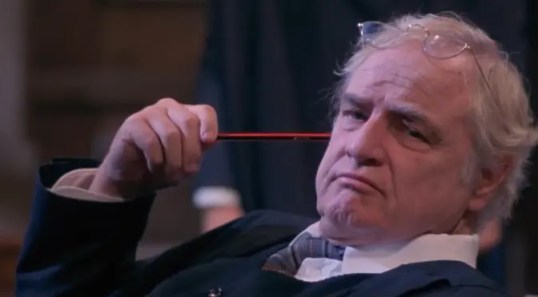
In 1990, Marlon Brando received his final Academy Award nomination when he was nominated for his supporting performance in 1989’s A Dry White Season.

Brando played Ian McKenzie, a human rights lawyer who lives and work in South Africa at the height of the Apartheid regime.  When we first see McKenzie, he’s sitting in his office and complaining about how all the flowers surrounding him have given him a permanent allergy.  When Ben Du Toit (Donald Sutherland) explains that he’s trying to learn the truth about why his gardener and his gardener’s son both died in the custody of South Africa’s “special branch,” McKenzie replies that bringing the case would be a waste of time.  McKenzie makes several dismissive comments about the case and tells Du Toit that pursing the matter would lead to Du Toit becoming a pariah himself.  Only when Du Toit says that he’ll just find another lawyer to pursue the manner does McKenzie agree to take the case.  His comments may have seemed callous but they were McKenzie’s way of testing Du Toit’s commitment to actually getting to the truth.

Up until the death of his gardener, Ben Du Toit was someone who blindly believed in the system.  A former rugby star and a teacher, Ben grew up in South Africa and is proud to call himself a “true African.”  (In one of the film’s best scenes, Ben’s driver, Stanley — played by Zakes Mokae, — informs Ben that being an African in South Africa means not being allowed to vote and having to carry identification papers everywhere with him.)  When the gardener’s son is first arrested, Ben repeatedly says, “He must have done something.”  When Ben’s gardener is arrested, Ben believes that it’s all just a terrible mistake and that he’ll be released soon.  Even after the gardener is killed, Ben initially believes the official story that the death was a suicide.  It’s only after Stanley takes Ben to the funeral home and shows him the gardener’s tortured body that Ben finally comes to realize that he was tortured to death by Captain Stolz (Jurgen Prochow).

Still, Ben is naive enough to assume that McKenzie will be able to get some sort of justice.  In court, McKenzie easily exposes the flaws in Stolz’s story.  When Stolz claims that the dead man’s injuries were the result of the man throwing himself against the bars of his cell, McKenzie mentions that the man’s back was injured and then asks if he was throwing himself backwards.  Stolz smirks and says that the man was “an animal.”  McKenzie may be a brilliant lawyer but it’s a foregone conclusion that he’s going to lose the case.  Stolz is exonerated and the expression on McKenzie’s face is one that indicate that he is not surprised at all.

It’s a small role.  Brando gets less than ten minutes of screentime but he makes perfect use of them and shows that, even in the latter half of his career, Brando could still give a good performance when he cared about the material.  Both Brando and Susan Sarandon took small roles in this anti-Apartheid drama because they believed in the message.  Sarandon’s casting is a bit distracting.  She never becomes the journalist she’s playing, instead she just seems like a movie star lending her name to a cause that she believes in.  But Brando becomes Ian McKenzie and he expertly reveals the absurd lengths to which the Apartheid government will go to excuse its actions.

The majority of the film deals with Ben Du Toit and his slow-awakening about the truth of the country that he calls home.  Upon realizing the truth about the country’s government and its actions, Du Toit declares that he can no longer go back to being who he once was and it costs him his family, his home, and ultimately his life.  Donald Sutherland does a wonderful job, portraying Du Toit’s growing understanding of what’s actually happening in South Africa.  Wisely, the film doesn’t portray Du Toit as being a saint.  It fully understands that Du Toit only started to care about Apartheid when it effected somebody that he knew and fortunately, Stanley is always there to call Du Toit out whenever he starts to forget about his own role in supporting the system that he now opposes.  It’s a powerful and heartfelt film, one that is well-known for Brando’s performance but works just as well when Brando is off-screen as well.
Lisa Reviews An Oscar Nominee: Darkest Hour (dir by Joe Wright)


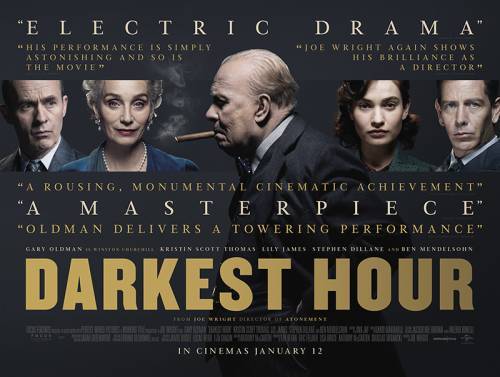
The 2017 best picture nominee, Darkest Hour, opens with Europe at war.

While the United States remains officially neutral, the Nazi war machine marches across Europe.  After years of appeasement, the United Kingdom has finally declared war on Germany but the feeling in Parliament is that Prime Minister Neville Chamberlain (Ronald Pickup) is not strong enough to take on Hitler.  When the Opposition demands that Chamberlain resign, Chamberlain does so with the hope that he’ll be replaced by Lord Halifax (Stephen Dillane).  Like Chamberlain, Halifax continues to hold out hope for some sort of negotiated peace with the Germans.  However, Halifax declines, saying that it’s not yet his time.  Instead, Chamberlain’s successor is Winston Churchill (Gary Oldman), the only Conservative that the Opposition is willing to accept as Prime Minister.

(This is a bit of invention on the part of the filmmakers.  In reality, the Opposition did demand Chamberlain’s resignation but they did not stipulate that he could only be replaced by Churchill.)

No one is particularly enthusiastic about the idea of Winston Churchill becoming prime minister.  Chamberlain and Halifax both view him as being a war monger who is so determined to prove himself as a military strategist that he’ll sacrifice thousands of British lives just for his own glory.  The King (Ben Mendelsohn) worries that Churchill is an unreliable radical and he still resents Churchill for defending the marriage of Edward VIII and Wallis Simpson.  Churchill is regularly described as being a buffoon and an eccentric.  He’s quick-tempered and obsessive about things that many people would consider to be of no importance.  When we first see Churchill, he’s making his new assistant (played by Lily James) cry because he’s discovered that she single-spaced a memo as opposed to double-spacing it.  The only people who seem to like Winston are the member of his family and even his loyal wife (Kristin Scott Thomas) is frequently frustrated with him.

Churchill’s enemies are not impressed by his first actions as prime minister.  They listen in disgust as he lies about the prospects of victory in France.  They are shocked by his refusal to even consider a negotiated peace.  They are horrified by his ruthless pragmatism as he willing sacrifice a thousand British soldiers in order to save several thousand more at Dunkirk.  An aristocrat who has been rejected by his peers, Churchill is betrayed by those serving in his government but beloved by the people who ride the Underground and who are being asked to potentially sacrifice everything to defeat Hitler’s war machine.

As directed by Joe Wright, Darkest Hour plays out like a dream, with 1940s Britain recreated in hues of black and gray.  The film’s visual palette is so dark that, at times, Gary Oldman’s Winston Churchill appears to literally emerge out of the shadows, an almost mythical figure who symbolizes a society in transition.  In many ways, Churchill is an old-fashioned Edwardian who nostalgically remembers the glory days of the British Empire.  At the same time, Churchill is enough of a realist to see that the world is changing and, regardless of who wins the war, that it will never be the same.  Churchill is enough of an aristocrat to be unaware of what a backwards V-sign means but also enough of a commoner to laugh uproariously upon learning its meaning.

Churchill spends a good deal of the film bellowing and, at times, it’s easy to see why many initially dismissed him as being a buffoon.  Indeed, in Darkest Hour, Churchill frequently is a buffoon.  But he’s also a pragmatic leader who truly loves his country and its people.  Oldman has a lot of scenes where he’s loud but he also has other scenes in which he reveals Churchill to be a thoughtful man who loves his country and who is determined to win a war that many believe to be unwinnable.  When he’s reduced to calling the United States and has to pathetically beg President Roosevelt to honor a treaty, you feel for Churchill and you share his frustration as he tries to get the flaky FDR to understand the reality of what’s happening in Europe.  When Churchill explains why he’s willing to sacrifice a thousand in order to save 41,000 more, Oldman delivers his lines with a steely certainty.  As played by Oldman, Churchill knows what has to be done, even if no one else has any faith in him.

It’s a good film, even if it ultimately feels more like a showcase for one actor than a cohesive narrative.  The rest of the cast does a good job, especially Ronald Pickup as the haunted and dying Neville Chamberlain.  But ultimately, Darkest Hour is Gary Oldman’s show.  That’s appropriate.  Much as how Churchill dominated British politics, Gary Oldman has dominated British acting.  Not surprisingly, Gary Oldman won his first Oscar for playing Winston Churchill in Darkest Hour.  The film was also nominated for best picture but it lost to Shape of Water.


Cannes Film Review: The Mission (dir by Roland Joffe)


(With this year’s Cannes Film Festival coming to a close, I figured that I would start of today by looking at some previous winners of the Palme d’Or.  We start things off with 1986’s The Mission.)

The Mission opens with a man stoically plunging over a waterfall.  That man is a priest who, in the 1740s, has been sent to convert the natives of the Paraguayan jungle to Christianity.  The natives’ reaction to the priest’s arrival was to tie him to a wooden cross and send him over the falls.  It’s an opening that perfectly captures one of the main themes of The Mission: the contrast between the beauty of nature and the savagery of man.

The majority of the film deals with two men.  Father Gabriel (Jeremy Irons) is the Spanish Jesuit who replaces the martyred priest.  Father Gabriel is a pacifist who manages to win the trust of the natives through a shared love of music.  Gabriel plays the oboe and, when it is snatched away from him, reacts not with anger but with acceptance.  With the help of Father John Fielding (Liam Neeson), Father Gabriel builds a mission and works to educate the natives.  This brings him into conflict with the local plantation owners, the majority of whom just see the natives as being potential slaves.

That’s where Mendoza (Robert De Niro) comes in.  A brutish and violent man, Mendoza makes his living kidnapping natives and selling them into slavery.  When Mendoza discovers that his fiancée, Carlotta (Cherie Lunghi), has fallen in love with his younger brother, Felipe (Aidan Quinn), Mendoza snaps and, in a moment of anger, kills his brother.  Seeking forgiveness for his violent past, Mendoza travels to Father Gabriel’s mission, dragging all of his armor and weaponry in a bundle behind him.  When Mendoza finally reaches the mission, he is not only forgiven by the natives but he also eventually ends up becoming a Jesuit himself.

And, for a while, everything is perfect.  That is until the Spanish turn over their land in South America to the Portuguese and the new colonials decide that having a mission around will make it a little bit too difficult to enslave the natives.  When Father Gabriel is ordered to close the mission, he refuses to do so.  He says that he will stay and that he is willing to be martyred if the Portuguese forces attack.  Gabriel believes that violence is a sin against God.  Mendoza, on the other hand, announces that he will stay and he is prepared to once again pick up weapons to defend the mission…

Dramatically, The Mission is uneven.  While Jeremy Irons and Liam Neeson are both believable and sympathetic as Father Gabriel and Father Fielding and fit right in with the film’s period setting, Robert De Niro seems miscast and out-of-place.  As good an actor as De Niro is, he just doesn’t belong in the jungles of South America.  Whenever he shows up or speaks, your mind immediately goes to New York City.  The film tries to juggle so many theological and political issues that it can get a bit exhausting trying to keep up with it all.  Watching the film, it was hard not to wish for a chance to see what a director like Werner Herzog or Terrence Malick would have done with the same material.

That said, The Mission is a visually impressive film, one that captures the beauty, the innocence, and the danger of the jungle.  The scenes of both Gabriel and Mendoza climbing the waterfall are stunning to watch and, in the end, the film does have a sincere message about the ongoing fight for the rights of indigenous people.  That counts for something.

The Mission received an Oscar nomination for Best Picture, though it lost to Platoon.  It also won the Palme d’Or, beating out such films as After Hours, Down by Law, Mona Lisa, Runaway Train, and The Sacrifice.