The next episode of Hammer House of Horror is The House That Bled To Death but I’ve decided not to share it for this Halloween because it features the death of a kitty and I’m kind of tired of pets dying in horror films. It’s an effective and scary episode, though. It’s on YouTube so if you want to watch it, feel free.
Moving right along, tonight’s episode is CharlieBoy. Graham (Leigh Lawson) and his wife Sarah (Angela Bruce) inherit an statue that they don’t realize also doubles as a really big voodoo doll. After stabbing the statue a bit too many times, Graham comes to realize that he’s accidentally condemned almost everyone he knows to death, including both him and his wife. Thanks to the fast-paced director of Robert Young and the committed performances of the cast, this is an entertainingly macabre episode. It originally aired on October 18th, 1980.
Welcome to Retro Television Reviews, a feature where we review some of our favorite and least favorite shows of the past! On Saturdays, I will be reviewing The American Short Story, which ran semi-regularly on PBS in 1974 to 1981. The entire show can be purchased on Prime and found on YouTube and Tubi.
This week, we have an adaptation of a short story by Ernest Hemingway.
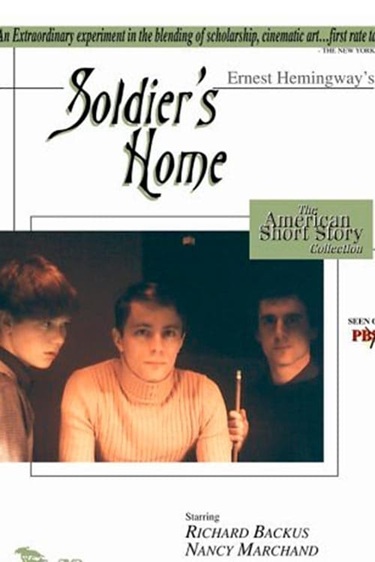
Episode #9 “Soldier’s Home”
(Dir by Robert Young, originally aired in 1977)
Having gone from attending college to serving in the Army during the Great War, Harold Krebs (Richard Backus) returns home to Oklahoma. He arrives home later than most of the other soldiers who served. (He stayed in Europe until 1919.) As a result, there’s no big parade waiting for him. Everyone in town seems to have moved beyond the war and they no longer have much of a desire to talk about it.
Harold, who was once a popular and optimistic member of the town’s social set, no longer feels that he fits in. He feels detached, watching people as they go about their lives but never feeling any desire to join them. His mother (Nancy Marchand) pushes him to go out and date and have a good time but Harold feels lost, regardless of how much she prays for him.
Ernest Hemingway’s short story was one of the first to realistically deal with the feelings of soldiers returning from combat. Though Harold doesn’t talk much about his experiences, one can tell that he saw and experienced things that left him scarred. After surviving the horror of The Great War, there’s no way Harold can just slip back into his normal routine.
The adaptation sticks closely to Hemingway’s story. Unfortunately, it doesn’t really find the visual style necessary to capture the power of Hemingway’s words. Hemingway was a deceptively simple storyteller and Robert Young’s film is a fairly straight-forward portrait of a young man who doesn’t want to do anything, one that fails to truly capture the subtext of Hemingway’s story. Richard Backus’s blank-eyed acting style worked well when he was playing a member of the undead in Deathdreambut, in this one, he just makes ennui seem boring and petulant. Nancy Marchand, not surprisingly, is far stronger in the role of his well-meaning but clueless mother.
As was almost always the case when it came to attempts to adapt Hemingway, it’s best just to read the original.
Though the Academy of Motion Picture Arts and Sciences claim that the Oscars honor the best of the year, we all know that there are always worthy films and performances that end up getting overlooked. Sometimes, it’s because the competition too fierce. Sometimes, it’s because the film itself was too controversial. Often, it’s just a case of a film’s quality not being fully recognized until years after its initial released. This series of reviews takes a look at the films and performances that should have been nominated but were, for whatever reason, overlooked. These are the Unnominated.
Oh, how this movie made me cry!
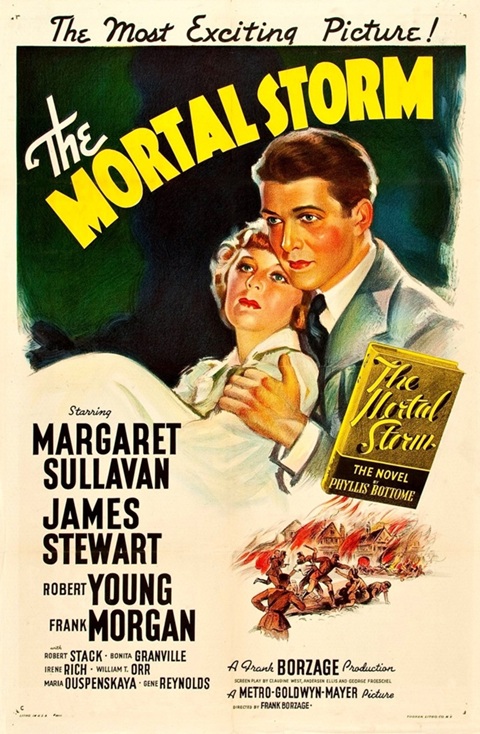
Released in 1940, at a time when war was spreading across Europe, Asia, and Africa but the United States was still officially neutral, The Mortal Storm opens on January 30th, 1933. In the mountains of Germany, near the Austrian border, Professor Viktor Roth (Frank Morgan) is celebrating his 60th birthday. He starts the day being applauded by his students at the local college. In the evening, he returns home for a celebration with his family, including wife (Irene Rich), his daughter Freya (Margaret Sullivan), his son Rudi (Gene Reynolds), and his two stepsons, Otto (Robert Stack) and Erich von Rohn (William T. Orr). Also present are Freya’s fiancé, Fritz (Robert Young) and one of Roth’s students, a pacifist named Martin Breitner (James Stewart). It’s a joyous occasion and the film takes its time introducing us to Prof. Roth and his extended family. At first, everyone seems very kind. They seem like people who most viewers would want to spend time with or live next to….
But then, the family’s maid excitedly enters the room and announces that it’s just been announced that Adolf Hitler is the new chancellor of Germany. Otto and Erich are overjoyed and head out to celebrate with the other members of the Nazi Youth Leage. Martin is less happy and excuses himself to return home. Roth and his wife worry about what this means for people who do not agree with Hitler’s beliefs. Freya says that they shouldn’t talk politics. It is jokingly mentioned that Hitler has taken away Roth’s special day but Roth’s young son Rudi says that he’s learned in school that the needs of the individual will never be more important than the needs of the state. If Hitler wants to take away your day, it’s your duty to give it up or face the consequences.
Based on a 1937 novel, The Mortal Storm was not the first Hollywood production to take a stand against Hitler and the Nazis but it was one of the best. I say this despite the fact that the film only hints at the fact that Prof. Roth is Jewish, something that was made very clear in the book. (In the movie, Roth and his wife worry what will happen to “Non-Aryans” and “freethinkers.”) That said, the film perfectly captures how quickly and insidiously the authoritarian impulse can spread. The town, which once seemed so friendly, becomes a very dark place as the students at the university put on their swastika armbands and start to hunt down anyone who dissents from the party line. When Roth says that, as a scientist, he does not believe one race can be genetically superior to another, his students walk out on him. A local teacher is beaten when he fails to return to the Nazi salute. When Martin refuses to join the Party, Otto and Erich turn against him despite being lifelong friends. When Martina and Freya flee for the border, Fritz pursues them. And even after Prof. Roth is sent to a concentration camp, Otto and Erich continue to follow the orders of Hull (Dan Dailey), the sinister Youth Party Leader.
It’s a powerful film, one that remains just as relevant today as it was when it was first released. Hull and Erich’s fanaticism would, today, find a welcome home on social media. The scenes in which the townspeople eagerly threaten to report their former friends and neighbors for failing to salute or show proper enthusiasm for the government have far too many modern day equivalents for me to even begin to list them all. This film was also the last the James Stewart made with frequent co-star Margaret Sullivan and they both give great performances. (All-American Jimmy Stewart might seem a strange choice to play a German farmer but he is never less that convincing as Martin, one of the few people in the town not to surrender his principles and beliefs to the crowd.) The film’s final moments, with the camera panning around the empty Roth home, brought very real tears to my eyes.
Despite being a powerful film, TheMortalStorm was not nominated for a single Oscar. (Jimmy Stewart did win his only Oscar that year but it was for The Philadelphia Story.) It’s temping to assume that, at a time when America was still divided about how to react to the war in Europe and when many Americans still remembered the trauma of the first World War, TheMortalStorm was too explicitly political and anti-Nazi to get a nomination but, the same year, The Great Dictatorwas nominated for Best Picture. It seems more likely that, in those days when the studios ruled supreme, MGM decided to puts it weight behind The Philadelphia Story rather than The Mortal Storm.
That said, The Mortal Storm was definitely worthy of being nominated, for Picture, Director, Screenplay, Actress (Margaret Sullivan), Actor (Stewart), Supporting Actor (Frank Morgan and Robert Stack), and Supporting Actress (Irene Rich and, in the role of Stewart’s mother, Maria Ouspenskaya). The film may not have been nominated but it remains a powerful and important work of art.
One of the greatest Hammer vampire films didn’t even star Christopher Lee. In fact, it wasn’t even a Dracula film. Instead, it was the story of a circus.
1971’s Vampire Circus tells the dark story of a Serbian village called Stetl. Early in the 19th century, the children of Stetl are dying. The superstitious villagers believe that Count Mitterhaus (Robert Tayman) might be responsible. In fact, they suspect that Count Metterhaus might be a vampire! Why? Well, first off, he only seems to be around during the night. Secondly, he lives in a big spooky castle. Third, he’s a count and don’t all counts eventually become vampires?
Now, it would be nice to say that all this turned out to be a case of the villagers letting their imaginations get the better of them but nope. It turns out that they’re pretty much right. One night, the local teacher, Albert Muller (Laurence Payne), sees his own wife, Anna (Domini Blythe) leading a child towards the dark castle. It turns out that Anna has fallen under the spell of Count Mitterhaus. The villagers promptly drive a stake through the Count’s heart, though he manages to do two things before dying. First off, he curses the town and announces that the blood of their children will give him new life. Secondly, he tells Anna to escape and track down his brother.
Fifteen years later and, as one might expect, Stetl is a town under siege. However, the town is not being attacked by vampires. (Not yet anyway.) Instead, the town has been hit by the plague and, as a result, it’s been isolated from the outside world. Men with guns have surrounded the town and are under orders to kill anyone who tries to leave or enter. Some in the village believe that this is the result of the Count’s dying curse while others just see it as more evidence of man’s inhumanity to man. Regardless, it’s not good situation.
Fortunately, escape arrives in the form of the Circus of the Night! That’s right, a gypsy carnival suddenly appears in town. How did it manage to slip by the blockade? Who knows and who cares? What’s important is that the villagers, especially their children, need an escape from their grim existence and the Circus seems to offer something for everyone. There are dancers. There are acrobats. There’s the mysterious tiger woman. There’s a mirror that makes you see strange things. And, of course, the are vampires….
That’s not really a shock, of course. The name of the film is Vampire Circus, after all. What always takes me by surprise is just how ruthless and cruel the vampires are in this film. Even by the standards of a 1970s Hammer film, this is a blood-filled movie but, even beyond that, the vampires almost exclusively seem to target children. Fortunately, all of Stetl’s children tend to be a bit obnoxious but it’s still a shock to see two fresh-faced boys get lured into a mirror where they are both promptly attacked by a vampire. (And don’t even get me started on what happens when one of the vampires comes across a boarding school.) Make no mistake, this circus is not made up of the type of self-tortured, romanticized vampires that have dominated recent films. These vampire are utterly viscous and without conscience. In other words, these vampires are actually frightening.
The members of the circus are, themselves, a memorable bunch. David Prowse is the hulking strongman. Lalla Ward and Robin Sachs are the achingly pretty, innocent-faced twin acrobats who greedily drink the blood of anyone foolish enough to wander off with them. Some members of the circus can transform into animals. What’s interesting is that not all of the members of the circus are vampires. Some of them, I guess, are just groupies.
Featuring the reddest blood that you’re ever likely to see and a cast of memorably eccentric character actors, Vampire Circus often feels more like an extremely dark fairy tale than a typical Hammer vampire film. Clocking in at 87 minutes, Vampire Circus is a briskly paced dream of carnivals and monsters.
4 Shots From 4 Films is just what it says it is, 4 shots from 4 of our favorite films. As opposed to the reviews and recaps that we usually post, 4 Shots From 4 Films lets the visuals do the talking.
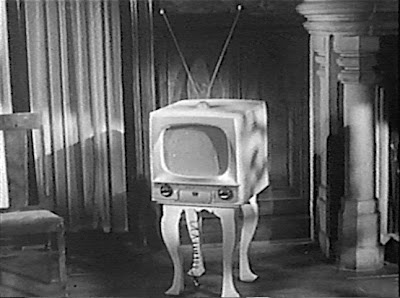
Only one more month to go and it’ll be time for TSL’s annual horrorthon! I’m already working on my October reviews. Here’s four shots from 4 films that I’m planning on reviewing in October!
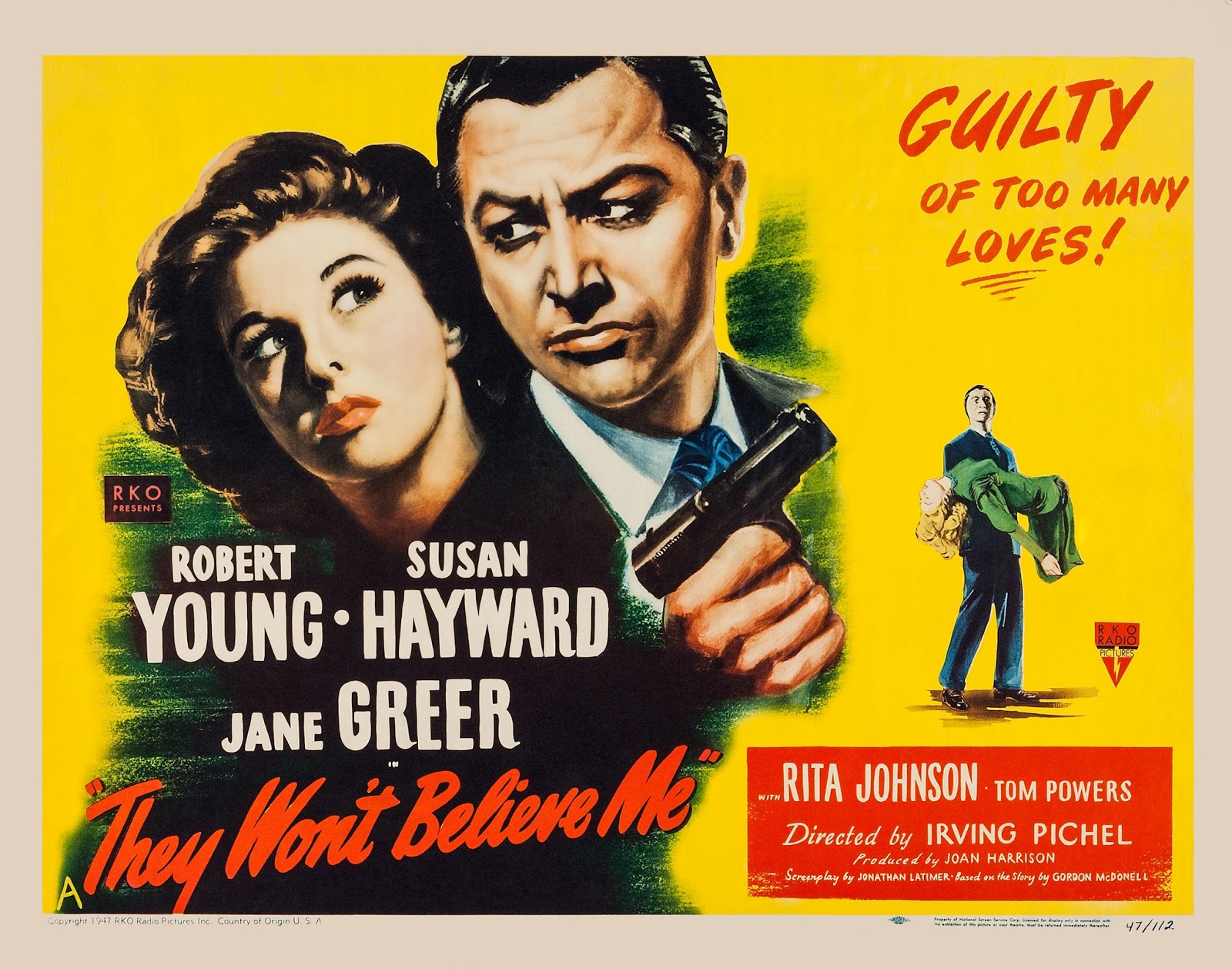
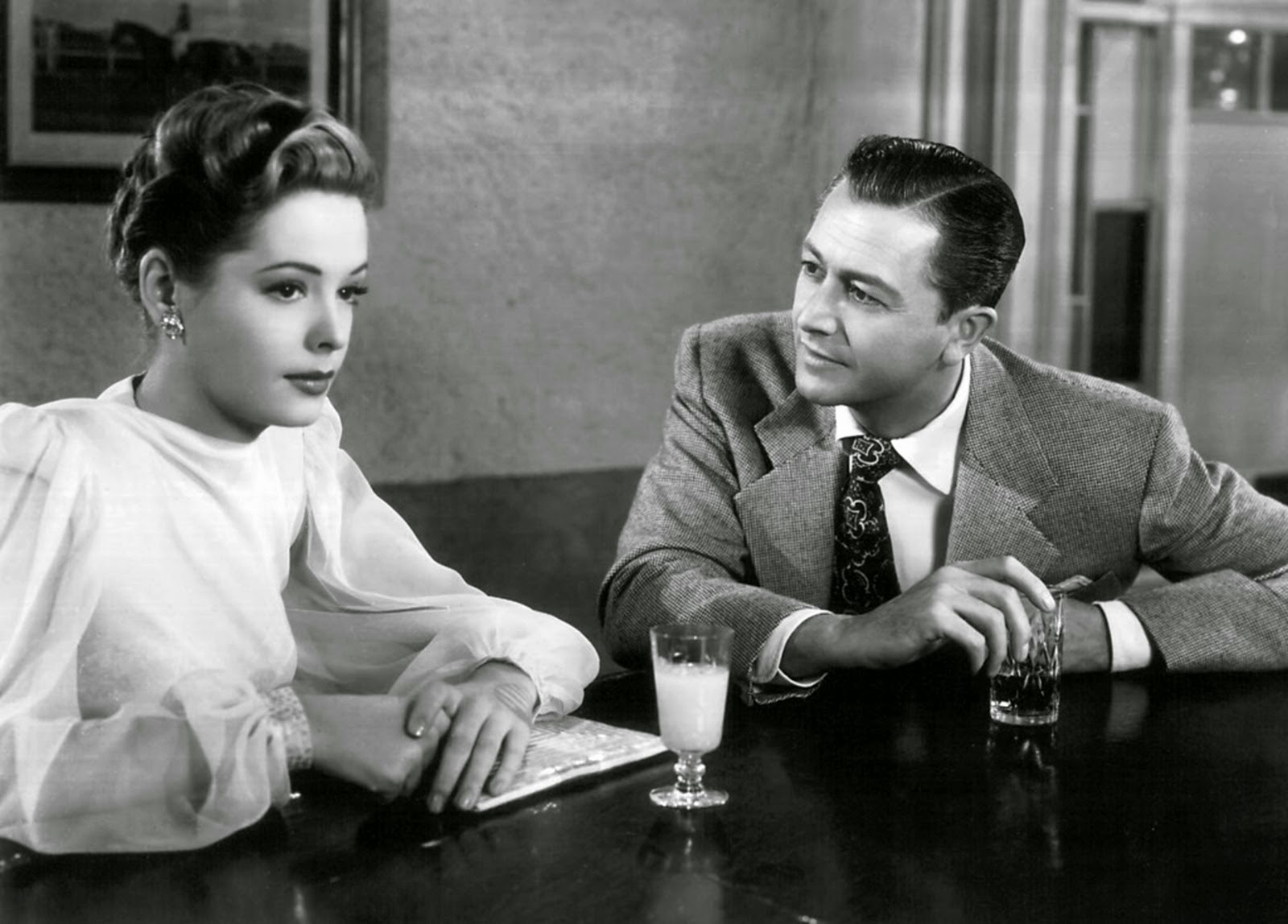
1947 was a peak year for film noir. There was BRUTE FORCE , BORN TO KILL , DARK PASSAGE, KISS OF DEATH, THE LADY FROM SHANGHAI, OUT OF THE PAST, and NIGHTMARE ALLEY , to name but a few. THEY WON’T BELIEVE ME doesn’t get the notoriety of those I just mentioned, but it can hold its own with them all. This unheralded dark gem from the RKO noir factory boasts an outstanding cast, and a taut, twisted screenplay from hardboiled pulp writer Jonathan Latimer.
Larry Ballantine’s on trial for the murder of his wife and his girlfriend. Larry’s a real cad, a lying and cheating weasel. He takes the stand and tells his side of the story, as the film goes into flashback to recount the sordid details. Larry’s stepping out on rich wife Greta with co-worker Janice, who gives him an ultimatum. She’s transferring to Montreal, and Larry…
I recently decided that I wanted to watch and review every single movie ever nominated for the Academy Award for best picture. As part of that mission, I recently rewatched one of my favorite also-rans, 1947’s Crossfire.
Crossfire is a message movie disguised as a B detective flick. A group of soldiers who have just returned from World War II decide to get together for a drink. At the bar, they run into a civilian named Joseph Samuels (Sam Levine). The soldiers end up going back to Samuels’s apartment and the next morning, Samuels is found dead. Obviously, he was killed by one of the soldiers but which one. Suspicion falls on the meek (and missing) Floyd Bowers (Steve Brodie) but police detective Finlay (Robert Young) and Sgt. Peter Keeley (Robert Mitchum) both (correctly) suspect that Samuels was actually murdered by the far more outspoken and imposing Montgomery (Robert Ryan). It quickly becomes obvious that Montgomery is an anti-Semite who killed Samuels solely because he was Jewish. However, neither Finlay or Keeley can prove it. The film quickly becomes a darkly intense duel between these three men as Finlay and Keeley attempt to trick Montgomery into implicating himself while Montgomery attempts to further frame Bowers for the murder.
Before Crossfire, director Edward Dmytryk specialized in making low-budget “B” movies and he brings that noir, near-grindhouse sensibility to Crossfire. As a result, Crossfire is a one of those rare “message” films that is actually entertaining. Only a few times does the film start to feel preachy and luckily, Robert Mitchum is there being his usual cynical self. If anyone could deflate the pompous nature of the mid-40s message movie, it was Robert Mitchum. The film says, “Love one another.” Mitchum replies, “Baby, I just don’t give a damn,” and he keeps things from getting too heavy-handed. Mitchum is one of three Roberts to star in this film. Robert Young plays the police inspector with just the right amount of world-weary indignation while Robert Ryan is a force of nature as the film’s brutal murderer. Don’t get me wrong. You can pretty much peg Ryan as a killer from the first minute he shows up on-screen. If Mitchum and Young smartly underplay their roles, Ryan goes the exact opposite direction. He’s an obvious brute but he’s also totally believable. You look at his character and it’s not difficult to imagine him passing the collection plate at Westboro Baptist Church. As well, Crossfire also features an excellent supporting term by one of my favorite noir actresses, the great and wonderful Gloria Grahame. She plays Bowers’ married girlfriend and gives a compellingly, real performance that suggests that maybe Hollywood in the 40s wasn’t quite as clueless as we all like to assume.
Crossfire was nominated for Best Picture of 1947 but it lost to another film about anti-Semitism, Elia Kazan’s Gentleman’s Agreement. (Oddly enough, both Kazan and Dmytryk would end up naming names during the McCarthy Era.) Like Gentleman’s Agreement, Crossfire was based on a novel. However, in the original novel, the victim was not Jewish but instead was gay. However, back in the 1940s, the Hollywood Production Code specifically forbade any open depiction of homosexuality and so, the crime went from being motivated by homophobia to anti-Semitism.


 Through the Shattered Lens