Retro Television Review: Money to Burn (dir by Robert Michael Lewis)


Welcome to Retro Television Reviews, a feature where we review some of our favorite and least favorite shows of the past!  On Sundays, I will be reviewing the made-for-television movies that used to be a primetime mainstay.  Today’s film is 1973’s Money To Burn!  It  can be viewed on YouTube.
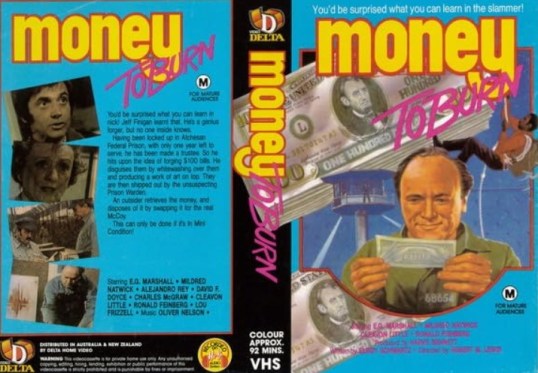
For someone who has spent the past few years in prison, Jed Finnegan (E.G. Marshall) sure is a nice old man!  He runs the prison print shop and all of the other prisoners love him.  The guards trust him.  The warden (David Doyle) is really impressed with Jed’s watercolors and is interested in helping Jed launch a career as an artist after he gets out of prison.  Every weekend, Jed’s wife, Emily (Mildred Natwick), comes up to the prison with a picnic basket and she has lunch with her husband.  Jed admits that his wife is not a particularly good cook but it’s obvious that he really looks forward to her visits.

Emily’s sweet nature keeps a lot of people from noticing that she is just as cunning and clever a criminal as Jed ever was.  She knows that Jed had printed up one million dollars in counterfeit bills and she is looking forward to helping him exchange the fake money for real money.  Jed’s plan is to steal the payroll of the local army base and just leave the fake money in place of the real money.  However, Jed’s been in prison for so long that he doesn’t know that the military no longer pays anyone in cash.  Everyone’s paying everyone by check!

(This film is very much from the 70s.  While Jed and Emily were shocked to discover that people were no longer being paid in cash, I was shocked to discover that they were being paid by check.)

Working with two recently released ex-cons (played by Cleavon Little and Alejandro Rey), Emily tries to find a new way to switch out the money.  She discovers that there’s an incinerator nearby where the government burns the currency that it no longer needs.  But it won’t be easy to break in and make sure that the right money get burned….

And that’s not even mentioning the trouble of getting the fake money out of the prison in the first place!

Money to Burn is likable mix of comedy and (very mild) action.  It’s a film about criminals but they’re very likable criminals who go out of their way not to hurt people.  Emily is even happy about the idea of not only stealing a million dollars but also helping the government out by taking the old currency off their hands.  Marshall, Natwick, Little, and Rey all give such warm and cheerful performances that you can’t help but hope that they get away with their scheme.  The film, which deftly balances comedy and drama, clocks in at a brisk 73 minutes and it has an absolutely wonderful twist ending.  This is definitely a heist film that deserves to be better known.
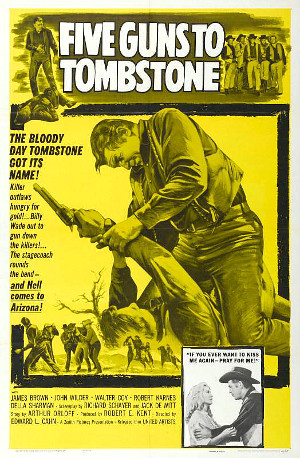
Five Guns To Tombstone (1960, directed by Edward L. Cahn)


Outlaw Matt Wade (Robert Karnes) escapes from prison and rejoins his old gang.  They ride out to Tombstone, Arizona, stopping off at the ranch of Matt’s brother, Billy Wade (James Brown).  Billy used to be an outlaw but eventually he hung up his guns, settled down, got married, and now he’s raising Matt’s teenage son, Ted (John Wilder).  Ted, who thinks that his father has just been paroled, is excited to see Matt but Billy doesn’t want Ted being led into a life of crime.  When Matt and the gang rob a bank, they frame Billy for the crime.  With the townspeople looking to lynch him and Ted drifting towards the wrong path in life, Billy has no choice but to pretend to be a part of the gang until he can dig up the evidence to clear his name.

If this sounds familiar, thank you for reading yesterday’s review of Gun Belt.  Released seven years after Gun Belt, Five Guns To Tombstone tells the exact same story as Gun Belt and, in many case, it features the exact same dialogue.  The only difference is that some of the names have been slightly changed.  The gang leader in Gun Belt was named Ike Clinton.  In this Five Guns To Tombstone, his name is Ike Garvey.  Billy Ringo becomes Billy Wade and Wyatt Earp because Marshal Sam Jennings.  Otherwise, it’s pretty much the exact same film.

Which one is the better film, Gun Belt or Five Guns To Tombstone?  Both films have plenty of two-fisted, gun-slinging action and a good cast of western character actors but I’d probably have to give the edge to Five Guns To Tombstone because John Wilder is more convincing in the role of the outlaw’s son than Tab Hunter was in Gun Belt.  Tab Hunter was young and callow and annoying but John Wilder is the type of confused kid that anyone could relate to.

Five Guns To Tombstone was one of the 9 films that Edward L. Cahn directed in 1960.  As with most of Cahn’s films, the action seems rushed but that’s appropriate for the story that Five Guns To Tombstone is telling.  (It’s also understandable.  When you’re directing 9 films a year, you don’t have the luxury of taking your time.)  Like Gun Belt, this is hardly a classic but western fans should enjoy it.

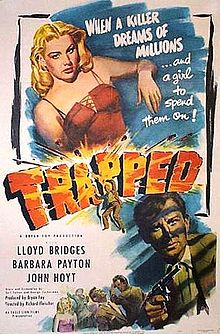
The Fabulous Forties #6: Trapped (dir by Richard Fleischer)


220px-Trapped_1949

After being disappointed with Guest In The House, I decided to go ahead and watch the sixth film in Mill Creek’s Fabulous Forties box set and I’m glad that I did.  1949’s Trapped turned out to be an entertaining little discovery.

Much like Port of New York, Trapped opens with documentary footage of the government at work and an official sounding narrator explaining to us that we are about to see a film about the hardworking agents of the Treasury Department.  In fact, the narrator goes on for so long about the Treasury Department that he starts to sound downright worshipful.  There’s nothing that the Treasury Department cannot do!  Who protects the President?  The Treasury Department!  Who tracks down counterfeiters?  The Treasury Department!  Who protects the coast?  The Coast Guard but guess what? The Coast Guard is actually a part of The Treasury Department!  The tone of the narration is so worshipful that it could almost pass for a Scientology recruiting film.  Just as only the Sea Org can protect us from Evil Lord Xenu, only the Treasury Department can stop phony money pushers!

Eventually, the narration ends and the actual movie begins.  Fortunately, the rest of Trapped more than makes up for that awkward introduction.  The film opens with a bunch of Treasury agents looking over a phony twenty-dollar bill.  The bill is almost perfect and the agents believe that it was printed using plates designed by one of the world’s greatest counterfeiters, Tris Stewart (Lloyd Bridges).  The only problem is that Stewart is in prison.  Obviously, someone else has gotten their hands on Stewart’s plates.

Stewart is upset that someone is getting rich off of his work.  So, he strikes a deal with the Treasury Department.  In return for being released, he will help them track down his plates.  The Treasury Department agrees and arranges for Stewart to “escape” during a phony prison break.

However, Stewart has plans of his own.  As soon as he’s out of jail, he knocks out his handler and escapes for real.  Tris is not only planning on tracking down his plates but he’s also going to go back into business printing and passing phony money.  He also reunites with his girlfriend, nightclub hostess Meg Dixon (Barbara Payton).

When he meets Meg, he discovers that she has a new admirer.  Johnny Hackett (John Hoyt) likes to hang out whenever Meg’s working.  Even though Johnny appears to have a thing for Meg, he and Tris still become friends.  Tris is even willing to bring Johnny in on the operation but, what Tris doesn’t realize, is that Johnny Hackett is actually Treasury agent John Downey (John Hoyt)…

Needless to say, violence, betrayal, and death follows.

Shot on location in some of the seediest parts of 1940s Los Angeles, Trapped is a fast-paced and exciting film noir.  (This is one of those films, like The Black Book, where shadows are literally everywhere.)  Lloyd Bridges (who, as a young man, could have passed for Kirk Douglas’s brother) gives a great performance as the charming but ultimately cold-hearted Tris Stewart while John Hoyt does a fairly good job as the conflicted Downey.  Barbara Payton, one of the more tragic figures from Hollywood’s Golden Age, does such a good job as Meg that it’s even more tragic to consider that, just a few years after making Trapped, her career would be destroyed by alcoholism and personal scandal and she would eventually end up as a homeless prostitute on Sunset Boulevard.

Trapped was a good discovery and you can watch it below!