18 Days of Paranoia #10: The Quiller Memorandum (dir by Michael Anderson)


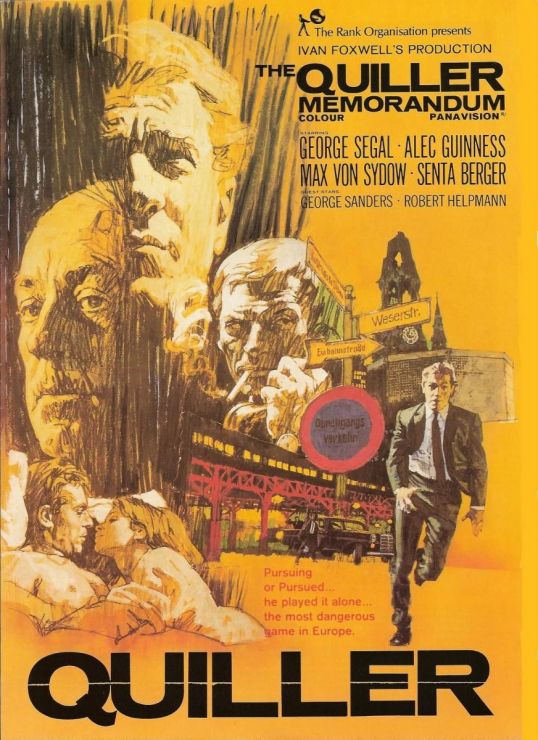
The 1966 film, The Quiller Memorandum, is a diabolically clever little spy thriller.

The film opens with a British secret agent getting gunned down while trying to make a call from a phone booth in Berlin.  While we never learn the exact name of the agency that the man was working for, we do discover that they don’t take kindly to their agents getting gunned down in phone booths.  They send in another agent, an American named Quiller (George Segal), to take his place.

In Berlin, Quiller’s boss is a man named Pol (Alec Guinness).  Pol explains that the man in the phone booth was actually the second of his agents to be assassinated in Berlin.  All of the agents were looking for information about a Neo-Nazi group called Phoenix.  Pol tells Quiller that it is vitally important they discover just where, in Berlin, Phoenix is headquartered.  Quiller is given a few items that were found on the dead man in the phone booth: a bowling alley ticket, a swimming pool ticket, and a newspaper article about a school where it was discovered that one of the teachers had Nazi sympathies.

Though The Quiller Memorandum was undoubtedly produced with the hopes of capitalizing on the popularity of the Bond films, Quiller is no James Bond.  We know that as soon as we see him.  It’s not just that Quiller’s an American while Bond was British.  It’s also that James Bond was played by the cool and calculating Sean Connery while Quiller is played by George Segal.  Whereas Connery’s Bond never loses his confidence, Segal’s Quiller comes across as being, at first, a bit cocky and, as a result, we worry about him.  Whereas Connery’s Bond rarely gave his actions a second thought, Segal brings a slightly neurotic edge to Quiller.  You take one look at Connery’s Bond and you know that he’s going to survive no matter what.  Quiller, however, you never get that feeling.  When he’s in danger, you worry about him because it’s easy to imagine him turning up like the man in the phone booth.

And, indeed, it doesn’t take long for Quiller to get captured by the members of Phoenix.  A man bumps him with a suitcase, injecting a drug into his system that makes Quiller become drowsy.  When Quiller awakens, he’s being interrogated by an erudite man named Oktober (Max von Sydow).  Oktober’s an aristocrat.  He speaks in a very calm tone, rarely showing any hint of anger.  The only thing that betrays his evil nature are his eyes, which are cold and soulless.

Even though Quiller survives the interrogation, it’s tempting to give up on him.  After all, Quiller got captured so easily and Oktober seems so clever that you kind of find yourself wondering if maybe the agency made a mistake when they gave this mission to Quiller.  That’s where The Quiller Memorandum surprises you, though.  Quiller turns out to be a lot more clever and resourceful than anyone gave him credit for being and, for that matter, the film itself turn out to have a few more twists and turns in store for the viewer.

It’s a clever and enjoyable spy film, featuring wonderful performances from Segal, Guinness, von Sydow, and Senta Berger as the teacher who may be in love with Quiller or who may have an agenda of her own.  The film may be a spy thriller but Michael Anderson directs it as if its a film noir, full of shadowy streets and morally ambiguous characters.  The script, by Harold Pinter, encourages us to trust no one and Anderson’s direction reminds us that we made the right decision.  On the dark streets of Cold War Berlin, no one is who they seem.

The Quiller Memorandum is a must-see for fans of 60 spy films.  Watch it with someone who you think you can trust.
Other Entries In The 18 Days Of Paranoia:

  1. The Flight That Disappeared
  2. The Humanity Bureau
  3. The Private Files of J. Edgar Hoover
  4. The Falcon and the Snowman
  5. New World Order
  6. Scandal Sheet
  7. Cuban Rebel Girls
  8. The French Connection II
  9. Blunt: The Fourth Man 

Horror Film Review: Patrick (dir by Richard Franklin)


Patrick_(film)

Patrick, a 1978 horror film from Australia, opens with the title character (played by Robert Thompson) watching as his mother makes love to her boyfriend.  The first thing that we notice about Patrick is his stare.  It’s intense and more than a little unsettling.  (Actually, to be honest, the first thing we notice about Patrick is his head of blonde hair.  But that stare is a close second.)  The next thing that we notice about Patrick is that he doesn’t speak.  Instead, he just stares.  Eventually, when his mother and her boyfriend are taking a bath, Patrick drops a heater into the water and electrocutes both of them.

Yes, Patrick has some issues.

When we next meet Patrick, three years have passed.  He’s in a coma now and spends all of his time laying in a bed in a private hospital.  Everyone says that he’s brain dead, despite the fact that he still reflexively spits.  The head nurse, the bitter Matron Cassidy (Julia Blake), hates the fact that Patrick is being kept alive.  As she tells a new nurse, she feels that he is a waste of space and she wishes that she could just turn off the machines that are keeping Patrick alive.

Strangely, Patrick shows no physical signs of having been in a coma for three years.  (One doctor points out that Patrick hasn’t even lost any weight during his time in the hospital.)  And then, there’s the fact that Patrick’s eyes are always open.  Even in a coma, he has the same intense stare.

An idealistic new nurse named Kathie (Susan Penhaligon) takes an interest in Patrick.  Over the objections of Matron Cassidy, Katie tries to talk to Patrick.  Kathie becomes convinced that Patrick’s spitting is not merely a reflex action but it’s actually his attempt to communicate.  Kathie becomes obsessed with proving the Patrick can still respond to the outside world.

And, in any other film, this is the type of storyline that would ultimately lead to a very inspiring conclusion, in which the idealistic nurse’s faith is validated and the stricken patient is finally allowed to find a measure of happiness and dignity.

However, Patrick is a horror film.

Kathie does eventually discover that Patrick can see and hear.  Patrick does know what’s going on in the outside world.  But what Kathie doesn’t expect is that Patrick turns out to be a bit of an obsessively jealous pervert.  Also, it turns out that Patrick has the power of telekinesis.  Soon, he’s using a typewriter to send Kathie messages like, “It’s time for Patrick’s handjob.”

Patrick also uses his powers to punish any man who he feels is getting too close to Kathie.  This includes Kathie’s husband, Ed (Rod Mullinar).  First, Patrick causes Ed to seriously burn his hands on a hot casserole dish.  Then he traps Ed in an elevator, forcing Kathie to beg for her husband’s life.

Patrick is a surprisingly well-acted and effective little horror film, one that spends as much time on maintaining the proper melancholy atmosphere as it does on trying to shock the audience.  The end result is an intelligent little gem that will make you think even as it attempts to scare you.  That said, my main memory of Patrick will always be that stare.  Seriously, it was so creepy!

A remake was released in 2013 but I have yet to see it.  However, I have seen the film’s unofficial Italian sequel and that’s what I’ll be reviewing next!

http://www.youtube.com/watch?v=6jb0yab5GpU