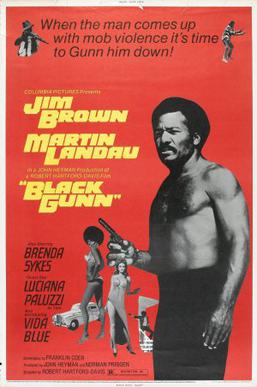
Black Gunn (1972, directed by Robert Hartford-Davis)


A war has broken out in Los Angeles.

The Black Action Group (B.A.G.) has robbed a Mafia bookmaking operation.  The Mafia, led by used car dealer Russ Capelli (Martin Landau, in his slumming it years), is less concerned with the money as they are with the fact that one of the militants, a Vietnam vet named Scott Gunn (Herbert Jefferson, Jr.), has also stolen a set of ledgers that could reveal every detail of their organization.  Capelli sends the psychotic Ray Kriley (Bruce Glover, father of Crispin) on a mission to track down Scott and kill him.

What the Mafia didn’t count on is that Scott’s older brother, Gunn (Jim Brown), is the owner of Los Angeles’s hottest nightclub.  When Scott approaches his brother, Gun tells him that he doesn’t care about the B.A.G. or any of their politics.  Still, Gunn allows Scott to stash the ledgers at his club and to hide out at his place.  When Scott still ends up getting murdered by Kriley, Gunn sets out to get revenge.

For the most part, Black Gunn is a standard blaxploitation movie with all of the usual elements, a cool nightclub, the mob, black militants,an anti-drug scene and a speech about why it’s important to not sell out to the man, and a hero played by an actor who may not have been able to show much emotion but who still radiated coolness.  Not surprisingly, Jim Brown is the main attraction here and he delivers everything that his fans have come to expect from him.  Blaxploitation regulars Bernie Case and Brenda Sykes also appear in the film.  Casey plays the head of B.A.G. while Sykes is wasted in a one-note role as Gunn’s girlfriend.  Among the villains, it’s fun to watch the glamorous Luciana Paluzzi plays a gangster’s niece and Bruce Glover is just weird enough to make Kriley interesting.  Though Martin Landau would end his career with a deserved reputation for being one of America’s greatest character actors, he spent most of the 70s sleepwalking through roles in low-budget action and horror films and his performance in Black Gunn is no different.  Having Capelli be both a car salesman and a gangster is a nice touch but otherwise, he’s just not that interesting of a character and Landau is only present to get a paycheck.

Black Gunn has some slow spots but the final shoot-out between the militants and the gangsters is exciting and so brutal that it will be probably take even the most jaded blaxploitation fan by surprise.  Black Gunn is hardly a classic but, like its hero, it gets the job done.

The Take (1974, directed by Robert Hartford-Davis)


Lt. Terrence Sneed (Billy Dee Williams), a tough and suave cop from San Francisco, is sent to New Mexico to help Police Chief Berrigan (Eddie Albert) take down the local crime syndicate.  No sooner has Sneed arrived in town than he’s helping to prevent a prison break and killing gangsters.  Berrigan is impressed and explains to Sneed that the local crime boss is Victor Manso (Vic Morrow).  Even though everyone knows that Manso is crooked, the police haven’t ever been able to put together a case that will stand up in court.  Maybe Sneed is the man who can do it.

What Berrigan doesn’t know is that Sneed is a crooked cop, himself.  As soon as Sneed leaves his meeting with Berrigan, he goes over to Manso’s office and collects his money.  Manso assigns Sneed to work with another crooked cop, Captain Dollek (Albert Salmi).  However, it turns out that Sneed has plans of his own.  While still on Manso’s payroll, Sneed starts to put together a case that might finally take Manso down.

The Take is full of good actors in small roles.  If you have ever wanted to see Billy Dee Williams share a scene with Frankie Avalon, The Take is the film for you.  Avalon plays Danny James, a small-time hood who is arrested and interrogated by Sneed.  At first, Danny is cocky and arrogant but, as soon as Sneed removes his jacket and his watch and makes a fist, Danny starts crying and begging Sneed not to beat him.  Danny is soon turned into an informant and then disappears from the movie.  The beautiful model Kathirine Baumann plays Danny’s girlfriend.  While only wearing a towel, she gives Capt. Dollek the finger and looks amazing doing it.  Sorrell Brooke, who later found fame as Boss Hogg on The Dukes of Hazzard, also has a few good scenes as Sneed’s deceptively respectable money launderer.

The Take can be a confusing film to watch because it’s never firmly established just how corrupt Sneed actually is.  Sometimes, Sneed just seems like he’s trying to make a little extra money and then, other times, he comes across as being a full-blown gangster.  Despite being on Manso’s payroll, Sneed seems to be determined to take him down and the film never makes clear why.  Billy Dee Williams is his usual supremely cool self but he seems almost too cool to play a morally ambivalent cop.  More impressive are Vic Morrow and Eddie Albert, who both shamelessly chew the scenery as two leaders on opposite sides of the law.

The Take is often mistakenly referred to as being a blaxploitation film but it’s really just a cop film with a lead actor who happens to be black.  Unlike the best blaxploitation films, there’s no political subtext to be found in the movie.  Sneed could just as easily be a corrupt white detective and, with the exception of one throwaway line, race is never mentioned.  While this is a minor cop film, it features a few good action scenes and, again, it’s your only chance to see two very different pop cultural icons, Billy Dee Williams and Frankie Avalon, acting opposite of each other.  That’s not a bad pay-off for 91 minutes of your life.

4 Shots From 4 Peter Cushing Films: Corruption, Scream and Scream Again, Asylum, Shock Waves


4 Shots From 4 Films is just what it says it is, 4 shots from 4 of our favorite films. As opposed to the reviews and recaps that we usually post, 4 Shots From 4 Films lets the visuals do the talking.

Today, we pay tribute to one of the greatest British film stars with….

4 Shots From 4 Peter Cushing Films

Corruption (1968, dir by Robert Hartford-Davis)

Scream and Scream Again (1970, dir by Gordon Hessler)

Asylum (1972, dir by Roy Ward Baker)

Shock Waves (1977, dir by Ken Wiederhorn)

Halloween Havoc!: Peter Cushing in CORRUPTION (Columbia 1968)


gary loggins's avatarcracked rear viewer

corrupt1

Hammer horror icon Peter Cushing is remembered for his two signature roles with the company, the obsessed Baron Frankenstein and the vampire hunter Van Helsing. The actor made many other films as well, but none as bizarre as CORRUPTION. This sleazy slice of 60’s dementia finds Cushing once again a brilliant surgeon, this time in a contemporary setting, in a gore fest that goes off the deep end with a uniquely wild denouement that will leave viewers in  shock.

corrupt2

Sir John Rowan (Cushing), eminent plastic surgeon,  is engaged to beautiful young model Lynn Nolan, popular fashion face of the day. Despite being tired, John attends a typical swinging 60’s party with her, and it’s clear he’s not comfortable in this milieu. When the host begins taking sexy pics of Lynn, John’s had enough and wants to leave. The host gets belligerent and a fight breaks out between the men, causing a flood lamp to…

View original post 614 more words