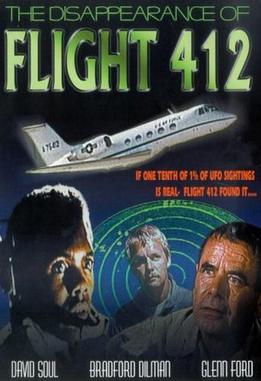
Because of recent electrical surges aboard its aircrafts, the commander of the Whitney Air Force Base 458th Radar Test Group sends a four-man crew up in Flight 412 to try to figure out what’s happening. Colonel Pete Moore (Glenn Ford) and Major Mike Dunning (Bradford DIllman) assume that it will just be a routine flight. Instead, they find themselves at the center of a government cover-up when Captain Bishop (David Soul) and the other members of the crew spot what appears to be a UFO. When two jets are sent out to intercept the object, the jets vanish.
Suddenly, Flight 412 is ordered to land at a seemingly deserted military base in the desert. When they do, the airplane is impounded and the crew is forced to undergo an 18-hour debriefing led by government agents. The agents demand that the crew members sign a statement saying that they didn’t see anything strange in the air before the jets vanished. Until all four of the men sign the release, the crew of Flight 412 are officially considered to be missing and will not be released until they agree to deny what they saw.
Meanwhile, Col. Moore tries to learn what happened to his men but the government, led by Col. Trottman (Guy Stockwell), is not eager to tell him.
This movie was made-for-television, at a time when people claiming to have been abducted by aliens was still a relatively new phenomenon. It was also made during the Watergate hearing and in the wake of the release of the Pentagon Papers, so the film’s sinister government conspiracy probably felt relevant to viewers in a way that it wouldn’t have just a few years earlier. I appreciated that the movie took a semi-documentary approach to the story but that it tried to be serious and even-handed. The film shows how witnesses can be fooled or coerced into saying that they saw the opposite of what they actually did see. Unfortunately, The Disappearance of Fight 412 is ultimately done in by its own cheapness. The overreliance on familiar stock footage doesn’t help the film’s credibility and there’s too many familiar faces in the cast for the audience to forget that they’re just watching a TV movie. The Disappearance of Flight 412 doesn’t really succeed but it is still interesting as an early attempt to make a serious film about the possibility of alien abduction and the government covering up the existence of UFOs.. Three years after this film first aired, Steven Spielberg would introduce these ideas to an even bigger audience with Close Encounters of The Third Kind.
Tim Murphy (Don Johnson, with a huge mustache) is a Vietnam vet who is still haunted by his actions during the war. As a result, he can’t hold down a job, he’s abusive to his wife, and he’s woken up in the middle of the night by constant nightmares. One day, at the unemployment office, he meets another vet named Luke (Robert F. Lyons) and the two of them bond over their shared experiences. While Tim tries to come to terms with what happened during the war, his wife Paula (Lisa Blount) tries to keep the household together.
Barely released in 1985, Cease Fire is a largely but unfairly forgotten Vietnam film. According the film’s imdb page, Don Johnson once told an interviewer that he couldn’t even remember starring in a film called Cease Fire. That piece of trivia sounded too good to be true and, after doing a google search, I have not been able to come across any interviews where Johnson says that. In fact, in an interview with the AV Club, Johnson says that he filmed Cease Fire in Miami shortly after doing his first audition for Miami Vice. According to Johnson this was in the early stages of Miami Vice‘s development, before Michael Mann was even attached to the project. Since Miami Vice premiered (with Mann producing and Johnson starring) in 1984, that probably means that Cease Fire was filmed in either 1982 or 1983. Considering that it was a low-budget and talky film about a very unpopular war, it is not surprising to discover that it sat on the shelf for a few years before finally being released in order to capitalize on the sudden stardom of its main actor.
Even though both take place in Miami and feature Don Johnson as a Vietnam vet, Miami Vice and Cease Fire are as different as night and day. Cease Fire is a low-key and muted character study of a traumatized man who is struggling to face what happened in the past. There’s not much action but there is a lot of talking. Some of the dialogue is clumsy and obvious but both Don Johnson and Robert F. Lyons give good performance as the traumatized vets and Cease Fire is honest enough to admit that, even if he does take a few steps in the right direction, Tim still has a long road ahead of him. Cease Fire, which never got a DVD release but which is available on Amazon Prime, is a sincere look at the reality of PTSD and the struggle that many vets face when they first return home. It’s not a perfect movie but it’s saved by its own good intentions and Johnson’s sincere performance in the main role.
Cease Fire was also the first film to be directed by David Nutter. Nutter is today probably best known for directing several episodes of Games of Thrones, a show that has even less in common with Cease Fire than Miami Vice.
Charles Durning plays Otis P. Hazelrigg, a postman in a small town who has an unhealthy interest in a ten year-old girl named Marylee (Tanya Crowe). When Marylee is mauled and nearly killed by a dog, Otis decides that she was attacked by Bubba Ritter (Larry Drake), a mentally challenged man who has the mind of a child. With Otis and his redneck friends looking to lynch him, Bubba’s mother disguises him as a scarecrow and tells him to stand out in a field and not move. When Otis and his friends discover Bubba hiding, they all shoot him until he’s dead. Otis puts a pitchfork in Bubba’s hands and tells the police that Bubba was attacking them and they didn’t have any choice but to shoot him.
Otis thinks that he’s gotten away with murder but he’s wrong. After Marylee sings a song in the same field where Bubba was killed, Otis’s friends start dying. One is suffocated in a grain silo. Another falls into a thresher. Before each one dies, they report seeing a scarecrow on their property. Otis thinks that Bubba’s mother is behind the murders but what if Bubba has actually come back to life?
Dark Night of the Scarecrow will mess up your mind, give you bad dreams, and leave you with a lifelong phobia o scarecrows. It’s that scary. I remember that they used to frequently show this movie on TV when I was growing up and even the commercials were scary. (The part of the movie that always messed with me were the shots of Bubba’s frightened eyes darting around underneath the scarecrow mask.) Scarecrows are naturally creepy and the movie’s atmosphere is unsettling but the most frightening thing about Dark Night of the Scarecrow is Otis and the redneck lynch mob that he puts together. Otis is a thoroughly loathsome character and Charles Durning goes all out playing him. Otis is a civil servant, which gives him some prestige in the town but he uses that prestige to bully Bubba and harass Marylee. His concern with Marylee especially feels wrong and the movie does not shy away from the subtext of his interest. The scarecrow might frighten you but you will absolutely loathe Otis and everyone who follows him.
Dark Night of the Scarecrow was made for television but it’s just as good as any theatrical release. It is also might be the first movie to feature a killer scarecrow. Several have been made in the years since but Dark Night of the Scarecrow was the first and it’s still the best.
To quote John McClane, “How can the same shit happen to the same guy twice?”
It has been eight years since Paul Kersey (Charles Bronson) lost his wife and single-handedly cleaned up New York City. The first Death Wish ended with Paul in Chicago, preparing to gun down a new group of criminals. I guess Chicago didn’t take because, at the start of Death Wish II, Paul is in Los Angeles and he’s working as an architect again. He has a new girlfriend, a bleeding heart liberal reporter named Geri (Jill Ireland, Bronson’s real-life wife) who is against the death penalty and who has no idea that Paul used to be New York’s most notorious vigilante. Having finally been released from the mental institution, Carol (Robin Sherwood) is living with her father but is now mute.
Crime rates are soaring in Los Angeles and why not? The legal system is more concerned with the rights of the criminals than the victims and Paul has retired from patrolling the streets. But when a group of cartoonish thugs rape and kill his housekeeper and cause his daughter to fall out of a window while trying to escape them, Paul picks up his gun and sets out for revenge.
Death Wish II was not the first sequel to Death Wish. Brian Garfield, the author of the novel on which Death Wish was based, never intended for Paul to be seen as a hero and was disgusted by what he saw as being the film’s glorification of violence. As “penance,” he wrote a sequel called Death Sentence, in which Paul discovered that he had inspired an even more dangerous vigilante. When Menahem Golan and Yoram Globus bought the rights to produce a second Death Wish film, they decided not to use Garfield’s sequel and instead went with a story that was co-written by Golan.
It’s the same basic story as the first film. Again, Paul is a mild-mannered architect who is a liberal during the day and a gun-toting reactionary at night. Again, it’s a home invasion and a death in the family that sets Paul off. Again, Paul gets help from sympathetic citizens who don’t care that the police commissioner (Anthony Franciosa) wants him off the streets. Jeff Goldblum played a rapist with a switch blade in the first film. This time, it’s Laurence Fishburne who fills the role. (Fishburne also carries a radio, which he eventually learns cannot be used to block bullets.) Even Detective Ochoa (Vincent Gardenia) returns, coming down to Los Angeles to see if Paul has returned to his old ways.
The main difference between the first two Death Wish films is that Death Wish II is a Cannon film, which means that it is even less concerned with reality than the first film. In Death Wish II, the criminals are more flamboyant, the violence is more graphic, and Paul is even more of a relentless avenger than in the first film. In the first Death Wish, Paul threw up after fighting a mugger. In the second Death Wish, he sees that one of the men who raped his daughter is wearing a cross, leading to the following exchange:
“Do you believe in Jesus?”
“Yes, I do.”
“Well, you’re going to meet him.”
BLAM!
Death Wish II is the best known of the Death Wish sequels. It made the most money and, when I was a kid, it used to show on TV constantly. The commercials always featured the “You believe in Jesus?” exchange and, every morning after we saw those commercials, all the kids at school would walk up to each other and say, “You believe in Jesus? Well, you’re going to meet him.” It drove the teachers crazy.
Overall, Death Wish II is a lousy film. Michael Winner, who was always more concerned with getting people into the theaters than anything else, directs in a sledgehammer manner that makes his work on the first film look subtle. He obscenely lingers over every rape and murder, leaving no doubt that he is more interested in titillating the audience than getting them to share Paul’s outrage. The script is also weak, with Geri so poorly written that she actually gets more upset about Paul going out at night than she does when she learns that Paul’s daughter has died. When Paul sets out to track down the gang, his method is to merely wander around Los Angeles until he stumbles across them. It doesn’t take long for Paul to start taking them out but no one in the gang ever seems to be upset or worried that someone is obviously stalking and killing them.
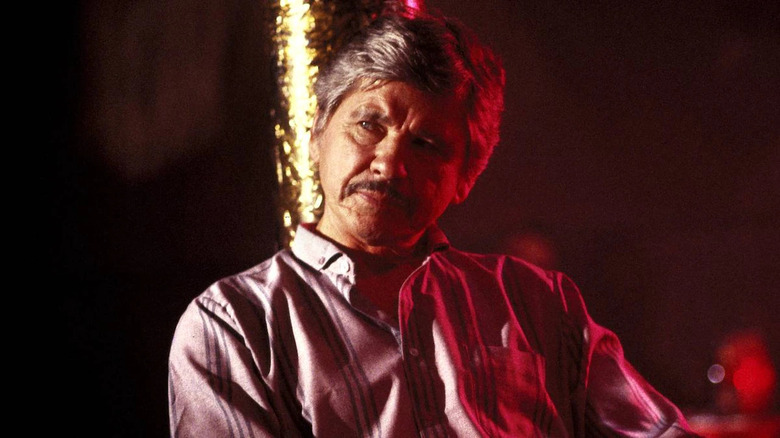
There are a few good things about the film. Charles Bronson was always a better actor than he was given credit for and it’s always fun to watch Paul try to balance his normal daily routine with his violent night life. Whenever Geri demands to know if he’s been shooting people, Paul looks at her like he is personally offended that she could possibly think such a thing. Also, the criminals themselves are all so cartoonishly evil that there’s never any question that Paul is doing the world a favor by gunning them down. For many otherwise sensible viewers, a movie like Death Wish II may be bad but it is also cathartic. It offers up a simple solution to a complex issue. In real life, a city full of Paul Kerseys would lead to innocent people getting killed for no good reason. But in the world of Death Wish II, no one out after nightfall is innocent so there’s no need to worry about shooting the wrong person.
Finally, the film’s score was written by the legendary Jimmy Page. The studio wanted Isaac Hayes to do the score but Winner asked his neighbor, Page. Page took the film, retreated into his studio, and returned with a bluesy score that would turn out to be the best thing about the movie. The soundtrack was the only one of Page’s solo projects to be released on Led Zeppelin’s record label, Swan Song Records.
Having just graduated from West Point, Lt. Jeff Knight (Michael Dudikoff, the American Ninja himself) is sent to Vietnam and takes over a battle-weary platoon. Lt. Knight has got his work cut out for him. The VC is all around, drug use is rampant, and the cynical members of the platoon have no respect for him. When Lt. Knight is injured during one of his first patrols, everyone is so convinced that he’ll go back to the U.S. that they loot his quarters. However, Knight does return, determined to earn the respect of his men and become a true platoon leader!
Though Cannon was best known for making B action movies (many of which starred either Chuck Norris or Charles Bronson), they occasionally tried to improve their image by releasing a prestige film. Platoon Leader is somewhere in the middle between Cannon’s usual output and their “respectable” films. It is based on a highly acclaimed memoir and, though the film was made in South Africa, it does a good job of recreating the look of Vietnam. For instance, Platoon Leader‘s version of Vietnam is more convincing than what Cannon later presented in P.O.W.: The Escape. Platoon Leader also spends some time developing its characters. Lt. Knight is more than just a stoic action hero, which already distinguishes it from 90% of Cannon’s usual output. At the same time, Platoon Leader was directed by Chuck Norris’s brother, Aaron, and he doesn’t hold back on the explosions and the gunfire that everyone had come to expect from a Cannon war film. The end result is an enjoyably hokey film that has a few more layers than the typical Cannon production but not too many.
This film was originally titled Nam but, after the success of Platoon, the title was changed to Platoon Leader. In typical Cannon fashion, Platoon Leader plays like a more jingoistic and even less subtle version of Stone’s film. The main difference is that Platoon‘s Lt. Wolfe never won the respect of his men and ended up getting killed with almost everyone else while Lt. Knight beats back the VC and shares a celebratory embrace with his sergeant.
One final note: keep an eye out for genre vet William Smith, who starred in The Losers (a film about a group of bikers who are recruited by the CIA and sent to Vietnam), in the role of Dudikoff’s superior officer. If Platoon Leader had been made in the 70s, Smith would have played Dudikoff’s role so his appearance here is almost a passing of the B-movie torch.
Normally, having a law named after you would be pretty cool but it appears that this is just a law that Jack came up with himself. Having to come up with your own law is kind of like having to come up with your own nickname. Dude, it’s just lame. Since Jack Murphy is played Charles Bronson, we can cut him some slack.
Murphy’s Law was one of the many film that, towards the end of his career, Bronson made for Cannon Films. He played a detective in almost all of them. Jack Murphy is Dirty Harry without the fashion sense. He is also an alcoholic who cannot get over his ex-wife (Angel Tompkins) and her decision to become a stripper. Not only has Murphy managed to piss off his superiors with his bad attitude but the mob is out to get him. Everyone has forgotten Murphy’s Law. Everyone is fucking with Jack Murphy.
Jack’s main problem, though, is Joan Freeman (Carrie Snodgress). Years ago, Murphy sent Joan to prison for murder but, because it’s California and Jerry Brown appointed all of the judges, Joan gets out after just a few years. Joan starts to systematically murder everyone that Murphy knows, framing Murphy for the murders. Murphy’s arrested by his fellow cops, all of whom need a refresher on Murphy’s Law. Though handcuffed to a young thief (Kathleen Wilhoite), Murphy escapes from jail and set off to remind everyone why you don’t fuck with Jack Murphy.
Murphy’s Law is a typical Cannon Bronson film: low-budget, ludicrously violent, borderline incoherent, so reactionary than it makes the Dirty Harry films look liberal, and, if you’re a fan of Charles Bronson, wildly entertaining. Bronson was 65 years old when he played Jack Murphy so he cannot be blamed for letting his stunt double do most of the work in this movie. What’s interesting is that, for once, Bronson is not the one doing most of the killing. Instead, it is Carrie Snodgress, in the role of Joan Freeman, who gets to murder nearly the entire cast. There is nothing subtle about Snodgress’s demonic performance, which makes it perfect for a Cannon-era Bronson film. In fact, Carrie Snodgress gives one of the best villainous performances in the entire Bronson filmography. There is never any doubt that Snodgress is capable of killing even the mighty Charles Bronson, which makes Murphy’s Law a little more suspenseful than most of the movies that Bronson made in the 80s.
Whatever else can be said about Murphy’s Law, it does feature one of Bronson’s best one liners. When Joan threatens to send him to Hell, Murphy replies, without missing a beat, “Ladies first.” Only Bronson could make a line like that sound cool. That’s Bronson’s Law.
Am I too young to start feeling nostalgic for the past?
It’s been 6 years since I graduated from the University of North Texas and, as much as I enjoy officially being an adult and all that good stuff, I have to admit that there’s a part of me that misses being in college. Even though I know that I will be returning to school to work on my master’s, there’s a part of me that really regrets that I’ll never again get to be an undergrad with the rest of my life in front of me.
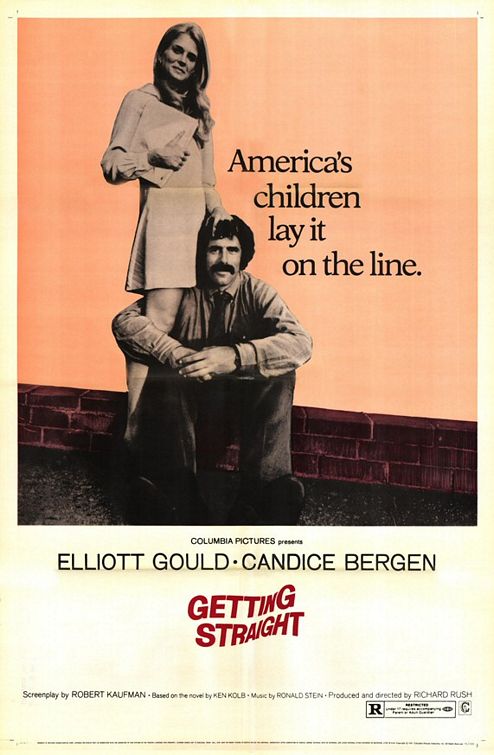
Fortunately, I review movies so, whenever I start to feel nostalgic for the past, I can just watch and review a movie. Last week, I was missing college. So, I watched a few films about college. The first film that I watched was from 1970 and it was called Getting Straight.
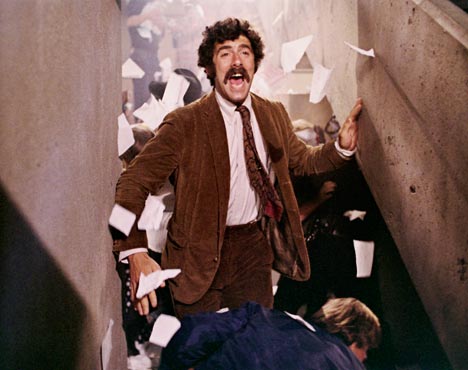
One of the first things that you notice while watching Getting Straight is that director Richard Rush apparently made the decision to film nearly the entire movie in extreme close-ups. When Nick, a spaced-out hippie played by Robert F. Lyons, steps into a room and starts laughing, the camera zooms in so close that you can practically see down the back of his throat. When Jan (played by a very young Candice Bergen) breaks down into tears after getting beaten up at a political demonstration, the camera so obsessively lingers over her tear-stained face that the viewer is left with little choice but to consider just how terrible a performance Bergen is actually giving. When Harrison Ford shows up in an early role, the camera zooms into his face, as if to force us to say, “Hey, that’s Harrison Ford!” Meanwhile, the star of the film, Elliott Gould, is in almost every scene and, thanks to Rush’s love of extreme close-ups, it’s hard not to focus on the fact that his thick sideburns and his walrus mustache looks like they are threatening to devour his entire face.
Elliott Gould plays Harry Bailey, a grad student at an unnamed California university. In his undergraduate days, Harry was a political activist who, we’re told, marched for civil right as Selma. Then he served in Viet Nam and not as some conscientious objector either (though that would have made sense, considering his political beliefs). No, Harry saw combat. And, while doing all of that, Harry also somehow found time to be in Paris during the 1968 student strike. However, Harry is now back in America and all he wants to do is get his master’s in education so that he can teach the underprivileged.
Along with his prominent facial hair and his colorful past, the main thing that you notice about Harry is that he yells. A lot.
Harry yells because his professors expect him to show up for classes that he doesn’t care about. When those same out-of-touch professors expect Harry to take a test that he doesn’t consider to be important, he gets his friend Nick to take it for him. Nick, being an idiot, signs his name to the test but then marks it out and writes down Harry’s name instead.
Harry yells because a bunch of student activists expect him to join their protests. Harry tells them that they’re shallow and the only reason they care about politics is because “protests are sexy.” Despite his condescending attitude, the rest of the student body continues to look up to Harry. I imagine it has something to do with the hypnotic power of his mustache.
Harry yells because a professor suggests that F. Scott Fitzgerald might be gay. Harry also says that Arizona is the best state of the union because it has the lowest occurrence of homosexuality. If nothing else, all of this serves to remind us that this film was made in 1970.
Mostly, however, Harry just yells at his girlfriend, Jan. Jan lies about being pregnant and Harry yells. Jan says that she’s thinking about getting married. Harry yells that she is a “dumb broad.” Jan says she’s on her period. Harry yells that she’s lying and that he’ll be over later that night. Harry yells when Jan breaks up with him. Harry yells when Jan introduces him to her new boyfriend, despite the fact that Harry has been screwing — in extreme close-up — every other undergrad on campus. Harry yells at her that she might as well just be a “man with a hole.”
In other words, Harry is a self-righteous jerk. Harry is a misogynist. Harry is a hypocrite. Harry is an asshole. And yet — probably because this film was made in 1970 — Harry is also supposed to be the film’s hero. Harry is supposed to be the character that we sympathize with and, indeed, every other character in the film is totally charmed by Harry and his behavior. Even poor abused Jan continues to come to Harry, despite the fact that her next door neighbor is Harrison Ford!
Harrison Ford in Getting Straight
Yes, there are many very valid criticisms to be made about Getting Straight. Harry is unlikable. Candice Bergen gives an amazingly bad performance. Richard Rush’s direction shows an overdependence on close-ups and rack focus shots, techniques that he uses so frequently that they eventually lose all meaning but instead simply come across as being nervous tics. Like so many of the counter cultural films of the early 70s, Getting Straight is an excruciatingly sexist film. That’s one thing that the films of both the counter-culture and the establishment had in common, a deep disdain and fear of women in general. Harry may claim that the student protestors are only into politics because they want to get laid but it’s hard to see how he’s any better. The middle stretch of Getting Straight could have just as easily have been called Harry Must Get Laid.
However, Getting Straight does get one thing right. It perfectly captures the atmosphere of college. From the pompous and out-of-touch professors to the creepy old grad students (that would be Harry) to the portentous seriousness of the student activists, Getting Straight captures all of that perfectly. As such, Getting Straight might not really work as a dramatic film but it’s definitely worthwhile as a record of a specific time and place. Much of what today seems annoying about a film like Getting Straight is really nothing more than a recording of what was once considered to be culturally acceptable.
Getting Straight is a portrait of 1970 that makes me glad that I was born in 1985.