Brad reviews THE STONE KILLER (1973), starring Charles Bronson!


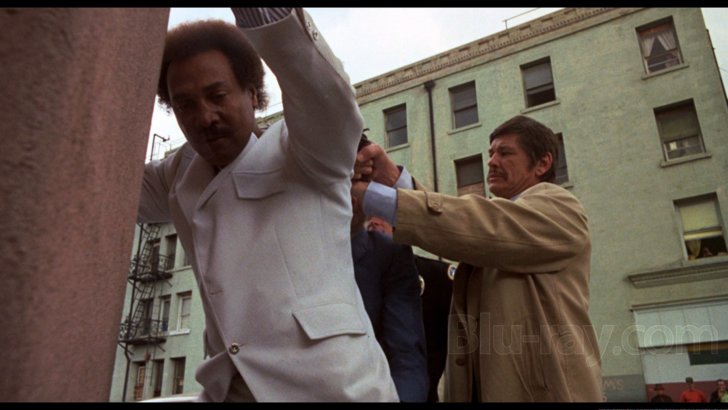
THE STONE KILLER opens in Spanish Harlem with detective Lou Torrey (Charles Bronson) following a young man, who had just shot a cop, into an abandoned building. When the young man refuses to turn himself in, and even tries to shoot Torrey, he gets blown away. In trouble with his superiors on the force, and being dragged in the press for the shooting, Torrey decides to change locations and continue his law enforcement career under his friend Les Daniels (Norman Fell) in Los Angeles. Soon after he arrives in Los Angeles, Torrey and his partner Mathews (Ralph Waite) are working a case against a drug dealer, when they arrest “Bootlace” Armitage (Eddie Firestone), a drug addict, but also a well-known hitman from New York. Torrey is delivering the “mechanic” back to New York for outstanding warrants when Armitage says that he is willing to give up some big information on “Wexton” in exchange for a reduced sentence. When Armitage is gunned down in what is obviously a professional hit, it’s clear that there is something going on that involves the name Wexton. We soon learn more as we meet mafia leader Al Vescari (Martin Balsam). As Vescari walks through a cemetery, he tells the leader of his operation, Lawrence (Stuart Margolin), of his plans to get revenge for a string of mafia killings that occurred 42 years earlier by using “stone killers,” in this case, former military men with no connection to the mob. As the film moves forward, Detective Lou Torrey and his fellow cops will eventually put the pieces together and find themselves taking on these “stone killers” and the mob! 

I’ll just go ahead and say up front that I’m a big fan of THE STONE KILLER these days, but that’s because the movie has grown on me over the years with repeat viewings. When I first watched the film as a teenager in the 1980’s, I enjoyed it as a tough cop film, but it wasn’t one of my favorites. I think that part of the reason I didn’t appreciate it as much back then is the more convoluted plot of the film. Most Bronson films have simple and easy to follow plot lines, but THE STONE KILLER includes a somewhat complicated mafia assassination plan, and it also sends the cops on wild goose chases that have nothing to do with the actual story. Watching the film as an adult, I appreciate Director Michael Winner taking us with him on some of those 1970’s flavored tangents that include getting to hang out with some hippies at an ashram, as well as some unjustly accused black militants. 

Even though the plot is more complicated than the average Charles Bronson film, director Michael Winner gives us some of the best action sequences of Charles Bronson’s career. There are two sequences in particular that stand out to me. After the impressive opening scenes where Torrey blows away the gun wielding young man in Spanish Harlem, it takes a while to get to the next extended action sequence, but it’s definitely worth the wait. The scene involves Detective Torrey in a car chase where he’s after one of the stone killers, Albert Langley (Paul Koslo), who’s on a motorcycle. In an era of great car chases, this is a doozy that features many amazing and dangerous stunts. The late 60’s and early 70’s are an embarrassment of riches for cinematic car chases and this one stands the test of time. The next great action sequence occurs later in the film when Detective Torrey and the cops bust the home and facility where the killers have trained for the planned massacre. Bronson is still in his physical prime in 1973, and his athletic prowess is clearly on display as he slides across floors, jumps on tables, and does anything else that is required to take down the bad guys. The film is not wall to wall action, but what’s here is as badass as it gets. 

Detective Lou Torrey is a really good role for Charles Bronson. In his best roles, Bronson is tough, but you can also tell that he cares about other people. That’s definitely the case here as he consistently shows empathy for some of the people he’s after. For example, at the beginning of the film, he has to shoot the young man in Spanish Harlem in self-defense, but he later explains to his sister that he didn’t want to do it, even expressing some understanding of how the young man may have found himself in that situation. A little later while arresting a drug dealer with his partner Mathews, Torrey is clearly disgusted when his partner uses racial slurs during the arrest. Torrey then talks to the man with respect and gets the needed information to arrest the man buying the drugs. There are further examples later in the film as he deals with other drug addicts and militants. I say none of this to insinuate that Bronson’s character is weak in any way. Rather, he seems to want to do his job and arrest criminals in a professional manner. He’s also a complex character in some ways as he will bend the rules to get what he needs if he has to. He does end up punching the car thief, Jumper (Jack Colvin), a couple of times during an interview. While this is definitely not legal, in the context of this film, it’s required in order to get to the facts of the case. Bronson is actually quite great in the film. 

Besides international superstar Charles Bronson, Michael Winner put together an amazing cast for THE STONE KILLER. Martin Balsam had won an Oscar a few years earlier, and he’s good here as the mafia boss with four decades worth of patience for revenge. Ralph Waite is also excellent as Bronson’s incompetent, racist partner Mathews. It’s hard to believe the guy would go on to play Papa Walton based on the ignorance he shows in both this film and in the Bronson/Winner collaboration CHATO’S LAND from the prior year. It’s fun watching both Norman Fell and John Ritter work together in this film, especially knowing that they would be making television history a few years later on the classic TV sitcom “Three’s Company.” The last two actors I want to mention are Stuart Margolin as the leader of the stone killers, Lawrence, and Paul Koslo as the bi-sexual badass musician Albert Langley. Both actors, especially Koslo, are good here and would have important roles with Bronson the next year as well. Margolin was an important character in DEATH WISH, and Koslo may have even outdone his work here the next year as a particularly slimy weasel in MR. MAJESTYK. Oh yeah, be sure to look for a short, uncredited cameo from B-movie queen Roberta Collins! I also want to shout out the musical score from Roy Budd, who also did the score for GET CARTER (1971). Thanks to Budd’s work, the opening credits are very cool and memorable. 

THE STONE KILLER was marketed as Charles Bronson’s “Dirty Harry” and meant to be his breakout hit in America. Unfortunately, while the film was an international hit, the actual grosses in the United States were respectable but not as much as the filmmakers had hoped for. As such, we didn’t get any more entries in the case log of Detective Lou Torrey and Bronson would have to wait another year for his American box office breakout with DEATH WISH. But that’s okay because THE STONE KILLER has stood the test of time as an excellent 1970’s cop film, emerging in my personal rankings as a major feather in the cap of Charles Bronson’s career. 
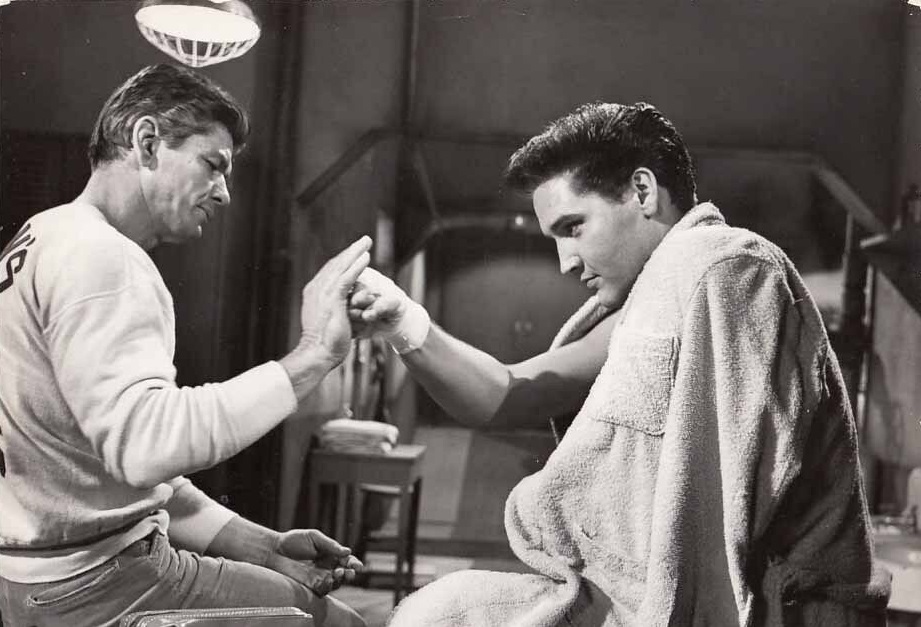
KID GALAHAD (1962) – Charles Bronson teaches Elvis how to box! Happy Birthday to the King!


In celebration of the January 8th birthday of the great Elvis Presley, I decided to watch his 1962 film KID GALAHAD, the only film where he co-stars with my movie hero Charles Bronson. I’ve always been a fan of Elvis Presley and seeing him on-screen with Bronson is a real treat for me.

KID GALAHAD opens with Walter Gulick (Elvis Presley) returning to his hometown in upstate New York. Recently discharged from the army, and in the need of money, the aspiring mechanic finds his way to Willy Grogan’s (Gig Young) boxing camp and agrees to spar with one of his up-and-coming young boxers. Walter doesn’t have much boxing skill, but he ends up having one hell of a right hook and knocks the young boxer flat on his ass. Seeing this, Willy Grogan, who has all sorts of personal and financial problems, thinks Walter might be the answer to getting out of debt to his bookie. Willy asks his trainer Lew (Charles Bronson) to work with the young, strong Walter, who’s now been dubbed “Galahad” by Willy’s girlfriend Dolly (Lola Albright) after he had protected her honor from a “man who doesn’t know how to behave around a lady.” Pretty soon, Willy has fights arranged for Walter under the name of “Kid Galahad.” The first fight begins with Galahad getting his faced being punched repeatedly until he gets one opening and then knocks the other fighter out with one punch. After that, with Lew’s help, Galahad’s skills start showing definite improvement. When he’s not working with Lew at the gym, Galahad finds time to romance and propose to Willy’s sister, Rose (Joan Blackman). This causes problems with the troubled Willy who doesn’t want his sister married to some “meatball” or “grease monkey.” Even worse, smelling money, gangster Otto Danzig (David Lewis) and his henchmen start putting pressure on the financially troubled Willy to force Galahad to take a dive in his big fight with “Sugar Boy” Romero so they can clean up on the fix, going so far as breaking Lew’s hands. Will Willy get the balls to say no to the gangsters? Will Galahad be able to beat Sugar Boy Romero and then retire to open his garage with Rose by his side? You probably already know, but you’ll just have to watch and see!

1962’s KID GALAHAD is a remake of a 1937 movie of the same name directed by Michael Curtiz, and starring cinematic legends Edward G. Robinson, Bette Davis, and Humphrey Bogart. I’ve never seen the earlier version, so I will not compare the two in any way. And to be completely honest, I haven’t watched very many Elvis Presley movies either. As I type this, I can’t think of a single moment I remember in his filmography not included in KID GALAHAD, and I wouldn’t have watched this one without the presence of Charles Bronson. With that said, I think Elvis gives a good performance in KID GALAHAD. He’s very likable, with his character having an old-fashioned chivalry towards women, a friendly, open way with men, and an appreciation for a strong work ethic. I think Elvis handles each of these parts of his character in a way to that makes me want to root for him. As good as Elvis is as Kid Galahad, Gig Young does most of the heavy lifting as the story really revolves around his character’s troubles even more than it does around Galahad. I think he does a pretty good job of taking a character who’s a pretty sorry guy, and by the end of the movie we actually find ourselves starting to like him. Even though he’s in a true supporting role, Charles Bronson is excellent as the trainer who teaches Galahad how to box. Every scene Bronson’s in is elevated by his enormous screen presence and authority. With Bronson in his corner, you feel Galahad is capable of anything. The most powerful scene in the entire film is when the gangsters try to buy his character off under the threat of violence, and he refuses, leading to his hands being broken. After becoming one of the biggest stars on the planet a number of years later, it’s easy to look back at these moments and wonder how in the hell was he not already a huge star in 1962.

Of course, this being an Elvis Presley movie, there are several musical numbers spread throughout the movie. While I don’t remember too much about the songs themselves, they didn’t really take me out of the drama of the movie either. I actually enjoyed seeing Elvis perform, with the people around him clapping along and enjoying themselves. I do remember a specific scene where Elvis is singing as he’s driving down the road, and Bronson’s sitting in the back seat with a big smile on his face like he’s having a great time. That’s my favorite moment of all the songs.  

Although I haven’t watched many of his movies, I’ve been an appreciative fan of Elvis Presley all my life. I can’t tell you how many times I heard his Christmas album in my younger years, as my mom would play it almost on repeat once we got to November. He was a talented, versatile singer whose charisma and stage presence have never been matched, and whose influence on music and entertainment is immeasurable. The fact that Elvis Presley and Charles Bronson made KID GALAHAD together means something to me, and I had a great time revisiting the film on his birthday!

See the Original Trailer for KID GALAHAD below.

Horror On TV: One Step Beyond 2.14 “Make Me Not A Witch” (dir by John Newland)


In tonight’s episode of One Step Beyond, Emmy (Patty McCormack) makes the mistake of telling her parents (Eileen Ryan and Leo Penn) that she can read minds.  Needless to say, the news does not go over as well as Emmy might have hoped.  Her parents have a farm to run!  The last thing they need is a witch in their midst!

Emmy runs to the church and prays, “Make me not a witch!”

But what if the world needs a witch?

As with every episode of One Step Beyond, this episode is supposedly based on fact.  Patty McCormack is best-remembered for her Oscar-nominated performance in The Bad Seed while Eileen Ryan and Leo Penn are best remembered as being the parents of Sean and Chris Penn.

This episode originally aired on December 22nd, 1959.

Enjoy!

Horror on TV: Kolchak: The Night Stalker 1.18 “The Knightly Murders” (dir by Vincent McEveety)


Tonight on Kolchak….

The armor of a 12-century knight is possessed and determined to keep anyone from harming the museum in which it is currently housed.  This includes anyone who might want to build a nightclub nearby.  With the armor trying to prevent Chicago from enjoying disco, it’s up to Carl Kolchak to report the story and solve the case!

I like this episode because it features a holy ax.

This episode originally aired on March 7th, 1975.

Enjoy!

http://www.youtube.com/watch?v=f0SUWOkBeJY

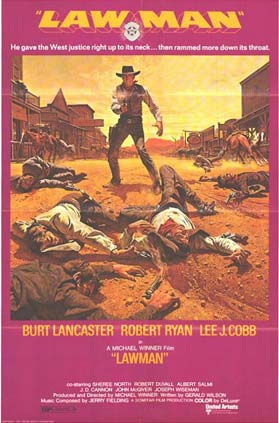
A Movie A Day #238: Lawman (1971, directed by Michael Winner)


In the 1880s, Jared Maddox (Burt Lancaster) is the marshal of the town of Bannock.  After a night of drinking and carousing leads to the accidental shooting of an old man, warrants are issued for the arrest of six ranch hands.  Maddox is determined to execute the arrest warrants but the problem is that the six men live in Sabbath, another town.  They all work for a wealthy rancher (Lee J. Cobb) and the marshal of Sabbath, Cotton Ryan (Robert Ryan), does not see the point in causing trouble when all of the men are likely to be acquitted anyway.  Maddox doesn’t care.  The law is the law and he does not intend to leave Sabbath until he has the six men.
Lawman starts out like a standard western, with a stranger riding into town, but then it quickly turns the western traditions on their head by portraying Marshal Maddox as being a rigid fanatic and the wealthy rancher as a morally conflicted man who does not want to resort to violence and who continually tries and fails to convince Maddox to leave.  In the tradition of Sergio Leone and Sam Peckinpah, there are no real heroes to be found in Lawman and, even when Maddox starts to reconsider his strict adherence to the law and refusal to compromise, it is too late to prevent the movie from ending in a bloody massacre.  Since Lawman was made in 1971, I initially assumed it was meant to be an allegory about the Vietnam War but then I saw that it was directed by Michael Winner, a director who specialized in tricking audiences into believing that his violent movie were deeper than they actually were.

Even if Lawman never reaches the heights of a revisionist western classic like Pat Garrett and Billy the Kid, it is still pretty good, with old pros Lancaster, Ryan, Cobb, and Albert Salmi all giving excellent performances.  The cast is full of familiar faces, with everyone from Robert Duvall to Richard Jordan to Ralph Waite to Joseph Wiseman to John Beck showing up in small roles.  In America, Winner is best remembered for his frequent collaborations with Charles Bronson.  Chuck is not in Lawman, though it seems like he should have been and Lee J. Cobb’s rancher is named Vincent Bronson.  Winner would not make his first film with Charles Bronson until a year later, when he directed him in Chato’s Land.

44 Days of Paranoia #10: The Intruder (dir by Roger Corman)


For today’s entry in the 44 Days of Paranoia, we take a look at one of the most underappreciated films of all time, Roger Corman’s 1962 look at race relations, The Intruder.

Despite the fact that he’s regularly cited as being one of the most important figures in the development of American cinema, Roger Corman remains an underrated director.  Many critics tend to focus more on the filmmakers that got their start working for Corman than on Corman himself.  When they talk about Roger Corman, they praise him for knowing how to exploit trends.  They praise him as a marketer but, at the same time, they tend to dismiss him as a director.

I would suggest that those critics see The Intruder before they presume to say another word about Roger Corman.

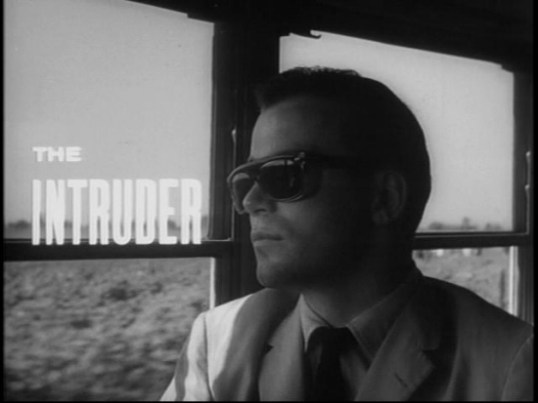
The Intruder opens with a young, handsome man named Adam Cramer sitting on a bus.  The first thing that we notice about Cramer is that he’s wearing an immaculate white suit.  The second thing we notice is that he’s being played by a very young (and, it must be said, rather fit) William Shatner.

I know that many people will probably be inclined to dismiss The Intruder from the minute they hear that it stars William Shatner.  Based simply on Shatner’s presence, they’ll assume that this film must be very campy, very Canadian, or both.  Well, they’re wrong.  Shatner gives an excellent performance in this film, bringing to life one of the most evil characters ever to appear on-screen.

Adam Cramer, you see, is a representative on a Northern organization known as the Patrick Henry Society and he’s riding the bus because he’s heading to a small Southern town.  The high school in that town has just recently been desegregated and Cramer’s goal is to make sure that no black students attend class.  As Cramer explains it, he’s a “social worker” and his goal is to help preserve Southern society.

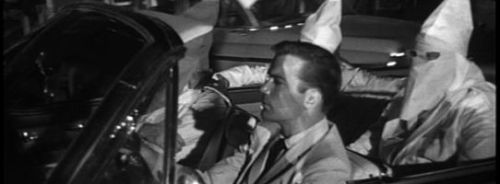
To achieve this goal, Cramer partners up with the richest man in town, Verne Shipman (who is played, rather chillingly, by Robert Emhardt).  With Verne’s sponsorship, Cramer gives an inflammatory speech in the town square and then later returns with a group of Klansmen.  As opposed to recent films like Django Unchained (which scored easy laughs by casting Jonah Hill as a Klansman and playing up the group’s ignorance), The Intruder presents the Klan as figures that have stepped straight out of a nightmare, making them into literal demons who appear at night and disappear during the day.  In a genuinely disturbing scene, the Klansmen set a huge cross on fire.  As the flames burn behind him, Cramer seduces the wife of a local salesman.

intruder-shatner-klan

After Cramer delivers his speech, the local black church is blown up and a clergyman is killed.  The editor of the town newspaper — who, before Cramer showed up, was opposed to desegregation — changes his mind and publishes an editorial strongly condemning Cramer.  Cramer’s mob reacts by nearly beating the editor to death.  Realizing that he’s losing the power to control the mob that he created, Cramer frames a black student for rape which leads the film to its powerful and disturbing conclusion.

Particularly when compared to other films that attempted to deal with race relations in 1962, The Intruder remains a powerful and searing indictment of intolerance and a portrait of how demagogues like Adam Cramer will always use fear, resentment, and ignorance to build their own power.  Corman filmed The Intruder on location in Missouri and used a lot of locals in the cast.  Judging from the disturbing authenticity of some of the performances that Corman got from some of these nonprofessionals, it’s not unreasonable to assume that quite a few of them agreed with everything that Adam Cramer was saying.

As opposed to most films made about the civil rights era in America, The Intruder doesn’t shy away from showing the ugliness of racism.  The Intruder casually tosses around the N word (and yes, it is shocking to not only hear Shatner use it but to see him smile as he does so) but, unlike a lot of contemporary films, it does so not just to shock but to show us just how naturally racism comes to the film’s characters.  The scene in which Verne repeatedly strikes a black teenager who failed to call him sir is also shocking, not just for the violence but because of how nobody seems to be particularly surprised by it.  As a result, The Intruder is not necessarily an easy film to watch but then again, that’s the point.  The hate on display in The Intruder should never be easy to watch.

The Intruder was written by Charles Beaumont, who also wrote several classic episodes of The Twilight Zone.  I think it can be argued that The Intruder represents the best work of Beaumont, Corman, and Shatner.  Unfortunately, but not surprisingly, The Intruder was the only film directed by Roger Corman to not be a box office success.

However, in a world where people are patting themselves on the back for sitting through The Butler, The Intruder is an important film that deserves to be seen now more than ever.

intruder (1962) title capture