Embracing the Melodrama Part II #90: Showgirls (dir by Paul Verhoeven)


ShowgirlsWell, this is it!

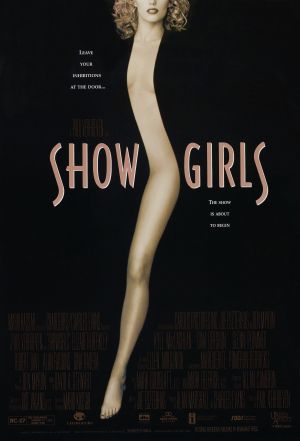
Showgirls in the 1995 film that, 20 years after it was first released, is still held up as the standard by which all subsequent bad films are judged.  The story behind the production is legendary.  Screenwriter Joe Ezsterhas was paid a then-record sum to write a script that ripped off All About Eve and featured lines like, “Come back when you’ve fucked some of that baby fat off,” and “You’re the only who can get my tits poppin’ right!”  (And let’s not forget the heroine’s oft-repeated catch phrase, “It doesn’t suck.”)  A major studio specifically hired Paul Verhoeven with the understanding that he was going to give them an NC-17 rated film.  And finally, the lead role was given to Elizabeth Berkley, an actress whose previous experience amounted to co-starring on Saved By The Bell.

(And, let’s be honest, the only reason Jessie Spano was a tolerable character was because she wasn’t Screech.)

Berkley plays Nomi Malone, a sociopath who wants to be a star.  She hitchhikes her way to Las Vegas where, as is destined to happen to anyone who shows up in Vegas or New York with a clunky suitcase, she is promptly robbed of all of her possessions.  “Fuck!  Fuck!  Fuck!  Fuck!” she yells, showing off the very expensive dialogue that was written for her by Joe Ezsterhas.  Eventually, Nomi starts to take her frustration out on a random car.  The car, it turns out, belongs to sweet-natured Molly (Gina Revara), who is a seamstress for a tacky Vegas show called Goddess.  

(Seriously, Goddess makes Satan’s Alley from Staying Alive look like a work of quiet genius.)

Soon, Nomi is living in Molly’s trailer and working as a stripper at the Cheetah Club.  The Cheetah Club is owned by Al, who is amazingly sleazy but who is also played by Robert Davi.  Robert Davi is one of those actors who knows how to make terrible dialogue interesting and it’s instructive to watch him perform opposite Elizabeth Berkley and the rest of the cast.  Whereas the majority of the cast  always seems to be desperately trying to convince themselves that their dialogue is somehow better than it actually is, Davi knows exactly what he’s saying.  Watching his performance, it’s obvious that Davi understood that he was appearing in a bad film so he figured that he might as well enjoy himself.

The same can be said of Gina Gershon, who plays Cristal Connors, the star of Goddess.  Sexually voracious Cristal is basically a male fantasy of what it means to be bisexual.  Cristal hires Nomi to give a lapdance to her sleazy boyfriend, Zack (Kyle MacLachlan, giving a good performance despite having to spend the entire film with hair in his eyes) and then arranges for her to be cast in the chorus of Goddess.  There’s absolutely nothing subtle about Gershon’s performance and that’s why it’s perfect for Showgirls.  It’s been argued that Showgirls is essentially meant to be a huge in-joke and, out of the huge cast, only Gershon, Davi, and occasionally MacLachlan seem to be in on it.

Certainly, it’s apparent that nobody bothered to tell Elizabeth Berkley.  Berkley gives a performance of such nonstop (and misdirected) intensity that you end up feeling sorry for her.  She’s just trying so hard and she really does seem to think that she can somehow make Nomi into a believable character.  And it’s actually a bit unfair that Elizabeth is always going to be associated with this film because I doubt any actress could have given a good performance in a role as inconsistently written as Nomi.  One second, Nomi is a wide-eyed innocent who is excited about living in Las Vegas.  The next second, she’s screaming, “FUCK OFF!” and threatening strangers with a switch blade.  She may be a survivor (and I imagine that’s why we’re supposed to root for her) but she’s also humorless, angry, and apparently clinically insane.

Hilariously, we’re also continually told, by literally everyone else in the movie, that she’s a great dancer, despite the fact that we see absolutely no evidence of this fact.  Check out this scene below, where Nomi dances with a lot of enthusiasm and little else.

Once Nomi is cast in Goddess, she promptly sets out to steal both the starring role and Zack from Cristal.  Nomi’s cunning plan, incidentally, amounts to fucking Zack in his pool and shoving Cristal down a flight of stairs.  Nomi’s finally a star but when a Satanic rock star named Andrew Carver (William Shockley) comes to town, Nomi is confronted with the sordid truth about Las Vegas and, because this long film has to end at some point, Nomi must decide whether to take a stand or…

Well, you can guess the rest.

(Incidentally, I like to assume that Andrew Carver was meant to be a distant cousin of the great short story writer Raymond Carver.)

There seems to be two schools of thought when it comes to Showgirls.

Some critics claim to Showgirls is just crap.  They say that it’s a terrible film with bad dialogue, bad acting, and terrible direction.  These critics view Joe Eszterhas as being the villain of this tale, a misogynist who conned the studios into paying two million dollars for a terrible script.

And then other critics claim that Showgirls is crappy on purpose.  They claim that Verhoeven meant for the film to be a satire of both American culture and Hollywood showbiz dramas.  For these critics, Verhoeven used Eszterhas’s terrible script and Elizabeth Berkley’s inexperience to craft a subversive masterpiece.

Myself, I fall somewhere in between.  Based on Verhoeven’s other films — Starship Troopers comes immediately to mind — I think his intent with Showgirls probably was meant to be satirical and subversive.  But, at the same time, I would argue that Verhoeven’s intent doesn’t change the fact that Showgirls is a surprisingly boring film.  For all the sex and the nudity and the opulent costumes and sets and all of the over-the-top dialogue, Showgirls is never really that interesting of a film.  It barely even manages to reach the level of being so-bad-that-it’s-good.  Instead,  it’s slow, it’s draggy, and — satiric or not — the bad performance, the bad dialogue, and the nonstop misogyny get a bit grating after a few minutes.

Of course, that’s why you should never watch Showgirls alone.  Showgirls is a film that you have to watch as a part of a group of friends so that you can all laugh together and shout out snarky comments.  The first time I ever saw Showgirls was at a party and it was a lot of fun.  But, for this review, I rewatched the film on Netflix and I was surprised by how much of a chore it was to sit through the entire running time.  This is one of those films — like Birdemic and The Room — that you have to watch with a group.  You watch for the experience, not the film.

Have you seen The Iceman?


The Iceman, a gangster biopic that stars the amazing Michael Shannon, came and went earlier this year.  It got respectful, if not rave, reviews but it certainly didn’t get the attention that it deserved.  That’s a shame because The Iceman is one of the best films of 2013.

Directed by Ariel Vromen, The Iceman tells the true story of Richard Kuklinski (Shannon), a Mafia contract killer who claimed to have killed anywhere from 100 to 250 people over the course of his three decade long career.  At the same time that Kuklinski was murdering the equivalent of the population of a small rural community, he was also living a double life as a suburban family man.  When he was finally arrested in 1986, neither his wife nor his daughters had any idea that he was a killer.  After being sentence to spend the rest of his life in prison, Kuklinski gave countless interviews (and was the subject of a creepy documentary that still shows up on HBO occasionally) until he finally died, under mysterious circumstances, in 2006.

When Kuklinski is first seen in the Iceman, it’s the 50s and he’s flirting with Deborah (Winona Ryder).  When another man speaks to Deborah, Kuklinski reacts by casually following the man outside and killing him.  Kuklisnki goes on to marry Deborah before he eventually meets crime boss Roy DeMeo (Ray Liotta) and is recruited to kill for a living.  It’s a good arrangement for Kuklinski because it turns out that killing is the only thing he’s good at and his marriage to Deborah allows him to tell himself that he’s just a blue collar family man doing his job.

As opposed to other cinematic sociopaths, Kuklinski is no glib charmer.  Instead, as the film repeatedly demonstrates, he is a remorseless killer who feels neither shame nor joy as a result of his actions.  Much like the character played by Michael Rooker in Henry: Portrait of a Serial Killer, Kuklinski is not defined by what hides behind his blank expression but by the fact that there’s nothing to hide because nothing’s there.

Even Kuklinski’s love for his family is, in one particularly harrowing sequence, revealed to be hollow and false.  As becomes apparent, the only thing that keeps Kuklinski from taking out his homicidal impulses on his family is the fact that there’s a never-ending supply of Mafia lowlifes who need to be executed.  Kuklinski and his associates exist in a moral vacuum and friendship and family life are ultimately a disguise as opposed to a reality.

If this makes The Iceman sound like a rather dark film, that’s because it is.  And yet, the film is never less than watchable.  It helps that Ariel Vromen gets excellent performances from his entire cast.  Both Winona Ryder and Ray Liotta are perfectly cast.  Robert Davi shows up as a mobster and James Franco has a very effective cameo as one of Kuklinski’s victims.  Stephen Dorff plays Kuklinski’s brother, who is serving a life sentence because, unlike his brother, he never figured out a way to turn his dark impulses into a business.  Best of all,  Chris Evans plays an especially sleazy hitman who drives an ice cream truck in his spare time.  When Evans first shows up, he seems almost like a comical character but, as the film progresses, Evans’ performance becomes more and more sinister until eventually, he’s calmly talking about killing his own children.  For those of us who have been conditioned to associate Chris Evans with the clean-cut Capt. America, it’s a revelation of a performance.

However, the film is truly dominated by Michael Shannon.  It’s not easy to make an empty character compelling but Shannon does so.  Shannon is such a charismatic performer that you want to like him when he first appears on screen.  As The Iceman plays out, you keep finding yourself hoping that Kuklinski will reveal some shred of human decency.  You find yourself studying Shannon’s rigid stance and cold eyes and hoping to find some evidence of compassion.  The genius of Shannon’s performance is that he makes Richard Kuklinski a fascinating character even as he slowly reveals just how hollow he actually is.

Is Michael Shannon the best American actor working today?  That was a question that filmgoers were forced to ask after seeing Shannon’s performance in 2011’s Take Shelter.  It’s a question that they should ask again after seeing his performance in The Iceman.  Without Shannon’s performance, The Iceman would be just another gangster film.  However, thanks to Shannon, it’s one of the best films of the year so far.

James Bond Film Review: Licence to Kill (dir. by John Glen)


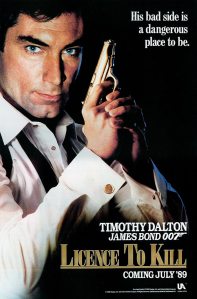
Licence to Kill, which was initially released in 1989, was the 16th “official” James Bond film.  It was also the second and the last one to feature Timothy Dalton in the role of James Bond.  This is the one where Felix Leiter gets eaten by a shark, Bond resigns from MI6, and ends up going to Central America in search of revenge.  Sad to say, it’s also one of my least favorite of the Bond films.

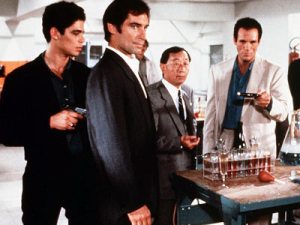
Licence to Kill starts out with Bond in Florida, attending the wedding of his best friend, Felix Leiter (played by David Hedison, who previously played the role in Live and Let Die).  However, before going to ceremony, Felix and Bond take a few minutes to arrest notorious drug lord Franz Sanchez (Robert Davi).  With the help of a crooked DEA agent (played by a wonderfully smarmy actor named Everett McGill), Sanchez escapes from custody.  Accompanied by his psychotic henchman Dario (Benecio Del Toro), Sanchez gets his revenge by killing the new Mrs. Leiter and feeding Felix to a shark.  When Bond discover the barely alive Felix, he also discovers a note that (in a scene borrowed from the novel Live and Let Die) reads, “He disagreed with something that ate him.”

Investigating on his own, Bond discovers that Sanchez’s partner in Florida is the wonderfully named Milton Krest (played by a brilliantly sleazy Anthony Zerbe).  Soon, James Bond is on a mission of vengeance that involves tracking down and killing every member of Sanchez’s organization.  However, M (Robert Brown) doesn’t like the idea of his best secret agent killing the entire population of Florida.  Bond responds by resigning from the service and heading to Central America on his own.

In typical Bond film fashion, James Bond manages to infiltrate Sanchez’s organization and Sanchez soon takes a liking to the man who has vowed to kill him.  Along the way, Bond romances both Sanchez’s abused mistress Lupe (Talisa Soto) and an ex-CIA agent named Pam Bouvier (Carey Lowell) and the viewers learn that Sanchez’s criminal enterprise not only involves drugs but also a crooked TV preacher (played by Las Vegas mainstay Wayne Newton) as well.

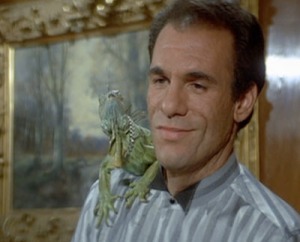
Let’s start with the positive.  Robert Davi, playing the role of Franz Sanchez, makes for a memorable villain.  Along with the silky charm and hints of madness that we’ve come to expect from Bond villains, Davi brings an almost perverse edge to the character.  Every line of dialogue that he delivers is practically dripping with decadence.  Whether he’s doting on his pet iguana, his main henchman Dario, or poor Lupe, Sanchez makes for a dangerously charismatic and compelling villain, one that feels like he would have been at home in one of Ian Fleming’s original novels.  Wisely, Davi plays his role almost as if he was playing James Bond and, as a result, the scenes that he shares with Dalton all have a crackling energy to them that is missing from the film as a whole.

In fact, almost all of the villains are compelling in this film, from Franz Sanchez all the way down to the lowliest henchman.  As played by a very young Benicio Del Toro, Dario is all smoldering intensity and arrogant swagger.  Smuggler Milton Krest is played by veteran character actor Anthony Zerbe and he gets one of the bloodiest death scenes in the history of the series.  However, I have to admit that my favorite bad guy was Sanchez’s business manager, Truman-Lodge (played by Anthony Starke).  Truman-Lodge is just so enthusiastic about the business opportunities that came along with allying oneself with evil that it’s rather infectious.

With such a memorable collection of bad guys, it’s a shame that the film didn’t provide them with any goals worthy of their evil talents.  In previous (and future) Bond films, far less interesting villains have still come up with plans to allow them to take over the world.  Even Moonraker‘s Hugo Drax was able to overcome his lack of personality and come up with a diabolical intergalactic scheme.  Meanwhile, Franz Sanchez — one of the most complex and impressive Bond villains of all time — is simply content to sell drugs and feed people to sharks.  It feels almost disrespectful to Davi’s performance that Sanchez’s goals are, ultimately, so boring.

And, in the end, I think that’s the main problem that I have with Licence to Kill.  The film feels so predictable.  There’s nothing about it that makes it comes across as a story that could only have been about James Bond.  Instead, it feels like the type of standard action/revenge film that always seems to come out every summer.  The film’s hero might be an Englishman named James Bond but he could just as easily be an American named Jake Sully.

According to Sinclair McKay’s invaluable history of the Bond franchise, The Man With The Golden Touch, Licence to Kill was specifically written to compliment Timothy Dalton’s more “realistic” interpretation of the Bond character.  As Dalton played Bond as grim and serious, Licence to Kill is a grim and serious film.  Innocents and villains alike die in bloody agony and, the few times that Dalton does smile, the expression looks so unnatural that you worry that his face is about to split in half.  Unfortunately, along with being grim and serious, Dalton’s Bond is also remote and uncharismatic and, with the exception of Robert Davi, he doesn’t have any chemistry with anyone else in the cast.  (Carey Lowell brings a lot of energy to the role of Pam but Dalton’s Bond never seems to be that into her.)  Dalton simply doesn’t make for a very compelling hero and, as a result, Licence to Kill ends up feeling like an empty collection of occasionally impressive stunts.

Licence to Kill holds a few dubious distinctions.  It was the least financially succesful of all the Bond films and it was also the last Bond film to be produced by Albert Broccoli and directed by John Glen.  It was also the last to feature Robert Brown in the role of M and, of course, it was also the last to feature Timothy Dalton in the role of James Bond.  (That’s not all that shocking when you consider just how miserable and bored Dalton seems to be in this film.)  Over the next six years, the Bond franchise would be mired in a lawsuit between Eon productions and producer Kevin McClory and when James Bond finally did return, he would do so in the form of Pierce Brosnan.

We’ll be taking a look at Goldeneye tomorrow.