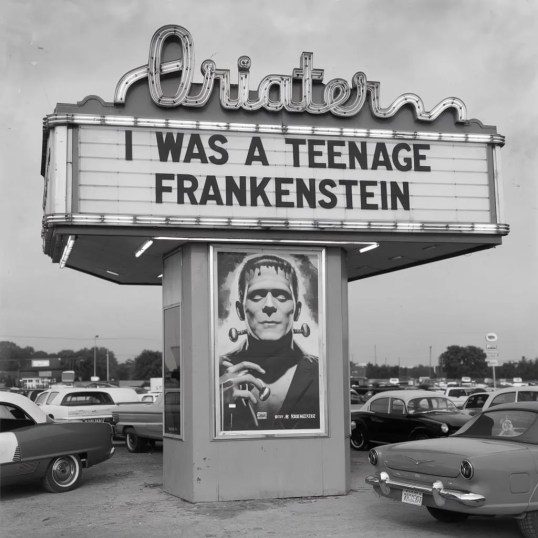
This film was produced as a direct result of the box office success of I Was A Teenage Werewolf. Just as in Teenage Werewolf, Whit Bissell plays a mad scientist who makes the mistake of trying to play God. (He also makes the mistake of keeping an alligator in his lab but that’s another story.) The end result …. Teenage Frankenstein!
The makeup on the Teenage Frankenstein is probably the best thing about this film. If nothing else, this film features a monster who actually looks like he was stitched together in a lab.
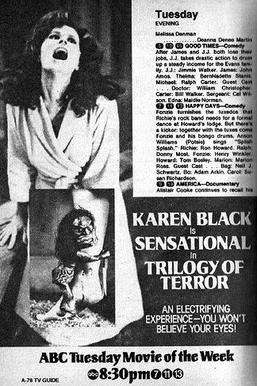
1975’s Trilogy of Terror is a true classic, a rare made-for-television horror film that could have just as easily and effectively been released in theaters.
As one can surmise from the title, it features three stories. Each story is directed by Dan Curtis and written by Richard Matheson. Each story also features Karen Black in the lead role, giving Black a chance to play not just one but four very different characters over the course of one film. One of the things that makes this film work so well is Karen Black’s totally committed performance. Sadly, Karen Black later expressed some regret about having appeared in the film because it led to her being typecast as a horror actress, which she definitely hadn’t been before. (One need only watch Karen Black in Five Easy Pieces, Nashville, or Family Plot to see what a good actress she was. Even in something like Easy Rider, where she had only a small role and very few lines, her talent is obvious.) As a result, Black was no longer considered for the big studio films that she had appeared in previously and instead, she spent the remained of her career appearing in low-budget horror films. That’s a shame because Trilogy of Terror really does show what a strong actress Black was.
The first segment features Black as Julie, a seemingly uptight teacher who somewhat surprisingly agrees to go out on a date with Chad (Robert Burton), a sleazy college student. Chad drugs Julie’s drink during their date and later undresses her and takes pictures which he then uses in an attempt to blackmail Julie into basically being his sex slave. Julie, however, turns out to have a big secret of her own and Chad discovers too late that he was the one who was being manipulated. This segment was the least interesting of the three stories but the ending was very satisfying. Anyone who has ever dated a “nice guy” who turned out to actually be a jerk will enjoy Julie’s revenge.
The second segment is enjoyably sordid, an over-the-top soap opera that I can’t talk too much about without spoiling the plot. Black plays Millicent, a repressed brunette, who is hatefully obsessed with her twin sister, blonde Theresa (Black again). Millicent fears that Therese is planning to corrupt and destroy her boyfriend, Thomas (John Karlen). Millicent explains to her therapist (George Gaynes) all of the terrible things that Therese has done. Of course, the truth turns out to be much more complicated. This story was entertaining and featured a surprisingly effective twist.
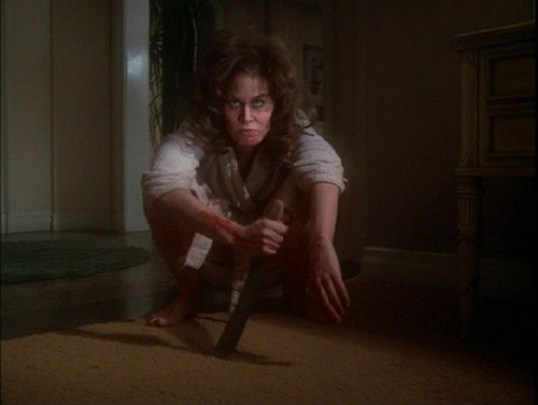
The third segment is the one that everyone remembers. Amelia (Karen Black) lives alone in a high-rise apartment and has recently purchased, as a present for her anthropologist boyfriend, a wooden fetish doll in the form of a misshapen aboriginal warrior with pointed teeth and a spear. The doll comes with a scroll that explains that the doll is inhabited by the spirit of a Zuni hunter and that the only thing keeping the doll from coming to life is the gold chain adorning the doll. Of course, the chain eventually falls off and Amelia finds herself being pursued through her apartment by a viscous doll that is obsessed with killing her. This is the simplest and the scariest of the Trilogy of Terror’s three stories. It’s easy to say that it’s just a doll until it pops out of nowhere and stabs Amelia in the ankle. This story ends on a properly dark note and that final image of Karen Black is haunting.
For a fifty year-old film, Trilogy of Terror holds up remarkably well. Watch it and witness just how good an actress Karen Black truly was.
Trilogy of Terror (1975, dir by Dan Curtis. DP: Paul Lohmann)
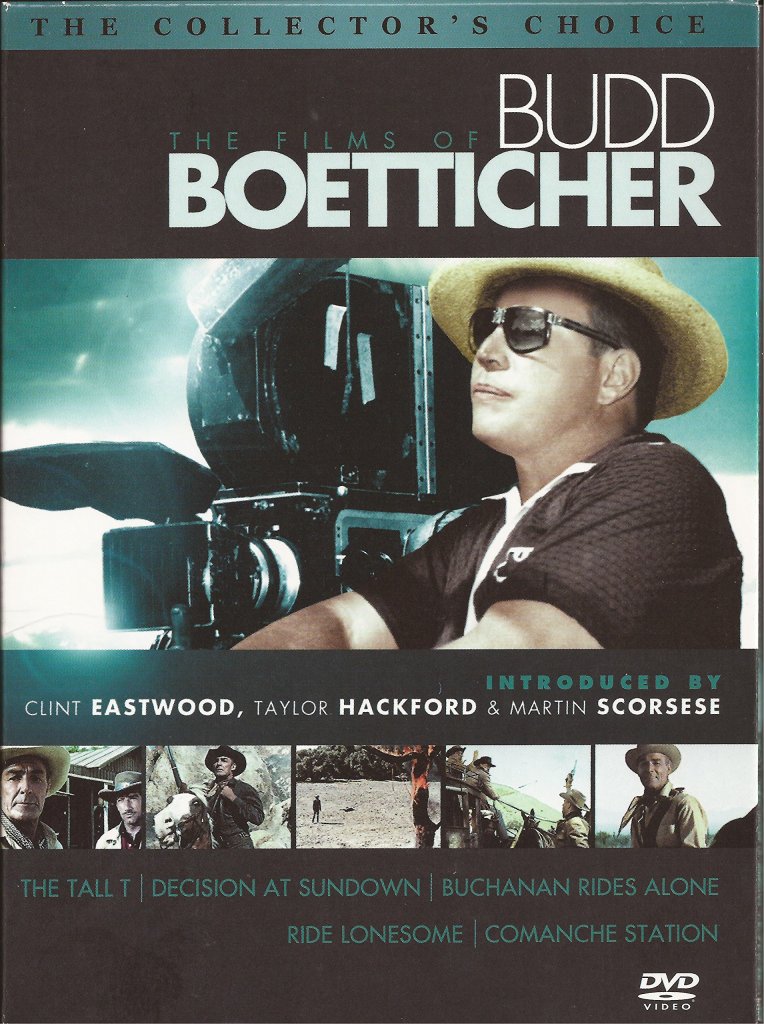
There was a time in my life, before streaming existed, where it seemed like I wanted to buy every movie that interested me in the slightest. The main ways I looked for new movie releases was to go to a store like the Hastings Entertainment Superstore and look at their inventory, or look at the new and recent releases on Amazon’s online store. I could spend hours looking for movies in either location, and I did. Sometime in 2008, I ran across a DVD box set described as “The Films of Budd Boetticher” that contained introductions by the likes of Martin Scorsese, Taylor Hackford, and Clint Eastwood. The films included on the box set were THE TALL T, DECISION AT SUNDOWN, BUCHANAN RIDES ALONE, RIDE LONESOME, and COMANCHE STATION. I remember seeing the names of these movies at various times in my life in my movie books. They had never really caught my attention, although I do remember that they would receive good reviews. This set did catch my attention, however, based on the interesting packaging and the fact that Scorsese and Eastwood were both singing the praises of the films. I did a little bit of quick research and decided to just buy the boxset. I’m glad to report that these films have turned into some of my very favorite movies, and I sing their praises to anyone who will listen.
Version 1.0.0
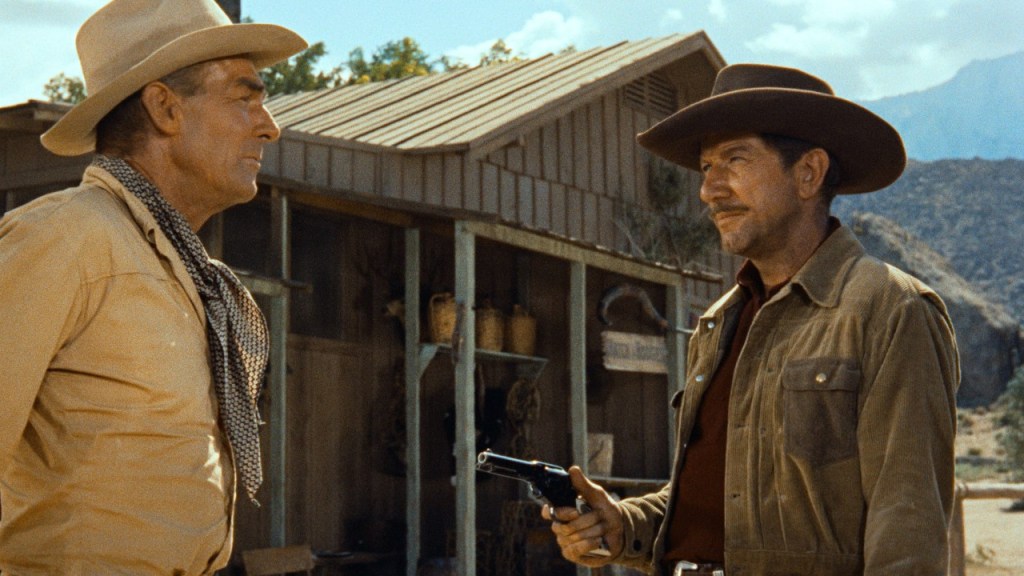
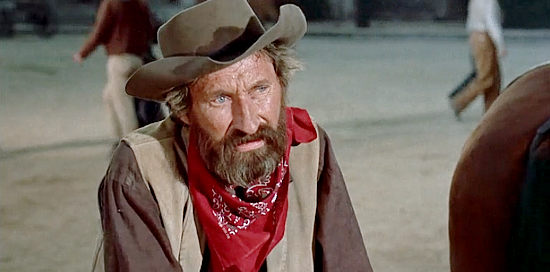
The earliest movie in this set is THE TALL T from 1957, which is based on Elmore Leonard’s short story, “The Captives.” The story opens with our hero Pat Brennan (Randolph Scott) stopping by the Sassabee Stagecoach Station and visiting with the owner Hank (Fred Sherman) and his son, Jeff (Christopher Olsen). Brennan seems like a good-natured guy who has a nice visit with the two and even agrees to purchase young Jeff some striped candy when he stops in the town of Contention later that day. Brennan heads on to Contention where we meet Ed Rintoon (Arthur Hunnicutt), a stagecoach driver who has been hired to take Willard and Doretta Mims (John Hubbard and Maureen O’Sullivan) to Bisbee for their honeymoon. Rintoon and Brennan are clearly old friends. As part of their various conversations, we learn that Doretta Mims is the daughter of Old Man Gateway, the man with the richest copper claim in the territory. After saying goodbye to Rintoon and buying young Jeff his striped candy, Brennan continues on to Tenvoorde’s (Robert Burton) ranch, in hopes of buying a seed bull for his own start-up ranch. For many years, Brennan had been the ramrod on Tenvoorde’s ranch, and the old man clearly wants him to come back. Tenvoorde offers Brennan a chance to get his bull for nothing, but he has to ride the bull to a stand still. If he can’t do it, then Tenvoorde keeps the bull and Brennan’s horse. Brennan takes him up on the offer, falls off the bull, dives into water trough to avoid getting stomped by the bull, and then heads back towards his ranch with nothing but his wet clothes and saddle. As he’s walking down the road, Rintoon comes by on his stagecoach with Mr. and Mrs. Mims. They pick Brennan up and give him a ride. When they stop back at the Sassabee Stagecoach Station, Hank and Jeff are nowhere to be seen. Rather, a voice from inside the station says “Drop your guns and come on down.” Frank Usher (Richard Boone) and young Billy Jack (Skip Homeier) emerge from the station with their guns drawn. When he’s getting down off the stagecoach, Rintoon goes for his shotgun and is shot down by another man, Chink (Henry Silva), whose been waiting in the shadows. These three men are waiting to rob the next stagecoach that comes along. They’ve already killed Hank and Jeff, and are planning to kill every person on this coach, when Willard tells them that his wife Doretta is from the richest family in the territory. Willard tells the three outlaws that Old Man Gateway will pay good money to get his daughter back, if they will just let them live. Usher, the leader of the bunch, likes this idea and sends Billy Jack and Willard back to Contention to request $50,000 from Gateway for the safe return of his daughter. With the endgame changed, Usher takes Brennan and Mrs. Mims to their hideout to wait to get their money from Gateway. Brennan knows that it’s just a matter of time before they are all killed, and he tells Mrs. Mims that they will need to be looking for any possible opportunity to escape.
THE TALL T is just so good. It’s amazing how much drama that director Budd Boetticher could fit into these films that all had running times of less than 80 minutes. The story is simple, but it deals with big themes like honor, cowardice, true love, sociopathic evil, and big dreams. Credit here has to be given to Elmore Leonard, the writer of the short story the film is based on. It must also be given to Burt Kennedy. Kennedy wrote the scripts for THE TALL T, RIDE LONESOME, and COMANCHE STATION. He’s not the credited writer for BUCHANAN RIDES ALONE but he did uncredited work on the script. Kennedy would go on to have a good career writing and directing his own westerns, like SUPPORT YOUR LOCAL SHERIFF, THE TRAIN ROBBERS, and HANNIE CAULDER, but his work with Boetticher is definitely some of his very best.
It’s also amazing how spare and simple everything looks in the THE TALL T. The land is just so dry, with nothing but big rocks and not a tree in sight. Growing up in Arkansas, I’m used to green fields and trees and flowers. It can almost feel like you’re choking on dust just watching this film.
The casting always seems to be perfect in Boetticher’s films. Randolph Scott is simpatico with Boetticher. His character here is a good man who will do what it takes to survive while also keeping his honor intact. Boetticher and Scott are truly a match made in heaven. Richard Boone is great as Frank Usher, the leader of the outlaws. He could have killed Scott’s character Brennan, but he is glad to have an honorable man to talk to after spending all of his time with Billy Jack and Chink. Boone somehow makes his outlaw leader into an honorable man even though he’s done many dishonorable things. It’s an impressive feat. Maureen O’Sullivan has an important role as Doretta Mims, the rich but plain woman, who married Willard because she was afraid she’d end up all alone. Her career goes all the way back to the 1930’s where she played Jane in the original Tarzan movies. She’s a good actress whose character undergoes the widest arc in the entire movie. Henry Silva’s Chink is a sociopath who is keeping score of the number of people he kills. Boone’s Usher would have been much better off if he would have gone with Chink’s advice and put Brennan and the Mims’ in the well back at the Sassabee station! Based on his nonchalant penchant for violence, you can see how Henry Silva would go on to having an amazing career playing bad guys. The last person I want to mention in the cast is Arthur Hunnicutt, who played Ed Rintoon. Hunnicutt is special to me because he comes from the hills of Arkansas, from a little town called Gravelly. He attended the same college I attended, although it was called the Arkansas State Teachers College when he was there. It was the University of Central Arkansas when I came through. Hunnicutt specialized in wise, rural characters. He was even nominated for an Acadamy Award a few years earlier for a movie called THE BIG SKY. He’d go on to be in so many good movies, including playing “Bull” in EL DORADO with John Wayne. I’m just proud of the guy for growing up in extreme rural Arkansas and then becoming a great character actor in Hollywood. I’ll watch anything he’s in.
I recommend all of these Budd Boetticher / Randolph Scott westerns, and THE TALL T is one of the very best!
This film was produced as a direct result of the box office success of I Was A Teenage Werewolf. Just as in Teenage Werewolf, Whit Bissell plays a mad scientist who makes the mistake of trying to play God. (He also makes the mistake of keeping an alligator in his lab but that’s another story.) The end result …. Teenage Frankenstein!
The makeup on the Teenage Frankenstein is probably the best thing about this film. If nothing else, this film features a monster who actually looks like he was stitched together in a lab.
For today’s horror on the Lens we have a made-for-TV movie that was produced and directed by Dan Curtis.
Trilogy of Terror, which aired in 1975, is an anthology film, featuring three segments that were each based on a short story from Richard Matheson. What makes this particular film special is that each segment features Karen Black playing a radically different character from the previous segment. The film really is a showcase for this underrated actress, though Black herself later said that the film ruined her career because it typecast her as a horror actress.
The third segment is the one that gets all the attention. That’s the one with the killer doll. I like all of the segments, though. The first one is often considered to be the weakest but anyone who has ever been through a similar situation will appreciate it as tale of revenge. The second segment has a playful vibe that I liked. And yes, the third segment is genuinely frightening.
This film was produced as a direct result of the box office success of I Was A Teenage Werewolf. Just as in Teenage Werewolf, Whit Bissell plays a mad scientist who makes the mistake of trying to play God. (He also makes the mistake of keeping an alligator in his lap but that’s another story.) The end result …. Teenage Frankenstein!
The makeup on the Teenage Frankenstein is probably the best thing about this film. If nothing else, this film features a monster who actually looks like he was stitched together in a lab.
This film was produced as a direct result of the box office success of I Was A Teenage Werewolf. Just as in Teenage Werewolf, Whit Bissell plays a mad scientist who makes the mistake of trying to play God. (He also makes the mistake of keeping an alligator in his lap but that’s another story.) The end result …. Teenage Frankenstein!
The makeup on the Teenage Frankenstein is probably the best thing about this film. If nothing else, this film features a monster who actually looks like he was stitched together in a lab.
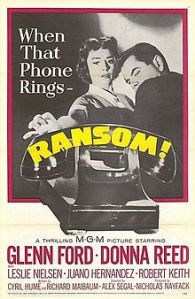
That’s the question asked in this unjustly obscure film from 1956. Dave Stannard (Glenn Ford) is a wealthy businessman, with a beautiful wife (Donna Reed), a big suburban home, and a butler named Chapman (the great Puerto Rican actor Juano Hernandez). One day, his son Andy (Bobby Clark) does not come home from school. The school says that a nurse showed up to pick Andy up for a doctor’s appointment but neither Dave nor his wife know about any appointment and their family doctor says that he would never send a nurse to pick up a patient.
Andy has been kidnapped. When the kidnappers call, they tell Dave that they want half a million dollars in ransom. Dave gets the money together but is then told, by reporter Charlie Telfer (Leslie Nielsen), that, once the kidnappers have the money, they will have no incentive to return Andy. Since Andy is the only person who could identity them to the police, they may very well kill Andy after getting the money. By paying the ransom, Dave will also be encouraging other kidnappers.
The next morning, Dave goes on television and announces that he will not be paying the ransom. Instead, he announces that if the kidnappers do not immediately return his son, the money will be given as a reward to anyone who helps to track them down.
If this sounds familiar, it’s because Ransom! was later remade by Ron Howard, with Mel Gibson as the father and Gary Sinise as the kidnapper. (Ransom! itself was a remake of a live television drama that aired in 1954.) As opposed to the Howard film, the original Ransom! is a low-key character piece, one that takes place almost entirely in the Stannard home and in which the kidnappers remain largely unseen. Almost the entire movie focuses on Dave, his decision, and his struggle to come to terms with that decision. Was Dave right or was he wrong? Ransom! is stagey but thought-provoking with excellent performances from the entire cast. Even Leslie Nielsen, making his film debut, does well in the type of dramatic role that defined his career until he reinvented himself as a masterful comedic actor.
They don’t make them like this anyone and that is too bad.
Occasionally, I’ll see a film like Crime of Passion or Bigger Than Life and I’ll say, “Wow, that’s really subversive for a movie that came out in the 1950s!”
And it’s true. We tend to think of the 1950s as being a time when conformity ruled all. It was a time of innocence and chastity, when cinema heroes all wanted to have a house in the suburbs and loving couples slept in separate beds and nobody ever questioned anything. Of course, the truth of the matter is that there were a lot of films released in the 50s that challenge that perception.
And then again, there were also films like 1955’s A Man Called Peter.
A Man Called Peter is a biopic about Peter Marshall (played by Richard Todd), a Scottish immigrant who came to the United States, became a Presbyterian minister, and then eventually became the Chaplain of the United States Senate. (That means that he would open each session of the Senate with a prayer and occasionally provide spiritual counsel to the senators.) I recently watched it on Netflix, specifically because I thought it might be appropriate for this series of political reviews.
And it is, but just barely.
It actually takes the film a while to get to the part where Peter Marshall becomes the Senate Chaplain. First, we watch him as a boy in Scotland, trying to stow away on a boat heading for America. Then, several years later, he’s out walking on a foggy night. He trips over a tree root and, as he lies on the ground, he announces that God has told him to 1) pursue a career as a minister and 2) to do so in America. (I have to admit that I was raised Catholic so I have no idea whether he was having a typical Presbyterian spiritual experience or not. But the film certainly takes it seriously.)
Peter ends up in America where he ministers to a church in Atlanta, marries Catherine (Jean Peters), and then eventually ends up at a church in Washington, D.C. When he eventually is asked to serve as Chaplain of the Senate, both he and the film go out of their way to avoid taking any definite position on any issue. Instead, Peter gives prayers that encourage the senators to put partisan bickering aside and work together to make the United States the best country in the world.
Having now watched all 120 minutes of A Man Called Peter, I can safely that this is a film that epitomizes everything that we always assume to be true about the 1950s. From the film’s view of marriage to religion to politics, A Man Called Peter is perhaps one of the most stereotypically 1950s movies ever made. This is such a 1950s movie that it’s even filmed in CinemaScope!
(And speaking of CinemaScope, A Man Called Peter looks great but it’s perhaps one of the least intimate biopics that I’ve ever seen. You can see every inch of the surrounding landscape but the human beings get lost.)
For me, the film’s most 1955 moment comes when Catherine first discovers that her husband has been reassigned to Washington, D.C. She and Peter are on their honeymoon when they get a telegram telling them that their new home in Washington is ready. Catherine is shocked. Peter says that he didn’t want to interrupt their honeymoon by telling her that they’re not going home to Atlanta. Instead, they’re going to an entirely new city and an entirely new life. (In other words, Peter has decided to say goodbye to Catherine’s family and friends.)
“Aren’t you pleased?” Peter asks her.
Cheerfully, Catherine replies, “Well, who wouldn’t be?”
 What would you do if your child was kidnapped?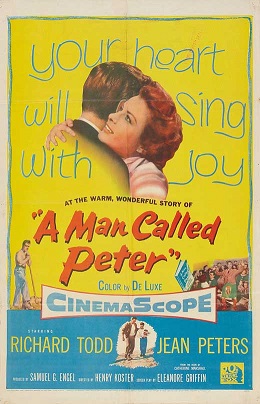
 Through the Shattered Lens