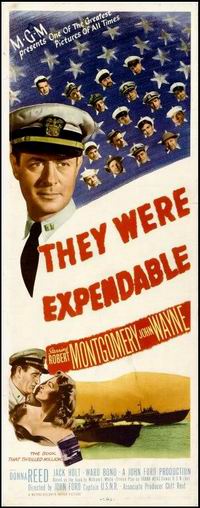
They Were Expendable (1945, directed by John Ford)


In December of 1941, Lt. John Brickley (Robert Montgomery) commands a squadron of Navy PT boats, based in the Philippines.  Brickley is convinced that the small and agile PT Boats could be used in combat but his superior officers disagree, even after viewing a demonstration of what they can do.  Brickley’s second-in-command, Rusty (John Wayne), is frustrated and feels that he will never see combat.  That changes when the Japanese attack Pearl Harbor and then turn their attention to the Philippines.  Brickley gets his chance to show what the PT boats can do but both he and his men must also deal with the terrible risks that come with combat.  Brickley and his men have been set up to fight a losing battle, only hoping to slow down the inevitable Japanese onslaught, because both they and their boats are considered to be expendable.  The hot-headed Rusty learns humility when he’s sidelined by blood poisoning and he also falls in love with a nurse, Sandy (Donna Reed).  However, the war doesn’t care about love or any other plans that its participants may have.  With the invasion of the Philippines inevitable, it just becomes a question of who will be sent with MacArthur to Australia and who will remain behind.

One of John Ford’s best films, They Were Expendable is a tribute to the U.S. Navy and also a realistic look at the realities of combat.  The movie features Ford’s trademark sentimentality and moments of humors but it also doesn’t deny that most of the characters who are left behind at the end of the movie will not survive the Japanese invasion.  Even “Dad’ Knowland (Russell Simpson), the fatherly owner of a local shipyard who does repair work on the PT boats, knows that he’s expendable.  He resolves to meet his fate with a rifle in hand and a jug of whiskey at his feet.  Rusty, who starts out thirty for combat, comes to learn the truth about war.  Ford was one of the many Hollywood directors who was recruited to film documentaries during World War II and he brings a documentarian’s touch to the scenes of combat.

Robert Montgomery had previously volunteered in France and the United Kingdom, fighting the Axis Powers before America officially entered the war.  After the war began, he entered the Navy and he was a lieutenant commander when he appeared in They Were Expendable.  Montgomery brought a hardened authenticity to the role of Brickley.  (Montgomery also reportedly directed a few scenes when Ford was sidelined with a broken leg.)  John Wayne is equally good in the role of the hot-headed Rusty, who learns the truth about combat and what it means to be expendable.  The cast is full of familiar faces, many of whom were members of the John Ford stock company.  Keep an eye out for Ward Bond, Cameron Mitchell, Leon Ames, Jack Holt, and Donald Curtis.

They Were Expendable is one of the best of the World War II movies.  It’s a worthy film for Memorial Day and any other day.
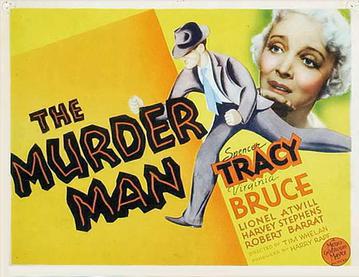
Film Review: The Murder Man (dir by Tim Whelan)


Seven minutes into the 1935 film, The Murder Man, 27 year-old James Stewart makes his film debut.

He’s playing a reporter named Shorty and, since this is a 30s newspaper film, he’s first seen sitting at a table with a bunch of other cynical reporters, the majority of whom seem to be alcoholics and gambling addicts.  Suddenly, words comes down that a corrupt businessman named Halford has been assassinated, shot by an apparent sniper.  (It is theorized that he was shot from one of those carnival shooting gallery games, which was somewhat oddly set up on a street corner.  Maybe there was shooting galleries all over place in 1935.  I supposed people had to do something to keep their spirits up during the Depression.)  While the other reporters run to the scene of the crime, Shorty is on the phone and calling his editors to let them know that a huge story is about to break.

Steve Grey (Spencer Tracy) is the reporter assigned to the story.  Crime is his beat and everyone agrees that no one’s better at covering criminals and understanding what makes them tick.  Unfortunately, it’s not always easy to track Steve down.  He’s a hard drinking reporter and lately, he’s been concerned about the collapse of his father’s business.  Still, when Steve is finally tracked down, he throws himself into covering the story and speculating, in print, about who could have killed Halford.  In fact, his girlfriend (Virginia Bruce) worries that Steve is working too hard and that he’s developing a drinking problem.  She suggests that Steve needs to take some time off but Steve is driven to keep working.

It’s largely as a result of Steve’s actions that a man named Henry Mander (Harvey Stephens) is arrested and convicted of Halford’s murder.  Steve should be happy but instead, he seems disturbed by the fact that he is responsible for Mander going to jail.  When his editor requests that Steve go to Sing Sing to interview Mander, a shocking truth is revealed.

Admittedly, the main reason that I watched The Murder Man was because it was the feature film debut of James Stewart.  (Stewart previously appeared in a comedy short that starred Shemp Howard.)  Stewart is only in a handful of scenes and he really doesn’t have much to do with the main plot.  To be honest, Shorty’s lines could have been given to anyone.  That said, Stewart still comes across as being a natural on camera.  As soon as you hear that familiar voice, you can’t help but smile.

Even if Stewart hadn’t been in the film, I would have enjoyed The Murder Man.  It’s fast-paced mystery and it has a decent (if not totally unexpected) twist ending.  It’s one of those films from the 30s where everyone speaks quickly and in clipped tones.  Casual cynicism is the theme for the day.  Spencer Tracy gives a wonderful performance as the hard-drinking and troubled Steve Grey and the scene where he meets Mander in prison is surprisingly moving.  Clocking in at only 68 minutes, The Murder Man is a good example of 30s Hollywood.

Lisa Reviews An Oscar Winner: The Life of Emile Zola (dir by William Dieterle)


The Life of Emile Zola, the winner of the 1936 Oscar for Best Picture of the Year, opens with two French artists living in a drafty apartment.

Emile Zola (Paul Muni) is destined to become one of France’s most popular and important writers.  Paul Cezanne (Vladimir Sokoloff) will eventually become one of the most important artists of the post-impressionist movement.  But for now, they’re just two struggling artists who have sworn that they will never sell out their principles.  They are poor but they’re happy.  That changes for Zola after he meets a prostitute named Nana (Erin O’Brien-Moore) and he uses her life story as the inspiration for a novel.  The book is controversial and its frank content scandalizes France.  The public censor comes close to banning it.  But it also becomes a best seller.  It’s the book everyone secretly owns but claims to have never read.

Zola writes several more books, all about the conditions of the working class in France.  Eventually, he becomes what he claimed he would never be, a wealthy man living in a mansion and having little contact with the poor and oppressed.  Cezanne sees Zola one last time, calling him out for having sold his talent for money.  Cezanne explains that, on general principle, he can no longer be Zola’s friend.

Meanwhile, a quiet and rather meek family man named Captain Alfred Dreyfus (Joseph Schildkraut) has been arrested and accused of being a spy for Germany.  There’s little evidence that Dreyfus is a spy.  Indeed, most of the evidence seems to point to a Major Walsin-Esterhazy (Robert Barrat).  But, because Dreyfus is considered to be an outsider, he is convicted in a show trial and exiled to Devil’s Island.

(In real life, it’s generally agreed that Dreyfus was a victim of anti-Semitism.  As the only Jewish member of the army’s General Staff, Dreyfus was viewed with suspicion by his colleagues even before anyone knew that there was a German spy.  The Life of Emile Zola doesn’t specifically state that Dreyfus was a victim of anti-Semitism, with the exception of a brief moment when one of his accusers looks at his personnel file and says, “He’s not one of us,” while pointing at the word “Jew.”  Otherwise, the fact that Dreyfuss was Jewish is never mentioned in the film.  It’s as if the film is going out of its way to avoid offending the very people that the movie is criticizing.)

After speaking to Dreyfus’s wife (played by Gale Sondergaard, who would later become the victim of a show trial herself when she was blacklisted as a suspected communist), Zola decides to take up Dreyfus’s case.  He publishes an open letter — J’Accuse — in which he states that Dreyfus was not given a fair trial and that Dreyfus is innocent of the charges against him.  Zola finds himself in court, accused of libel.  Zola uses his trial to give Dreyfus the hearing that he never received.  While the army boos his every utterance, the people of France rally to his side.

The Life of Emile Zola is an early example of the type of prestige production that today is often referred to as being an “Oscar picture.”  It tells a true story.  As a film that condemns the treatment of Alfred Dreyfus but avoids stating the obvious reason why Dreyfus was targeted in the first place, it’s political without being radical.  And it features a performance from the most acclaimed actor of the era, Paul Muni.  Muni gives a powerful performance as Zola, holding the viewer’s attention even during the lengthy trial scenes that take up most the second half of the film.  That said, the true star of the film is Joseph Schildkraut, who plays Dreyfus as being a kind and trusting soul who finds himself caught up in a Kafkaesque nightmare.  At one point, Dreyfus is given a gun and told that there’s one way that he can avoid being put on trial for treason.  Schildkraut played the scene so well that I wanted to cheer when he refused to surrender.

The Life of Emile Zola is a big and, at times, self-consciously important production.  It was clearly designed to win a bunch of Oscars and it certainly managed to do that.  Compared to some of the other films nominated that year — The Awful Truth, Dead End, A Star is Born, Lost Horizon, Stage Door, In Old Chicago — The Life of Emile Zola can seem a bit stodgy.  However,  the performances of Muni and Schildkraut continue to make the film worth watching.

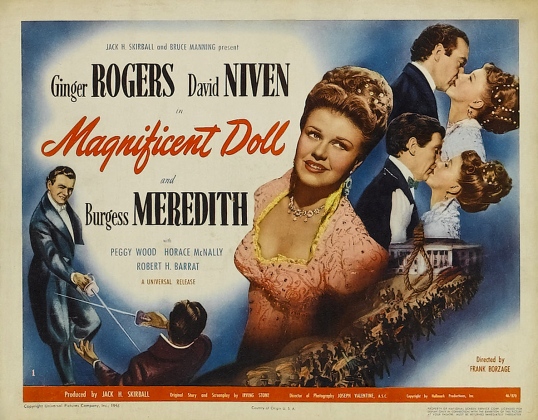
Shattered Politics #8: Magnificent Doll (dir by Frank Borzage)


Poster - Magnificent Doll_02

I’ve always been tempted to write one of those quizzes that you always see on Facebook, “Which American first lady should you be?”  That’s a question that I’ve often asked myself.  I know that I would not want to be any of our most recent first ladies.  (Sorry, Michelle.  Sorry, Laura.  Sorry, Hillary.)  Occasionally, I think that I would have liked to have been Jacqueline Kennedy, if not for what happened in Dallas.  Teddy Roosevelt’s daughter, Alice, is definitely a historical role model for me but it’s debatable whether she could truly be considered a first lady.  And, of course, there’s always Grover Cleveland’s wife Julia but ultimately, for me, there’s really only one choice.

If I could be any American first lady, I would be Dolley Madison.

Dolley, of course, was the wife of James Madison, who was not only our fourth President but also one of the smartest.  Madison was a skilled writer and scholar but he had absolutely no social skills.  Dolley, on the other hand, was vivacious and was, by the standards of the dentistry-free days of the 19th Century, one of the most beautiful women in America. Whereas James was uncomfortable meeting with people and struggled to express himself, Dolley was the world’s greatest hostess, bringing opposing forces together through the sheer force of her own charm and ability to throw a great party.  When the British invaded Washington D.C. during the War of 1812, Dolley was the one who saved the famous portrait of George Washington from being burned with the rest of the White House.

So, yes, I would definitely be Dolley Madison.

(Yes, I know that there’s some debate over whether her name should be spelled Dolly, Dolley, or Dollie.  I spell it Dolley and since I would have been her, I think my opinion counts for something.)

It’s a shame that there haven’t been many movies made about Dolley Madison.  Perhaps the best known is 1946’s Magnificent Doll, which is not a very good movie but which is amusing if you know something about history.

Magnificent Doll opens with young Dolley Payne (Ginger Rogers) being forced to marry John Todd (Horace McNally), a much older lawyer.  (John saved the life of Dolley’s father and, in gratitude, Dolley’s father gave him his daughter.)  Though John falls in love with her, Dolley refuses to show him any sign of affection and good for her!  (Seriously, arranged marriages suck.)  But then John dies of yellow fever and Dolley declares that she did love him all along.

But life goes on!

Soon, Dolley and her mother are running a boarding house in Philadelphia.  Fortunately, they happen to be running it at the same time that the Continental Congress is attempting to write the Constitution.  Several of the delegates are staying at the boarding house and two of them take a romantic interest in Dolley.

First there’s Aaron Burr (David Niven), a charming scoundrel who appeals to Dolley’s wild side.  Aaron does things like take her to a bar and kiss her underneath a staircase.  Aaron is vain.  Aaron is self-absorbed.  Aaron is an ambitious and charismatic brooder whose moods can be unpredictable.  Aaron is exiting!  Aaron is dangerous!  Aaron is a rebel!

And then you’ve got Aaron’s friend, James Madison (Burgess Meredith).  James is shy and gentle.  He’d rather read a book than go out.  He’s the type of smart kid who all the other kids make fun of but he’s also a good, decent man who has a great future ahead of him.  He just needs someone to bring him out of his shell.

In short, Aaron is the type of boy that you hope invites you to prom.  James is the type of boy that you marry.

And, when Dolley does marry James, it sends Aaron Burr into such a tail spin that he nearly prevents Thomas Jefferson from becoming President in 1800…

And, needless to say, this film is in no way historically accurate.  It is true that Aaron Burr was nearly elected President in 1800 and, had he been, Thomas Jefferson would never have been President.  However, most historians seem to agree that has more to do with Aaron Burr being ambitious and nothing to do with Dolley Madison.  In the end, Magnificent Doll may be amusing in its inaccuracies but bad history is still bad history.

That said, there’s still a part of me that enjoyed Magnificent Doll, despite the fact that it moves way too slowly and none of the actors (with the exception of David Niven) appear to be all that invested in their roles.  I think, ultimately, the reason I enjoyed Magnificent Doll was because it really is basically just a YA version of American history and, as a result, it does have some curiosity value.  One gets the feeling that if Magnificent Doll were released today, it would be split into two different films and that it would be promoted on social media with hashtags reading #TeamAaron and #TeamJames.

That said, if there’s any first lady who deserves a biopic (one that’s good as opposed to so-bad-its-interesting) it’s Dolley Madison.  (Personally, I would cast Amy Adams in the role.)  #TeamDolley all the way!