Welcome to Late Night Retro Television Reviews, a feature where we review some of our favorite and least favorite shows of the past! On Wednesdays, I will be reviewing Monsters, which aired in syndication from 1988 to 1991. The entire series is streaming on YouTube.
This week, the first season of Monsters come to an end.
Episode 1.24 “La Strega”
(Dir by Lizzie Borden, originally aired on May 27th, 1989)
Vito (a young Rob Morrow) enters a pawn shop shortly before closing. He tells the proprietor, Lia (Linda Blair), that he’s shopping for something for his girlfriend. But, as soon as Lia turns her back, Vito draws a knife and announces that he’s actually come to kill her. Lia, however, has a gun and without flinching, she shoots at the floor. Vito, who is far less calm than Lia, drops the knife.
Lia takes Vito to her apartment above the shop. He tells her that he knows that she’s “La Strega” and that, ten years earlier, she put a curse on his mother (played by Maria Tucci) when she and Lia had a dispute over a ring that his mother brought to the shop. His mother has just died as a result of the curse and Vito wants vengeance.
Lia explains that she’s not a witch and that Vito’s mother’s dispute was actually with Lia’s mother. Lia also suggests that it was Vito’s mother who tried to steal the ring. Lia says that Vito will spend the next two weeks working for her and seeing what type of person she actually is. If, at the end of the two weeks, he still wants to kill her, she’ll accept that it is fate. Vito agrees.
For the next two weeks, Vito works in the shop and lives in Lia’s apartment. (I guess someone else is handling his mother’s funeral.) Vito is haunted by dreams in which both Lia and his mother attempt to seduce him and beg him to kill the other. Vito starts to fall in love with Lia and, as the two weeks come to a close, Lia says that she wants to enjoy what might be her last night on Earth….
Directed by feminist filmmaker Lizzie Borden, this episode ends the first season of Monsters on a rather moody note. Vito is never quite sure whether or not he can trust either Lia or the angry spirit of his mother and, in the end, no one’s motives are really that clear. The episode ends on a rather enigmatic note, which is a polite way of saying that it’s confusing as Hell. That said, Rob Morrow, Maria Tucci, and Linda Blair all give good performances and Borden does a good job of creating an appropriately dream-like atmosphere. In the end, the main impression one takes from this episode is that Vito, for all of his bluster, was essentially just a pawn in a supernatural battle between two powerful women, even if Vito himself wasn’t smart enough to realize it. This episode is not a bad note for the first season to end on.
The first season of Monsters was uneven. When it was good, it was really good. When it was weak, it was really weak. For the most part, though, it was enjoyable and most of the stories were memorably macabre.
Next week, we’ll see if that trend continue as we start the second season of Monsters!
Undoubtedly, there’s a great and important film waiting to be made about the Flint water crisis. Unfortunately, the new Lifetime film Flint is not it.
As I watched Flint last night, it occurred to me that it’s been a while since the Flint water crisis made the national news. For a few weeks in 2016, it was all anyone was talking about but then the governor of Michigan announced that he wouldn’t be running for President and the media promptly deserted Flint. I think most people in the country assumed that Flint now magically had clean water. In reality, Flint hasn’t had reliably clean water since 2014. Earlier this year, it was announced that Flint’s water quality has returned to acceptable levels but residents were still advised not to use it until all of Flint’s water pipes had been replaced. When one looks at the coverage that the crisis has received, one gets the feeling that the media stopped caring once it became apparent there wasn’t going to be an easy and quick solution.
That’s the thing with this crisis. There is no easy way to resolve it and it’s not a happy story. Even when all of the pipes are finally replaced (which will be 2020 at the earliest), it’s not going to be a happy ending as much as it’s just going to be an ending. The citizens of a city were poisoned because a bunch of civil servants wanted to save money. There’s no way to spin that into a positive. Even if the people of Flint are no longer drinking contaminated water, that doesn’t change the fact that they once did and no one in power seemed to care until they had no choice but to pretend to be outraged.
Flint is a well-meaning film but it’s immediately handicapped by the fact that it’s a Lifetime film and, therefore, has to take a Lifetime approach to the material. which means that things have to end positively. The film does a good job of showing brown water running out of taps and detailing why clean water is a necessity. And the film also deserves some credit for including a note informing us that the pipes in Flint are still in the process of being replaced and that the citizens are still being told either use filters or bottled water. But, too often, the film turns what should have been a modern-day horror story into a simplistic story of “you go girl!” activism. When the film should be angry, it’s merely annoyed. When the film should be furious about the present, it’s too busy being optimistic about the future. Instead of really exploring what led to the crisis in the first place, the focus of the film is on city council meetings and the cartoonishly slick mayor getting voted out of office. “Yay!” the movie seems to proclaim, “Sucks about the poisoned water but at least everyone got to bond and now we have proof that democracy works and the government really does care!”
(There’s even two scenes where a city councilman tells the activists to keep fighting, the movie’s way of saying, “See! Not all politicians are bad!”)
Oh well. I don’t want to be too critical because, while the movie may have been strictly by-the-numbers, it at least tried to remind people about what’s going on in Flint. That’s certainly more than the national media’s doing these days.
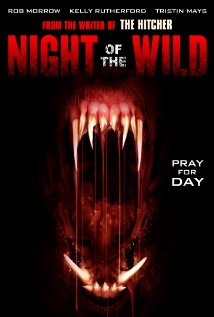
After I finished up my review of Buried Secrets, it was time to watch Night of the Wild. Night of the Wild, which was produced by the wonderful people at The Asylum, originally aired on the SyFy network on October 3rd. Much like Ominous, The Hollow, and They Found Hell, it was aired as a part of their 31 Days of Halloween. I was on vacation when Night of the Wild was originally aired, so I missed it.
Night of the Wild is exactly the type of film that appears to have been made to give me nightmares. It’s a film about killer dogs and I’ve always been a bit scared of dogs. Recently, as a result of meeting some very well-behaved and sweet-natured members of the species, I’ve become a little bit more accepting of them but, for the most part, dogs still make me very nervous. I just can’t deal with all the barking and the growling and the jumping. Add to that, it freaks me out that dogs are apparently attuned to human emotions because I tend to be pretty moody. Get a dog around me and chances are my emotional nature will cause them to have a nervous breakdown.
Night of the Wild opens with a green meteorite crashing down to Earth. It lands near a small farming community. Soon, glowing chunks of the meteorite are appearing everywhere and the town’s dogs start to turn against their owners. (It’s debatable whether or not it’s just dogs that go crazy. One of my favorite shots of the movie is of a hundred cats safely perched up in a tree, as if they’re aware that the dogs are having issues and don’t want anything to do with them. There’s another shot the features several cows mooing in a slightly ominous fashion, as if they also can’t wait to take out a few farmers.) It’s pretty much a typical SyFy/Asylum scenario — the dogs go on a rampage through town, a lot of people die, and the members of a family (made up of Rob Morrow, Kelly Rutherford, Tristin Mays, and Carmen Tonry) try to get to safety.
And yet, there are a few things that set Night of the Wild apart from other SyFy films.
First off, there’s the look of the film. According to the imdb’s trivia section, director Eric Red and cinematographer Spencer Hutchins were inspired by the look of Dario Argento’s classic Suspiria. And you can certainly tell while watching the film. The colors are vibrant. The green glow of the meteorite is often seen in the background. When the dogs lay siege to a farmhouse, the reddish lighting will remind you of Suspiria‘s scenes of Jessica Harper investigating the hidden passageways of that haunted dance academy.
The other thing that sets apart Night of the Wild is just how violent and gruesome the film eventually becomes. Unlike Sharknado 3, this is not a comedy. This is not a film that invites you to laugh over all the mayhem. Night of the Wild is a grim and dark movie, one in which you’re never quite sure who is going to survive and who is going to fall victim to the dogs.
Night of the Wild is a film that will make you want to hug your favorite cat.
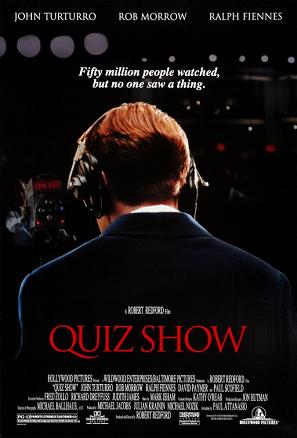
For today’s entry in the 44 Days of Paranoia, I want to take a look at a film that I recently caught on cable — 1994’s Quiz Show.
Directed by Robert Redford and based on a true story, Quiz Show was nominated for the Academy Award for best picture but lost to Forrest Gump. Among those of us who obsess over Oscar history, Quiz Show is often overshadowed by not only Forrest Gump but two of the other nominees as well, Pulp Fiction and The Shawshank Redemption. When compared to Pulp Fiction, Quiz Show certainly feels old-fashioned. At the same time, it’s not quite as much of a sentimental crowd-pleaser as Gump or Shawshank. Perhaps for those reasons, Quiz Show never gets quite as much attention as some other films that have been nominated for best picture. However, taking all of that into consideration, Quiz Show is still one of the best films of the 90s.
Quiz Show takes us back to the 1950s. The most popular show on television is 21, a game show in which two contestants answer questions, win money, and try to be the first to score 21 points. The American public believes that all of the questions asked on 21 are locked away in a bank vault until it’s time for the show. What they don’t know is that the show’s producers have instead been rigging the show, giving the answers to contestants who they feel will be good for ratings.
When Quiz Show begins, nerdy Herbie Stempel (John Turturro) has been the champion for several weeks. However, both the show’s producers and sponsors feel that the untelegenic Herbie has peaked. Hence, the handsome and charismatic Charles Van Doren (Ralph Fiennes) is brought on the show and Herbie is ordered to lose to him. Reluctantly, Herbie does so.
Charles is initially reluctant to cheat but, as he continues to win, he finds himself becoming addicted to the fame. Charles is the son of the prominent academic Mark Van Doren (Paul Scofield) and his success on television finally gives him a chance to escape from his father’s shadow. Indeed, the film’s subtle and nuanced portrait of Charles and Mark’s loving but competetive relationship is one of the film’s greatest strengths.
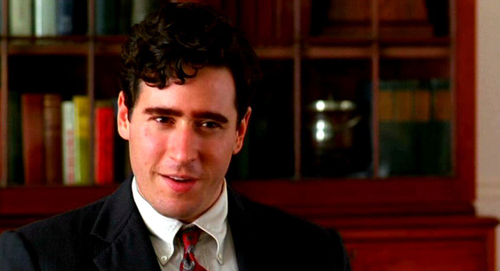
Herbie, however, is bitter over having to lose and has subsequently gambled away all of his winnings. When 21′s producer (David Paymer) refuses to help Herbie get on another TV show, Herbie reacts by going to the New York County district attorney and publicly charging 21 as being fixed. Though the grand jury dismisses Herbie as being obviously mentally unbalanced, his charges come to the attention of a congressional investigator, Richard Goodwin (Rob Morrow).
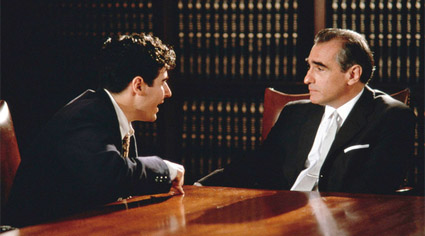
Goodwin launches his own investigation into 21 and discovers that the show is fixed. (As the ambitious Goodwin puts it, he wants to “put television on trial.”) Along the way, he also meets and befriends Charles Van Doren and finds himself torn between his desire to expose the show and to protect Charles from the bad publicity. Again, the film is to be applauded for the subtle way that it uses Goodwin’s investigation of both Charles and Herbie as a way to explore issues of both class resentment and class envy. Goodwin may have come from the same ethnic background of Herbie but it quickly becomes obvious that Goodwin has more sympathy for the genteel (and very WASPy) world that produced Charles Van Doren. When Goodwin tries to justify protecting Charles, his wife (played by Mira Sorvino) responds by calling him “the Uncle Tom of the Jews” and it’s hard not to feel that she has a point.
While I greatly enjoyed Quiz Show, I do have to say that, on one major point, the film fails. Try as he might, director Redford never convinces us that a rigged game show is really as big of a crime as he seems to be believe it to be. Perhaps in the 1950s, people were still innocent enough to be shocked at the idea of television reality being fake but for cynical contemporary viewers, it’s hard not to feel that the “scandal” was more about Richard Goodwin’s ambition and less about any sort of ethical or legal issue. Towards the end of the film, one character suggests that television will never be truly honest unless the government steps in to regulate it. “What?” I yelled back at the TV.
Seriously, it seemed like a bit of an overreaction.
As I watched Quiz Show, I found it hard not to think about the reality shows that I love. For instance, I know that The Bachelor and The Bachelorette are largely staged. I know that the previous season of Big Brother was largely set up so that Amanda could win. (And, believe me, if Amanda hadn’t sabotaged her chances by turning out to be a mentally unstable racist bully, she would have won and she would probably would have been invited back for the next all-stars season.) I know that shows like Storage Wars and Dance Moms are “unscripted” in name only. I know that reality shows aren’t real but my attitude can basically be summed up in two words: “who cares?” Perhaps I would be more outraged if I lived in the 50s which, to judge from both Quiz Show and a host of other movies, was apparently a much more innocent time.
That said, I really enjoyed Quiz Show. A lot of that is because I’m a history nerd and, therefore, I have a weakness for obsessively detailed period pieces. But even beyond that, Quiz Show is a well-made, entertaining film that features three excellent lead performances and several strong supporting turns. If you love to watch great actors playing great roles then Quiz Show is the film for you. Rob Morrow lays his Boston accent on a bit thick but otherwise, he does a good job of suggesting both Goodwin’s ambition and the insecurities that lead him to desire Charles’s friendship even as he tries to expose him as a fraud. John Turturro brings an odd — if manic — dignity to Herbie Stempel while Johann Carlo is well-cast as his wife. Best of all, Ralph Fiennes makes Charles Van Doren into a sad, frustrating, and ultimately sympathetic character while Paul Scofield is the epitome of both paternal disappointment and love as his father. The film is full of great supporting turns as well, with David Paymer and Hank Azaria perfectly cast as the show’s producers and Christopher McDonald playing the show’s host with the same smarmy charm that he brought to a similar role in the far different Requiem For A Dream. Perhaps best of all, Martin Scorsese shows up as the owner of Geritol and gets to bark, “Queens is not New York!”
Even if Robert Redford doesn’t quite convince us that the quiz show scandal was as big a deal as he obviously believes it to be, Quiz Show is still an uncommonly intelligent film and one that deserves to rediscovered.





 Through the Shattered Lens