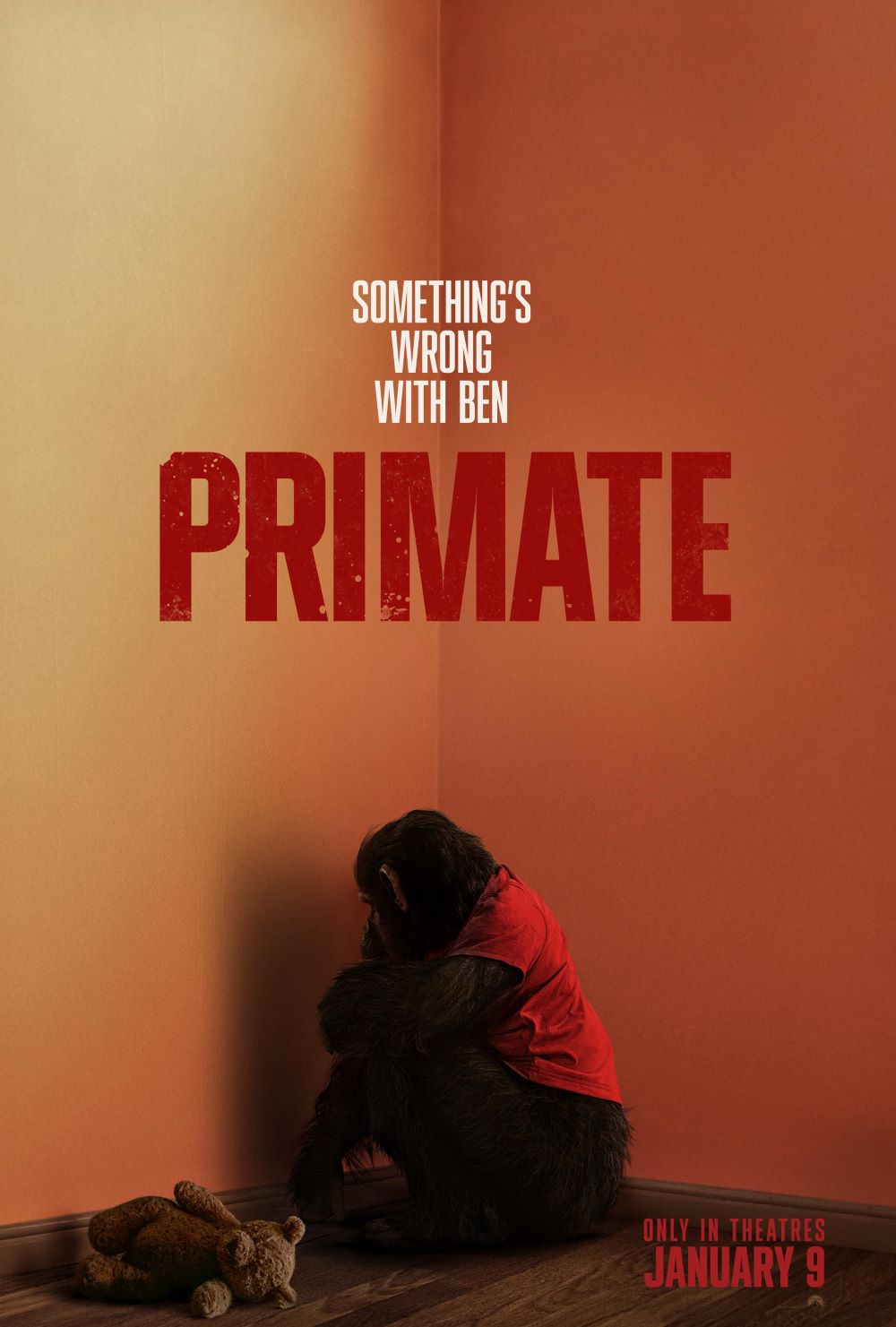
Review: Primate (dir. by Johannes Roberts)


“There’s something wrong with Ben.” — Lucy Pinborough

Primate is the kind of nasty little horror movie that knows exactly what it is: a killer-chimp siege flick with a mean streak, a surprising amount of craft, and just enough emotional texture to keep it from feeling like pure junk food. It is also, very unapologetically, a January-release bloodbath built around one simple promise: you came to watch a chimp rip people apart, and the film is absolutely going to deliver on that.

Set on a remote, luxury house carved into a Hawaiian cliffside, Primate follows Lucy, a college student returning home to her deaf father Adam, younger sister Erin, and Ben—their adopted chimpanzee, who has been taught to communicate using a custom soundboard. The setup leans a bit into family melodrama and awkward-friends-on-vacation vibes: Lucy brings her buddies Kate and Nick, Kate drags along wildcard Hannah, and a pair of party bros, Drew and Brad, orbit the group on the way to a weekend of drinking by the infinity pool. Things tilt into horror when Ben is bitten by a rabid mongoose, starts behaving erratically, and eventually tears the face off the local vet before busting out of his enclosure and turning the house into a kill zone. From there, the movie pretty much drops the pretense of being about anything except survival, creative carnage, and the miserable logistics of trying to outrun a furious primate on a cliff.

Director Johannes Roberts, who previously did 47 Meters Down and The Strangers: Prey at Night, brings that same B-movie efficiency here—minimal fat, fast escalation, and a willingness to lean into the ridiculous without winking too hard. Once Ben escapes, the film basically becomes a series of tightly staged, high-tension set pieces: kids trapped in a pool while a chimp stalks the edge, frantic dashes through glass corridors, and messy, up-close attacks where you really feel the weight and speed of the animal. The pool sequence in particular is a great example of Roberts finding one strong visual idea—humans stranded in water because the predator can’t swim—and milking it for all the dread he can. It’s simple, almost old-fashioned monster-movie blocking, but it works because the geography is clear and the danger feels immediate rather than abstract.

Visually, the film is punching above what you might expect from “rabid chimp horror.” The cliffside house setting gives Roberts and his team a lot to play with: long glass walls, sharp drops, tight stairwells, and that infinity pool hanging over nothing. The camera favors clean, legible compositions instead of frantic shaky-cam, which means when the violence happens, you actually see it—and the movie is proud of that. There’s a grimy 80s-video-store energy to the way kills are framed and lingered on just long enough to be uncomfortable, but not so long that they turn into camp. Adrian Johnston’s synth-heavy score leans into that retro horror vibe too; it buzzes and screeches like someone let a demon loose on a cheap keyboard, and it matches the film’s mix of nasty and playful pretty well.

The real secret weapon here is Ben himself. Rather than going full CGI or trying to work with a real chimp, the production uses a combination of suit performance, animatronics, and careful staging, with Miguel Torres Umba giving the creature its physical personality. The result is surprisingly convincing; there are stretches where it feels like you’re watching a real animal charge people on stairs or slam into doors, which makes the violence land harder. You can tell the effects team put in serious work on the costume and facial mechanics—Ben’s expressions shift from confused, childlike attachment to full-on feral rage, and that emotional readability helps sell him as a character instead of just a prop. Importantly, the film avoids the “PS3 cutscene” problem of bad CG animals, which would have killed the tension immediately.

Performance-wise, this is very much “do your job and don’t get in the way” acting, and that’s mostly a compliment. Johnny Sequoyah makes Lucy feel grounded enough that you buy her as both final girl and guilty older sister who’s been away too long. Troy Kotsur, as Adam, is probably the standout human presence; his scenes use sign language not as a gimmick, but as part of how the family actually lives, and his mixture of vulnerability and stubbornness gives the movie a little heart. The rest of the cast—Jessica Alexander, Victoria Wyant, Gia Hunter, Benjamin Cheng, and the cannon-fodder guys—do what’s asked: they feel like actual young adults rather than complete idiots, which helps when the film needs you to invest in whether they make it out. Nobody is delivering awards-caliber work, but nobody is embarrassing themselves either, and in a film where a chimp tears someone’s jaw off, that’s honestly the sweet spot.

Tonally, Primate walks a line between brutal and darkly funny, and your mileage will depend on how much you enjoy mean-spirited genre films. This is not a movie that’s precious about its characters; the script makes it clear that almost anyone can get obliterated at any moment, and the kill scenes are loud, wet, and often abrupt. There’s a streak of black comedy in how casually some of the deaths happen—a rock to the head here, a shovel to the face there—but Roberts never tips fully into self-parody. At the same time, the film does gesture at something sadder in the idea of a beloved family member suddenly turning dangerous because of a disease, and in the way Lucy has to reconcile her childhood bond with Ben with the reality of what he’s become. The movie doesn’t dig into that theme deeply, but it’s present enough to keep things from feeling completely hollow.

Where Primate stumbles is mostly in its limitations, and whether those feel like flaws or just genre boundaries will depend on what you’re looking for. The script is extremely straightforward: characters have clear, basic motivations, relationships are sketched in a few lines, and then everyone gets funneled into the survival engine. If you want layered character work, subtext about animal ethics, or a big commentary on captivity and communication, this is not that movie, even though the setup with a sign-literate chimp and a linguist mother hints at richer territory. The film also indulges in the usual horror conveniences—texts ignored, warnings missed, people splitting up when they probably shouldn’t—though to its credit, the characters generally behave less stupidly once they understand the situation. And as gnarly as the gore is, the movie’s reliance on shock and escalation can make the back half feel a bit repetitive: Ben appears, someone gets mauled, survivors scramble, repeat.

From an honesty standpoint, Primate is absolutely worth watching if you have a soft spot for creature-features, killer-animal movies, or throwback 80s-style horror that doesn’t pretend to be more than a vicious good time. It’s tightly paced, well shot, and anchored by a genuinely impressive creature performance that justifies the whole exercise. If you’re squeamish about animal violence, or you want your horror to come with metaphor, political commentary, or emotional catharsis, you’ll probably bounce off this pretty quickly. But if you can meet it on its own trashy, committed wavelength, there’s something satisfying about watching a studio-backed film go this hard, this graphically, on such a simple premise. It feels like the kind of bloody, fast-moving B-movie you’d have rented on VHS for a sleepover, only now it’s playing in theaters with a slicker finish and a killer chimp named Ben waiting to wreck your night.
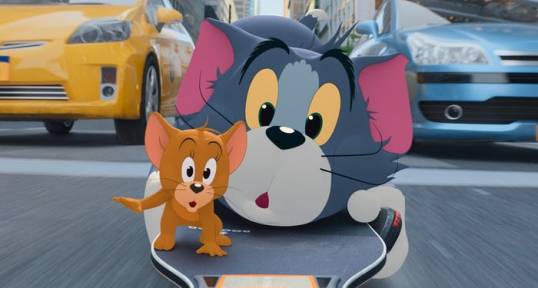
Film Review: Tom & Jerry (dir by Tim Story)


Kayla Forester (Chloe Grace Moretz) has recently arrived in Manhattan, fleeing her go-nowhere hometown in Pennsylvania.  She’s determined to finally do something with her life, spurred on by the feeling that there are other people who are just as young as she is but who have already managed to get their lives together.  She doesn’t have much work experience but she has endless ambition and she’s also willing to lie, cheat, and steal if it means finding a better life.

Tom Kat (played by himself) is an aspiring pianist and creator of ludicrously elaborate mouse traps who finds his ambitions hampered by the fact that he’s a cartoon cat who can’t talk and who has a habit of getting involved in elaborate mishaps.  Even his attempts to make a meager living by playinf piano in Central Park are continually thwarted by all of the other cartoon animals that are lurking around New York City.  (“Look!” a little boy announces, “that cat’s playing a piano!”  His father explains that it’s common to see all sorts of strange things in New York.)

Jerry Mouse (playing himself) is Tom’s longtime rival.  A cartoon mouse who is also a plucky kleptomaniac, Jerry has recently arrived in Manhattan.  He’s looking for a home and he wastes no time in reigniting his decades old feud with Tom and, of course, engaging in countless acts of petty thievery.

Together, they solve crimes!

Well, no, actually, they don’t.  Instead, they commit a few.  Kayla gets things started by stealing someone else’s resume and getting a job working at a luxury hotel.  Under the mistrustful eye of event manager Terence Mendoza (Michael Pena), Kayla tries to make sure that two celebrities, Ben (Colin Jost) and Preeta (Pallavi Sharda ), have the perfect wedding in the hotel’s ballroom.  Despite being in no way qualified for her job, Kayla proves to be a quick learner and she even manages to deal with the hotel’s temperamental head chef, Jackie (played, somewhat inevitably, by Ken Jeong).  The only problem is that Jerry has moved into the hotel as well.  Realizing that a mouse could ruin the entire wedding, Kayla hires Tom to track the little rodent down.  Tom and Jerry better work out their differences before the wedding because Ben and Preeta are scheduled to ride two cartoon elephants down the aisle and you know how elephants feel about mice!

Tom & Jerry is a hybrid film, a mix of live action and animation.  New York City is real.  All of the human characters are played by actual humans.  However, every single animal — from the title characters to the elephants to Ben’s bulldog to the pigeons that fly over Central Park and provide a chorus to the action — is a 2D cartoon character.  It’s actually a pretty cute idea and, to the film’s credit, it doesn’t waste anyone time with elaborate excuses for why this is.  Everyone in the film simply accepts that they live in a world with cartoon animals.  No one is particularly surprised with Kayla hires a cartoon cat to take care of the cartoon mouse problem.

Tom & Jerry works whenever it focuses on the title characters.  It’s actually a lot of fun to watch the two of them chasing each other through a live action New York City and never suffering any injuries regardless of how many mallets they hit each other with.  Unfortunately, the film slows down whenever it focuses on the human characters.  Chloe Grace Moretz is one of the best actresses of her generation and it’s always nice to see her playing a character who isn’t being stalked or having to deal with some sort of unimaginable tragedy but still, Kayla’s story is never really interesting enough to justify taking the focus away from Tom and Jerry.  For most of the movie, poor Michael Pena gets stuck playing the film’s designated villain, even though Terrence is basically just doing his job.  In the end, of course, everyone learns an important lesson and they’re all the better for it but most viewers would probably trade the lesson for more of the mouse and the cat.

Still, whenever it’s just Tom and Jerry doing their thing, this is a cute movie.  I just wish the movie hadn’t gotten bogged down with everything else.

Film Review: Deadpool 2 (dir by David Leitch)


“From the studio that killed Wolverine!” the poster proclaims.

“Directed by the man who killed John Wick’s dog” the opening credits announce.

Deadpool 2 is so meta that it even opens with a close-up of a figurine of Hugh Jackman impaled on a rock or a branch or whatever it was that finally killed him at the end of Logan.  Deadpool, the irrepressible and nearly indestructible mercenary played by Ryan Reynolds, announces that he’s willing to accept the challenge posed by Logan‘s tragic ending.  Deadpool promises us that, in the movie we’re about to watch, he’ll die as well.  Deadpool then proceeds to blow himself up.

Of course, those of us who have seen first Deadpool film know better than to panic when Deadpool’s severed head flies at the camera.  Deadpool heals so quickly that, as long as his powers are working, he can’t be killed.  If he gets shot or stabbed, the wound heals almost immediately.  Broken bones mend themselves in record time.  When Deadpool literally gets ripped in half, he promptly starts to grow new legs.  Without his powers, of course, Deadpool would have died a long time ago.  He has cancer, a fact that the film doesn’t dwell upon but which still adds a bit of unexpected depth to the character and his trademark dark humor.

Of course, Deadpool is not just unique because his near-immortality.  Deadpool is also unique in that he, and he alone, understands that he’s a character in a movie.  Even more importantly, he understands that he’s a character who is being played by an actor named Ryan Reynolds.  (Some of Deadpool 2‘s best jokes — which I won’t spoil here — are at the expense of some of Reynolds’s earlier career choices.)  While everyone else in the film is taking things very seriously, as characters in comic book films tend to do, Deadpool is pointing out all of the clichés and even the occasional plot hole.  When Cable (Josh Brolin), a cyborg warrior from the future, offers up a hasty explanation for why he can’t just use time travel to solve all of his problems, Deadpool dismisses it as “lazy writing.”

With the monster success of Wonder Woman, Infinity War, and Black Panther, Deadpool is the hero that we now need.  I mean, let’s be honest.  Comic books movies can be a lot of fun and, right now, we’re living in the golden age of super hero cinema.  At the same time, these films can occasionally get a little bit pompous.  Think about the unrelenting grimness of the DC films.  Think about all the sturm und drang that made up the undeniably effectively ending of Infinity War.  It in no way detracts from those films to say that Deadpool’s refusal to take either himself or the movie too seriously often feels like a breath of fresh air.  Deadpool is the one hero who is willing to say to the audience, “Yes, it’s all ludicrous and silly and occasionally a little bit lazy.  Isn’t it great?”

And yet, even with all that in mind, Deadpool 2 has a surprisingly big heart.  Even while it encourages us to laugh as its excesses, the sequel makes clear that it has a bit more on its mind than the first film.  Deadpool 2‘s plot deals with the efforts of both Deadpool and Cable to track down an angry mutant who goes by the somewhat regrettable name of Firefist (Julian Dennison).  Cable has come from the future to kill Firefist and prevent him from eventually destroying the world with his anger.  As for Deadpool, he feels that the spirit of someone he loved wants him to save Firefist.  As for Firefist himself, he’s an escapee from the Essex Home For Mutant Rehabilitation, a Hellish orphanage where the hypocritical headmaster and his perverted staff attempt to torture young mutants into being normal human beings.  The parallel to conversion therapy is an obvious one and there’s always just enough outrage underneath the film’s humor.

Deadpool 2 is a fast-moving and quick-witted sequel and Ryan Reynolds is, once again, perfect in the role of the demented lead character.  The jokes are nonstop and fortunately, so is the action.  There’s a lengthy fight between Cable and Deadpool that’s destined to go down as a classic.  Another exciting scene opens with parachutes and ends with … well, I can’t tell you.  I won’t spoil it, beyond to say that sometimes, being a hero is all about good luck.  Deadpool 2 is an ultra-violent, ultra-profane action-comedy with a heart of iron pyrite.  It’s not a film to take the kids too.  Deadpool himself points that out.  (He also points out that the babysitter is probably stoned by now.)  However, Deadpool also says that this sequel is a film about family and, amazingly enough, it turns out that he’s not lying.

So far, 2018 has been the year of the comic book movie and Deadpool 2 is a welcome addition.