Made-For-TV Horror: Good Against Evil (dir by Paul Wendkos)


The 1977 made-for-TV movie Good Against Evil opens with a woman giving birth in a hospital.  Her baby daughter is forcefully taken from her and given to her father, the sinister Mr. Rimmin (Richard Lynch).

Two decades later, Jessica Gordon (Elyssa Davalos) has grown up and is working at a boutique in San Francisco.  When her car is rear-ended by a free-spirited, van-driven single guy named Andy Stuart (Dack Rambo), it’s love at first sight.  Jessica and Andy are so caught up in their whirlwind romance that they don’t even notice that there’s a schlubby guy following them everywhere that they go and that strangers are giving them dirty looks.  Someone does not want Jessica and Andy to end up together.

How could anyone object to two young people falling in love, you may ask.  Well, it turns out that Jessica is meant to be a bride of Satan and the plan is for her to eventually give birth to the Antichrist.  Everyone in Jessica’s life works for Mr. Rimmin …. or, at least, everyone but Andy.  Andy suddenly showing up and falling in love with Jessica throws a big old monkey wrench into Rimmin’s carefully crafted scheme.  Mr. Rimmin reacts by sending an army of adorable cats to harass Andy.

This might sound like it has the makings for a good made-for-TV horror film and, in fairness to Good Against Evil, the first 50 minutes or so are pretty well-done.  The movie does a good job of building up and maintaining an atmosphere of paranoia and I enjoyed watching all of the people attempting to discreetly keep an eye on Andy and Jessica whenever they went out.  When Mr. Rimmin finally abducted Jessica and took her back to his mansion, I was prepared to see Andy risk his life to rescue her….

That didn’t happen, though.  Instead, Andy got involved with the case of a little girl who was possessed.  (Again, in all fairness, he got involved because he read a news story about the girl drawing a pentagram while in a coma and he assumed that meant she was a victim of the same cult that abducted Jessica.)  Andy meets the girl’s mother (played by Kim Cattrall) and then helps an exorcist (Dan O’Herlihy) perform an exorcism.  The movie ends with Jessica, still in the clutches of Mr. Rimmin.

Good Against Evil was apparently a pilot for a television series that wasn’t picked up.  I assume the plan was that Andy would have a weekly supernatural adventure while trying to recuse Jessica from Mr. Rimmin.  The idea had some potential.  As always, Richard Lynch is a wonderfully sinister villain.  But the pilot shoots itself in the foot by getting distracted with the whole exorcism storyline.  It’s wonderful to see the great Dan O’Herlihy as a priest but the exorcism storyline really does come out of nowhere and the exorcism scene itself so blatantly copies The Exorcist that they really should have given William Peter Blatty an onscreen credit.  Sadly, because this was a pilot, the movie ends with the main storyline unresolved.  The joke is on us for caring about two people in love.

Good Against Evil is one of those films that can be found in a dozen Mill Creek box sets.  Ultimately, it’s as forgettable as its generic name.

Retro Television Reviews: Fantasy Island 4.1 “The Devil and Mandy Breem/The Millionaire”


Welcome to Retro Television Reviews, a feature where we review some of our favorite and least favorite shows of the past!  On Tuesdays, I will be reviewing the original Fantasy Island, which ran on ABC from 1977 to 1986.  Almost the entire show is currently streaming is on Youtube, Daily Motion, and a few other sites.

This week, season 4 begins with …. THE DEVIL!

Episode 4.1 “The Devil and Mandy Breem/The Millionaire”

(Dir by Vince Edwards, originally aired on October 25th, 1980)

The fourth season of Fantasy Island opens with Mr. Roarke and Tattoo once again upset with each other.

When a man named Fred Catlett (Arte Johnson) wrote to Mr. Roarke and said that his fantasy was to become an instant millionaire, Roarke turned down his fantasy for …. reasons, I guess.  Seriously, becoming an instant millionaire sounds like a typical fantasy and I seem to remember that it’s one that Roarke has granted for other guests on the series.  I’m not sure why Roarke decided that poor, meek Fred Catlett was somehow unworthy of his fantasy.

For whatever reason, though, Roarke does turn down the fantasy.  So, imagine his surprise when Fred shows up on the island!  Tattoo explains that he decided to give Fred his fantasy.  Roarke tells Tattoo that he’ll receive no help and no money from him.  Tattoo is shocked and I’m wondering if this means that Fred will get a refund.  I mean, Fantasy Island is not cheap.  Actually, if Fred already had enough money to come to Fantasy Island, that does make his fantasy seem a little bit weird.  It seems like you have to be a millionaire to get your fantasy in the first place.

Roarke, I should add, is a hypocrite because he totally suspends the rules for this week’s other guest.  Mandy Breem (Carol Lynley) has come to the Island with her fantasy being that she wants the Island to save her life.  However, Mandy refused to explain all of the details of her fantasy until she came to the Island.  Roarke allows her to come, despite not knowing what she wants.  If Tattoo did something like that, Roarke would never let him hear the end of it.

So, what is Mandy’s fantasy?  A year ago, Mandy’s husband (Adam West) underwent a surgery.  Fearful of his life, Mandy made a deal with …. THE DEVIL!  She agreed that, if he saved her husband’s life, she would give up her soul in a year’s time.  Well, that year is coming to a close and Mandy has come to Fantasy Island, hoping that she can somehow get out of the deal.  The Devil (played by a dapper Roddy McDowall) has followed her and soon, Roarke must confront the Lord of Darkness for the sake of Mandy’s soul.

This is a really fun story, largely because the performance of Roddy McDowall as the devil.  Wearing a black suit and a white tie and delivering all of his lines with just the right mix of menace, sarcasm, and camp McDowall is the ideal trickster.  The smoky confrontation between Roarke and the Devil is the highlight of the episode, with both Montalban and McDowall both seeming to relish they drama of the moment.  Ricardo Montalban once said that, while the show’s producers wanted to keep Roarke as enigmatic as possible, he always envisioned Roarke as being a fallen angel who was doing his penance on Fantasy Island.  And, indeed, there is a hint of that in his confrontation with the Devil, with the show suggesting that this is neither the first nor the final time that the two shall meet.

As for the other fantasy, Tattoo’s solution is to steal a magic lamp and give it to Mike.  Mike rubs the lamp and wishes for a million dollars.  A briefcase full of money flies through the sky and lands in front of him.  Mike is convinced the magic worked but actually the briefcase was tossed out of a moving car and now, three thieves (Arlene Golonka, Ross Martin, and Joe Turkel) want their money back!  It all works out in the end.  Despite Roarke’s earlier refusal to grant Fred his wish, this was ultimately a typical Fantasy Island fantasy.  While it really couldn’t compete with Mr. Roarke facing off against the Devil, it did, at least, give Tattoo something to do.  One gets the feeling that this episode was specifically conceived so that both Ricardo Montalban and Herve Villechaize could get their chance in the spotlight without having to actually interact with each other.  And it works out wonderfully, with Tattoo’s silly antics providing a nice balance to the more dramatic stuff involving Mr. Roarke.

All in all, even if it’s obvious that Ricardo Montalban and Herve Villechaize were still not getting along behind the scene, this was a fantastic start for season 4!

A Movie A Day #335: Ruby and Oswald (1978, directed by Mel Stuart)


The year is 1963.  The month is November.  The city is Dallas.  The President of the United States, John F. Kennedy, is coming to visit and two very different men have very different reactions.  An eccentric and lonely strip club owner, Jack Ruby (Michael Lerner), worries about an anti-Kennedy ad that has just appeared in the Dallas Morning News.  Another loner, a strange man named Lee Harvey Oswald (Frederic Forrest), is busy making plans of his own.  When Kennedy is assassinated, history brings Ruby and Oswald together in a way that a shattered nation will never forget.
This is a curious one.  It was made for television and, according to Wikipedia, its original running time was 180 minutes.  The version that I saw, on VHS, was barely 90 minutes long so obviously, the version I saw was heavily edited.  (In the 70s, it was common for made-for-TV movies to be reedited for both syndication and overseas theatrical release.)  Maybe that explains why Ruby and Oswald felt do disjointed.  In the version I saw, most of the emphasis was put on Jack Ruby running around Dallas and getting on people’s nerves.  Very little time was devoted to Oswald and the film was almost entirely stolen by Lerner. Michael Lerner is a familiar character actor.  You may not know his name but you will definitely recognize his face.  Lerner was convincing and sometimes even sympathetic as the weaselly Ruby.  Ruby and Oswald supported the Warren Commission’s findings, that Oswald killed Kennedy and Ruby shot Oswald out of a sense of loyalty to Jackie Kennedy.  Michael Lerner’s performance was so good that he almost made that theory plausible.

One final note, for fans of WKRP in Cincinnati: Gordon Jump and Richard Sanders, best known as Arthur Carlson and Les Nessman, were both in Ruby and Oswald, though they did not share any scenes together.

Shattered Politics #41: Billy Jack Goes To Washington (dir by Tom Laughlin)


39c7523029bb4c926a278a4a6a333ae5

The Happy Hooker wasn’t the only person to go to Washington in 1977!  Billy Jack may have started out killing bikers and then moved on to killing Bernard Posner and then finally ended up killing yet another Mr. Posner but, in 1977, Billy Jack was appointed to the U.S. Senate.

Now, it may seem strange to think of someone like Billy Jack being appointed to the U.S. Senate.  Over the course of the previous three films in the franchise, Billy had been shot in the back, shot in the leg, arrested for murder, convicted of manslaughter, and then shot by the National Guard.  In Billy Jack and The Trial of Billy Jack, Billy goes as far as to state that he does not feel the laws of the United States apply to him.

And then, when you consider that the three previous films all featured old, rich, white guys plotting to kill Billy, you would be justified in wondering how he would ever find himself appointed to serve in the senate.

But it happened!

And we’ve got a movie to prove it.

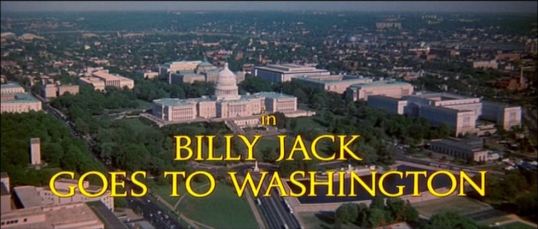
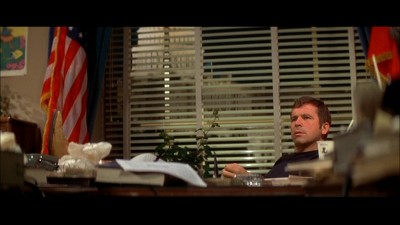
Directed by and starring Tom Laughlin, Billy Jack Goes To Washington is actually a remake of Mr. Smith Goes To Washington.  (To the film’s credit, it’s honest enough to actually give credit to Mr. Smith‘s screenwriters in the opening credits.)  What’s remarkable is just how faithful a remake Billy Jack Goes To Washington actually is.  All the scenes made famous by Jimmy Stewart — the scene where the newest member of the Senate attempts to introduce his first bill, the scene where he’s shocked to discover that Sen. Paine (played here by E.G. Marshall) takes orders from Boss Bailey (Sam Wanamaker), the scene where cynical Saunders (Lucie Arnaz) tells the senator that he should leave Washington, and, of course, that famous filibuster — are all faithfully recreated here.  The only difference, of course, is that it’s no longer idealistic Jimmy Stewart proving himself to be incredibly naive about politics.  Instead, it’s a former Green Beret, half-Indian, judo master named Billy Jack.

Tom Laughlin was a good actor, which is something that’s often overlooked by reviewers writing about the Billy Jack films.  As flawed as The Trial of Billy Jack may have been, Tom Laughlin was a compelling enough presence that the film itself remains a compulsively watchable 3-hour mess.  Laughlin had a very authoritative presence.  You looked at him and you knew that he knew what he was doing.  He was someone who you automatically wanted on your side, a natural born leader who knew how to get things done.  However, in Billy Jack Goes To Washington, Laughlin attempts to play Billy Jack as the type of naive neophyte who would be shocked to discover that politicians are corrupt.  But surely, after spending three films being harassed by every authority figure in America, Billy would have already realized that.  There’s nothing about Laughlin’s screen presence that suggests he could ever be that innocent.

And that’s the main problem with Billy Jack Goes To Washington.  For the film to have any chance of working, you have to forget everything that you’ve learned about Billy Jack over the previous three films.  However, if you haven’t seen any of the other Billy Jack films, then you probably wouldn’t be watching Billy Jack Goes To Washington in the first place.

Of course, since this is a Billy Jack film, there are a few scenes that were nowhere to be found in Mr. Smith Goes To Washington.  For instance, Saunders’s husband is murdered when he threatens to reveal the truth about Bailey’s operation.  Later, Billy, Jean (Delores Taylor), and Carol (Teresa Laughlin) are confronted by a gang of Bailey’s assassins and, for the only time in the entire movie, Billy goes through that whole routine where he takes off his boots while slowly speaking and then kicks everyone’s ass.  (Jean and Carol get to join in the ass-kicking as well and good for them!)

And, of course, there’s the scene where Billy, Jean, and the kids from the Freedom School (who are apparently now known as Billy’s Raiders) have a meeting with two liberal social activists.  It’s an interesting scene because it was clearly unscripted and it has a naturalistic feel to it that’s lacking from the rest of the film.  However, that does not mean that it’s a particularly good scene.  If I learned anything from Billy Jack Goes To Washington, it’s that self-righteous activists in 1977 were just as boring as self-righteous activists in 2015.

And yet, as I’ve said about all of the other Billy Jack films, I can’t bring myself to be too hard on Billy Jack Goes To Washington.  Again, it all comes down to sincerity.  It’s clear that Laughlin and Taylor felt they were making a difference with their films and that sincerity comes through in a way that makes Billy Jack Goes To Washington a likable, if rather inept, film.

Billy Jack Goes To Washington ran for a week in one theater in 1977 and was reportedly such a box office disaster that it couldn’t get a wider release.  (In a commentary track that he recorded for the film’s DVD release, Laughlin suggests the film was the victim of shadowy government forces.)*  While Laughlin and Taylor would later try to make The Return of Billy Jack, that film was left uncompleted at the time of Laughlin’s death.  So, the last time that filmgoers would see Billy Jack, he would still be U.S. Sen. Billy Jack.

And really, that’s the perfect ending for the saga of Billy Jack.  Starting out as a loner who protected a small California town from a biker gang to eventually becoming the protector of the Freedom School to finally embracing both non-violence and his love for Jean, Billy Jack earned himself a happy ending.

Having now watched and reviewed all four of the Billy Jack films, all I can do is say thank you to Delores Taylor and the spirit of Tom Laughlin.  It was great ride.

1251421109_1

—-

* To be honest, the commentaries that Laughlin and Taylor recorded for the Billy Jack films are actually very informative and interesting.  Laughlin actually had a far better sense of humor than you might guess from some of the movies he directed.