Retro Television Review: Homicide: Life On The Street 3.5 “The Last Of The Watermen”


Welcome to Retro Television Reviews, a feature where we review some of our favorite and least favorite shows of the past!  On Sundays, I will be reviewing Homicide: Life On The Street, which aired from 1993 to 1999, on NBC!  It  can be viewed on Peacock.
If you’re checking with the imdb and saying, “You’re reviewing these out of order!,” I’m reviewing them in the order that they were meant to air as opposed to the order by which NBC showed them.

Episode 3.5 “The Last of the Watermen”

(Dir by Richard Pearce, originally aired on December 9th, 1994)

We learn a bit more about the personal lives of Baltimore’s Homicide detectives with this episode.

For instance, we discover that Munch and Gee living in the same neighborhood.  When Gee, whose washing machine has broken down, visits the local laundromat, he’s not necessarily overjoyed to see Munch sitting there.  Munch talks and talks.  Gee lights a cigar and tries to read his newspaper in peace.  Munch keeps talking.  Gee points out that it’s the weekend and he doesn’t like to talk to anyone on the weekend.  Sunday is his day.  Munch nods and then keeps talking.  Gee stands up and moves to another part of the laundromat.

We also get to meet Kay Howard’s family.  Disgusted by the latest murder scene that she and Beau have come across and the fact that an elderly woman was murdered and her tongue was subsequently cut out and then stuffed down her throat (yikes!), Kay decides that she’s due some vacation time.  She leaves Baltimore and drives out to the local fishing village where she grew up.  She spends time with her father and her brother and a guy who she once had a romantic relationship with.  She visits her mother’s grave.  It’s interesting to see Kay outside of Baltimore and to see how she interacts with family.  It was so interesting that I was kind of annoyed that she still ended up working a murder.  A local environmental activist is murdered.  Kay worries that the murderer might have been her brother but it turns out to have been another fisherman.  I mean, I get it.  The show is called Homicide and Kay is a detective but still, I would have been just as happy if the show had just focused on her family and their rituals.  This episode is 30 years old but the scenes of the blue collar fishermen talking about how they were being “regulated” out of their life’s work still rang true.

While Kay was visiting family, Felton got a temporary new partner and you’ve probably already guessed that it was Pembleton.  This is not the first time that Pembleton has been assigned to work with Felton.  The pilot featured that classic scene of Pembleton checking car-after-car while Felton complained about Pembleton always having to be right.  Felton and Pembleton do make for an interesting team, if just because they do seem to sincerely dislike each other.  (I also enjoyed Gee’s half-smile as Pembleton reacted to the news that he would be working with Felton.)  In this case, Pembleton and Felton working together didn’t lead to any great fireworks, other than Felton reacting with shock at the idea of Pembleton preferring hockey to basketball.  The killer of the elderly woman turned out to be her grandson who said he did it because she wouldn’t stop talking.  That was sad, to be honest.  Grandmothers are supposed to talk.  Felton and Pembleton dragged the kid off to jail.

This was an okay episode.  After the emotional powerhouse of Crosetti, it was good to get something that was a bit more lowkey.  It was nice to be reminded that everyone has a family.
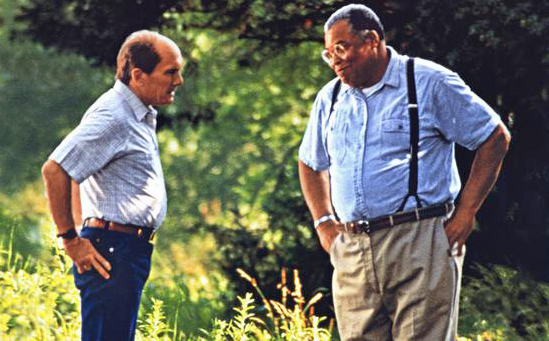
A FAMILY THING (1996) – Robert Duvall & James Earl Jones are brothers!


Just for the hell of it, I went on a little Robert Duvall marathon for his birthday on January 5th. I started the marathon off with his superior western with Kevin Costner, OPEN RANGE (2003). Next up was Duvall’s excellent crime film with Joe Don Baker and Robert Ryan, THE OUTFIT (1973). Duvall was in badass mode in this one. Based on one of Richard Stark’s “Parker” books, this was my first time to watch the film and damn, it was excellent. After that, I watched the bleak THE ROAD (2009), starring Viggo Mortensen, where Duvall just had a small part. It was a downer. I finished off the marathon late in the evening with A FAMILY THING (1996). I remember when this movie came out in the 1990’s because it was co-written by Billy Bob Thornton. Thornton was still a year away from his massive success with the movie SLING BLADE, but I knew him from his writing and co-starring in the superior crime film ONE FALSE MOVE (1991), as well as his small role in TOMBSTONE (1993). As an Arkansan, I knew Thornton was from Arkansas so I had taken a particular interest in him. But I was only 22 years old when A FAMILY THING was released, and a movie about a couple of old guys resolving family issues didn’t seem that appealing to me. As a guy into his 50’s, the entire concept seems more interesting to me now, so I gave it a spin for the first time to close out the marathon.

The story opens up in rural Arkansas with Earl Pilcher Jr. (Robert Duvall) getting the shock of his life when his beloved mother writes a final letter to him and instructs her local pastor to deliver it a few days after her death. The letter tells Earl that his biological mother was a black woman named Willa Mae who died in childbirth. It seems that Earl’s dad had gotten Willa Mae pregnant, and since he came out white, his “mother” was able to raise him as her own without having to tell him the truth. The letter also tells him that he has a half-brother named Ray Murdock (James Earl Jones) living in Chicago. It’s her dying wish that he meet Ray and get to know him as family. Pissed at his dad, and wanting to honor his mom, Earl heads to Chicago to meet Ray. Earl knows that Ray is a cop so he’s able to track him down. They immediately don’t like each other, but through a variety of circumstances, Earl ends up staying at Ray’s house for a couple of days. While there, he meets Ray’s wise, old Aunt T., Willa Mae’s sister (Irma P. Hall) and his sullen son Virgil (Michael Beach). Will the two men continue to push each other away, or will they eventually find the family connection that exists under all that messy past? 

I was surprised how deeply I was affected by A FAMILY THING. I’d be lying if I said I didn’t get teary-eyed a couple of times. The movie may use issues of adultery and racism to get the ball rolling, but more than anything else, it seems to understand that life is messy and that people are messy. We’ll disappoint ourselves, we’ll disappoint other people, and other people will disappoint us. There’s a reason that many people find their love in dogs and cats instead of people, because real relationships can be tough. The truth about my own life is that I could not have appreciated this film in 1996 at only 22 years of age. I was too naive. That’s no longer the case in 2025, and I can now truly relate to this story of two men who share a painful history, find common ground, and decide it’s worth moving forward together because family really does matter.

A movie like A FAMILY THING has no chance of working without a great cast, and this movie is a thespian jackpot. Robert Duvall is spot on perfect as the good ole guy from Arkansas, with a little bit of a racism engrained down deep into his soul, who now has to deal with the fact that he is half black. The scene where he confronts his dad about the lies that had been told to him all his life is as good as it gets. James Earl Jones matches Duvall in the even trickier role as the man who has always known about his “white” half brother Earl. This man has buried his hatred away for Earl’s father for decades, who he blames for the death of his own mother, and now has to deal with those feelings being dredged back up to the surface when Earl shows up in Chicago. Jones perfectly balances his character’s desire to keep the past in the past, with his decency as a man who doesn’t want to just throw Earl out on the street. He eventually softens towards him no matter how much bitterness he has for Earl’s dad. And neither Duvall or Jones even give the best performance in the film. That honor goes to Irma P. Hall as the blind, but extremely perceptive Aunt T. She sees through all of their bullshit, as she states to each of them on different occasions, and encourages them to get to know each other because they’re family. As they play games of racism and bitterness, she reminds them they are brothers no matter the color of their skin. It’s the performance of a lifetime and was at least worthy of an Oscar nomination in my opinion. 

Overall, A FAMILY THING may compress the amount of time and potential therapy it would take to resolve the type of family history presented here, but it does find a certain truth in the power of relationships. Earl and Ray don’t have to recognize the fact that they are brothers. As a matter of fact their lives are just fine without each other. But it’s their willingness to embrace the messy truth and find a way to connect with each other that makes the movie meaningful to me! 

Here’s the trailer for A FAMILY THING.

A Movie A Day #234: The Final Days (1989, directed by Richard Pearce)


Since yesterday’s entry in movie a day featured Philip Baker Hall playing Richard Nixon in Secret Honor, I decided to use today’s entry to talk about a movie that featured Lane Smith in the same role.

Based on Bob Woodward and Carl Bernstein’s follow-up to All The President’s Men, The Final Days is about the final months of the Nixon presidency.  The movie begins shortly after the resignations of Nixon aides John Ehrlichman and H.R. Haldeman and follows Nixon (Lane Smith) as he grows increasingly more isolated and reclusive in the White House.  All the familiar moments are here, Nixon ranting against the Kennedys and the establishment, Kennedy talking about his difficult childhood, and, most famously, Nixon asking Henry Kissinger (Theodore Bikel) to pray with him on the night before his resignation.  The Final Days also focuses on the ambitious men who surrounded Nixon during his downfall and who helped to engineer his eventual resignation, especially Al Haig (David Ogden Stiers).

A lot of very good actors have played Richard Nixon.  Anthony Hopkins and Frank Langella both received Oscar nominations for playing him and Philip Baker Hall probably should have.  Rip Torn, John Cusack, Kevin Spacey, Dan Hedaya, and Bob Gunton have all taken a shot at the role.  But, in my opinion, no one has done a better job as the 37th president than Lane Smith, who bore about as close a resemblance to Nixon as anyone could without a prosthetic nose.  Even more than Anthony Hopkins did in Oliver Stone’s Nixon, Lane Smith captured not only Nixon’s insecurity and paranoia but also his provides hints of the great leader that Nixon could have been if not for his own self-destructiveness.