For today’s music video of the day, we have one of David Lynch’s final short films. From his collaboration with Chrystabell, here is the haunting Sublime Eternal Love.
Enjoy!
For today’s music video of the day, we have one of David Lynch’s final short films. From his collaboration with Chrystabell, here is the haunting Sublime Eternal Love.
Enjoy!
Welcome to Late Night Retro Television Reviews, a feature where we review some of our favorite and least favorite shows of the past! On Saturdays, I will be reviewing the Canadian sitcom, Check it Out, which ran in syndication from 1985 to 1988. The entire show is currently streaming on Tubi!

This week, Howard’s paranoid and with good reason! They are all out to get him….
Episode 3.4 “I’m Okay, You’re A Spy”
(Dir by Alan Erlich, originally aired on October 17th, 1987)
After the new stockboy, 12 year-old Brad (played by T and T‘s Sean Roberge), shows Howard a newspaper article about how the company that purchased Cobb’s has been sending corporate spies into its stores to evaluate management, Howard gets extremely paranoid. He becomes convinced that there must be a spy in the store. He gathers Brad, Leslie, Christian, Viker, and Marlene into the stockroom and asks them if they’ve noticed anyone strange in the store. He also suggests that any one of them could possibly be the spy.
Or maybe — just maybe — the spy is the new butcher who keeps asking Howard all sorts of questions about the other employees. He would seem to be the most likely suspect and we know it’s him because the episode opens with him getting his assignment and talking about how he can’t wait to get Howard Bannister fired. Howard, of course, is so paranoid about the possibility of there being a spy in the store that he expresses all of his fears and frustrations to the spy. In other words, this is yet another episode episode where Howard is a complete moron. The previous season was split evenly between episodes where Howard was competent and episodes where Howard was an idiot. The episodes featuring stupid Howard were always funnier than the episodes featuring smart Howard so I think the showrunners made the right decision to focus o Howard’s stupidity in the third season. No one wants to watch a show about a good boss. What fun is that?
(It’s kind of like how we loved The Office when it was all about Michael screwing up but, when it became about new boss Andy proving himself, we all tuned out.)
It turns out that not everyone at the new corporation is supportive of the whole spy thing. T.C. Collingwood comes to the store and informs Howard that his butcher is the spy. Howard replies by giving the spy a lot of work to do. I guess that’s one way to handle it but it doesn’t change the fact that Howard told the spy that everyone at the store was incompetent and should be fired. This episode makes less and less sense the more that I think about it. Can’t corporate just look at whether or not the store had made any money and use that to determine whether or not Howard’s doing a good enough job? This episode didn’t make much sense.
Incidentally, Edna was on vacation during this episode. How many vacation does Edna get in the year? It seems like she’s never at the store. I have a feeling that Howard is going to run off with T.C. Collingwood at some point in the new future. Maybe that’s for the best. At least then Edna wouln’t have to flee to Florida every month.
Next week …. Howard wants to be a TV star! We’ll see what happens.

“Brandon, you are not ready to be my head chef.”
Oh my God, did Chef Ramsay really just say that!? I’ve watched a lot of episodes of Hell’s Kitchen but I don’t think any elimination has taken me as much by surprise as the elimination of Brandon this week. Brandon is who I expected to win this season and I know that I’m not alone in that. That said, Brandon did struggle at service. Of all the chefs to receive black jackets, Brandon struggled the most and, even more importantly, Brandon was really the only one to struggle. Ramsay didn’t have much of a choice but I have a feeling Brandon will return in a future season.
Speaking of Chef Ramsay, I also caught the second part of the Kitchen Nightmares premiere. I’m glad that Ramsay apparently thinks that he’s fixed that restaurant but I can promise that there is no way I would ever voluntarily eat at any establishment featured on this show. I don’t care if it’s clean now. Once a rat trap, always a rat trap.
This week’s episode of Abbott Elementary surfaced in comparison to last week’s but that’s to be expected considering the brilliance of last week’s show. I still laughed at Ava trying to figure out what it’s like to “date the poors.”
On Peacock, I watched the three episode documentary Girls Gone Wild: The Untold Story and yes, that was certainly disgusting and disturbing, It was even worse than Hulu’s Jerry Springer: Fights, Camera, Action, which I also watched. I guess I felt like catching up on some sordid history this week!
Speaking of sordid, Who Wants To Marry A Multi-Millionaire is on YouTube. I watched it and I have to admit that I laughed when the “millionaire” came lurching out and started speaking in a voice that sounded exactly like Bill Hader’s. Who Wants To Marry A Multi-Millionaire was a one-time, two-hour special that aired in 2000. The man behind this fiasco (the marriage was annulled, the millionaire was not a millionaire but just a guy who was the subject of multiple restraining orders) went on to create The Bachelor.
Also on YouTube, I found all six episodes of The Starlet, a reality competition show where aspiring actresses competed for a walk-on role on One Tree Hill. Stop laughing, it was a real show. I vaguely remember watching it when it first aired. I watched it a second time on Monday because I was bored. One of the judges was Faye Dunaway. Faye was surprisingly nice. The mean judge was Vivica A. Fox.
Case and I are continuing to watch Dark, on Netflix. What a fascinating and macabre show! I recommend it to anyone reading.
I watched the latest episodes of Special Forces: World’s Toughest Test but I don’t remember a damn thing about them, other than it amused me how everyone pretended to be taking everything so seriously.
And, as always, I watched the shows that I review on a weekly basis. I’m not going to sit here and list them all because I’m tired. But you can find all my reviews on this site. Yay!
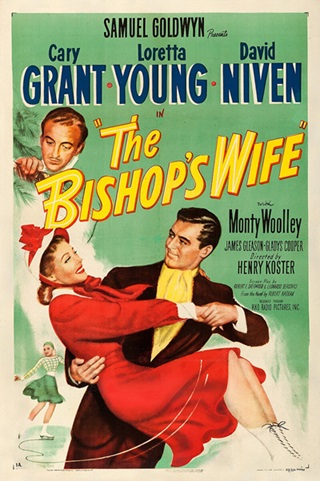
In 1947’s The Bishop’s Wife, Cary Grant stars as Dudley.
We first see Dudley walking down the snow-covered streets of a city that is preparing for Christmas. He watches Julia Broughman (Loretta Young), the wife of the local Anglican bishop. He stops to talk to Prof. Wutheridge (Monty Woolly), a secular humanist who is close to Julia and her husband, despite being irreligious himself. Dudley seems to know all about the professor, even though the professor is not sure who he is. The professor mentions that he was fired from a university because he was considered to be a “radical,” even though he has no interest in politics. The professor says that the town’s church has seen better days, especially since the Bishop is more interested in raising money from the rich to build a grand new cathedral than actually meeting with the poor who need help.
The last person that Dudley visits is Bishop Henry Broughman (David Niven). Dudley reveals to Henry that he’s angel and that he’s come in response to Henry’s prayers. Henry has been frustrated in his attempts to raise money for a new cathedral. Dudley has come to provide guidance.
With only the Bishop knowing the truth about Dudley, Dudley becomes a houseguest of the Broughmans. The Bishop has become so obsessed with his new cathedral that he’s not only been neglecting his diocese but also his family. While Dudley tries to show Henry what’s really important, he also helps Julia and her daughter Debby (Karolyn Grimes) to fit in with the neighborhood. (Bobby Anderson, who played the young George Bailey in It’s A Wonderful Life, makes an appearance as a boy having a snowball fight who says that Debby can’t play because no one wants to risk hitting a bishop’s daughter with a snowball.) The Bishop becomes jealous of Dudley and perhaps he should be as Dudley finds himself falling in love with Julia and considering not moving on to his next assignment.
(And now we know where Highway to Heaven got the inspiration for 75% of its episodes….)
The Bishop’s Wife is an enjoyable film, one that is full of not just Christmas imagery but also the Christmas spirit as well. The Bishop finally realizes that his planned cathedral is more of a gift to his ego than to the men and women who look to him for guidance and comfort in difficult times. David Niven is, as always, likable even when his character is acting like a jerk. That said, this is pretty much Cary Grant’s show from the start. Suave, charming, and gently humorous, Grant joins Claude Rains and Henry Travers in the ranks of great cinematic angels. Never mind that Grant’s character is a bit pushy and has his own crisis of faith. From the minute that Grant appears, we know that he’ll know exactly the right way to answer Henry’s prayers.
Cary Grant was not nominated for Best Actor for his performance here. Undoubtedly, this was another case of Grant making it all look so easy that the Academy failed to realize just how good of a performance he gave. Interestingly enough, The Bishop’s Wife was one of two Christmas films nominated for Best Picture that year, along with Miracle on 34th Street. Both films lost to Gentleman’s Agreement.
Welcome to Retro Television Reviews, a feature where we review some of our favorite and least favorite shows of the past! On Saturdays, I will be reviewing Welcome Back Kotter, which ran on ABC from 1975 to 1979. The entire show can be purchased on Prime.
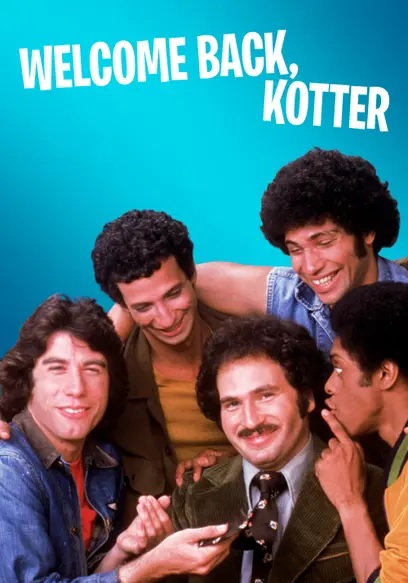
This week, it’s Welcome Back Barbarino!
Episode 4.14 “Bride and Gloom”
(Dir by Norman Abbott, originally aired on January 13th, 1979)
Epstein needs a favor from Barbarino. Remember the time I saved your life? Epstein asks. No, Barbarino replies. Well, no matter! Epstein is still intent on getting to Barbarino to pay him back marrying Epstein’s Guatemalan cousin, Angelina (Rachel Levario). Angelina needs her citizenship so Vinnie just needs to stay married to her from three days and then they’ll get a divorce and Vinnie can continue to date Nurse Sally (Linda McCullough). (“What you’re doing is so noble!” Sally tells Barbarino. I am not sure I would have the same reaction to my boyfriend announcing he was marrying someone else.)
Julie and Woodman tell Barbarino that he’s too young to get married and it’s somewhat jarring to remember that Barbarino and the rest of the Sweathogs are still just supposed to be high school kids. (John Travolta was the youngest member of the cast but, by the time the fourth season rolled around, even he looked too old to be hanging out at Buchanan High.) Gabe is not around to provide any advice and I don’t think this episode even bothered to come up with an excuse to explain his absence.
Angelina does not speak a word of English so Epstein serves as the translator while she and Barbarino fight about the wedding. Angelina wants a nice wedding. Barbarino just wants to get it over with. They compromise by holding the ceremony in Barbarino’s ugly apartment. (If the show couldn’t even spend the money to convince Gabe Kaplan to appear in the show that he was starring on, there was no way they were going to splurge for an extra set.) The guests are the Sweathogs and Julie and, for some reason, Mr. Woodman. Babarino and Epstein both have huge families but none of them show up for the wedding. I guess hiring extras would have cost money. The show did hire an actor to play the priest so that was good of them.
Does Vinnie Barbarino get married? No. Angelina changes her mind and marries a musician instead. Barbarino can go back to dating Sally and I guess Gabe will just hear about it later at dinner.
“I’m so confused!” Barbarino says at one point and the audience goes wild. Even though Travolta spent this episode looking like he was pretty much over the whole thing, the studio audience was happy to see him. The show’s greatest strength, at this point, was Travolta but this episode also shows the limits of the show’s format. Barbarino had to be both a high school student and a green card groom. It felt odd and kind of unpleasant.
Finally, why is Barbarino’s apartment is always so filthy? I get that he’s supposed to be poor and living in New York but seriously, couldn’t they have swept the set occasionally? The sight of that apartment always depresses me.
This episode features the cast going through the motions and, as was often the case with season 4, it’s obvious that no one really wants to be there. I certainly didn’t want to be there! Next week features Barbarino’s final appearance on the show. Soon, Vinnie will be free.
The other night, I was watching Class of 1984 with a group of friends (including three TSL writers), and I we started discussing what our high schools were known for. When I was a student there, my high school was probably best known for the fact that Jessica Simpson attended the school in the 90s. She didn’t graduate because she left Texas for Hollywood but that was still our claim to fame. It’s interesting because people didn’t care that was my school was also named one of the best high schools in America and that it had an acclaimed drama department. But they definitely cared that Jessica Simpson dropped out before I was even old enough to attend.
(Is it a good thing when your school is best known for a student who dropped out and went on to become a success with G.E.D.?)
Today’s song of the day was inspired by that conversation. Here’s Jessica Simpson, covering These Boots Are Made For Walkin’.
(Yes, I know that no cover can compare to Nancy Sinatra’s other but I didn’t go to Nancy Sinatra’s high school. Plus, I’m a Southern girl with a closet full of boots. I relate to this version.)
You keep sayin’ you’ve got somethin’ for me
Somethin’ you call love but confess
You’ve been a’messin’ where you shouldn’t ‘ve been a’messin’
And now someone else is getting all your best
These boots are made for walkin’
And that’s just what they’ll do
One of these days these boots are gonna walk all over you
Ya
You keep lyin’ when you oughta be truthin’
And you keep losing when you oughta not bet
You keep samin’ when you oughta be a’changin’
Now what’s right is right but you ain’t been right yet
These boots are made for walkin’
And that’s just what they’ll do
One of these days these boots are gonna walk all over you
You keep playin’ where you shouldn’t be playin’
And you keep thinkin’ that you’ll never get burnt (ha)
I just found me a brand new box of matches, yeah
And what he knows you ain’t had time to learn
These boots are made for walkin’
And that’s just what they’ll do
One of these days these boots are gonna walk all over you
Are you ready, boots? Start walkin’
(Lyrics by Lee Hazlewood)
Today is the 121st birthday of one of the great actors of Hollywood’s Golden Age, the one and only Cary Grant. For those of us who love to watch older films, Grant is usually the epitome of old-fashioned movie star charisma. He was an actor who could do it all, from screwball comedy to tear-jerking melodrama to exciting thrillers. What one usually hears about Cary Grant is that he was an actor who was taken for granted because he made everything seem so effortless.
And yet, there was a darkness to Grant’s best performances. Like Jimmy Stewart, he was an actor whose affable screen presence often hinted at inner turmoil. And, much as in the case of Stewart, Alfred Hitchcock was a director who immediately understood that. He cast Grant in some of his best films, usually playing a character with a secret or two to hide. One of my favorite “darker” Grant performances and films is 1946’s Notorious.
Directed by Alfred Hitchcock, Notorious opens with T.R. Devlin (Cary Grant) meeting and, it is implied, seducing Alicia Huberman (Ingrid Bergman). Alicia, at the time, was attempting to drink away her sorrow over her father being convicted of treason for his pro-Nazi activities during World War II. As the daughter of an American Nazi with a reputation for drinking too much and being promiscuous, Alicia is indeed notorious. That’s something that Devlin uses to his advantage the next morning when he informs that hangover Alicia that he is an American intelligence agent and that he is investigating the activities of a group of Nazi sympathizers who fled to South America at the end of the war. He wants Alicia, as the daughter of a known sympathizer, to infiltrate their operations.
Reluctantly, Alicia agrees and, while they wait for to learn the exact details of her assignment, they fall in love. Devlin is not happy when his superiors inform him that they want Alicia to approach and seduce Alex Sebastian (Claude Rains), a friend of her father’s who now lives in Brazil with his domineering mother (Leopoldine Konstantin). Alicia is even less happy when Devlin tells her of the assignment, especially as she knows that the weak-willed Sebastian has always been in love with her. She assumes that Devlin only pretended to love her.
After Devlin arranges for Alicia to be at the local riding club at the same time as Alex, Alex meets her and immediately brings her to the mansion that he shares with his mother. Alex is an interesting character. When we first meet him, he hardly seems like a Nazi sympathizer. His happiness when he sees Alicia and the apparent sincerity of his love for her stands in contrast to the often cold, manipulative, and harsh Devlin. Sebastian invites Alicia to move into his mansion and soon, Alicia tells Devlin that he can add Sebastian to “my list of playmates.” When Sebastian asks Alicia to marry him, Devlin tells Alicia to do what she wants. Alicia married Sebastian though she loves Devlin but she soon discovers just how for Sebastian and his mother will go to protect themselves and their Nazi conspirators.
Notorious is famous for its 2 and a half kissing scene between Devlin and Alicia, filmed at a time when the production code specifically stated that kisses could only last for three seconds. Hitchcock handled this by interrupting the kiss every three seconds and then having his two stars get back to it. Both Cary Grant and Ingrid Bergman said the scene was awkward to shoot, specifically because they had to keep finding reasons to split apart without splitting too far apart but the effect onscreen is amazingly romantic and probably about as erotic as 1940s studio production could be. In that scene, you have no doubt that Devlin and Alicia share a passion that Alex, even though he is in love with Alicia, could never understand. Grant and Bergman have an amazing chemistry in this scene and really the entire film.
As played by Cary Grant, Devlin is not always likable in Notorious. He can be cold and manipulative and judgmental but, in the end, we never doubt his love for Alicia. Alex also loves Alicia but he ultimately puts himself (and his mother) first. As for Alicia, she is someone who has been unfairly branded by both the activities of her father and her past reputation and anyone who has ever come to work or gone to school on a Monday morning and heard the snickering that goes along with the rumors about what she did during the weekend will immediately relate to Alicia. Alicia is told that the mission is a way to redeem herself but the film suggests that no redemption is necessary. If anything, it’s Devlin who needs to redeem himself for the way he previously manipulated and judged her. Devlin and his superiors are trying to stop a group of Nazi sympathizers from graining power in South America and their mission is an important one. (That sentiment would be even more true from audience watching in 1946, just a year after the end of World War II). But the important of their mission doesn’t change the fact that the people involved are human beings with very real and very fragile emotions.
Notorious features some of Hitchcock’s best set pieces, from the famous kissing scene to another scene involving the key to a wine cellar. Grant, Bergman, and Rains give three of their best performances in this intelligent thriller. (Watching, one can see why Ian Fleming suggested Cary Grant as a possible James Bond.) I first saw Notorious in a film class in college. At first, the class was a bit hesitant about a black-and-white movie from 1946 but, by the end, there were cheers as Devlin rushed to save Alicia. Notorious is a timeless classic.

Notorious (1946, dir by Alfred Hitchcock, DP: Ted Tetzlaff)
There was a time in my life, before I could drive, when I would beg my parents to stop at the video store every time we went to the neighboring town of Conway, Arkansas. The town I grew up in was too small to have more than just a gas station, so this movie buff had to take advantage of every trip to town. One night when we were headed home, my parents relented to my repeated requests, so we stopped off at Budget Video. I wanted to choose all the movies, but unfortunately mom and dad would also let my brother and sister choose movies from time to time as well. On this particular night, my brother wanted to rent THE UNTOUCHABLES (1987). I don’t remember what I was wanting, but I do remember that it was not THE UNTOUCHABLES. I probably pouted a little bit, but we ended up taking THE UNTOUCHABLES home with us. We turned it on that night, and I’ll gladly admit that I was 100% wrong. THE UNTOUCHABLES immediately became one of my favorite films. Great job, bro!
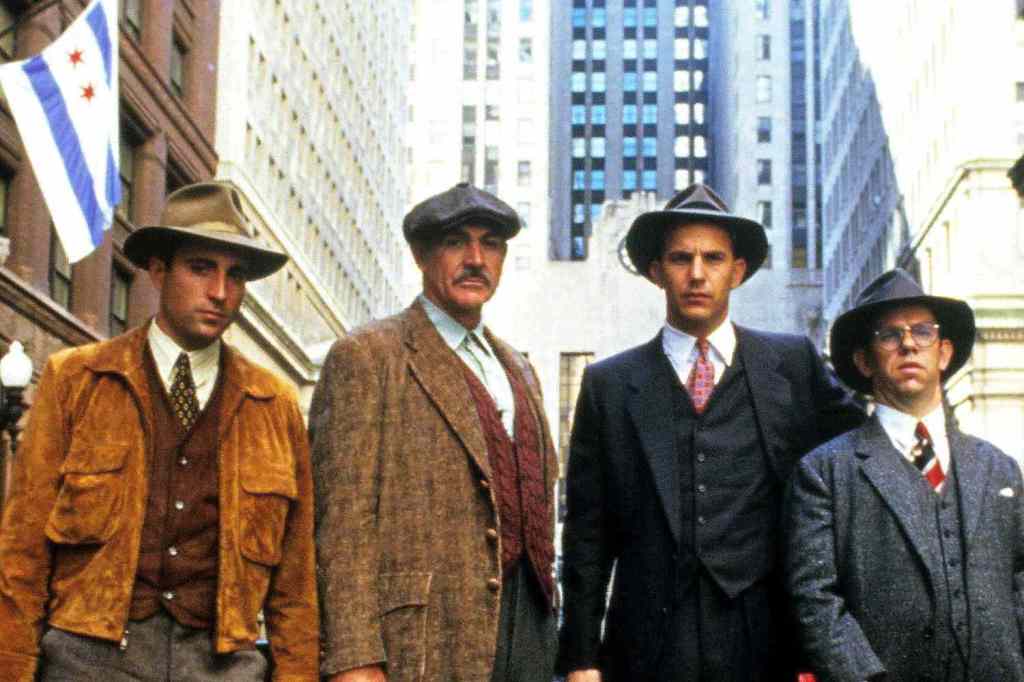
It’s 1930 and Prohibition is the law of the land in the United States of America. Treasury agent Eliot Ness (Kevin Costner) has been given the seemingly impossible task of bringing down notorious gangster Al Capone (Robert De Niro), who supplies booze to nearly all of Chicago. Capone doesn’t just supply the booze, he rules Chicago with an iron fist; and if you’re a local business who doesn’t want to buy his product, he just may blow your ass up! Ness’ job is made especially difficult due to the rampant corruption in Chicago, where everyone from the Mayor, to the judges, lawyers, and law enforcement officers are all on Capone’s payroll, making it pretty much impossible to trust anyone. In a complete stroke of luck, Ness encounters the honest Irish American policeman James Malone (Sean Connery) and asks him to join him in bringing down Capone. With Malone, Ness has found that honest and badass cop who’s not afraid to go up against Capone and his goons. Knowing that most of the police force is already compromised, the two men head to the police academy to try to find another honest cop. This turns out to be another great move as they come upon an Italian American trainee named George Stone (Andy Garcia), who’s a prodigy with a gun. Their last, and greatest move in this humble CPA’s opinion, comes when they accept accountant Oscar Wallace (Charles Martin Smith) to their team. Wallace is convinced that the key to bringing down Capone is trying to build a tax evasion case against him. He’s initially laughed at, but it’s soon apparent that this accountant knows his debits and credits, and his expertise may be just what’s needed to end Capone’s reign of terror once and for all.
I’ve always considered THE UNTOUCHABLES to be a near perfect film. One of the main reasons I find the film so perfect is the direction of Brian De Palma. I’ve been a fan of his “style” for so long, with films like DRESSED TO KILL (1980) and BLOW OUT (1981), but I think he just nails the material here. There are so many great scenes, but the “Union Station” sequence has to be one of the most perfectly choreographed sequences of all time. The building of the tension, the slow-motion shootout when the bad guys arrive, and finally the badass resolution all prove what an absolute master De Palma could be with the right material. De Palma claims that he made up the series of shots as he was filming the scenes at the train station, making the final product that much more impressive. And this all plays out against the background of a “lullaby theme” composed by the legendary Ennio Morricone (THE GOOD, THE BAD, AND THE UGLY). This is what “cinema” is all about.
THE UNTOUCHABLES has an amazing cast of actors to bring its “based on real events” story to life. Kevin Costner was just beginning to emerge as a movie star when this movie was made back in 1987. Especially as a younger actor, Costner was good at projecting both a certain innocence, tempered with the willingness to do what it takes to get the job done once his family and friends are put in danger. And what can you say about actors like Sean Connery and Robert De Niro?!! Connery is so charismatic, wise, and tough as the beat cop who shows Eliot Ness how to beat Capone… ”he sends one of yours to the hospital, you send one of his to the morgue!” He’s a beat cop because he’s incorruptible, and Connery projects that stubborn honesty perfectly. I’m so glad that Connery won an Oscar for this performance, as it would be the only time he would ever be nominated for an Academy Award. He’s amazing in this role, even if his accent is Scottish rather than Irish (a notable controversy at the time). Connery may have won the Oscar, but Robert De Niro matches him scene for scene. His ability to make Capone both charismatic and evil in equal measure is an example of what makes De Niro special as an actor. So many actors phone in these types of broad performances, but not De Niro. I also just think it’s cool that De Niro admitted that his performance was heavily influenced by Rod Steiger’s in 1959’s AL CAPONE. I love Steiger and consider this a wonderful tribute. Throw in a young Andy Garcia, the always underrated Charles Martin Smith, and a creepy Billy Drago as Frank Nitti, and you have one of the better casts ever assembled. I especially became a fan of Garcia based on his performance in THE UNTOUCHABLES.
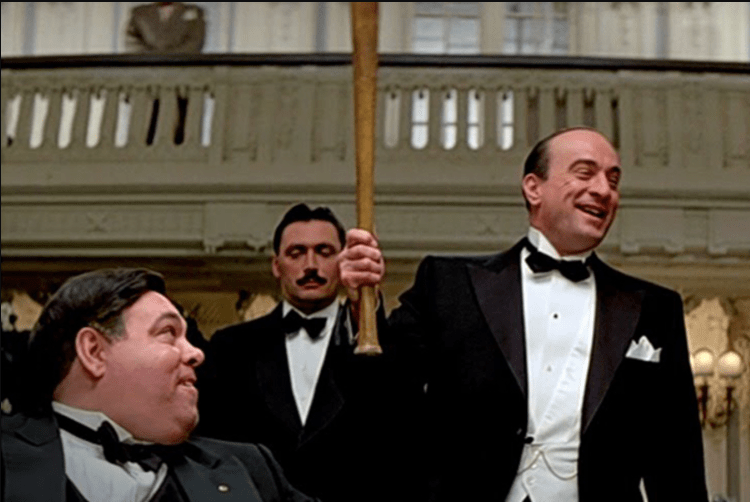
The last person I want to mention is the screenwriter, David Mamet. His screenplay is another perfect element of THE UNTOUCHABLES. The same man who has directed his own films like HOUSE OF GAMES (1987), HOMICIDE (1991), THE SPANISH PRISONER (1997), and SPARTAN (2004) knows how to write a great screenplay. There are so many amazing moments, from the “baseball bat” sequence to the “Stone recruitment” scene, and even Ness’ “he’s in the car” line about Frank Nitti, it’s a muscular screenplay full of big-time moments of audience satisfaction.
At the end of the day, THE UNTOUCHABLES is just a great movie. I still periodically thank my brother for picking it out that fateful day in the late 80’s, and it will always be one of my very favorites. It’s one of those movies that I recommend with zero reservations!
Check out the trailer below, and if you’re smart, you’ll watch one of the great movies of the 1980’s, Brian De Palma’s THE UNTOUCHABLES.
How about starting the long weekend with X?
This video stars and was directed by Exene’s son, Henry Mortensen and co-stars her niece, Carolyn Allen. The video was shot in Cannery Row in Monterey, California.
Enjoy!
1941’s Here Comes Mr. Jordan tells the story of Joe Pendelton (Robert Montgomery).
Joe’s a boxer, an honest and kind-hearted guy who is in training for the big title fight. Despite the concerns of his trainer, Max (James Gleason), Joe decides to take his own private airplane out for a flight. A freak accident causes the plane to go into a nosedive and Joe suddenly finds himself standing amongst the clouds with a bunch of other people who are waiting for their chance to enter Heaven.
7013 (Edward Everett Horton), an angel, explains that he took Joe’s soul up to heaven when he saw that the plane was about to crash. Joe is not happy about this. He wants his title fight! 7013’s superior, Mr. Jordan (Claude Rains), checks his records and discovers that a mistake has been made. Joe was supposed to live until 1991 and he was also supposed to win the boxing championship. Unfortunately, Max has had Joe’s body cremated. Mr. Jordan decides to put Joe’s soul into the body of someone else who is scheduled to die. Joe asks to be put in the body of an athlete so that he can pursue his boxing career.
Instead, Joe ends up in the body of a middle-aged banker named Bruce Farnsworth. Farnsworth has been poisoned by his wife (Rita Johnson) and her lover (John Emery). At first, Joe refuses to become Farnsworth but when he sees his murderers taunting Bette (Evelyn Keyes), whose father was defrauded by Farnsworth, Joe changes his mind. His murderers are shocked when Farnsworth turns out to be alive. Bette is shocked when the previously cold Farnsworth helps her get back the money that her father lost. And Max is shocked when Farnsworth calls him to the mansion and explains that he’s really Joe Pendleton. Only with Joe/Farnsworth plays the saxophone badly does Max believe what Joe says. Joe asks Max to train him for the boxing match that he was scheduled to fight while alive. Max agrees but Mr. Jordan warns Joe that, if he’s going to fulfill his destiny and become champ, it’s not going to be as Bruce Farnsworth, regardless of the fact that Joe/Farnsworth and Bette have now fallen in love.
A romantic comedy that is blessed with two likable performances from Robert Montgomery and Evelyn Keyes and a great one from Claude Rains, Here Comes Mr. Jordan was nominated for Best Picture of 1941. It lost to How Green Was My Valley. While Here Comes Mr. Jordan really can’t compare to some of the other films that lost (amongst the other nominees were Citizen Kane and The Maltese Falcon), it’s still a wonderfully charming film that holds up well today. Everyone should be as lucky as to have a guardian who is as charming and urbane as Claude Rains is as Mr. Jordan.
In 1978, Here Comes Mr. Jordan was remade by Warren Beatty, who named his version of the story Heaven Can Wait. That version of the story was also nominated for Best Picture, though it lost to The Deer Hunter.
 Through the Shattered Lens