This is another music video that immediately made me want to take a trip to the countryside so I could enjoy the view before losing everything to the curse of industrialization.
Enjoy!
This is another music video that immediately made me want to take a trip to the countryside so I could enjoy the view before losing everything to the curse of industrialization.
Enjoy!
Welcome to Late Night Retro Television Reviews, a feature where we review some of our favorite and least favorite shows of the past! On Mondays, I will be reviewing CHiPs, which ran on NBC from 1977 to 1983. The entire show is currently streaming on Prime!
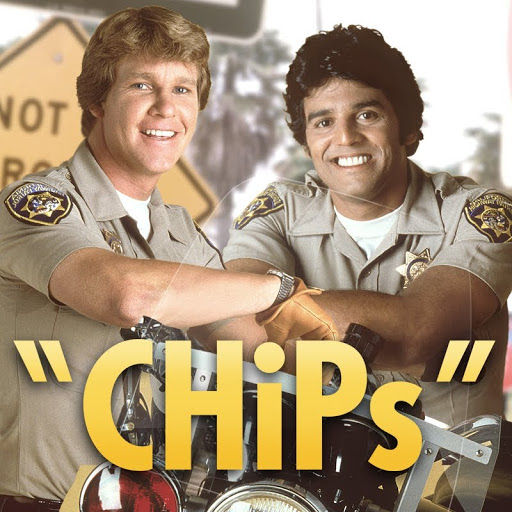
Baker and Ponch — but mostly Ponch — get a chance to shine this episode.
Episode 3.12 “Destruction Derby”
(Dir by Gordon Hessler, originally aired on November 24th, 1979)
Ponch and Baker are working undercover!
That’s …. odd. Aren’t they just members of the Highway Patrol? I mean, don’t get me wrong. I know that being a member of the Highway Patrol isn’t easy and I don’t mean to imply that they’re not doing an important job. But it just seems like undercover work would be something that you would give to a detective. It seems like you would need some sort of special training to do that. For a show that, in the past, has pretty much taken a day-in-the-life approach to its stories, a sudden undercover episode just feels weird.
Ponch and Baker are working at the local demolition derby, trying to uncover a drug ring that…. I don’t know. I guess people who sell drugs enjoy demolition derbys. To be honest, I get the feeling that someone in production said, “Let’s shoot a bunch of demolition derby footage and then we’ll just make up something stupid to justify it.” When it comes to the derby, Baker is working as a member of the pit crew and, of course, Ponch is the one driving the car. And, of course, Ponch turns out to be a natural because there’s nothing that Ponch can’t master. Ponch also falls for the only driver who can beat him, the mysterious Billy Wakefield (Angel Tompkins). This episode is from the 70s so, of course, there’s a scene where she takes off her helmet, her long blonde hair falls across her back, and I guess everyone at home is supposed to go, “A woman race car driver!? What is this madness!?”
Baker is not totally wasted in this episode. He gets to save Ponch’s life when the bad guys attempt to booby trap Ponch’s car. He also gets to play tennis with Getraer and Grossman. This episode may feature Ponch and Baker going undercover but it seems like the real plot is just Baker and Ponch doing fun California things. This episode basically is a commercial for the state. Look! the episode says, Tennis! Handball! Demolition Derbies! Erik Estrada! We’ve got it all!
Erik Estrada can be seen wearing a wrist brace in this episode, which I assume is a lingering result of the accident that he’s spent the last few episodes recovering from. I make a lot of jokes about Estrada but, from watching the last few accidents, it is obvious that he was pretty seriously injured in that stunt-gone-wrong. That, while recovering, he appeared on camera at all seems worthy of respect. A major theme of this episode seems to be that Ponch is back and Baker, after having the lead role for a few episodes, in once again back to being a supporting player. Thank you for your service, Larry Wilcox.
Anyway, this episode featured a lot of fast cars and a lot of crashes so I liked it.
Happy birthday, Chuck!
Welcome to Late Night Retro Television Reviews, a feature where we review some of our favorite and least favorite shows of the past! On Sunday, I will be reviewing the Canadian series, Degrassi High, which aired on CBC and PBS from 1989 to 1991! The series can be streamed on YouTube!

This week, everyone faces a test.
Episode 4.13 “Testing, One, Two, Three”
(Dir by John Bertram, originally aired on January 30th, 1990)
After being absent for the past few episodes, Joey and Caitlin are finally the center of this week’s story. Both of them are struggling. Joey, despite all of his efforts to study and pay attention in class, is still getting bad grades. The school counselor thinks that Joey has dysgraphia, a learning disability that makes it difficult for him to express his thoughts in an organized fashion. Caitlin, meanwhile, is going to have to appear in court as a result of getting arrested while vandalizing that nuclear plant.
A few thoughts:
And that’s it for the week. Remember — in yourself, you must believe!
Since Sunday is a day of rest for a lot of people, I present #SundayShorts, a mini review of a movie I’ve recently watched.
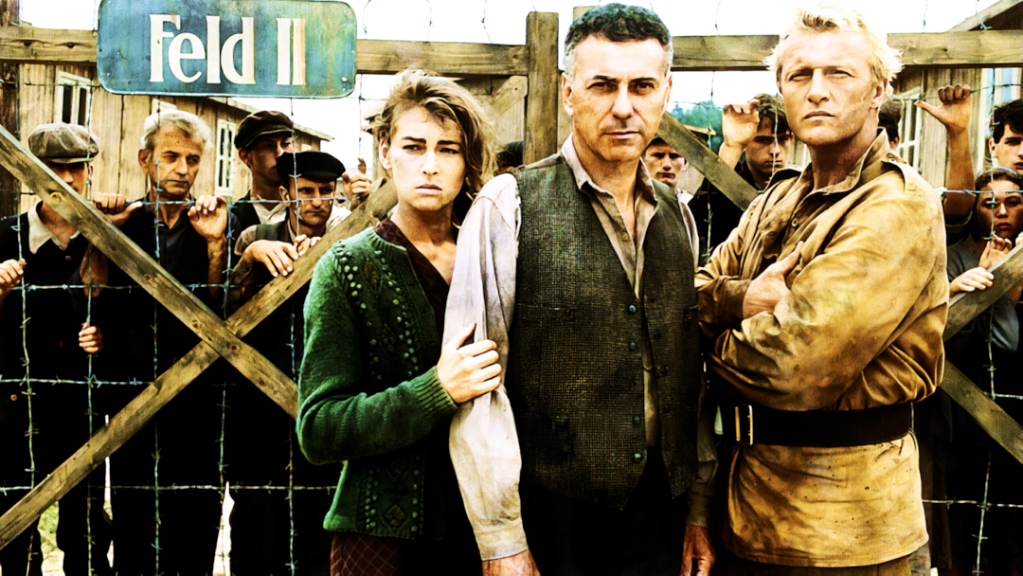
The 1987 movie ESCAPE FROM SOBIBOR is the historical re-creation of the escape from the Nazi Death Camp Sobibor, where approximately two hundred fifty thousand Jews were executed. Of the approximately six hundred prisoners who attempted to escape, around three hundred succeeded with somewhere between 50 and 60 surviving to see the end of the war.
The plot of ESCAPE FROM SOBIBOR revolves around Leon Feldhendler (Alan Arkin), the leader of the Jewish prisoners at Sobibor, who eventually comes to realize that they are being held in nothing more than a death camp. He figures out that the only people being allowed to live are the goldsmiths, seamstresses, shoemakers, and tailors; these are the people who are able to repair the shoes, recycle the clothing, and melt down any silver or gold for the Nazis. He also knows that once the trains stop coming in, all the remaining Jews will be murdered. As such, he and a group of men devise a plan for every prisoner to escape by luring the Nazi officers into the prisoners’ barracks and killing them as quietly as possible. With the help of a group of highly skilled Jewish, Russian soldiers, led by Sacha Pechersky (Rutger Hauer), their plan was put into action on October 14th, 1943, leading to the largest escape from a prison camp of any kind in Europe during World War II.
ESCAPE FROM SOBIBOR is an excellent film, and it’s currently streaming on Amazon Prime and TUBI as I type this. If you enjoy THE GREAT ESCAPE (1963), I promise you will enjoy this film. It’s very hard to watch at times, as most Nazi concentration camp movies are, but you can’t help but be completely invested when the prisoners attempt their escape at the end. It’s always important to remind ourselves of the levels of evil and heroism that our fellow humans are capable of. ESCAPE FROM SOBIBOR does an excellent job of that.
Here are five interesting facts about the film:
I highly recommend ESCAPE FROM SOBIBOR. It’s an important film and one of the greatest films that Rutger Hauer ever worked on. Enjoy the trailer below!
Today’s song of the day is a reminder to set your clocks if you haven’t done so already. We lost an hour this morning and who knows if we’ll ever get it back.
Here is Hans Zimmer’s beautiful Time, from the Inception soundtrack.
Welcome to Retro Television Reviews, a feature where we review some of our favorite and least favorite shows of the past! On Sundays, I will be reviewing Homicide: Life On The Street, which aired from 1993 to 1999, on NBC! It can be viewed on Peacock.
If you’re checking with the imdb and saying, “You’re reviewing these out of order!,” I’m reviewing them in the order that they were meant to air as opposed to the order by which NBC showed them.
Episode 3.5 “The Last of the Watermen”
(Dir by Richard Pearce, originally aired on December 9th, 1994)
We learn a bit more about the personal lives of Baltimore’s Homicide detectives with this episode.
For instance, we discover that Munch and Gee living in the same neighborhood. When Gee, whose washing machine has broken down, visits the local laundromat, he’s not necessarily overjoyed to see Munch sitting there. Munch talks and talks. Gee lights a cigar and tries to read his newspaper in peace. Munch keeps talking. Gee points out that it’s the weekend and he doesn’t like to talk to anyone on the weekend. Sunday is his day. Munch nods and then keeps talking. Gee stands up and moves to another part of the laundromat.
We also get to meet Kay Howard’s family. Disgusted by the latest murder scene that she and Beau have come across and the fact that an elderly woman was murdered and her tongue was subsequently cut out and then stuffed down her throat (yikes!), Kay decides that she’s due some vacation time. She leaves Baltimore and drives out to the local fishing village where she grew up. She spends time with her father and her brother and a guy who she once had a romantic relationship with. She visits her mother’s grave. It’s interesting to see Kay outside of Baltimore and to see how she interacts with family. It was so interesting that I was kind of annoyed that she still ended up working a murder. A local environmental activist is murdered. Kay worries that the murderer might have been her brother but it turns out to have been another fisherman. I mean, I get it. The show is called Homicide and Kay is a detective but still, I would have been just as happy if the show had just focused on her family and their rituals. This episode is 30 years old but the scenes of the blue collar fishermen talking about how they were being “regulated” out of their life’s work still rang true.
While Kay was visiting family, Felton got a temporary new partner and you’ve probably already guessed that it was Pembleton. This is not the first time that Pembleton has been assigned to work with Felton. The pilot featured that classic scene of Pembleton checking car-after-car while Felton complained about Pembleton always having to be right. Felton and Pembleton do make for an interesting team, if just because they do seem to sincerely dislike each other. (I also enjoyed Gee’s half-smile as Pembleton reacted to the news that he would be working with Felton.) In this case, Pembleton and Felton working together didn’t lead to any great fireworks, other than Felton reacting with shock at the idea of Pembleton preferring hockey to basketball. The killer of the elderly woman turned out to be her grandson who said he did it because she wouldn’t stop talking. That was sad, to be honest. Grandmothers are supposed to talk. Felton and Pembleton dragged the kid off to jail.
This was an okay episode. After the emotional powerhouse of Crosetti, it was good to get something that was a bit more lowkey. It was nice to be reminded that everyone has a family.
Today’s music video of the day is another voyage into the wild world of the rural landscape. I watched this video and ordered a new pair of thigh high boots.
Enjoy!
Welcome to Late Night Retro Television Reviews, a feature where we review some of our favorite and least favorite shows of the past! On Saturdays, I will be reviewing the Canadian sitcom, Check it Out, which ran in syndication from 1985 to 1988. The entire show is currently streaming on Tubi and Peacock!

I guess Howard’s a TV star now.
Episode 3.9 “Bannister & Dale”
(Dir by Alan Erlich, originally aired on November 14th, 1987)
Mr. Dale (Paul Soles) is an old vaudevillian who now shops at Cobb’s. He doesn’t have enough money to pay his rent so Howard gives him a job working at the store. He doesn’t have enough money to keep his retirement home running so Howard gets Mr. Dale booked on a television show. Mr. Dale’s old partner died in 1952 so Howard agrees to step in and….
Wait. Howard’s a talent agent now?
Seriously, how does a grocery store manager have the connections necessary to get an obscure vaudevillian booked on a national talk show? I mean, I get that they’re all up in Canadas and it’s a simpler place but still, it just seems like a stretch. And really, how popular was vaudeville in the 80s? I always see all of these old TV shows, where the characters are doing a fundraiser or something and they recreate a vaudeville act or they put on clown makeup and sing Bring In The Clowns but it never feels very realistic.
Anyway, most of the show is made up of Howard and Mr. Dale recreating Mr. Dale’s old vaudeville routines and it’s all pretty dumb. But I will say that it was a lot easier for me buy Don Adams as an old man who remembered and loved vaudeville than as the swinging 40-something store manager that the show usually presents him as being. Still, it’s a bit strange to imagine a national talk show setting aside time for an act featuring an old vaudevillian and a grocery store manager. I guess that’s Canada for you.

I watched the Oscars on March 2nd. I originally intended to watch it on Hulu but Hulu struggled, just as Netflix did during its first time out, with streaming such a large event and I ended up just watching the ceremony on boring old ABC. I liked the Oscars this time around. Conan O’Brien was a good host. The politics were kept to a minimum. The ceremony moved along efficiently and it was hard not to get caught up in Sean Baker’s enthusiasm. I cheered when Flow won. I groaned when the Best Documentary winners started their long ramble. The ceremony felt like a throwback to the old Oscars. The ratings were not good, regardless of how they’ve been spun. Eventually, the Oscars will be something that will be exclusively streamed on Hulu and that’s it. Hopefully, Hulu will get the bugs out of the system before next year.
Before I watched the Oscars, I watched Devil In The Family: The Fall of Ruby Franke, the latest creepy true crime docuseries on Hulu. I watched as Ruby went from a successful mommy vlogger to a convicted felon. Interestingly, most of the people hurt by Ruby went on to become influencers themselves. The docuseries was an intense look at just how crazy people can get in a world where everyone is famous.
Also on Sunday, I watched Gordon Ramsay rescue a gastropub on Kitchen Nightmares. Come Thursday, I watched another episode of Dark with Case.
Throughout the week, I watched my usual shows for my Retro Television Reviews. I didn’t watch a lot and I need to get caught up on Abbott Elementary, Survivor, and a few others. But this week was still an improvement over last week!
 Through the Shattered Lens