Film Review: Joe Kidd (dir by John Sturges)


1972’s Joe Kidd opens with the title character (played by Clint Eastwood) in jail.  Joe is a New Mexico rancher and apparently, someone with a long history of getting in trouble with the law.  This time, he’s been arrested for poaching and disturbing the peace.  Given a choice between a fine and ten days in jail, Joe goes for the ten days.  Cowardly Sheriff Mitchell (Gregory Walcott) says he’s going to put Joe to work.  Joe Kidd snarls in response.

However, that’s before Luis Chama (John Saxon), a Mexican revolutionary, raids the courthouse and demands that all of his people’s ancestral land be returned to them.  Local landowner Frank Harlan (Robert Duvall) forms a posse to track Chama down.  Joe says that he has nothing against Chama but that changes once he discovers that Chama raided his ranch and beat up one of his ranchhands.  Joe joins the posse but he soon discovers that Harlan and his men are sadists who are more interested in killing Mexicans than actually capturing Chama.

I was actually pretty excited about watching Joe Kidd.  Clint Eastwood, Robert Duvall, and John Saxon, three of my favorite actors in the same movie!  How couldn’t I be excited?  Unfortunately, neither Duvall nor Saxon are at their best in this film.  Frank Harlan is a one-dimensional villain and Duvall doesn’t make much of an effort to bring any sort of unexpected nuance to the character.  Duvall doesn’t give a bad performance but it’s hard not to feel that Harlan is a character who could have been played by any forty-something actor.  It feels like waste to cast such a good actor in such a thin role.  (Add to that, I prefer Duvall when he plays a good guy as opposed to when he plays a bad guy.)  As for Saxon, this is probably one of his worst performances but his character is also rather underwritten and the film can’t seem to decide if it wants the viewer to be on his side or not.  Saxon delivers his lines in an exaggerated Mexican accent that makes it difficult to take Louis Chama seriously.  Gregory Sierra would have made a good Louis Chama but Saxon just seems miscast.

Fortunately, Clint Eastwood is always a badass, even in an uneven film like this.  Eastwood is at his best in the early scenes, when he’s grouchy and hungover and annoyed at finding himself in the jail.  He is believably outraged by Harlan’s tactics and, in typical Eastwood fashion, he delivers every pithy one-liner with just enough style to keep things interesting.  That said, Eastwood is let down by a script that never really makes it clear why Joe Kidd stays with the posse once it becomes clear that he’s traveling with a bunch of sociopaths.  Joe’s motivations are never really clear.  In the end, he seems like he goes through a lot of trouble to protect his farmland and get revenge for one of his ranch hands (who is just beaten up), just to then desert it all once all the shooting is over.

That said, Joe Kidd is a gorgeous film to look at and Joe makes creative use of a steam engine.  This isn’t the film to show anyone who isn’t already an Eastwood fan.  But, for those of us who are already fans of Clint, it’s enjoyable to watch him snarl, even if it is in a lesser film.
Film Review: Kelly’s Heroes (dir by Brian G. Hutton)


1970’s Kelly’s Heroes takes place in France during the Second World War.  The American army is moving through the country, liberating it town-by-town.  Private Kelly (Clint Eastwood) is a former lieutenant who was busted down in rank after leading a disastrous raid on the wrong hill.  (It was the fault of the generals but Lt. Kelly was set up as a scapegoat.)  When Kelly learns that the Germans are hiding a huge amount of gold in an occupied town, he gathers together a team of weary soldiers, misfits all, and plans to go AWOL to steal the gold for themselves.

Kelly’s Heroes was one of the big budget studio films that Eastwood made after finding stardom in Europe with Sergio Leone’s Spaghetti westerns.  This is very much an ensemble film, in the vein of The Dirty Dozen.  Indeed, Eastwood’s co-star, Telly Savalas, was in The Dirty Dozen.  Here, Savalas plays Big Joe, the sergeant who isn’t sure that he wants to put his men in danger for gold that may or may not exist.  Don Rickles plays Crapshoot who is …. well, imagine Don Rickles in the middle of World War II and you have a pretty good idea of who Crapshoot is.  Stuart Margolin, Harry Dean Stanton, Perry Lopez, Gavin MacLeod shows up as soldiers.  Carroll O’Connor plays the bombastic general who mistakes Kelly’s attempts to go AWOL for a brilliant tactical maneuver,  Like all of the senior officers in this film, O’Connor’s general is a buffoon.  Kelly’s Heroes was made during the Vietnam War and, much like Patton (released the same year), it attempts to appeal to both the establishment and the counterculture by making the heroes soldiers but their bosses jerks.

And that brings us to Donald Sutherland, who plays a tank commander named Oddball.  You may not have know this but apparently, there were hippies in the 40s!  Actually, I don’t think that’s true but there’s really no other way to describe Oddball than as a Hollywood hippie.  He’s a blissed-out, spacey guy who thinks nothing of accidnetally driving his tank through a building.  The films ask us to believe that the long-haired and bearded Oddball is a World War II tank commander and Sutherland is such a likable presence that it’s temping to just go with it.  Oddball was obviously included to bring in “the kids” but he does generate some needed laughs.  This is a very long movie and the comedic moments are appreciated.

Kelly’s Heroes is two-and-a-half hours long and it definitely could have been shorter.  Director Brian Hutton allows some scenes to drag on for a bit too long and he sometimes struggles to balance the moments of comedy with the moments of violent drama (quite a few character dies) but he does get good performances from his ensemble.  Eastwood’s taciturn acting style is nicely matched with Savalas’s more expressive style and it’s hard not smile at Don Rickles, insulting everyone as if they were guests at Joe Gallo’s birthday party.  The film, at times, doesn’t seem to know if it wants to be a satire or a straight heist film but the cast keep things watchable.  Eastwood even gets to show a few hints of the dry sense of humor that always hid behind the perpetually bad mood that often seemed to hang over him in his early films.  Whatever flaws the film may have, it was a box office success.  One year after this release of Kelly’s Heroes, Eastwood would make history as Dirty Harry.

Film Review: Two Mules For Sister Sara (dir by Don Seigel)


In 1970’s Two Mules For Sister Sara, Clint Eastwood and Shirley MacClaine take on the French!

It’s an often forgotten piece of history that, during the American Civil War, the French invaded Mexico and tried to turn it into a colony, one that was ruled by the hapless Archduke Maximillian.  The French were then led by Napoleon III, a rather enigmatic figure who spent his entire reign trying to live up to his namesake (and failing).  While the Americans would never have tolerated a French invasion of Mexico under normal circumstances, the Civil War provided enough of a distraction for Napoleon III to make his move in 1861.  Of course, as soon as the Civil War ended, America turned its attention to getting the French out of Mexico and, by the end of 1867, Maximillian had been executed and Napoleon III had withdrawn his forces.

Two Mules For Sister Sara takes place shortly after the end of the American Civil War, when the latest Mexican Revolution was in full swing.  Clint Eastwood plays Hogan, a former union officer who is now in Mexico working as a mercenary.  He’s been hired to help the revolutionaries attack a French garrison, in return for being given half of whatever is found inside.  Traveling through the desert, he comes across a group of bandits who are about to rape a woman named Sara (Shirley MacClaine).  Hogan guns down the bandits and is then shocked when Sara dons a habit and introduces herself as a nun who has been helping the revolutionaries.  She requests that Hogan travel with her and continue to protect her.  Hogan is reluctant, saying that he doesn’t want to become Sara’s mule when she already has one.  (That would be two mules for Sister Sara …. get it?)  But since Sara is a nun and claims to have no idea how to defend herself in the wilderness, Hogan agrees.  Sara and Hogan become unlikely allies as they get further and further involved in the Mexican Revolution.

Two Mules For Sister Sara owes a good deal to the Spaghetti westerns that were then coming out of Italy.  (Eastwood, of course, owed much of his stardom to his appearances in Sergio Leone’s Dollars trilogy.)  The Mexican Revolution was always a popular subject amongst the writers and directors of the Italian Spaghetti westerns.  Of course, Two Mules For Sister Sara is lacking in the political subtext that appeared in many of the Italian films.  Director Don Siegel may have been a liberal but, unlike many of his Italian contemporaries, he wasn’t a Marxist.  Instead, Two Mules For Sister Sara shows its Spaghetti influence in its panoramic visuals, it’s somewhat cynical sense of humor, and the casting of Eastwood as a taciturn mercenary whose main concern is using the revolution to make some money.  Eastwood plays a slightly more humorous version of his Man With No Name.  Hogan may be a cynic who doesn’t speak unless it’s absolutely necessary but he also possesses a good enough heart that there’s no way he’s going to abandon Sister Sara to fend for herself.  (The Man With No Name, on the other hand, would probably not have been so generous.)  Of course, Sister Sara has a secret of her own….

Supposedly, Eastwood and MacClaine didn’t get along particularly well while making Two Mules For Sister Sara.  (During preproduction, the film was envisioned as starring Eastwood and Elizabeth Taylor.)  If there was hostility between the two leads, it worked in the film’s favor because both Eastwood and MacClaine do a good job of playing off of each other.  MacClaine, at first, seems too contemporary for the role but, as the film progresses, she becomes more convincing.  There’s a revelation towards the end of the film that reveals that many of the moments that made MacClaine seem miscast were actually deliberate.  As for Eastwood, there’s a subtle humor running through his performance, as if he’s poking fun at his own tight-lipped persona. His performance here shows hints of the actor that he would become.

Two Mules For Sister Sara is an entertaining western, one that features Eastwood and Seigel celebrating and, at the same time, poking fun at the genre.  A year after this film, Eastwood and Seigel would make film history with Dirty Harry.

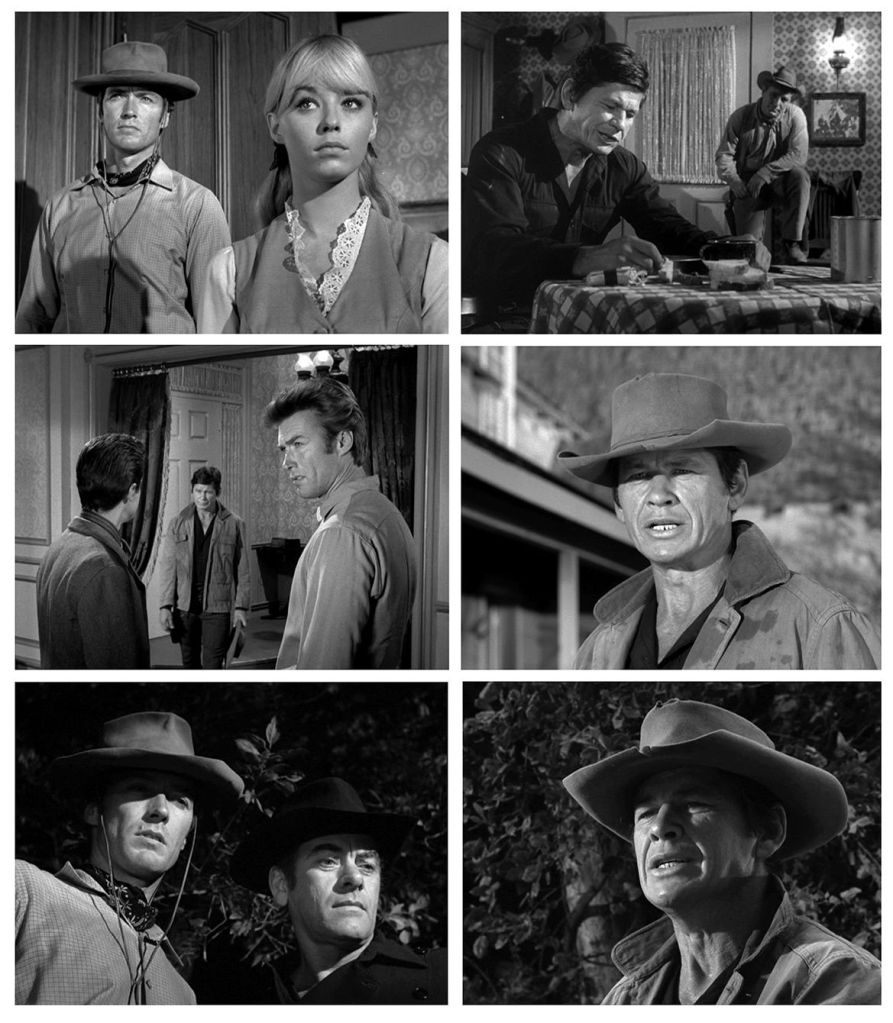
RAWHIDE (TV Series) – starring Clint Eastwood – S8, E10: “Duel at Daybreak” (Guest star – Charles Bronson)


This episode of the classic western TV series RAWHIDE opens as Rowdy Yates (Clint Eastwood) and his group of drovers agree to drive 750 head of cattle belonging to rancher Mason Woodruff (Larry Gates) to market. The deal gets off to a bad start when Roman Bedford (Brendon Boone), who’s part of Yates’ outfit, finds himself trying to romance Vicki Woodruff (Jill Haworth), the daughter of the ranch owner. Woodruff’s foreman and world class A-hole, Del Lingman (Charles Bronson) sees Roman making his move and gets pissed. You see, Del wants Vicki for himself, so he tries to bully Roman into a gunfight. Luckily for young Roman, Rowdy and Mason Woodruff are able to momentarily diffuse the situation before the cowboy can be blown away by the experienced gunman. Unable to accept the humiliation that he suffered at the hands of Del, Roman challenges him to a duel to settle the score. Roman is a good shot, but he’s not a fast draw, so a couple of the men with Yates’ crew, Jed Colby (John Ireland) and Simon Blake (Raymond St. Jacques), try to teach him some tricks that just may give him a chance against Del’s superior gunplay. To complicate matters even further, Mason Woodruff has a hidden criminal past that Roman may know about. Because of this, the rancher has another reason to want Roman dead, and Del Lingman is just the man to take care of the problem. Who will survive the duel at daybreak?!! 

As hard as it is to believe, my viewing of “Duel at Daybreak” is the only episode of RAWHIDE that I’ve ever watched, and it’s special to me for two reasons. First, the episode premiered on my mom’s 14th birthday, November 16, 1965. And second, it’s the only time that tough guy icons Clint Eastwood and Charles Bronson would appear on screen together. For historical reference, this was the last season of RAWHIDE, with only three episodes of the classic series to come after this. Eastwood was at the beginning of his legendary movie career after filming FISTFUL OF DOLLARS (1964) and FOR A FEW DOLLARS MORE (1965) for director Sergio Leone. Bronson, who was already a well-respected character actor, was two years away from making THE DIRTY DOZEN (1967) and three years away from breaking out as an international superstar by playing Harmonica in Leone’s masterpiece, ONCE UPON A TIME IN THE WEST (1968). 

For the episode itself, Charles Bronson is the true standout as Del Lingman. He’s the kind of mean SOB who would goad a man into a gunfight, kill him, and then sit down for dinner without a care in the world. Bronson has a face that makes for a good villain, and he often played the bad guy in his early TV shows and movies. He projects real menace and danger in this role. Clint Eastwood’s Rowdy Yates may be the star of the show and the trail boss, but he’s a bit more of a secondary character in this specific episode as the main tension is between Bronson and the young cowboy played by Brendon Boone. Looking back now, it’s an incredible missed opportunity that the “duel at daybreak” wouldn’t feature Eastwood versus Bronson. Eastwood mostly tries, and fails, to play peacemaker in the episode. The two legends do exchange a potentially badass back and forth when Eastwood is trying to deescalate the situation and keep Bronson from shooting the young cowboy over a little mud on his pants:

Rowdy Yates: “Putting a high price on a pair of pants, ain’t you?”

Del Lingman: “Perhaps you’d like to pay for them.”

Rowdy Yates: “Any time, mister.”

It’s a good scene, but it’s just a shame that they didn’t get a chance to mix it up at the end. 

As Charles Bronson’s biggest fan, I enjoyed seeing a couple of actors who worked with him in the 80’s. John Ireland, who plays Jed Colby in this episode, co-starred with Bronson in MESSENGER OF DEATH (1988) as Morman patriarch Zenus Beechum. It’s not one of Bronson’s best, but one of the highlights of the film is its strong cast. Ireland has roles in so many great films, including MY DARLING CLEMENTINE (1946), RED RIVER (1948), GUNFIGHT AT THE O.K. CORRAL (1957) and FAREWELL MY LOVELY (1975). He would appear in 11 episodes of RAWHIDE. Raymond St. Jacques, who plays Simon Baker in this episode, has a very memorable role in Bronson’s disturbing hitman thriller THE EVIL THAT MEN DO (1984). In a unique twist in the Bronson filmography, Jacques’ bodyguard character Randolph gets duped into thinking he’s about to get some three-way action with Bronson and Theresa Saldana only to end up dead with a knife sticking out of his throat. It’s a memorable meet and kill. I noticed he played a character named “Coffin” Ed Johnson in COTTON COMES TO HARLEM (1970). With a name like that, he’s got to be good! He would appear in 13 episodes of RAWHIDE. 

Overall, “Duel at Daybreak” is a special episode of RAWHIDE since it put Eastwood and Bronson on screen together for the only time in their careers. I wish they could have fought with fists or guns, but it wasn’t meant to be. Beggars can’t be choosers, and at this point, I’ll gladly take what we got.

Film Review: Francis In The Navy (dir by Arthur Lubin)


In 1955’s Francis In The Navy, Donald O’Connor plays Lt. Peter Sterling, an officer in the U.S. Army who gets word that his best friend, a talking mule named Francis (voice of Chill Wills), is about to be auctioned off by the U.S. Navy.  Sterling rushes to the Naval base but, along the way, his wallet gets stolen, he gets mistaken for an AWOL soldier, and Francis gets sold to a laboratory.

Hold on, I’m re-reading that last paragraph to make sure that I didn’t hallucinating typing all that…

Peter argues that he’s not the AWOL soldier, he’s just someone who looks just like him.  Peter gets tossed into the psychiatric ward.  Francis advices Peter …. yes, the mule that can talk gives Peter advice on how to get out of the mental ward …. to pretend to be the AWOL sailor.  Unfortunately, the sailor is a champion boxer so that means Peter will have to enter the ring.  Peter, needless to say, is not a boxer.  Peter also falls for a nurse (Martha Hyer) but — uh oh! — she’s the sister of the AWOL soldier.  Well, that’s kind of awkward.  I don’t have a brother but if I did, I doubt I would ever want to make out with anyone who looked like him.  Like seriously….

Hold on, I’m re-reading that last paragraph to see if there’s anything that I need to add.

Like, seriously, what the Hell?  This movie has a talking mule, an oddly incestuous subtext, and Donald O’Connor playing two roles.  Doing some research, I discovered that this was the sixth film to deal with the adventures of Peter Sterling and Francis.  This was the last one of them to star Donald O’Connor, who apparently resented getting upstaged by a mule.  There was one more Francis movie after this one and it starred Mickey Rooney.  It was called Francis In The Haunted House so who knows?  Maybe I’ll review it for our October horrorthon.  (Don’t count on it.)

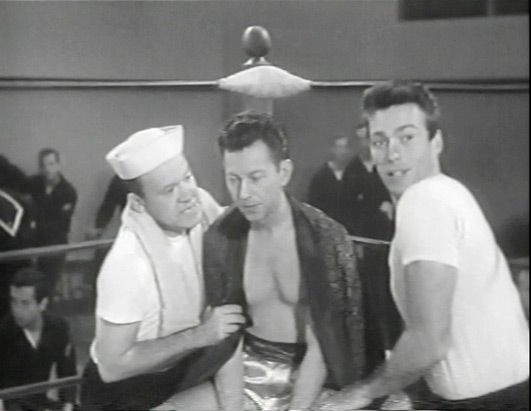
As weird as this film is, it’s kind of likable.  Donald O’Connor is a favorite of mine and this one featured O’Connor in two roles, as both the hapless Peter and also the sailor who goes AWOL and repeatedly refuses to help Peter out.  And, while I’m not really sure why he’s talking, Francis was actually cute.  I enjoyed the boxing scene where he attempted to help Peter out.  Unfortunately, there’s only so much a mule can do.

As for why I’m reviewing this movie, it’s because Clint Eastwood is in the cast.  He plays Jonesy, a friend of the AWOL sailor who becomes a friend of Peter’s.  Now, to be clear, Clint doesn’t do a lot in the movie.  He works Peter’s corner during the boxing match.  Otherwise, he spends most of the time in the background and he has a few scenes where he hangs out with the rest of the AWOL sailor’s friends.  That said, Clint does make an impression.  Even in this very early role, he had an impressive screen presence.  He’s the tallest guy there and he’s got the best hair.  Once you spot him in a scene, it’s hard to look away.

Francis In The Navy is historically significant because it’s the first film for which Clint Eastwood received on-screen credit.  (Eastwood previously appeared in films like Revenge of the Creature and Tarantula but his name wasn’t included in the credits.)  It’s an odd film, one that’s likable if you’re in an undemanding mood and you enjoy goof — extremely goofy — humor.  It would be forgotten if not for Eastwood’s appearance.  Seen today, this film, like Eastwood’s other early appearances, reminds us that everyone started somewhere.

Music Video of the Day: I Talk To The Trees by Clint Eastwood (1969, dir by Joshua Logan)


Okay, it’s not so much a music video as it’s a scene from a movie but whatever.  It’s Clint Eastwood’s birthday, we’re about to post a ton of Clint Eastwood-related reviews today, and I wanted to start things out with Clint!

This scene is from 1969’s Paint Your Wagon.  You know what?  Clint’s voice wasn’t that bad in this movie.  That said, I’m glad I talked to my sister into reviewing it instead of me.  When I was in college, I took a class about musicals and there was this frat boy sitting behind me who just obsessed with Paint Your Wagon,

Happy birthday, Clint!

Enjoy!

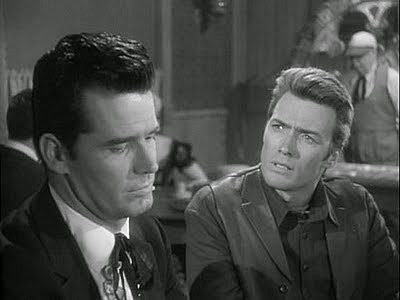
MAVERICK (TV Series) – starring James Garner – S2, E19: “Duel at Sundown” (Guest star – Clint Eastwood)


Bret Maverick (James Garner) stops off and visits his old friend Jed Christianson (Edgar Buchanan). Jed is desperate to break up the hot and heavy romance between his beautiful and wild daughter, Carrie (Abby Dalton), and a good for nothing gunslinger named Red Hardigan (Clint Eastwood). He asks Bret to stay for a while and help break them up. Not really wanting to get involved, Bret changes his tune when he’s offered $1,000 to hang around for a week. There is one serious problem, though, and that’s the fact that Red has a reputation for being extremely fast and accurate with a gun, and he’s not afraid to use it. When Bret actually sees a demonstration of Red’s shooting skills, he knows he’s going to have to come up with a plan to drive Red away that avoids a gunfight at all costs. And that’s exactly what he does. I won’t give away exactly what he does, but it involves his brother Bart (Jack Kelly) and a notorious gunslinger named John Wesley Hardin, and it’s genius! 

As we continue to celebrate the birthday of Hollywood legend Clint Eastwood, I decided I’d watch his 1959 guest starring appearance on the TV series MAVERICK with James Garner. I recently watched Eastwood and Garner work together in the enjoyable “geezers in space” movie SPACE COWBOYS (2000), which came out about 40 years after this. With that fresh in mind, I especially enjoyed seeing them work together while they were both in their prime. “Duel at Sundown” is the first episode I’ve watched of the MAVERICK TV series, and I must say that I had a ball with it. James Garner’s effortless charisma and laid back demeanor as Bret Maverick make his character right down my alley. Nothing seems to rattle the man, and he’s as funny as hell! As of the time of this review, all five seasons of the series are streaming on PlutoTV, so I’m planning on catching some more episodes as I can. As far as the young Clint Eastwood, who was 29 when this show premiered, he definitely looks the part of a future star. Maybe I’m just being influenced by what he’s accomplished over the last 60 years, but his steely intensity, his great head of hair, and his way with the ladies are all on display. And even though his character of Red is a hot headed gunslinger who’s driven by jealousy, there are a couple of times when he flashes that million dollar smile, and you can’t help but like him. For me, it’s fun to watch these megastars in roles when they were just working actors trying to build a career. You can usually see the qualities that will make them the most popular actors in the world, but they’re still going to lose to the star of the series at the end. It’s a rite of passage. 

Overall, “Duel at Sundown” is an excellent introduction to the MAVERICK TV series for me. It’s funny and actually quite clever, as evidenced by the scheme that Bret Maverick comes up with at the end to keep from having to face Red in a gunfight. But the true highlight is seeing Garner, in one of his signature roles, working with a young Eastwood who’s destined for stardom. I highly recommend it! 

10 Films For The Weekend (5/30/25)


Here are ten films that I recommend checking out this weekend.  These films are all streaming so, if you’re stuck inside due to weather or crippling depression, give them a shot!

In Honor of Clint Eastwood

Saturday will be Clint Eastwood’s 95th birthday.  Clint’s career has stretched from the 50s t0 the present day.  (Though some thought he might retire after 2024’s Juror #2, Eastwood is reportedly working on a new film.)  We’ll be posting a lot of Eastwood reviews tomorrow but I want to take the time right now to mention three of his films that will be streaming this weekend.

First off, 2024’s legal thriller, Juror #2 (which I consider to be the best film of 2024), is still streaming on Max.  Featuring excellent performances from Nicholas Hoult and Toni Collette, Juror #2 is an entertaining courtroom thriller that, in its efficient and non-flashy way, shows that Eastwood is still one of the best directors work.

Clint Eastwood was 88 years old when he gave one of his best performances in 2018’s The Mule.  The Mule tells the true story of a 90 year-old widower who found a second job smuggling drugs across the country for a Mexican cartel.  Eastwood gives a likable performance as someone who is definitely not an action hero but who gets a second lease on life by working with some very dangerous people.  This film is tense, poignant, and surprisingly funny at time.  It’s on Netflix.

Also on Netflix is 2014’s American Sniper, a film that Eastwood directed.  Bradley Cooper gives a strong performance as Chris Kyle and Eastwood direction will leave you breathless.  This film was controversial when it was released.  It had only been two years since Eastwood gave his speech at the Republican Convention and, amongst the online crowd, there was still a lot of anger at him.  (Considering that the online critics often presented themselves as being film experts, it was surprising how many of them apparently did not know that Eastwood was, at the time, a lifelong Republican.  Apparently, he’s currently registered as a Libertarian.)  Personally, I don’t find American Sniper to be a political film.  Eastwood’s made a lot of films about war and he’s never been one to glorify it.  Instead, as with many of Eastwood’s films, it’s a character study of man who has to learn how to live with his actions.

Here’s Some More Action

If you’re in the mood for some non-Eastwood action, here’s some suggestions.

Rolling Thunder (1978), starring William Devane and Tommy Lee Jones, is both a revenge film and a look at the struggle of two men returning to a country that they no longer recognize.  Devane and Jones’s characters have recently returned from a Vietnamese POW camp.  When Devane’s wife and son are killed by bandits and Devane’s hand is lost in a garbage disposal, he and Jones join forces to “clean them up.”  This film is a favorite of Quentin Tarantino’s and I personally consider it to be one of the best Texas-set films ever made.  Devane has never been better and Jones deserved an Oscar for his performance as the emotionally shattered and withdrawn vet who comes to life when it time to “kill a bunch of people.”  Rolling Thunder is currently on Tubi.

Jeff says that The Delta Force (1986) is the greatest film of all time.  And while I personally don’t think that’s possible as long as Money Plane exists, I will say that there is something very emotionally satisfying about watching Chuck Norris and Lee Marvin take out a bunch of terrorists.  I dare you not to shed a tear when George Kennedy’s priest walks to the front of the plane and declares that if the terrorists are taking the Jewish passengers hostage, they’ll have to take him as well because “I’m Jewish.”  The Delta Force can be found on Tubi and Prime.

Finally, I don’t think Brad would forgive me if I left out Charles Bronson.  Breakheart Pass (1975) is an interesting and unfairly overlooked Bronson western, one that mixes a genuine murder mystery with all the action that one could hope for.  Playing a 19th century detective on a train, Bronson more than holds his own against an impressive array character actors, including Charles Durning and Ben Johnson.  It can currently be viewed on Tubi and Prime.

Odds and Ends

I read a story this week that France is planning on banning outdoor smoking.  Seriously, what is happening to that country?  How did they go from being the country of sexy ennui to the country that bans smoking?  It’s a shame.  If you want to remember France the way it was and the way it should still be, check out Jean-Luc Godard’s classic Breathless (1960), a film that still packs quite a stylistic punch.  Jean-Luc Belmondo is the ultimate existential outlaw.  Jean Seberg is the perfect femme fatale beatnik.  The ending remains haunting and unforgettable.  Belmondo would never let anyone tell him whether or not he could smoke.  The film is currently streaming on Max.

Uh-oh!  This weekend might be your last chance to see my favorite film of 2020, Money Plane, on Tubi!  (It’s currently listed in the dreaded “Leaving Soon” category.)  Ignore what the critics not named Lisa might tell you.  Money Plane is an absolute blast.  If for no other reason, see it for Kelsey Grammer’s wonderfully unhinged performance as the Rumble.  For now, Money Plane is on Tubi and Prime.

Also listed as “Leaving Soon,” is Dario Argento’s classic directorial debut, Bird With The Crystal Plumage (1970).  One of the best giallo films ever, Argento’s thriller continues to be a twisted delight, featuring excellent performance from Tony Mustante and Suzy Kendall and one death scene that literally makes me put my hands over my eyes every time I watch the movie.  This is one of the great shockers.  For now, it can be found on Tubi and Prime.

Finally, The Last Movie Star (2017) is a flawed film but it features a wonderful, late career performance from Burt Reynolds.  The Last Movie Star pays tribute to both Reynolds as an actor and a cinematic icon.  It can be found on Tubi.

Check out last week’s suggestions here!


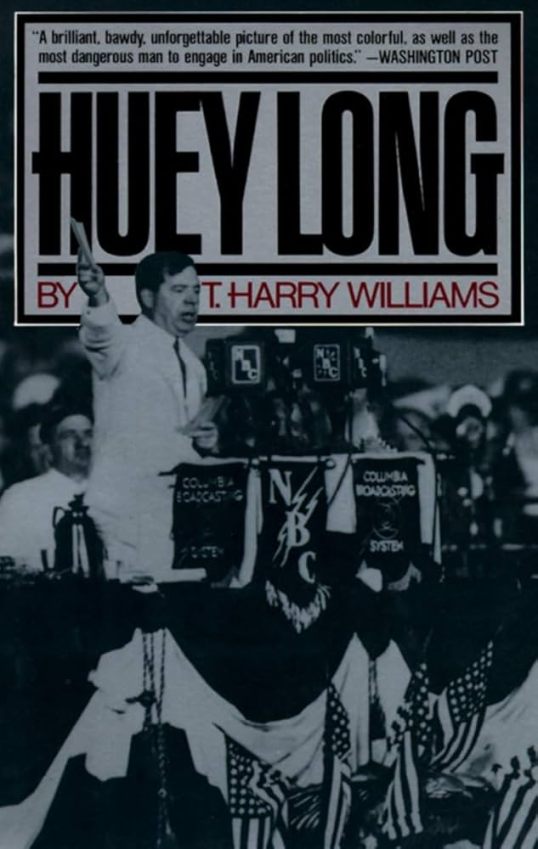
A Book To Read This Weekend (5/30/25)


If you’ve got a lot of time to kill this weekend and if you’re interested in how a dictator could come to power in the United States of America, check out Huey Long by T. Harry Williams.

The winner of 1970’s Pulitzer Prize and the National Book Award, this 900-page book tells the story of Louisiana’s Huey Long.  Long went from being an outsider to being governor of his state to being a member of the United States Senate and finally, to the verge of running for the presidency.  The only that that stopped Huey from running for President in 1936 were multiple bullets, at least one of which was fired by the son of a political rival.  (The majority of them were probably fired by Long’s own bodyguards, with Huey falling victim to “friendly fire.”)  Huey was a controversial figure, a socialist who talked like a populist, a clever politician who pretended to be a buffoon, and a leader who was hates by many but who was also so beloved by many other that his family held control of Louisiana politics for decades after his death.

I first bought this book in high school.  My history teacher had assigned the class to write book reports about a political figure.  My teacher was impressed when I said that I would be writing about Huey Long.  Of course, I put off writing the report until the day before it was due.  I also put off reading (and, for that matter, even opening) the book.  When I mentioned this to my mom, she took one look at the 900-page biography that I hadn’t even started to read, and said, “Why did you pick such a long book!?”

(I always pick the longest books I can find.  I like to read and, when it comes to biographies, I like to get all the details.)

For the next few hours, I skimmed through the book as I wrote my report.  I wrote about his early political campaigns, the role he played in the elections of both Woodrow Wilson and Franklin Roosevelt, and the steady stream of corrupt flunkies that he brought into Louisiana’s government.  I included the details of Huey Long’s Share The Wealth plan and explained why Huey’s scheme was just a bunch of commie propaganda.  My teacher gave my report a 100 (and he added an “A++,” which he circled in red!), said that it was good enough for college, and commended me on my hard work.  My mom read my teacher’s comments and said I had more lives than a cat.

Even just skimming the book, I found Huey’s story to be fascinating.  He stood up to the power brokers.  He fought for the poor.  He took kickbacks from the same corporations that he claimed to despise.  He treated Louisiana like his own fiefdom.  He might have ordered a few murders.  And, years later, when I sat down and actually read the book, I discovered that Huey’s life was even more interesting than I initially realized.  Huey Long may be 900 words long but he lived his life in such an over-the-top fashion and the times in which he lived were so interesting that the book becomes a surprisingly quick read.  It helps that T. Harry Williams was a lively writer.  This isn’t some slow-moving, self-consciously scholarly tome.  This is a book that really captures the unique oddness of Louisiana and its politics.

If you’re looking for a long but rewarding read and if you’re a history nerd like me, check this book out.  And then watch All The King’s Men (the original, not the remake!).  Willie Stark, the governor at the heart of All The King’s Men, was based on Huey Long.  Somehow, Long lived a life that was even more dramatic than his fictional counterpart.

(Check out last week’s Books For The Weekend here!)