Lisa Marie Reviews An Oscar Nominee: Nebraska (dir by Alexander Payne)


As Brad mentioned earlier, today is Bruce Dern’s birthday!

Bruce Dern is a favorite actor of mine.  He’s one of those performers who, over the course of his very long career, has appeared in all sorts of different and occasionally odd films, sometimes as a lead but most often as a character actor.  He appeared in biker films, westerns, literary adaptations, and Oscar-winners.  He killed John Wayne in The Cowboys.  He introduced Peter Fonda to acid in The Trip (Dern, for his part, has said that he the only person on the set of that film who has never done acid.)  He captured the trauma of Vietnam in Coming Home.  He played one of the great hyperactive cops in The Driver.  He came close to playing Tom Hagen in The Godfather and was the original choice for the attorney who was eventually played by Jack Nicholson in Easy Rider.

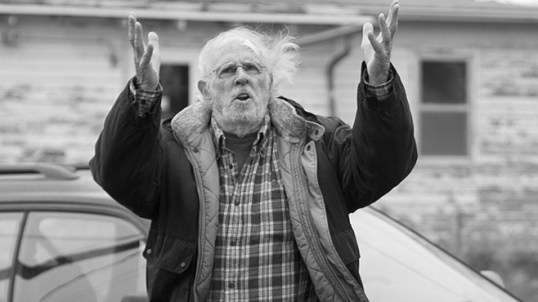
In 2013’s Nebraska, he broke my heart.

In Nebraska, Dern plays Woody Grant, an elderly man who is convinced that he’s won a million-dollar sweepstakes.  Everyone around him, including his wife (June Squibb) and his oldest son (Bob Odenkirk), realizes that the sweepstakes is a scam and that Woody has actually won nothing.  But Woody is convinced that a million dollars is waiting for him.  All he has to do is somehow make it from Montana to Nebraska.  At first, Woody attempts to walk along the interstate.  When that doesn’t work and the police end up arresting him and sending him home, his youngest son, David (Will Forte), agrees to drive Woody down to Lincoln, Nebraska.  David knows that there’s not any money waiting for Woody but, unlike his mother and his older brother, David hasn’t given up on the idea of connecting with his father.

Nebraska is a road movie, with the majority of the film following David and Woody as the drive through rural and smalltown America.  They stop off in Woody’s former hometown, where they meet Woody’s brother (Rance Howard) and also Woody’s former business partner, a bully named Ed (Stacy Keach).  Ed is convinced that Woody stole money from him.  Woody blames Ed for the loss of his air compressor.  Their anger has simmered for years and, at first, it’s tempting to assume that it’s simply one of those grudge matches that old men seem to have a weakness for.  But Ed turns out to truly be a rotten human being and Woody …. well, Woody his own problems but at least he’s not as bad as Ed.

Before I say anything else, I want to praise the entire cast.  June Squibb, Bob Odernkirk, Stacy Keach, Rance Howard, Melinda Simonsen (who has a small role as a receptionist in Lincoln), they all bring their characters to memorable life.  Will Forte is the heart of the film, trying to keep his family together and standing up for his father when it matters.  If you only know Will Forte as MacGruber, you need to see Nebraska.  That said, this film is dominated by Bruce Dern’s poignant, sad, and often very funny performance as Woody Grant.  Woody is a flawed character and Dern wisely doesn’t try to sentimentalize or downplay any of those flaws.  He drinks too much, he neglected his family when he was younger, he holds a grudge, and he’s incredibly stubborn.  But, as played by Dern, you just can’t help but like Woody and hope that he finds some sort of happiness.  Even though the viewer, like everyone else in Woody’s life, knows that the sweepstakes is a scam, it’s still hard not to spend the film hoping that Woody will prove everyone wrong when he makes it to Nebraska.

Nebraska was nominated for Best Picture while both Bruce Dern and June Squibb picked up acting nominations.  That year, the Best Picture race was dominated by 12 Years A Slave.  Matthew McConaughey won Best Actor for Dallas Buyers Club while Lupita Nyong’o won Best Supporting Actress for 12 Years A Slave.  Alexander Payne lost Best Director to Gravity’s Alfonso Cuaron.  Gravity also won the Oscar for Best Cinematography, defeating Nebraska’s gorgeous black-and-white imagery.

Oscars or not, Nebraska is a wonderful, late career showcase for the great Bruce Dern.
Song of the Day: Dust (What I Know) by Downtown Sasquatch


Today, the Shattered Lens wishes a happy birthday to Shane Kippel!

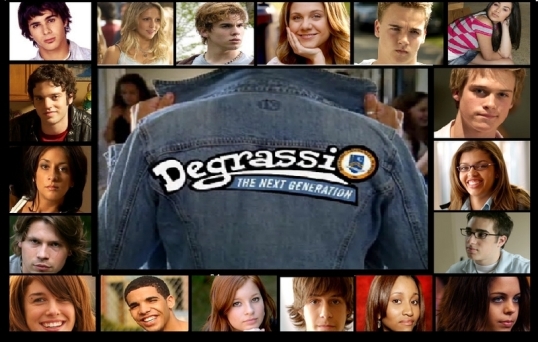
Shane Kippel, as I’m sure I don’t have to tell you, played Spinner Mason on Degrassi: The Next Generation.  He started out as the school bully but, by the time the third season began, he was pretty much the heart of the ensemble.  How cool was Shane Kippel?  He was so cool that Spinner ended up getting held back three times just so there would be an excuse to keep Kippel on the show!

(“What type of idiot fails his own language!?” Spinner once said when confronted with his grade in English.  Oh, Spinner!)

Today’s song of the day features Shane Kippel on drums.  From Degrassi, here is Downtown Sasquatch with Dust!

(The other members of the band are Jake Epstein on vocals, Aubrey Graham on guitar, and Adamo Ruggiero on bass.)

Retro Television Reviews: An Update


I know I originally said that my Retro Television Reviews would return this week but I’m actually going to need another week, both for my health and also so I can get caught up on some other things that I’ve been putting off taking care of.  So, Retro Television Reviews will return on Monday, June 9th!

Thank you for your patience and understanding!

Song of the Day: Oops! I Did it Again, covered by Nouveau Lounge and Amanda Stewart


I’ve always liked this cover version of the classic Britney Spears song.  Plus, I actually got to see these guys perform in London a few years ago!

Here is today’s song of the day.

Music Video of the Day: I Miss The Band by Alanis Morissette (2021, dir by Victor Indrizzo)


Today is Alanis Morissette’s 51st birthday.

Today’s music video of the day is for a song that she wrote about not being able to tour during the COVID lockdowns.  The song is all about how much she misses traveling with her band.  When the song was released, it was used to raise money for Morissette’s backing band, who couldn’t work because the governments across the world tried to ban mass gatherings.

Seriously, I think some people have forgotten — or have chosen to pretend to forget — just how insane things got with the COVID lockdowns.  We were all missing our friends, our family, our lives …. our band.

(Sorry, I’m not yet ready to forgive and forget.  15 Days To Slow The Spread because 48 Months To Do What You’re Told Or Else.  I just spent a week and a half watching Clint Eastwood films so I’m definitely not in a rule-following mood right now.)

Enjoy!

Film Review: City Heat (dir by Richard Benjamin)


In 1984’s City Heat, Clint Eastwood plays Lt. Speer, a tough and taciturn policeman who carries a big gun, throws a mean punch, and only speaks when he absolutely has to.

Burt Reynolds plays Mike Murphy, a private investigator who has a mustache, a wealthy girlfriend (Madeleine Kahn), and a habit of turning everything into a joke.

Together, they solve crimes!

I’m not being sarcastic here.  The two of them actually do team up to solve a crime, despite having a not quite friendly relationship.  (Speer has never forgiven Murphy for quitting the force and Murphy has never forgiven Speer for being better at everything than Murphy is.)  That said, I would be hard-pressed to give you the exact details of the crime.  City Heat has a plot that can be difficult to follow, not because it’s complicated but because the film itself is so poorly paced and edited that the viewer’s mind tends to wander.  The main impression that I came away with is that Speer and Murphy like to beat people up.  In theory, there’s nothing wrong with that.  Eastwood is legendary tough guy.  Most people who watch an Eastwood film do so because they’re looking forward to him putting the bad guys in their place, whether it’s with a gun, his fists, or a devastating one-liner.  Reynolds also played a lot of tough characters, though they tended to be more verbose than Eastwood’s.

That said, the violence in City Heat really does get repetitive.  There’s only so many times you can watch Clint punching Burt while various extras get gunned down in the background before it starts to feel a little bit boring.  The fact that the film tries to sell itself as a comedy while gleefully mowing down the majority of the supporting cast doesn’t help.  Eastwood snarls like a pro and Reynolds flashes his devil-may-care smile but, meanwhile, Richard Roundtree is getting tossed out a window, Irene Cara is getting hit by a car, and both Kahn and Jane Alexander are being taken hostage.  Tonally, the film is all over the place.  Director Richard Benjamin was a last-minute replacement for Blake Edwards and he directs without any sort of clear vision of just what exactly this film is supposed to be.

On the plus side, City Heat takes place in Kansas City in 1933 and the production design and the majority of the costumes are gorgeous.  (Unfortunately, the film itself is often so underlit that you may have to strain your eyes to really appreciate it.)  And the film also features two fine character actors, Rip Torn and Tony Lo Bianco, are the main villains.  For that matter, Robert Davi shows up as a low-level gangster and he brings an actual sense of menace to his character.  There are some good things about City Heat but overall, the film is just too messy and the script is a bit too glib for its own good.

Burt Reynolds and Clint Eastwood had apparently been friends since the early days of their careers.  This was the only film that they made together.  Interestingly enough, Reynolds gets the majority of the screentime.  Eastwood may be top-billed but his role really is a supporting one.  Unfortunately, Reynolds seems to be kind of bored with the whole thing.  As for Clint, he snarls with the best of them but the film really doesn’t give him much to do.

A disappointing film, City Heat.  Watching a film like this, it’s easy to see why Eastwood ended up directing himself in the majority of his films.

The Unnominated #17: Honkytonk Man (dir by Clint Eastwood)


Though the Academy of Motion Picture Arts and Sciences claim that the Oscars honor the best of the year, we all know that there are always worthy films and performances that end up getting overlooked.  Sometimes, it’s because the competition too fierce.  Sometimes, it’s because the film itself was too controversial.  Often, it’s just a case of a film’s quality not being fully recognized until years after its initial released.  This series of reviews takes a look at the films and performances that should have been nominated but were, for whatever reason, overlooked.  These are the Unnominated.

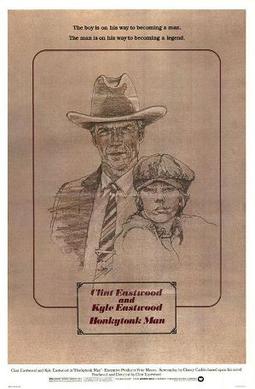
1982’s Honkytonk Man was a Clint Eastwood film that I had never heard of, until I came across it on Prime.  I decided to take a chance and I rented it.  I’m glad that I did because it turned out to be one of Eastwood’s best films.

Clint stars as Red Stovall, a country singer turned farmer during the Great Depression.  Kyle Eastwood stars as Red’s nephew, 14 year-old Whit “Hoss” Wagoneer.  When Red gets an opportunity to perform at the Grand Old Opry, he decides to head for Tennessee.  Since Red is dying of tuberculosis and barely knows how to drive a car, he is accompanied by Grandpa Wagoneer (John McIntire) and Whit.  Whit may be young but he knows how to drive and soon, he’s driving Red and Grandpa across the country.  When a highway patrolman (Tim Thomerson) stops them, he says that Whit is too young to drive.  After watching a speeding Red struggle to keep the car in the right lane, the patrolman pulls up beside them and says, “Let the kid drive.”

Honkytonk Man features an unexpected performance from Eastwood.  Typically, we think of Eastwood’s characters as being the epitome of cool.  Red is definitely not that.  Red is a screw-up, someone who gets arrested while trying to steal chickens and who frequently gets conned by those that he meets during his journey.  When the car breaks down in Arkansas, Red is too busy drinking to remember to catch the bus to Tennessee.  He spends the night with a hitchhiker named Marlene (Alexa Kernin).  The next morning, Whit wakes Red up and informs him that he only has a few minutes before the next bus leaves.  Marlene announces that she’s pregnant.  “HOLD THE BUS!” Red yells as he hastily puts on his clothes.

That said, Whit loves his uncle and the two Eastwoods, Clint and Kyle, both give excellent performances in Honkytonk Man.  In fact, his performance here is probably the best that Clint Eastwood has ever given.  Clint plays with his own image here.  Initially, the film almost feels like a satire of Clint’s hypermasculine persona.  (There is one scene where Eastwood handles a gun but it doesn’t play out the way that you might expect it to.)  But, as the film progresses and Red’s illness grows worse, we start to understand Red and his way of looking at the world.  Red is flawed but he loves his nephew and he loves music and, in the end, what’s important is not whether or not his song were recorded but instead that he spent his final days with Whit.  The film may start out as a comedy but it ultimately becomes a meditation on aging and how one faces the inevitability of death.

As a director, Eastwood takes his time.  He lets the movie play out slowly, with the casual pace of country story.  It’s a film full of wonderful performance and beautiful visuals and it more than earns our patience.  Wisely, Eastwood the director realizes that this story really isn’t about Red.  The story is about Whit (or Hoss, as he asks to be known) and his experiences with his uncle.  Whit worships his uncle but he also comes to learn that the most important thing is to be able to respect yourself.  In this film, Clint Eastwood knows the story that he’s telling and he knows exactly how to tell it.

Honkytonk Man went unnominated as far as the Oscars are concerned.  In the year when the well-intentioned but dramatically inert Gandhi dominated the awards and the nominations, Honkytonk Man was forgotten.  That’s a shame.

Previous Entries In The Unnominated:

  1. Auto Focus 
  2. Star 80
  3. Monty Python and The Holy Grail
  4. Johnny Got His Gun
  5. Saint Jack
  6. Office Space
  7. Play Misty For Me
  8. The Long Riders
  9. Mean Streets
  10. The Long Goodbye
  11. The General
  12. Tombstone
  13. Heat
  14. Kansas City Bomber
  15. Touch of Evil
  16. The Mortal Storm

Film Review: Bronco Billy (dir by Clint Eastwood)


In 1980’s Bronco Billy, Clint Eastwood plays Billy McCoy.

Billy is an aging cowboy, a trick-shooter who owns Bronco Billy’s Wild West, a traveling circus that has definitely seen better days.  Bronco Billy and his friends travel the country, going from small town to small town and putting on a show.  Billy is definitely the star and the highlight of each show is him shooting balloons and tossing a knife while his female assistant is strapped on a revolving disk.  Unfortunately, Billy’s latest assistant flinches and gets a knife in her leg.  Billy needs a new assistant and, wouldn’t you know it, Antoinette Lily (Sondra Locke) needs a job!

Antoinette is a runaway bride.  She married John Arlington (Geoffrey Lewis), not because she loved him but because she needed to get married by the time she turned 30 or she would lose her inheritance.  After the ceremony but before the wedding night, Antoinette fled.  The police assume that John murdered her and promptly arrest him.  John, suspecting that his wife is still alive, pleads insanity so that he can avoid the electric chair.

As Billy’s assistant, Antoinette challenges the way that Billy has always done the show, often to such an extent that you really have to wonder why she sticks around.  Since this is a Clint Eastwood film, there a bar brawl where Billy rescues her from being assaulted by a couple of rednecks.  Unfortunately, Antoinette’s arrival coincides with a string of accidents and other unfortunate incidents.  The other members of the show start to suspect that Antoinette might be bad luck.  Myself, I’m not superstitious and I don’t think that people can bring bad luck.  I think people make their own luck.  However, it’s hard to overlook the fact that Antoinette finds out that her husband is facing the death penalty due to her disappearance and her reaction is to basically shrug it off.  Sondra Locke gives a rather flat performance was Antoinette, suggesting none of the quirkiness necessary to make her anything more than a very childish and very self-centered person.  Antoinette is a role that demands the eccentricity of a young Sissy Spacek or Shelley Duvall or even Beverly D’Angelo, who did such a good job in Every Which Way But Loose.  Sondra Locke gives a boring performance and it drags down the film.

That said, there is a lot to like about Bronco Billy.  In many ways, this film feels like Clint Eastwood’s take on a Robert Altman film.  The plot is episodic and casual and the best scenes are the ones the emphasize the members of the circus as being a family of misfits.  (Indeed, one reason why Locke’s performance feels so jarringly wrong is because both she and Antoinette never seem to be interested in the other members of the show.)  Billy may be their leader and their main attraction but every member of the show plays a role in keeping Billy’s Wild West alive.  Scotman Crothers, Sam Bottoms, Bill McKinney, Dan Vadis, and Sierra Pecheur all give likable performances that bring the film’s world to life.  The film becomes about more than just the aging Billy trying to find his place in a changing world.  It’s a film about a group of people who have come together to form their own community and, by the end of the movie, it’s a community that you can’t help but love.  In many ways, this film features both Eastwood the director and Eastwood the actor at his gentlest and most humanistic.  Billy and his show bring the old west to a new America and, in the end, you’re happy they did.

Film Review: Every Which Way But Loose (dir by James Fargo)


In 1978’s Every Which Way But Loose, Clint Eastwood plays Philo Beddoe.

Philo’s an ordinary guy with beautiful hair and a way with throwing punches.  He’s a truck driver.  He enjoys a cold beer.  He enjoys country music.  He makes some extra money by taking part in bare-knuckle brawls.  Everyone says that he could be the next Tank Murdock, a legendary fighter.  Philo is just a simple, blue collar guy who lives in a small house, next door to his best friend Orville (Geoffrey Lewis) and Orville’s profanity-loving mother (Ruth Gordon).  Philo also owns an orangutan named Clyde.  He saved Clyde from being sent to live in a “desert zoo.”

(Actually, now that I think about it, most blue collar guys don’t own monkeys but whatever.  Clyde’s cute and Eastwood’s Eastwood.)

When Philo meets a country singer named Lynn Halsey-Taylor (Sondra Locke), he is immediately smitten.  When Lynn disappears and leaves Philo a cryptic note, Philo decides to go looking for her.  Clyde, Orville, and Philo hit the road.  Along the way, Orville meets and picks up a woman named Echo (Beverly D’Angelo).  This is a road movie so, of course, Clyde, Orville, Philo, and Echo have their adventures on the way to Colorado.  They end running afoul both a corrupt cop and a gang of buffoonish bikers.  Philo enters a fight whenever they need money and one occasionally gets the feeling that Eastwood took this role to show off the fact that, for someone approaching 50, he still looked good without a shirt on.  And good for him!  Because, seriously, Clint does look good in this movie….

I have to admit that, for all of my attempts at sophistication, my roots are in the country and I’ve traveled down enough dirt roads that I find it hard to resist a good redneck story.  And really, there aren’t many films that as proudly and unashamedly redneck than Every Which Way But Loose.  It’s a film that has a laid back, take-it-as-it-comes vibe to it.  Philo may be looking for Lynn but he seems to be okay with taking a few detour along the way.  There’s no real sense of urgency to any part of the movie.  Instead, Every Which Way But Loose was made for people who like a cold beer at the end of the day and who find Ruth Gordon to be hilarious when she curses.  Myself, I don’t drink.  That’s one part of the country lifestyle that passed me over.  But I did enjoy seeing Ruth Gordon cuss out the Nazi biker gang.

Eastwood, Lewis, and D’Angelo have a likable chemistry and the monkey’s cute.  Unfortunately, Sondra Locke isn’t particularly well-cast in the role of Lynn.  (Considering that she was in a relationship with Eastwood, it’s amazing how little chemistry they have in this movie.)  As I watched the film, it occurred to me that it probably would have worked better if Locke and D’Angelo had switched roles.  Locke’s character is supposed to be a femme fatale type but she gives a boring performance and, as a result, the revelation that Philo has misjudged her doesn’t really carry any emotional weight.

That said, this film features some beautiful shots of the wilderness, a charming romance between Lewis and D’Angelo, and a shirtless Clint Eastwood beating folks up.  That’s more than enough to please this secret country girl.