Horror Film Review: The Black Sleep (dir by Reginald Le Borg)


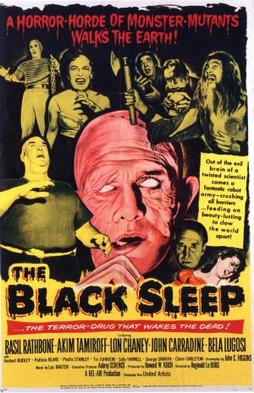
1956’s The Black Sleep opens in a London prison cell.  The year is 1872 and Dr. Gordon Ramsay (Herbert Radley) awaits execution.  He’s accused of murdering a chef who twice sent rubbery scallops to the pass …. wait, a minute, sorry.  Wrong Gordon Ramsay!  This Gordon Ramsay is accused of murdering a man named Curry and he’s considerably more whiny than the modern-day Gordon Ramsay.

Ramsay is visited by Sir Joel Cadman (Basil Rathbone) and Cadman’s associate, Odo the Gypsy (Akim Tamiroff).  Cadman explains that he has developed a potion called “The Black Sleep.”  Drinking it will put the drinker in a state of suspended animation that can pass for death.  And, indeed, it will turn into death unless Cadman administers the antidote.  Cadman offers to give the potion to Ramsay, in return for Ramsay helping Cadman out with his own experiments.  Ramsay agrees.

Ramsay is found “dead” in his cell.  His body is claimed by Cadman and Odo.  (Odo mentions that, in a past life, he was a grave robber and that he died as a result of the guillotine.)  Ramsay is revived and goes to work with Cadman.  As soon as Ramsay enters Cadman’s mansion, he finds himself surrounded by several familiar faces.  For instance, Lon Chaney, Jr. plays the twisted Mungo, who stumbles through the hallways of the mansion and can only be controlled by Daphnae (Phyllis Stanley).  Bela Lugosi plays Casimir, the mute butler.  Bohemud (John Carradine) is a bearded man who rants and raves and calls for Biblical vengeance.  And finally, in the basement, there’s Mr. Curry (Tor Johnson), the man who Ramsay was convicted of murdering!  It turns out that Cadman isn’t quite as benevolent as he presented himself as being.

The Black Sleep may feature an incoherent story but it has a great cast and it is entertaining to see Carradine, Chaney, Tor Johnson, Akim Tamiroff, Bela Lugosi, and Basil Rathbone all living under the same roof and trying to outdo each other as far as the scenery chewing is concerned.  Admittedly, some members of the cast look healthier than others.  Rathbone is as imperiously dashing as always and John Carradine appears to be having a lot of fun with his role.  Akim Tamiroff gets all of the best lines as Odo and he delivers them with just the right amount of wit.  Unfortunately, neither Chaney and Lugosi were in good shape when they appeared in this film.  Lugosi was ill when he did the film.  Chaney, meanwhile, had seen his one-promising career sabotaged by his own alcoholism and, by the time the 50s rolled around, his once handsome features were now ravaged by his drinking.  It transformed him from being a somewhat dull leading man to a craggly character actor.  (Producer/director Stanley Kramer considered Chaney to be one of the best character actors in Hollywood and cast him in both High Noon and The Defiant Ones.)  In The Black Sheep, Chaney’s face is twisted and almost ravaged.  It works for the film but it’s still sad to see.  As for Tor Johnson …. hey, he’s Tor Johnson.  He growls and he tosses things around and he does so convincingly.

(In an interview shortly before his death, Tor said he was offered the role of Oddjob in Goldfinger.  It’s sad to think the world was robbed of the Sean Connery/Tor Johnson team-up it needed.)

This was Bela Lugosi’s final film performance before his death in 1956.  (The footage that appears in Plan 9 From Outer Space was filmed before The Black Sleep.)  It’s a shame that Lugosi wasn’t given more to do in his final film.  Lugosi, with that famous voice, ending his career playing a mute just doesn’t seem right.
Horror Film Review: The Mummy’s Ghost (dir by Reginald Le Borg)


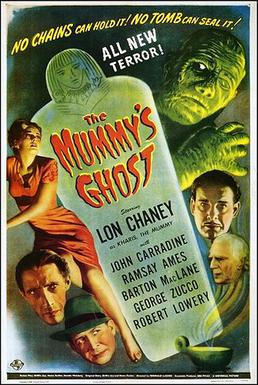
When we last checked in with Kharis the Mummy, he was trapped in the middle of an inferno in Massachusetts.  Having come to America to kill the members of the expedition that discovered the Tomb of Ananka and who brought Princess Ananka’s body to the United States, Kharis (Lon Chaney, Jr.) was trapped by the citizens of the town of Mapleton who, in the best tradition of Universal horror, cornered Kharis in a house and then set the place on fire.

1944’s The Mummy’s Ghost begins with the revelation that Kharis did not die in that inferno.  Somehow, he managed to escape and, rather improbably, he’s spent the last few years wandering around town without anyone ever noticing him.  The film presents Kharis as being largely a nocturnal creature but, even if he is only coming out at night, it still seems strange that no one would notice a mummy wandering around, especially since the entire town was traumatized by Kharis’s previous reign of terror.  As well, it’s also been established that Kharis owes his eternal life to an ancient Egyptian plant.  One reason why Kharis has always needed a “minder” is because Kharis needed someone who could keep him supplied with the plant.  So, if Kharis has been wandering around Massachusetts for the past few years, from where has he been getting the plant?

The Mummy’s Ghost also established that, in Egypt, High Priest Andoheb (Georg Zucco) is still alive.  This is somewhat surprising, considering that Andoheb died in both The Mummy’s Hand and The Mummy’s Tomb.  But no matter!  Andoheb is apparently still alive.  He’s really old and his hands shake but he’s still alive and he’s still determined to bring both Kharis and Princess Ananka back to Egypt.  This time, he sends Yousef Bey (John Carradine) to Massachusetts.

Yusef Bey takes over managing Kharis and he’s even able to supply Kharis with more of the special plant the keeps him alive.  However, Kharis grows upset when it discovers that Bey has tracked down the reincarnation of Ananka in the person of Amina (Ramsay Ames) and that, rather than return her safely to Egypt, Bey wants to give her eternal life with the help of the plant and then marry her.  This leads to Kharis going on a rampage and carrying Amina into a nearby swamp while Amina’s boyfriend, Tom Hervey (Robert Lowery), chases after them.

Full of plot holes and inconsistencies, The Mummy’s Ghost is about as silly as a mummy film can be.  If the previous films about Kharis managed to create a feeling of tragic inevitability as Kharis tracked down all of the people who had entered Ananka’s tomb, The Mummy’s Ghost presents Kharis as being something more akin to Frankenstein’s Monster, an inarticulate and easily frustrated creature who does things with little rhyme or reason.  That said, the film does make good use of Lon Chaney Jr’s hulking physicality as Kharis.  He’s still an intimidating figure when he goes after someone.  And John Carradine’s pained expression as Yousef Bey is memorable as a reminder of how much Carradine disliked most of the Universal monster films in which he found himself.  Otherwise, The Mummy’s Ghost is fairly forgettable.

Previous Universal Horror Reviews:

  1. Dracula (1931)
  2. Dracula (Spanish Language Version) (1931)
  3. Frankenstein (1931)
  4. Island of Lost Souls (1932)
  5. The Mummy (1932)
  6. The Invisible Man (1933)
  7. The Bride of Frankenstein (1935)
  8. Dracula’s Daughter (1936)
  9. Son of Frankenstein (1939)
  10. Black Friday (1940)
  11. The Invisible Man Returns (1940)
  12. The Mummy’s Hand (1940)
  13. The Wolf Man (1941)
  14. Ghost of Frankenstein (1942)
  15. Invisible Agent (1942)
  16. The Mummy’s Tomb (1942)
  17. Frankenstein Meets The Wolf Man (1943)
  18. Son of Dracula (1943)
  19. House of Frankenstein (1944)
  20. The Invisible Man’s Revenge (1944)
  21. House of Dracula (1945) 
  22. Creature From The Black Lagoon (1954)

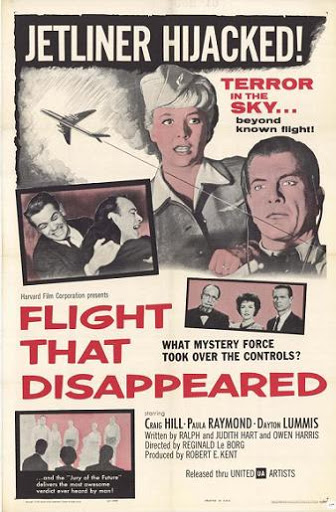
18 Days of Paranoia #1: The Flight That Disappeared (dir by Reginald Le Borg)


Way back in the early days of the site, I did a series of reviews called 31 Days of Paranoia, in which I reviewed films about mysteries, cover-ups, and conspiracies.  Unfortunately, because I wasn’t all that disciplined about posting during the early days of the Shattered Lens, my 31 Days of Paranoia ended up being something like 24 days.  Still, it was a lot of fun and, historically, it was important because it was the very first “themed” series of reviews that I had ever done.  Shattered Politics, Embracing the Melodrama, Back to School, Sprin Breakdown, and all the rest started with 31 Days of Paranoia.

So, with this being the 10-year anniversary of the Shattered Lens’s founding and Spring Breakdown wrapping itself up tomorrow, I figured why not return to where it all started.  From now til April, please enjoy …. 18 Days of Paranoia!

We begin with:

The 1961 film, The Flight That Disappeared, deals with an airplane that …. wait for it …. disappears!

What’s happened to Trans-Coast Airways Flight 60?  When it first took off from Los Angeles, everything seemed fine.  It was carrying a small but well-behaved group of middle-aged people to Washington D.C.  The pilots all seemed like good professionals.  The two flight attendants were busy serving people coffee and having conversations about whether or not one of them would ever get married.  She had every right to be concerned, of course, seeing as how she was in her 20s and still unmarried and childless, despite the fact that this film was made in 1961.

It doesn’t take too long for something strange to happen.  The plane suddenly starts to climb upward, eventually going up over 10 miles high in the sky.  The pilots can’t do anything to get the plane to come back down.  Due to the lack of oxygen, some of the passengers start to pass out.  One passenger panics and opens a door, out of which he promptly falls.  Oddly, this doesn’t create the whole vacuum effects that we always see in other movies where a window or a door is opened while a plane is in the air.  Stranger still, no one thinks to close the door afterwards.  Was this intentional or was it just crappy filmmaking?  It’s hard to say.

Why is the plane being lifted up into the air?  Could it have something to do with the three atomic scientists who are all on the plane?  One of them, Dr. Morris (Dayton Lummis), is wearing glasses and has a van dyke beard so you know he’s smart!  It turns out that Dr. Morris has been working on the Beta Bomb, which is apparently the most powerful atomic bomb ever built.  I kept waiting for someone to ask Dr. Morris why it was called the Beta Bomb and not the Alpha Bomb or the Omega Bomb or the Big Scary Bomb or the …. well, seriously, anything would be better than Beta Bomb!  Everyone in the movie says, “Beta Bomb,” in a tone that’s meant to communicate reverence but it just sounds too much like “Beta Male” for me to really take it seriously.

But, again, who is responsible for the flight climbing?  Is it the Russians?  Is it aliens?  Is it some enemy of the American way?  While everyone else on the plane is passed out, the three scientists find themselves awake.  Their watches are no longer running and, despite the fact that they appear to be alive, their hearts are no longer beating.  Are they dead?  Or have they been transported to the future where they will now be put on trial for the crime of developing the Beta Bomb?

Of course, the thing with being put on trial in the future is that it provides the perfect defense for making weapons in the present.  “Hey,” a smart defense attorney would say, “you’re still alive in the future and you’ve got time travel technology so what are you bitching about?”  But the jurors explain that they’re actually the ghosts of the people who would have been born in the future if not for the Beta Bomb which …. what?  So, is the plane in the future or is it in the afterlife?  The film itself doesn’t seem to be sure.

I’m probably making it sound like this is a more intriguing film than it actually is.  This movie is about 72 minutes long and all the stuff with the people in the future takes place during the final 10 minutes.  That means that the film is essentially just 60 minutes of people saying, “We’re still climbing.”  From a historical point of view, it’s an interesting example of people being paranoid about the arms race.  (If the film were made today, the future the ghostly jurors would be the souls of people who were not born in the future due to climate change.)  From an entertainment point of view, it’s a forgettable dud.

Horror on the Lens: Diary of a Madman (dir by Reginald Le Borg)


For today’s horror on the lens, check out the 1963 film, Diary of a Madman!

It’s simply not October without at least one film featuring the great Vincent Price.  In Diary of a Madman, Price plays Simon Cordier, a French magistrate.  What is it that’s causing Simon’s personality to change?  What is making him suffer from greater and greater delusions?  Is he just going insane?  Or is he being haunted by a malevolent spirit known as a horla!?

Any film that features Vincent Price being sinister is worth watching and Diary of a Madman actually features one of his better performances.  Overall, Diary of a Madman is an enjoyable attempt at psychological horror.

Enjoy it below!