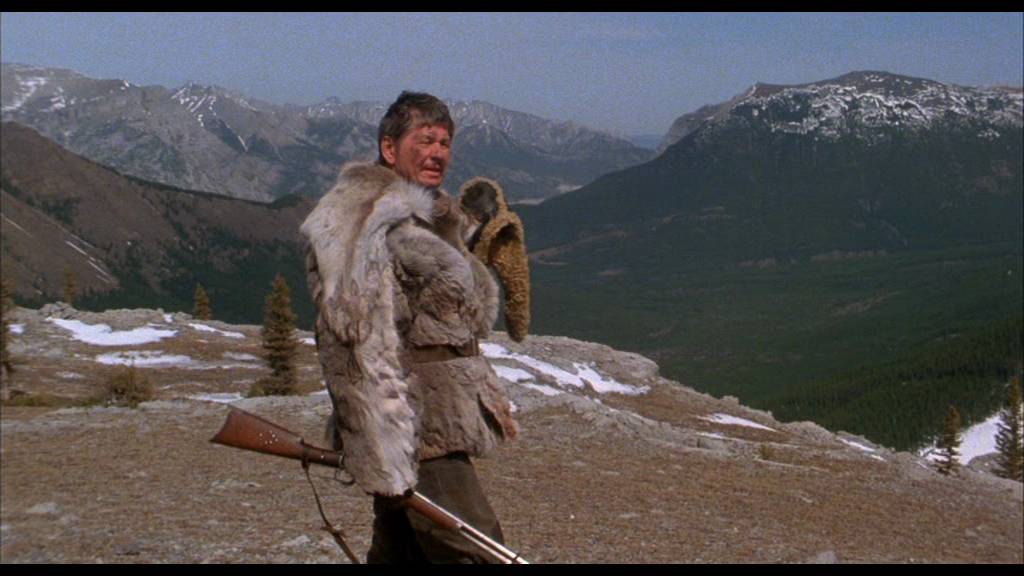
Brad reviews DEATH HUNT (1981), starring Charles Bronson, Lee Marvin, Carl Weathers, and Andrew Stevens! 


Today is actor Andrew Stevens’ 70th birthday. I grew up watching Stevens in the Charles Bronson films 10 TO MIDNIGHT (1983) and DEATH HUNT (1981), the movie I’m reviewing today. I also enjoyed watching him in Brian De Palma’s THE FURY (1978). Later in his career he stepped behind the camera where he produces and directs mostly low budget films. As of this writing, he’s still going strong, and he’s built quite a nice career. And for me, my appreciation all started because he worked with Charles Bronson when he was in his twenties!

In the “based on a true story” DEATH HUNT, Charles Bronson plays trapper Albert Johnson, who lives in the Yukon Territory in the year of 1931 and just wants to be left alone. Early in the film, Johnson comes across a vicious dogfight and rescues one of the participants who’s almost dead. The problem is that the dog belongs to a piece of shit named Hazel (Ed Lauter), and even though Johnson pays him for the dog, Hazel heads to town and tells Sergeant Edgar Millen (Lee Marvin), of the Royal Canadian Mountain Police, that Johnson stole his dog. Millen doesn’t have time for Hazel’s B.S., so he tells him to go on. Millen would rather drink whiskey and hang out with his friends and co-workers in town. These people include the experienced tracker Sundog, aka George Washington Lincoln Brown (Carl Weathers), a young fresh-faced constable with the RCMP named Alvin Adams (Andrew Stevens), his latest lover Vanessa McBride (Angie Dickinson), and everyone’s favorite sidepiece, the Buffalo woman (Amy Marie George). Not willing to let things slide, Hazel and his men go up to Johnson’s cabin and start some more trouble, and one of his buddies gets his scalp shot off by the more than capable Johnson. Even though the entire mess has been started by Hazel and his crew of goons, who include character actors William Sanderson and Maury Chaykin, Millen is forced to try to bring Johnson in, so they can straighten everything out. When it seems Johnson may be about to go in with Millen, one of Hazel’s dumbass men opens fire, and all hell breaks loose. In the aftermath, Johnson escapes, kicking off a massive manhunt across the mountains and wilderness of the Yukon Territory! 
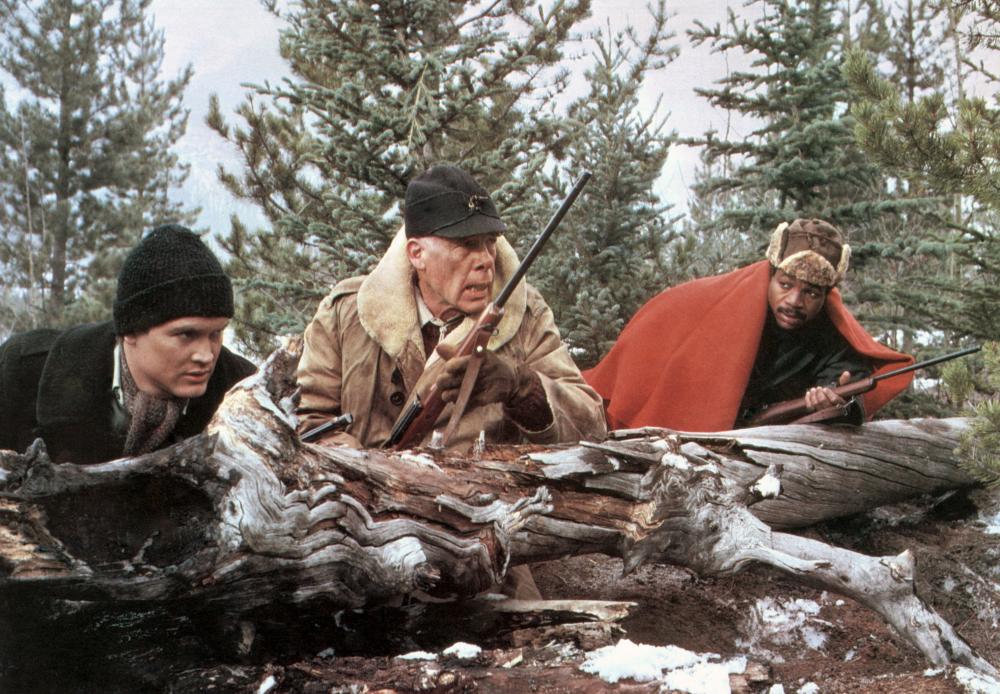
DEATH HUNT is an awesome film, primarily because it pairs Charles Bronson, as the tough mountain man, against Lee Marvin, as the seasoned lawman who probably has only one chase left in him. This is a match made in heaven, and even though the two stars share little screen time, the icons dominate each frame of the film. Their characters respect each other and you get the feeling the two men, who couldn’t be more different in real life, probably felt the same way about each other. The remainder of the cast is filled with so many recognizable names and faces. I’d say the the best performances outside of Bronson and Marvin come from Carl Weathers, Andrew Stevens and Ed Lauter. I like the camaraderie that Weathers shares with Marvin, and of course he’s a lot of help when the action starts. Initially, Stevens seems like he’s going to be another “new kid” who’s too inexperienced to be of much help, but he proves to be more than capable by the end of the film. And good grief is Lauter good at playing a piece of crap! Everything about Hazel is cruel, sadistic, and ignorant, and he plays the part perfectly. A scene where a bullying Hazel gets his comeuppance at the hands of the young Adams (Stevens), is a highlight of the film. Sadly, Angie Dickinson, one of the most beautiful women in the history of cinema, is somewhat wasted in her small, unimportant role. I still like seeing her though, even if the part is beneath her. 

Aside from the phenomenal cast that Director Peter R. Hunt (DR. NO and THUNDERBALL) was able to assemble, there are other good reasons to watch DEATH HUNT. I love movies that are filmed outside of the city, and you can’t get much further out of the city than the Canadian Rocky Mountains. This setting provides plenty of beauty, but its frozen landscape and bitter conditions also allow for a sense of loneliness, isolation and desperation to seep in for the various characters as the manhunt stretches out over time. There is also some rugged and violent action spread out through the film. I was caught off guard the first time I watched the film by some of the more graphic violence in the action scenes. I’ve already mentioned Bronson’s character basically blowing a guy’s head off, and there’s another scene involving William Sanderson getting his arm caught in a trap. These scenes make my toes curl up just thinking about them. The action highlight occurs when the men think they have killed Johnson in an explosion, to only have him emerge from the smoke and flames of his decimated cabin with slow motion shotgun blasting. It’s an incredibly badass moment in the movie and in Bronson’s overall filmography. Finally, the story is interested in contrasting the old ways of doing things, as exemplified by Bronson and Marvin, versus the new ways of doing things, as exemplified by the young Stevens and a hotshot pilot (Scott Hylands) who is called in to help with the search. Edgar Millen is somewhat of a dinosaur who isn’t ready to truly move into the 20th century. He wants to catch Johnson through old-fashioned, out maneuvering him in the wilderness, while Stevens’ character brings in a radio and the expertise to use it, and Hylands tries to locate him and gun him down from high in the sky. These two schools of thought clash and play out to varying degrees of success and failure as the chase rushes toward its conclusion.

DEATH HUNT is not a perfect film by any stretch of the imagination, but it’s been one of my favorite Bronson films since I first saw it the mid to later 80’s. Just seeing Bronson and Marvin together on screen, in a rugged, violent, badass story, goes a long way with me. It’s as simple as that! See the trailer below:
The TSL Grindhouse: Mitchell (dir by Andrew V. McLaglen)


I come here to defend Mitchell.

First released in 1975, Mitchell does not have a great reputation.  It’s often described as being one of the worst of the 70s cop films and Joe Don Baker’s performance in the lead role is often held up to ridicule.  A lot of that is due to the fact that Mitchell was featured on an episode of Mystery Science Theatre 3000.  Last year, for my birthday, my friend Pat McCurry actually hosted a showing of the MST 3K version of Mitchell.  I laughed all the way through it.  It was a funny show and most of the jokes uttered by Joel and the Bots landed.  That said, I wish they hadn’t been so hard on Joe Don Baker.  Baker was an outstanding character actor, one whose good ol’ boy persona sometimes kept people from realizing just how fiercely talented he actually was.

Here’s the thing with Mitchell.  Just because a film is snarkable, that doesn’t mean that it’s a bad film.  Just because there are moments in a film that inspire you to talk back to the screen, that doesn’t make it a bad film.  Some of the most enjoyable films that I’ve ever watched were enjoyable specifically because they were made to inspire the audience to talk back to the characters.  Whatever flaws you may want to find in Mitchell, it’s an entertaining film.  The plot may be impossible to follow but who cares?  When you’ve got Joe Don Baker, John Saxon, and Martin Balsam all in the same film, does the plot really matter?

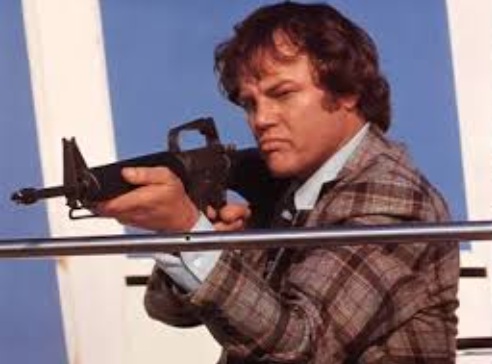
This is a film that you watch for the personalities involved.  Balsam plays a wannabe drug lord who always seems to be somewhat annoyed.  Someone once describes Bernie Sanders as always coming across as if he was about send his meal back to the kitchen because it was too cold and that’s a perfect description of Balsam’s performance in Mitchell.  John Saxon plays a sleazy rich guy who murders a burglar and then tries to cover up his crime.  Saxon is calm, cool, collected, and completely confident that his wealth will get him out of anything.  And then you’ve got Joe Don Baker as Mitchell, wearing an ugly plaid suit, drinking beer the way that I drink Diet Coke, and continually pretending to be dumber than he actually is.  There’s an interesting subtext to these three characters and how they interact.  Saxon and Balsam play criminals who are both rich and who both think they can get away with anything because they’ve got money.  Mitchell is a complete and total slob, a guy with a cheap apartment, a cheap suit, and absolutely no refinement at all.  Mitchell uses his good old boy persona to get the bad guys to continually underestimate him.  He ultimately turns out to be smarter and actually more ruthless than any of them.

Joe Don Baker throws himself into the role of Mitchell and there’ actually a lot of intentional humor to be found in his performance.  Baker doesn’t play Mitchell as being a supercop.  Instead, he plays Mitchell as being a blue collar guy who gets absolutely no respect.  Even when he’s on a stakeout, a random kid starts arguing with him.  (Mitchell loses the argument.)  Mitchell’s a jerk who busts his hooker girlfriend (Linda Evans) for having weed on her but he’s also the only one who could stop Balsam from doing whatever it is that Balsam thinks he’s trying to do.  (Again, don’t spend too much time trying to understand the plot.)  Mitchell’s super power is that he’s a slob who doesn’t give up.  To paraphrase Road House‘s Dalton, he plays dumb until it’s time not to be dumb.

As I said, it’s an entertaining film.  Where else are you going to see a not particularly high-speed chase between two station wagons?  Where else are you going to see John Saxon in a dune buggy or Joe Don Baker in a helicopter or Martin Balsam as the captain of a yacht?  Where else are you going to see a film that features its hero saying, “Yep, that’s grass,” before arresting his lover?  Mitchell is fun and entertaining and I’ll always defend both the movie and its star.

Happy 74th Birthday, Kurt Russell! In GUNS OF DIABLO (1964), a young Kurt graces the screen with cinema icon Charles Bronson.


As a person who sees his love of movies through a lens of “Bronson connections,” I have a special fondness for Kurt Russell. In 1963 and 1964, Charles Bronson worked on a television series with Kurt Russell called THE TRAVELS OF JAIMIE MCPHEETERS. The series itself is the story of twelve year old Jaimie McPheeters (Kurt Russell) who, along with his ne’er-do-well doctor dad (Dan O’Herlihy) and a ragtag group of pioneers, travel westward from Paducah, Kentucky to the California gold fields in 1849. Charles Bronson first appeared on episode 10 of the series, and would stay with the series until it ended after 26 episodes. Russell was the star, with Charles Bronson riding along in the important role of Linc Murdock, the guide who gets them through all sorts of dangerous situations. 1964’s GUNS OF DIABLO is an interesting concoction, using the final episode of the series, “The Day of Reckoning” and adding some new scenes shot specifically for a movie release.

GUNS OF DIABLO opens with Linc Murdock (Charles Bronson) leading the wagon train across a raging river. The group constructs a wooden barge, and most of the group makes it across safely. Unfortunately for one of the groups, a tree floating down the river smashes into the barge, causing it to sink along with the wagon and the man on top of it. Murdock jumps into the river and is able to save the man who unfortunately suffers a broken leg. Needing to rest for a few days, Murdock decides to go into the local town, Devil’s Gap, to get supplies. Jaimie (Kurt Russell), a boy with the wagon train, asks his dad if he can go with him. Dad says yes under one condition, Jaimie gets a real bath while he’s in town. So Linc and Jaimie head off together. When they get to town, Linc immediately goes to the saloon to get a beer, where he sees the beautiful Maria (Susan Oliver), a woman with whom he has a dangerous past. Via flashback, we learn the story of Linc and Maria falling in love while he was working as a hand on the Macklin ranch five years earlier. But it was a doomed love affair as Maria had been promised to the eldest son of the family, Rance Macklin (Jan Merlin). When Linc and Maria plan to elope and get married, Rance and his brothers get the drop on them. A big gunfight ensues, with Rance taking a shot in the arm, and Maria being shot in the crossfire. Believing her to be dead, Linc barely escapes with his own life.

Back in the present time we meet a Maria who is stuck in a loveless marriage to a one-armed Rance. Rance and his brothers have lost the ranch and are always trying to stay one step ahead of the law. That’s why Maria’s been reduced to working as a waitress at the saloon. She also believes that Linc ran out on her five years ago, so she’s mad at him. But soon those old feelings start stirring up deep within her when Linc talks sweet to her. When the duplicitous bartender Ives (John Fiedler) sees Linc go into Maria’s room, he sends word to Rance. Soon the Macklin Brothers are on their way back to town to settle their old score with Linc. What they didn’t count on was the 12 year old Jaimie McPheeters, with all of his youthful exuberance and ingenuity, being there to swing the odds in Linc’s favor! I made up that last line, but Jaimie does help Linc a couple of times. 

I mentioned earlier that GUNS OF DIABLO was assembled together using the final episode of THE TRAVELS OF JAIMIE MCPHEETERS, along with some new footage added specifically for the movie. I’ve never seen the final episode of the series that this movie was based on, but I have seen some of the earlier episodes and I did notice one key difference. The TV series revolves mostly around the trials and tribulations of Jaimie and his dad, Dr. Sardis McPheeters. Dan O’Herlihy played Dr. McPheeters in the series, but actor Russ Conway plays him in this movie. He’s not a big part of the movie, just appearing at the beginning and the end, but it was odd seeing a different actor portraying Jaimie’s dad. It sure would be great if the series were to become more widely available at some point in time. I’d love to compare the TV version to this movie version.

Charles Bronson was not a big movie star when GUNS OF DIABLO was released, but he was a well respected character actor. He had already headlined his own TV series, MAN WITH A CAMERA (1958-1960), and he had prominent roles in the massive box office hits THE MAGNIFICENT SEVEN (1960) and THE GREAT ESCAPE (1963). This movie heavily focuses on his character, and Jaimie McPheeters takes a back seat. Bronson, already 43 years old, was more than up to the challenge. He comes across as a decent, hardworking man, who’s capable of taking care of himself. In other words, he shows the strength and charisma that would make him the most popular actor in the world just a few years later. Susan Oliver is quite beautiful as Maria. Although primarily known as a blonde, blue eyed beauty, her hair is dark here. She’s so beautiful that I can understand why a man with such limited options would be willing to fight to the death for her. And what can you really say about Kurt Russell?! He’s such a good child actor. While Jaimie McPheeters may not be the focus of the movie, he’s still so good in the role, showing kindness, loyalty and bravery in equal measure. In a world where so many child actors can’t adjust to life as an adult, Russell has made it look easy for the last six decades. In my opinion, he’s one of the all time greats. 

Overall, GUNS OF DIABLO will never be confused with HIGH NOON (1952) or RIO BRAVO (1959), but for a movie assembled from a 60’s TV western and a few newly shot scenes, it’s actually quite enjoyable. And the storyline may not be the most original, but the time tested tale of true love and honor winning out over greed and evil will always make for compelling viewing. I got my first VHS of this film in the 80’s and I still own it to this day. I even watched it multiple times while I was writing up this review. As far as I’m concerned, GUNS OF DIABLO is well worth watching for fans of westerns or fans of the stars. 

Rather than sharing a trailer for the film I thought I’d share this heartwarming story of the time Kurt Russell bought Charles Bronson a birthday gift while they were working together on this series. It’s a classic. Enjoy, my friends!

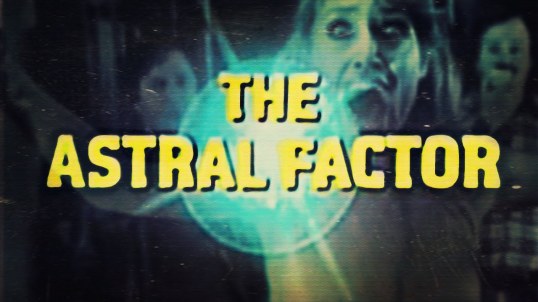
Horror Film Review: The Astral Factor (dir by John Florea)


Filmed in 1978 but not released until 1984, The Astral Factor tells the story of Roger Sands (Frank Ashmore).

Known as the Celebrity Killer, Roger is a serial killer who murdered women who reminded him of his famous mother.  It may seem like Roger is destined to spend the rest of his life in prison but what the legal system didn’t consider is that Roger has the ability to not only move things with his mind but to also turn himself invisible.  How did Roger get those powers?  Who knows?  At one point, Roger’s psychiatrist mentions that Roger was a student of the paranormal.  Later, it’s revealed that he had several books about the supernatural in his bedroom.  Apparently, Roger figured out how to do it himself.

Anyway, Roger is now invisible and soon, he has escaped from prison.  He is determined to kill the five women who testified against him at his trial, both because they remind him of his mother and also because he blames them for sending him to prison.  Roger strangles his victims, which in this case means that the actresses playing them have to pretend like they’re struggling with someone who can’t be seen.  In fact, Roger spends almost the entire film in a state of invisibility.

How do you catch a killer who can’t be seen?  It’s a fair question but police Lt. Charles Barnett (Robert Foxworth) might have the answer.  Barnett’s solution involves grabbing a gun and keep firing it until you hit something.  That’s a straight-forward solution but The Astral Factor is a pretty straight forward film.  The film begins with Roger turning invisible and, to its credit, it doesn’t spend too much time trying to justify or explain Roger’s magical powers.  The film understands that all the audience really needs to know is that Roger can’t be seen and that it’s up to Lt. Burnett to find a way to stop his killing spree.

The Astral Factor is a low-budget film, one that is full of formerly prominent performers who obviously showed up to get a quick paycheck.  Sue Lyon, Marianne Hill, Leslie Parrish, and Elke Sommer all play potential victims and all of them look like they would rather be doing anything other than appearing in The Astral Factor.  Robert Foxworth, to his credit, does his best to give a convincing performance as a level-headed cop who is forced to accept the reality of the paranormal.  Not only is he having to investigate a series of murders but he’s having to do it on his birthday.  Stefanie Powers plays his girlfriend, Candy.  Candy often refers to herself in the third person whenever she’s having a conversation with her boyfriend.  I tend to do the same thing so at least there was a character in this movie to whom I could relate.  Knowing the rules of the genre, I spent the entire movie expecting Candy to be put in danger and I was actually impressed when my expectations were subverted and that didn’t happen.

With the exception of a few atmospheric scenes and an entertainingly garish and tacky dance number, the film itself has the rather flat look of a made-for-TV movie, though the occasional hint of nudity indicates that it was meant to be a theatrical release.  As I mentioned at the start of this review, The Astral Factor was originally filmed in 1978 but it sat on the shelf until 1984.  That’s when a slightly shortened version was released under the title The Invisible Strangler.  Today, the film is available in countless Mill Creek Box Sets, under its original title and with its original run time restored.

Horror on the Lens: Jesse James Meets Frankenstein’s Daughter (dir by William Beaudine)


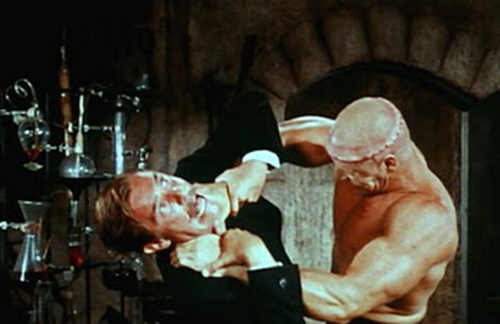
This 1966 western/horror hybrid is just about as stupid as you think it is but it’s also a lot of fun if you’re in the right mood.  Notorious outlaw Jesse James (John Lupton) attempts to hold up a stagecoach but, in the process, his hulking partner Hank (Cal Bolder) is serious wounded.  Some helpful peasants direct Jesse and Hank to the mysterious German doctor who happens to live in a nearby dark and scary house.  That doctor is Maria Frankenstein (Narda Onyx) and she’s been conducting experiments to bring dead Mexicans back to life.  Imagine her joy when the nearly dead Hank shows up at her laboratory.  Anyway, Maria performs a brain transplant on Hank and once Hank comes back to life, she informs him that his new name is “Igor.”  Yes, she does.  That plot description pretty much tells you everything you need to know about the movie but I vaguely enjoyed vaguely paying attention to it.  Maria’s German accent is hilariously overdone, the Frankenstein laboratory is full of pointless electrical things, and a character dies halfway through the film just to later show up again with no explanation.  It’s that type of movie.

And it’s also the type of movie that you can watch below!

Enjoy!

http://www.youtube.com/watch?v=BF1leghsszg

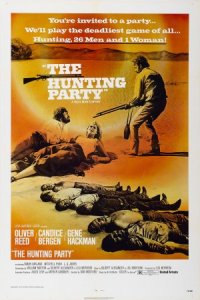
A Movie A Day #258: The Hunting Party (1971, directed by Don Medford)


Old west outlaw Frank Calder (Oliver Reed) wants to learn how to read so he and his gang ride into the nearby town and kidnap Melissa Ruger (Candice Bergen).  Because he saw her reading to a group of children, Calder assumed that Melissa was a school teacher.  Instead, Melissa is the wife of a brutal cattle baron and hunter named Brandt Ruger (Gene Hackman).  Even after Calder learns the truth about Melissa’s identity, he keeps it a secret from his gang because he knows that they would kill her and then kill him as punishment for kidnapping the wife of a man as powerful as Brandt.  Stockholm Syndrome kicks in and Melissa starts to fall in love with Calder.  Meanwhile, Brandt learns that his wife has been kidnapped and, with a group of equally brutal friends, he sets out to get her back.  In Brandt’s opinion, Calder has stolen his personal property.  Using a powerful and newly designed rifle, Brandt kills Calder’s men one-by-one until there is a final, bloody confrontation in the desert.

Coming out two years after Sam Peckinpah redefined the rules of the western genre with The Wild Bunch, The Hunting Party owes a clear debt to Peckinpah.  Much as in The Wild Bunch, the violence is sudden, brutal, and violent.  What The Hunting Party lacks is Peckinpah’s attention to detail and his appreciation for the absurd.  Instead, The Hunting Party is just one shooting after another and, devoid of subtext or any hint of a larger context, it quickly gets boring.

Fans of Oliver Reed, however, will want to watch The Hunting Party because it features one of his best performance.  For once, Reed is actually playing the nice guy.  He may be an outlaw but he still cries when a mortally wounded member of his gang begs Calder to put him out of his misery.  Gene Hackman is also good, even though he’s playing one of his standard villain roles.  (The less said about Candice Bergen’s performance, the better.)  The Hunting Party may be dully nihilistic but Oliver Reed shines.