Law of the Canyon (1947, directed by Ray Nazarro)


When a gang of outlaws starts hijacking freight wagons and then ransoming them back to their owners, government agent Steve Langtry (Charles Starrett) is sent to investigate.  He both goes undercover as an inexperienced traveler and as the masked Durango Kid.  As always, he is accompanied by Smiley Burnette.  In this installment, Smiley tries to invent a machine that can find silver and he also sings a few songs.  His backing band, The Lone Star Cowboys, follow him everywhere that he goes but they don’t actually get involved in the action.

This is another Durango Kid movie, with all of the usual horse chases and shootouts.  The same action montage that started Phantom Valley also starts this movie.  As always, Charles Starrett is convincing when riding a horse or shooting a gun.

What sets this Durango Kid movie apart from the others is the main villain.  Dr. Middleton (played by a regular member of the Durango Kid stock company, Fred F. Sears) appears to be a kindly man who serves as a middleman between the citizens and the outlaws.  Actually, he is working with the outlaws and receives a commission of every ransom that he negotiates.  The reason he can get away with it is because he’s drugged the Sheriff (George Cheseboro)!  He attempts to drug Durango too but luckily, Smiley drinks the water instead.

While it won’t convert anyone who isn’t already a fan of the genre or the character, this is another entertaining outing for the Durango Kid.
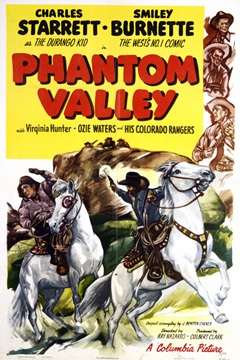
Phantom Valley (1948, directed by Ray Nazarro)


There’s trouble in Phantom Valley.  The ranchers who founded the town are increasingly at odds with the newly arrived homesteaders.  Each side blames the other for the tensions.  Marshal Steve Collins (Charles Starrett) is sent to investigate who is responsible for all of the trouble but, when two people are murdered, it is up Steve’s alter ego, the masked Durango Kid, to investigate and solve the murders.  Helping him out is his ever-loyal sidekick, Smiley Burnette.  Smiley compares himself to Sherlock Holmes, walks around with a magnifying glass, and sings a few songs.

This Durango Kid film opens with a exciting montage of cattle stampedes, shoot-outs, floods, and horse chases.  Even though it’s almost all stock footage that appeared in a countless number of other B-movies, it’s still exciting to watch.  Despite the opening montage, there’s still less stock footage than usual in Phantom Valley.  The emphasis is instead on the Durango Kid as a detective, trying to solve a stone-cold whodunit.  It makes for an interesting change of pace and the Durango Kid gets to show off his intelligence along with his shooting and horse riding skills.  Charles Starrett is convincing as a detective.  Even if he is trying to solve the case a century before finger printing, The Durango Kid knows that hand-writing is just as easy a way to identity a culprit.  Smiley Burnette, as usual, handles the comedic relief and the singing.  I could have done without the songs but Smiley trying to use a magnifying glass and losing his temporary position as the town’s marshal to a child will always be good for a laugh.

Phantom Valley was a welcome change of pace for the Durango Kid.  Western fans will find much to appreciate.

Streets of Ghost Town (1950, directed by Ray Nazarro)


Years ago, Bill Donner (George Cheseboro) double-crossed the other members of the Selby Gang and ran off with all of their stolen gold.  Now, Donner is blind and half-crazy.  When he says that he hid the gold in the ghost town of Shadeville, the Durango Kid (Charles Starrett), Smiley Burnette, and Sheriff Dodge (Stanley Andrews) ride off to find it.

Shadeville is long abandoned and, as the three men spend the night in a deserted saloon, Smiley is worried about ghosts.  The Durango Kid tells the story of the first time he met the Selby Gang.  The next morning, they discover that they are not the only ones who have come to Shadeville to look for the gold.

Like many of the later Durango Kid movies, Streets of Ghost Town is mostly made up of stock footage to Starrett’s earlier films.  This was a cost-cutting technique on the part of Columbia Pictures but it actually works because the flashbacks were always to the horse chases and the gunfights that the audience came to see in the first place.  In the days before home video and cable, those scenes were probably still new to many of the people sitting in the theater.

Starrett always made for a good hero and Smiley Burnett’s comic relief never took away from the films’s storylines.  This outing features a great scene where Durango shoots a skull in the dark just to let anyone watching him know that he’s a good shot.  I also enjoyed George Cheseboro’s manic performance as a man who really loves his gold.  Despite all of the stock footage, Streets of Ghost Town is still an above average Durango Kid film, predictable but entertaining if you’re a fan of the genre.

Top Gun (1955, directed by Ray Nazarro)


Rick Martin (Sterling Hayden) rides his horse into his hometown of Casper, Wyoming.  He has an important message to deliver to the town marshal but first, he visits his mother’s grave and discovers that there is a maker with his name on it and an open grave waiting for him.  Many of the other makers are for people who are specifically identified as have been “Murdered by Rick Martin.”

Rick is notorious for being a gunslinger and most of the town considers him to be nothing but a murderer, despite Rick’s claim that he’s never shot anyone who didn’t try to shoot him first.  Despite the town’s feelings towards him, Rick warns his old friend, Marshal Bat Davis (James Millican), that the notorious outlaw Tom Quentin (John Dehner) is coming to Casper and is planning on tearing the place up.  Rick offers to stick around and help fight Quentin and his men but the city council orders him to leave.

City councilman Canby Judd (William Bishop) especially wants to get rid of Rick.  Judd murdered Rick’s mother for her land and he is also engaged to Rick’s former girlfriend, Laura (Karin Booth).  When Rick asks Laura to come to California with him, Judd and his gunslinger (played by Rod Taylor, in one of his first film roles) conspire to put Rick in jail.  At first, the town is happy to have Rick behind bars but then Tom Quentin and his gang show up.

Though it will never be the most popular film to use the title, 1955’s Top Gun is an intelligent B-western that puts as much emphasis on the hypocrisy of the town as it does on gunfights and duels.  The population sign specifically says that Casper is home to “1,002 law-abiding citizens” and it is obvious that Rick is not considered to be good enough to be one of those citizens.  Rick may have a violent past but he’s honest about who he is, unlike the holier-than-thou townspeople who put Rick in jail and then expect him to help them out when the real outlaws arrive.  Though the townspeople pretend that there’s no place for someone like Rick Martin in their society, Rick understands the harsh reality of life in the old west.  Director Ray Nazarro does a good job choreographing the fight scenes and Sterling Hayden give a tough and angry performance as Rick Martin and he’s supported by an able cast of western regulars.  Western fans will find much to enjoy while watching Top Gun.

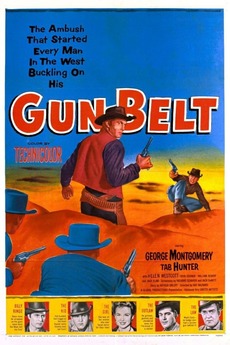
Gun Belt (1953, directed by Ray Nazarro)


Outlaw Matt Ringo (John Dehner) escapes from prison and reunites with his old gang.  Riding out to Tombstone, Matt tracks down his son, Chip (Tab Hunter).  Chip is now living with his uncle, Billy Ringo (George Montgomery).  Billy was once a member of Matt’s gang but he’s gone straight, he’s given up his guns, and he now has a ranch of his own.  Billy tries to keep the naive Chip from idolizing his father but Chip is bored with life on the ranch.  Matt not only works to turn Chip against his uncle but he also frames Billy for a bank robbery.  With the town convinced that Billy has returned to his outlaw ways, Billy has no choice but to reach out to the most honest lawman in town, Wyatt Earp (James Millican).

The most interesting thing about this western is the way that it blends real people, like Wyatt and his brother Virgil (Bruce Cowling), with characters who were obviously fictionalized versions of the participants in the gunfight at the OK Corral.  The Ringos are obviously based on Johnny Ringo who, as anyone who has seen Tombstone has seen you, never went straight in real life.  Meanwhile, the head of the gang is named Ike Clinton.  Did someone misspell Ike Clanton’s name while writing the script or was the name really changed for some unknown reason?  Ike Clanton wasn’t around to sue over the way he was portrayed in the movie.

Beyond the mix of a little truth with a lot of fiction, Gun Belt is a traditional western with bad outlaws and upstanding lawmen and a naive cowpoke who has to decide whether he wants to follow the path of good or evil.  George Montgomery has the right presence to be a believable as both a retired outlaw and rancher and James Millican brings quiet authority to the film’s version of Wyatt Earp.  Western fans will be happy to see Jack Elam in the role of one of the gang members.  The only really false note is provided by Tab Hunter, who comes across as very young and very callow and not believable at all as someone who could work on a ranch or successfully pursue a career as a professional lawbreaker.

Seven years after it was released, Gun Belt was remade as Five Guns To Tombstone.

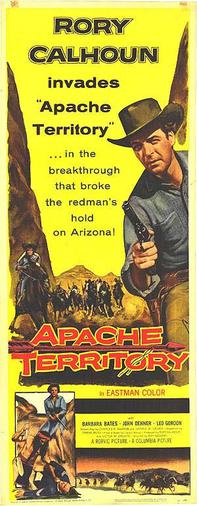
Apache Territory (1958, directed by Ray Nazarro)


In this B-western, Rory Calhoun plays Logan Cates, an old west drifter, while traveling through the desert, comes across a young woman named Junie Hatchett (Carolyn Craig).  Junie’s parents were settlers who were captured and killed by a group of Apaches.  Knowing that the Apaches will still be looking Junie, Logan takes her to a nearby canyon where there’s water and shelter.  Soon, other victims of the Apaches start to show up at the canyon.  With their supplies dwindling and the Apaches surrounding them, Logan has to keep everyone alive and lead them to safety.

Complicating matters is that one of the people who shows up at the canyon is Logan’s ex-girlfriend, Jennifer (Barbara Bates).  Jennifer is traveling with her new husband, the wealthy (and therefore cowardly) Grant Kimbrough (John Dehner).  Also seeking shelter at the canyon are a group of Calvary officers, a Pima Indian named Lugo (Frank DeKova), and a naive teenage cowboy named Lonnie (Tom Pittman).

Based on a novel by Louis L’Amour, Apache Territory is a pretty standard western.  Some of the battle scenes are surprisingly brutal — particularly when one of the Calvary officers gets hit by a flaming arrow — but otherwise, this is a typical B-western, the type of movie that would have been the second part of a double bill at a Saturday matinee.  Logan Cates is able to survive because, unlike Grant Kimbrough, he knows and respects the land and, unlike the Calvary officers, he respects his enemy.  He’s a typical western hero, though well-played by Rory Calhoun.

The main problem with the film is that, for a film about a group of people trapped in one location, it never achieves any sense of claustrophobia.  The size of the canyon seems to change from shot to shot.  The film’s finale involves a well-realized dust storm but it still never reaches the type of action-packed conclusion that most western fans will be hoping for.  It ends with a whimper instead of a bang.  It feels more like an extended episode of Gunsmoke or The Virginian than a feature film.

This one will be best appreciated by undemanding fans of the genre.