Based on a novel by veteran sports writer Dan Jenkins, Dead Solid Perfect takes an episodic look at a year on the PGA tour. Kenny Lee (Randy Quaid) is a good but aging golfer who wants to finally have his time in the spotlight. His sponsor (Jack Warden) is an eccentric old racist. His girlfriend (Corinne Bohrer, who has a lengthy scene where she walks naked down hotel hallway while carrying an ice bucket) isn’t looking for a commitment while his wife (Kathryn Harrold) is getting sick of his emotional immaturity. Kenny Lee just wants to hit the perfect shot.
An early HBO production, Dead Solid Perfect is one of the best movies ever made about pro golfers, not that there is really much competition. Eschewing the pretentious blathering that has marred other golf films (like The Legend of Bagger Vance), Dead Solid Perfect focuses on the day-to-day life of aging athletes who have never had to grow up. This was Dan Jenkins’s specialty and Dead Solid Perfect feels authentic in a way that many other sports film, like Bagger Vance, do not. Randy Quaid, long before he had his widely publicized breakdown and started making videos about the “star whackers,” is perfectly cast as Kenny. Sadly, Dead Solid Perfect has never been released on DVD or Blu-ray but it will entertain any golf fan who owns an operational VCR.
Of course, the best movie about golf is still Caddyshack.
Packard Walsh (Nick Cassavetes) has a pretty good business going. He and his gang of “road pirates” patrol the Arizona desert. Whenever they spot a car that they want, they demand that the driver race for pink slips and they cheat to win. Through fear and intimidation, Packard rules the town of Brooks and not even Sheriff Loomis (Randy Quaid) can stop him.
Packard is obsessed with Keri Johnson (Sherilyn Fenn), who works as a carhop at Big Kay’s Burger. Packard considers Keri to be his property and even demands that she drink his blood so that they will be forever linked. Earlier, Packard and his gang killed Keri’s boyfriend, Jamie. When a new kid named Jake (played by Charlie Sheen) shows up in town, both Keri and Jamie’s brother (Matthew Barry) feel as if they know him from somewhere. Jake also has scars on his back the match Jamie’s wounds.
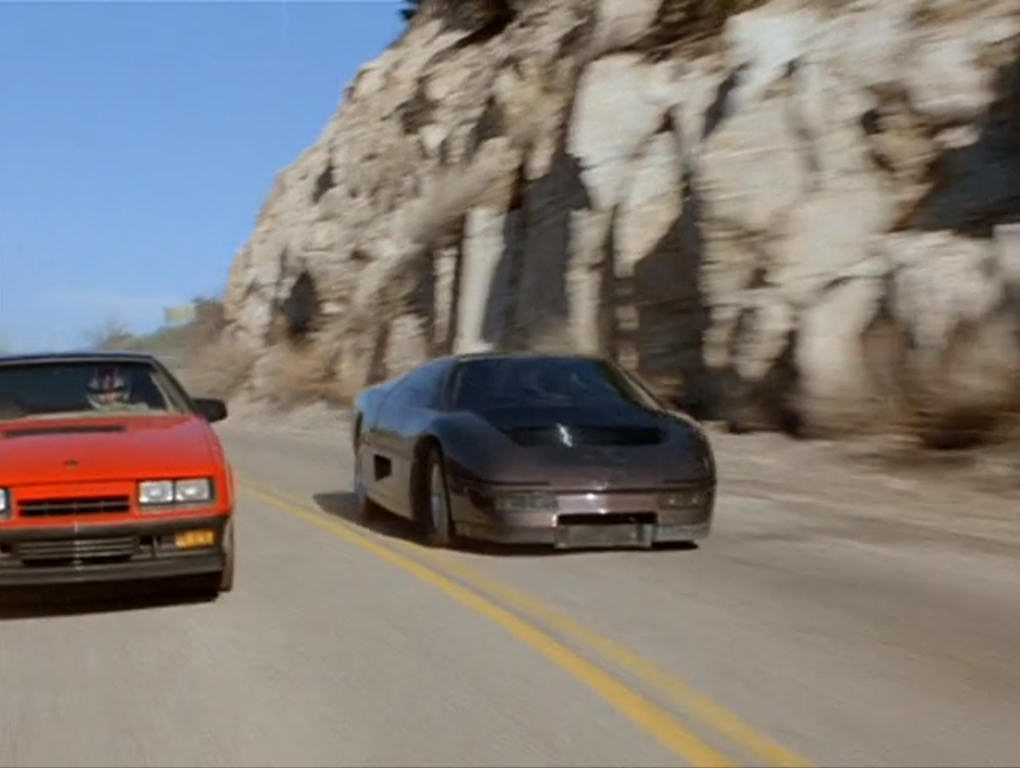
Shortly after Jake’s arrival, a mysterious black Turbo Interceptor appears on the roads. The unseen driver challenges each member of Packard’s gang to a race and then purposefully crashes into them. Whenever the Turbo explodes, it rematerializes somewhere nearby. When the driver does finally get out of the Turbo, it turns out that he’s covered in black leather armor and his face is hidden behind a black helmet.
According to Rughead (Clint Howard), the only member of Packard’s gang who did not take part in Jamie’s murder, the driver is “a wraith, man! A ghost, an evil spirit — and it ain’t cool!”
The Wraith is one of those films that always used to show up on TV when I was a kid. Thought it was often advertised as being a horror film, it’s actually an uncredited remake of High Plans Drifter with Clint Eastwood replaced by Charlie Sheen. Seen today, The Wraith is a major nostalgia trip. One of the fun things about watching the movie is ticking off all of the clichés that make this a definite 80s film, from the cars to the slang to the soundtrack. (It does not get more 80s than a soundtrack featuring both Billy Idol and Robert Palmer.) Packard’s gang is all made up of generic punk types. My favorite was Skank (David Sherrill), who had a mohawk and drank brake fluid.
Of course, the cars are the main appeal of The Wraith. All of the, are cool (even Rughead’s pickup truck) but the obvious star of the film is that black Turbo Interceptor. At its best, it rivals even Marty McFly’s DeLorean as the coolest car to show up in an 80s sci-fi film.
The Wraith may not be the greatest movie ever made but if you are into fast cars and Sherilyn Fenn at her loveliest, you should enjoy it.
One of my favorite online film reviewers is Mitch Lovell of the Video Vacuum. The thing I like about Mitch is that he doesn’t worry about how many Oscars a film has been nominated for or whether or not a film’s politics are currently in fashion. Unlike a lot of online reviewers, he doesn’t worry about whether or not he’s going against the “accepted” views of the critical establishment. Instead, he’ll watch a film and tell you exactly how he felt about it.
For example, Mitch Lovell’s review of the otherwise critically acclaimed 1976 best picture nominee Bound for Glory can be summed up in three words: “boring as fuck.” Every other online review that I’ve found for Bound for Glory offers up polite but rarely inspiring praise for this rather lengthy film about the folk singer Woody Guthrie. Most of those reviews do acknowledge that the film moves at its own pace but we are told that we will be rewarded for being patient. If the review was written after 2010, you can be sure that the reviewer will be sure to say that Bound for Glory reminds us of why labor unions are still important and need to be protected from the Tea Party. (The idea apparently being that, if a film has the right politics, it doesn’t have to actually be all that interesting.) It’s all rather predictable and that’s why we’re lucky to have reviewers like Mitch Lovell around. Whether you agree with him or not, it’s good to have a reviewer who will go against the conventional wisdom.
I recently watched Bound for Glory as a part of TCM’s 31 Days of Oscars and, to a large extent, I have to agree with Mitch Lovell’s review. This is a movie that is not only long but which moves slowly as well. It’s not that the film has a deliberate pace. It’s just slow! (If you want to see a film that makes good use of a deliberate pace, check out Barry Lyndon.) David Carradine plays Woody Guthrie, a sign painter who, during the Great Depression, abandons his family in Texas and, by hopping trains, makes his way to California. He works with fruit pickers. He tries to convince his fellow workers to form a union. He gets beat up a lot.
And he plays his guitar.
If there’s anything that remains consistent about Bound for Glory, it’s that Woody is always playing his guitar and that every time he starts to play, something terrible either has happened or does happen. There’s a huge dust storm. Woody plays his guitar. A fight breaks out at a union meeting. Woody plays his guitar. A bunch of hoboes on a train get beat up. Woody plays his guitar. Woody shows up at a textile mill and starts to play his guitar. He gets beaten up by a bunch of thugs. Woody impresses Pauline (Gail Strickland) by playing his guitar and soon, he’s cheating on his wife. Woody partners up with another folk singer, Ozark Blue (Ronny Cox), and they get their own radio show where Woody plays guitar. Woody promptly gets fired.
It quickly became apparent to me that Woody Guthrie’s guitar was cursed. Whenever he played it, poor people ended up getting oppressed.
In many ways, Bound for Glory is a prototypical example of what it means to be an acclaimed-at-its-time-but-subsequently-forgotten best picture nominee. It’s a big epic film that tells a fictionalized account of a real person’s life story. Woody Guthrie is best known for writing This Land Is Your Land, which is a song that I mostly associate with pretentious super bowl commercials. As Bound for Glory details, Woody was also a union organizer and political activist but what’s odd is that the film keeps the exact details of what he believed rather vague. We’re given the general idea of what Woody believed but we’re not given any specifics. As a result, Woody just comes across like another part-time social protestor as opposed to being a true political thinker (much less a revolutionary).
On a positive note, Bound for Glory is impressive to look at. The film’s cinematographer was the famous Haskell Wexler (who also directed Medium Cool, a film that was as upfront about its politics as Bound for Glory is vague) and Wexler captures some hauntingly beautiful images of the American wilderness. The scene where a gigantic wall of dust crashes down onto a small Texas town is especially memorable.
Otherwise, though, Bound for Glory is pretty much a snoozefest. It was nominated for best picture of 1976 and, when you compare it to fellow nominees like All The President’s Men, Network, Taxi Driver, and even Rocky — Bound for Glory does feel a bit out of place.
Then when you consider some of the other films that came out in ’76 — Carrie, Face to Face, The Front, God Told Me To, Logan’s Run, The Man Who Fell To Earth, Marathon Man, The Omen, The Outlaw Josey Wales, Lipstick, Robin and Marian, The Sailor Who Fell From Grace With The Sea, and The Town That Dreaded Sundown — the nomination of Bound for Glory feels like even more of a mistake.
Monday is the first day of school down here in Dallas so it seems only appropriate that this latest entry in our Back to School series should be a look at one of those most quintessential Texas films ever made, the 1971 best picture nominee, The Last Picture Show.
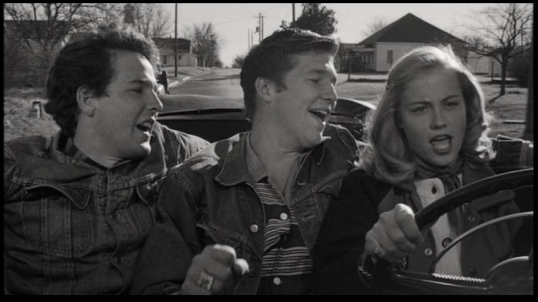
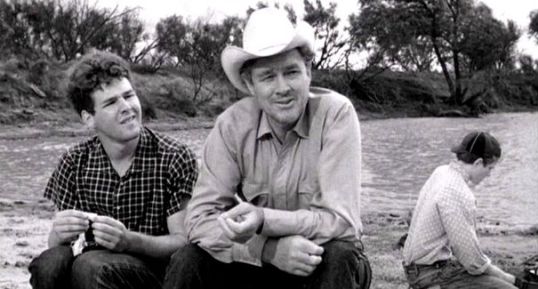
Directed by Peter Bogdanovich and based on a novel by Larry McMurtry, The Last Picture Show takes place in 1951 and tells the story of two high school seniors, best friends Sonny Crawford (Timothy Bottoms) and Duane Jackson (Jeff Bridges, reminding us once again why everbody loves him). Sonny and Duane live in the rural town of Anarene, Texas. With little to look forward to in the future, beyond perhaps getting a job working in the oil fields, Sonny and Duane are both intent on enjoying their final year of high school. Sometimes, that means driving down to Mexico for the weekend. Sometimes, it means going to the only theater in town and seeing a movie. Most of the time, however, it means hanging out in a pool hall owned by the strict but fatherly Sam (Oscar winner Ben Johnson). Often times they are accompanied by the intellectually disabled Billy (Sam Bottoms), who responds to everything with a blank smile and spends most of his spare time wandering around with a broom, futilely trying to sweep the dusty streets.
The charismatic and impetuous Sonny is dating the beautiful and self-centered Jacy Farrow (Cybil Shepherd), who is the daughter of the wealthiest woman in town. Jacy knows that her cynical mother (Ellen Burstyn) is having an affair with an oil worker named Abilene (Clu Gulager) but she’s more concerned with her own future. Even though she’s dating Sonny, Jacy still accepts an invitation from the awkward Lester Marlow (played by a memorably goofy Randy Quaid) to attend a naked indoor pool party. At the party, she meets Bobby Sheen (Gary Brockette), who is rich and will be able to provide her with the future that Duane never will. However, Bobby tells Jacy that he isn’t interested in her because she’s a virgin. If nothing else, this gives Jacy a reason to stay with Duane, at least until after they have sex.
Meanwhile, the far more sensitive Sonny ends up having an affair with Ruth Popper (Cloris Leachman, who won an Oscar for her performance in this film), the wife of the high school football coach. It appears that Sonny truly cares about Ruth but then he finds himself being tempted by none other than his best friend’s girlfriend…
At heart, The Last Picture Show really is basically a small town soap opera, a Texas version of Peyton Place.The difference between the two films — beyond the fact that The Last Picture Show just happens to be a 1oo times better than Peyton Place — is that The Last Picture Show doesn’t take place in a beautiful, idealized small town. Instead, the town ofAnarene is a believably bleak location, one that will be familiar to anyone who, like me, grew up in the American southwest. A good deal of the success of The Last Picture Show is due to the fact that it was actually filmed on location in Archer City, Texas.
(Nothing annoys me more than when I see the mountains of California in the background of a movie that’s supposed to be taking place in North Texas. We don’t have mountains up here. For the most part, we don’t even have hills. The land is flat. You can see forever, if you know where to look.)
Of course, you can’t talk about The Last Picture Show without talking about Robert Surtees’s stunning black-and-white cinematography. Not only does the black-and-white remind us that this is a film about a fading way of life but it drives home the fact that Sonny and Duane don’t have much to look forward to. Growing up in Anarene means they are destined for lives without color or excitement. In the end, can you really blame them for occasionally acting before they think?
Ultimately, the success of The Last Picture Show is due to a lot of things. This was Peter Bogdanovich’s second film as a director and he did such an excellent job here that he’s basically spent the rest of his career trying to live up to this one film. (That said, Bodganovich also left his wife for Cybill Shepherd — despite the fact that his wife was the one who suggested that he make this film and cast Cybill in the first place! Don’t worry though — Polly Platt got her revenge by having a far more successful career than her ex-husband and she even produced Say Anything, a film that we will soon be looking at.) The screenplay, by McMurtry and Bogdanovich, is full of sharp dialogue and memorable characters. As for the performers, this is probably one of the best acted films ever made. Jeff Bridges and Timothy Bottoms play off each other well, Cybill Shepherd is the epitome of casual destructiveness, and Ben Johnson is brilliantly cast as the film’s moral center. My favorite performance comes from Ellen Burstyn, who delivers every line with just the right combination of contempt and ennui.
Ellen Burstyn in The Last Picture Show
If you’re a Texan, The Last Picture Show is one of those films that you simply have to see. And if you don’t enjoy it and if you don’t relate to at least a few of the characters (I related to Jacy, though I like to think that I’m a lot nicer in the way I treat people), then you’re not a real Texan.
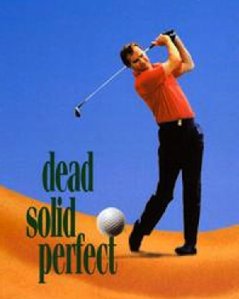 Based on a novel by veteran sports writer Dan Jenkins, Dead Solid Perfect takes an episodic look at a year on the PGA tour. Kenny Lee (Randy Quaid) is a good but aging golfer who wants to finally have his time in the spotlight. His sponsor (Jack Warden) is an eccentric old racist. His girlfriend (Corinne Bohrer, who has a lengthy scene where she walks naked down hotel hallway while carrying an ice bucket) isn’t looking for a commitment while his wife (Kathryn Harrold) is getting sick of his emotional immaturity. Kenny Lee just wants to hit the perfect shot.




 Through the Shattered Lens