“You and I both know that this clock is bullshit. You make your decisions about the people in this courtroom before they’re even in this chair.” — Det. Chris Raven
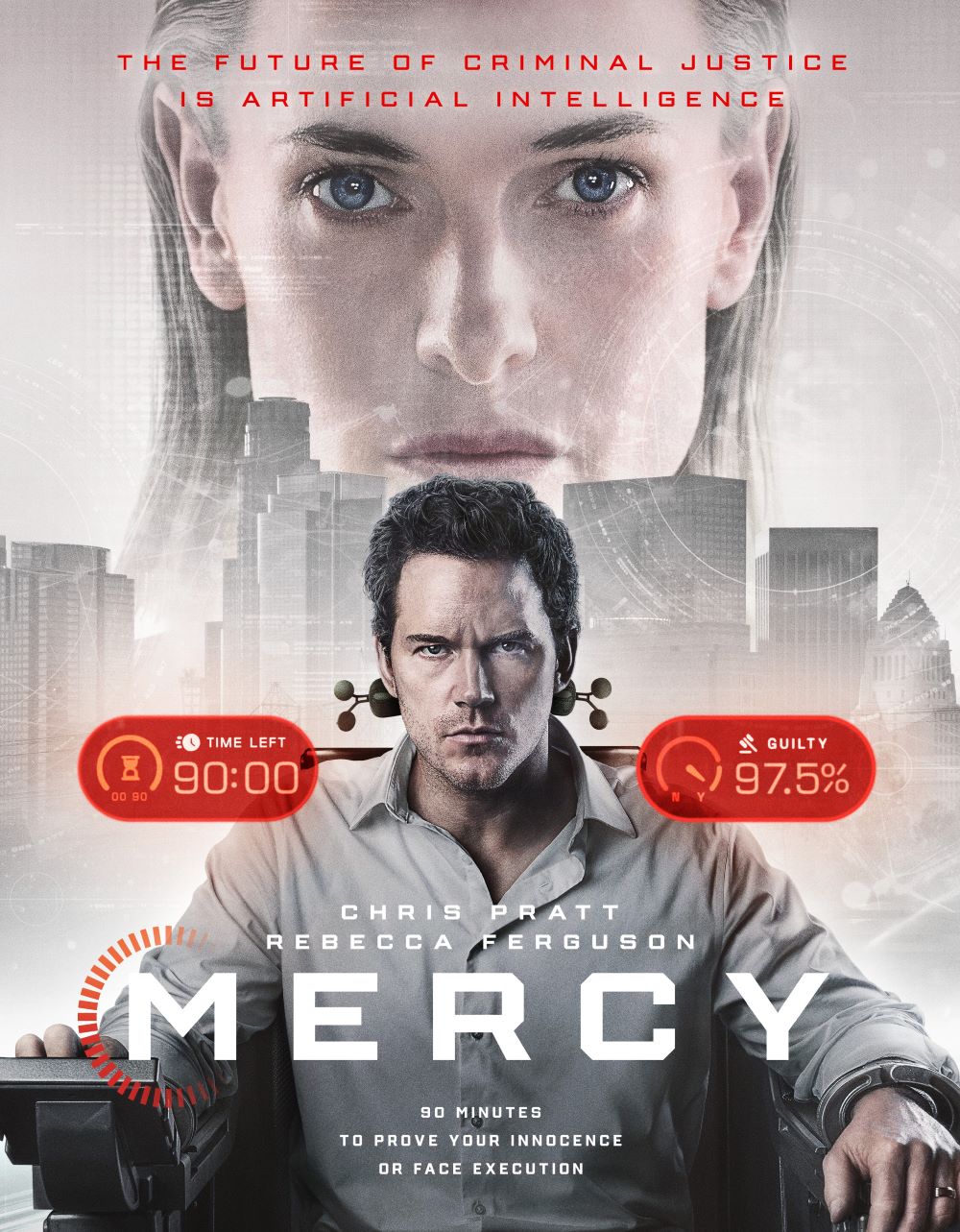
Mercy is the kind of movie that looks great in a trailer and promises a slick, high‑concept thriller, but then sputters once you sit through it. It’s set in a near‑future Los Angeles where the LAPD relies on a program called the “Mercy Court,” in which AI judges rapidly process violent crime cases, and the whole thing is framed as a techno‑noir twist on the courtroom thriller. The central gimmick is compelling on paper: detective Chris Raven wakes up strapped into a high‑tech chair, accused of brutally murdering his wife, and has 90 minutes to prove his innocence before being executed by a sonic blast. That setup alone should guarantee at least a tense, scrappy B‑movie; instead, the film keeps undercutting itself with lazy writing, cluttered subplots, and a surprising lack of nerve.
The biggest problem is the script, which feels like it’s trying to be three different movies at once and doesn’t really commit to any of them. On one level, Mercy wants to be a real‑time investigation, where Raven works with an AI judge to access security feeds, social media, emails, and police databases to piece together his wife’s murder. In practice, this becomes a series of exposition dumps—Raven talking out his thought process, the AI reciting rules, and side characters popping in just long enough to drop information before the movie rushes on. It’s not building tension; it’s building a checklist. The film’s pacing stays brisk, but that’s because so much of the middle act feels like procedural filler rather than a genuine mystery.
Tonally, Mercy swings wildly between modes. At times it’s going for something like a sleek, dystopian Minority Report–style narrative, then it veers into a revenge‑driven character drama about a cop who may be too reliant on an authoritarian justice system, and then it suddenly transforms into a generic bomb‑plot action movie. The initial setup—a world where people suspected of murder are strapped into a chair, presumed guilty, and given a brutally short window to prove themselves—feels genuinely unsettling. But the movie doesn’t really sit with those implications; it flirts with the moral and ethical questions and then rushes off to a more conventional, physical threat. What should be a caustic, uncomfortable critique of automated justice reduces to another last‑minute rescue mission.
The central mystery is another missed opportunity. The evidence stacked against Raven is substantial—blood on his clothes, footage from cameras, his drinking problem, and a history of violent outbursts—but the film telegraphs the real culprit so early that the final reveal feels less like a twist and more like a completion of prior signposting. The story tries to make the framing of Raven seem like a master‑plan‑level conspiracy, but the plan hinges on an almost impossible level of predictability on his part. The more the movie explains, the harder it becomes to buy into the logic of the setup. Instead of feeling like the net has tightened around him in a sophisticated way, it feels like the script is forcing contrivances to land on top of him.
Chris Pratt’s performance is an odd fit for the material. The movie seems determined to present him as a darker, more tortured version of himself, and there are a few moments where that dynamic works—Raven’s vulnerability, his self‑loathing, his conflicted belief in the system he helped create. But the script never really lets him live in the morally grey space it clearly wants him to inhabit. Instead, it keeps reassuring us that he’s essentially a good cop who’s been wronged, which undercuts any real tension about whether he might actually be guilty or at least dangerous. You get glimpses of a more interesting character, but they’re constantly being smoothed over by the need for a likable protagonist.
The AI judge, voiced and embodied by Rebecca Ferguson, is one of the few genuinely strong elements here. She plays the voice and presence of the system with a cool, clipped rationality that occasionally shades into dry wit, and her interactions with Raven hint at a more ambitious film lurking underneath. The idea of an AI judge slowly questioning its own assumptions—pushing back on emotional appeals, probing inconsistencies, and gradually developing something resembling curiosity—is inherently compelling. Ferguson gives the character enough personality and nuance to make that arc feel plausible, but the script mostly treats her as a glorified search engine and a moral referee for the final act, when she should be the co‑lead driving the film’s central conflict.
The supporting cast is fine, but underused. Raven’s partner mostly exists to run errands off‑screen—tracking suspects, raiding houses, reacting over the comms—so the movie can cut away from the courtroom whenever it gets bored. Raven’s AA sponsor is saddled with a mix of clumsy foreshadowing and heavy‑handed motivation, which only becomes relevant when the revenge angle kicks in. Raven’s daughter functions almost entirely as emotional leverage and a hostage, escalating the stakes in a way that feels mechanical rather than organic. You can tell the film wants these relationships to carry weight, especially when it leans on family flashbacks and guilt, but they play out like bullet points instead of lived‑in dynamics.
Visually, the film leans into its creator’s usual fondness for screens within screens, overlay graphics, and multimedia collage. The Mercy Court itself is a striking concept—an almost clinical chamber where Raven is strapped into a chair while the AI’s interface shifts around him—yet the movie keeps cutting away to external action once the premise might otherwise grow too tense or claustrophobic. The pacing is brisk, and there are a few set‑pieces—an intense raid on a suspect’s house, the final assault on the courthouse—that deliver a basic level of genre competence. The issue is that competence is about as high as Mercy ever aims; it never really experiments with the form or stakes of its own setup.
Where the film stumbles most is in its attempt at commentary. The world it presents is, on paper, horrifying: defendants are presumed guilty, strapped into a chair, surveilled across every aspect of their digital life, and given a brutally short window to clear their name before being executed. That’s fertile ground for a scathing critique of mass surveillance, algorithmic justice, and the erosion of due process. But the movie is oddly kind to the system itself; by the end, the AI judge is portrayed as more reasonable and “fair” than most humans, and the real villain is just an individual with a personal grudge. The film nods at privacy violations and the moral grey zones of automating justice, then quickly moves on to a more traditional, physical threat. For something that positions itself as a provocative AI courtroom thriller, it ends up feeling strangely apolitical and conflict‑averse.
To be fair, there are a few things Mercy gets right. The core structure—a detective investigating his own case against a clock—remains inherently watchable, even when handled clumsily. Ferguson’s performance gives the material a center of gravity whenever it threatens to spin out into nonsense. And there’s an occasionally interesting tension between Raven’s instinct‑driven, emotionally charged approach and the AI’s cold, probabilistic logic, suggesting a better film that really pits those worldviews against each other instead of letting them conveniently converge. If you go in with low expectations and a tolerance for generic sci‑fi thrillers, you might find it mildly diverting.
But for anyone hoping Mercy would be a sharp, nasty, high‑concept genre piece with something to say about AI, policing, and due process, it’s a disappointment. The movie leans on an admittedly strong premise, some slick production design, and a few scattered performances, yet it never commits to either being a full‑tilt B‑movie or a genuinely thoughtful techno‑thriller. It’s not unwatchable, just frustratingly timid—content to skim the surface of its own ideas and then blow something up when things get complicated. By the time the credits roll, you’re left with the sense that the AI judge wasn’t the only one operating on a strict time limit; somewhere along the way, the film seems to have run out of patience with itself, too.

 Through the Shattered Lens