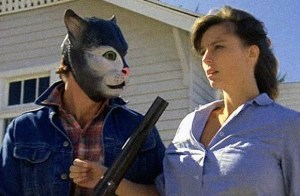
The TSL’s Grindhouse: The Final Terror (dir by Andrew Davis)


“Marco!?”

“Melanie!?”

“Margaret!?”

“Dennis!?”

“Eggar!?”

“Windy!?”

If you watch the 1983’s The Final Terror, be prepared to frequently hear the names of the film’s characters.  For a slasher film about a bunch of campers wandering through the forest, The Final Terror has a surprisingly large cast and they all spend a good deal of time walking around and yelling out each other’s names.  Somehow, people keep getting lost even though they know that there’s a killer out there and they all really should be sticking together.

Interestingly enough, for a slasher film, there aren’t that many deaths.  The majority of the cast survives.  Even the most obnoxious of the campers, the one who seems like an obvious victim, manages to make it through to the finale.  I guess we should be happy that most of them survived and this was apparently their final terror.  The majority of the campers were teenagers and if you’re having your surviving your final terror when you’re not even old enough to drink yet …. well, consider yourself lucky.

The Final Terror is set up like an entry in the Friday the 13th franchise but it’s never anywhere close to being as sleazy as those films.  Whether that’s a good or a bad thing depends on what you, as a viewer, want in terms of a wilderness slasher film.  If you want lots of sex, blood, and people making stupid decisions, The Final Terror will probably bore you to death, despite the fact that it includes all three.  If you want a relatively realistic film about being lost in the wilderness while being stalked by an unseen killer, you’ll probably appreciate The Final Terror.  This film was directed Andrew Davis, who went on to direct several big budget Hollywood action films.  Before he became an action director, though, he worked as an assistant to cinematographer Haskell Wexler on the semi-documentary Medium Cool.  Davis brings that realistic style to The Final Terror.  Even though the film does feature some familiar faces, it’s easy to believe that you’re just watching a bunch of campers trying to survive for the weekend.

As for the cast, Rachel Ward plays one of the leaders of the campers.  Joe Pantoliano makes an early appearance as the creepy Eggar.  Daryl Hannah plays Windy.  Mark Metcalf plays another camper named Mike.  The entire ensemble actually does a pretty good job.  As I said, you really do believe that the majority of the cast are delinquent teenagers who have been sent on a camping trip.  When they work together to keep someone from bleeding to death, it almost feels like an educational film.  “Because the campers worked together,” you can imagine a narrator saying, “they might survive The Final Terror.”

The Final Terror is not bad, though I have to admit that I like my 80s slashers to be a little bit more sordid.  But for what it is — an attempt to take a realistic approach to a genre that is regularly held in dismissive disdain — The Final Terror works surprisingly well.  As captured by Andrew Davis, the wilderness is both beautiful and terrifying.  You’ll never catch me camping!

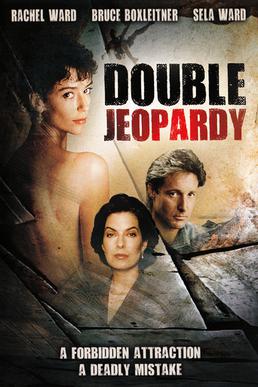
Double Jeopardy (1992, directed by Lawrence Schiller)


Salt Lake City is riveted by the sensational murder trial of mountain climber Lisa Burns Donnelly (Rachel Ward).  Lisa killed her ex-boyfriend, Eddie.  She says that she did it in self-defense after Eddie raped her.  The prosecution claims that she murdered Eddie after he caught her cheating on him with another man.  Lisa’s lawyer, Karen Hart (Sela Ward), is up for a judgeship.  Her husband, Jack (Bruce Boxleitner) is Lisa’s ex-boyfriend.  What Karen doesn’t know is that, other than Lisa, Jack is the only person who witnessed what happened the night of the murder because, just moments before, he and Lisa had been committing PG-13-rated adultery in her shower.

One of the interesting things — in fact, maybe the only interesting thing — about Double Jeopardy is that several online sellers claim that the film stars Aaron Eckhart.  It is true that Eckhart is in the movie.  It was shot in Salt Lake City while he was a student at BYU and it was his film debut.  However, Eckhart has about a minute of screen time and about five lines.  He plays a Marine named Dwayne who someone meets in an airport.  His big line is, “Semper Fi, babe!”

As for the film, since it’s set in Salt Lake City, there’s a lot of talk about how Lisa is being unfairly judged for her unconventional (read: non-Mormon) life style and there’s a heavy-handed subplot about Jack trying to put on a production of The Crucible but it doesn’t add up too much.  It would probably have been easier for the movie to make a point about religious and moral persecution if Lisa wasn’t actually guilty of murdering Eddie.  Instead, the movie leaves you thinking, “Maybe those Mormons have a point.”

Double Jeopardy tries hard to be something more than your standard legal thriller but it’s pretty forgettable.  Rachel Ward was always a great femme fatale and Sally Kirkland gives a good performance as the cop who sees through both Lisa and Jack.  The film was produced for Showtime at a time when cable was still trying to prove that it could provide original content worth paying for so there’s some cursing and sideboob tossed in, as if to say, “See?  You don’t get this on NBC!”  Otherwise, this is a by-the-numbers made-for-TV movie.

The TSL’s Horror Grindhouse: Night School (dir by Ken Hughes)


Someone is decapitating women in Boston and police Lt. Judd Austin (Leonard Mann) is determined to discover where the killer’s head is at!

The victims seem to come from all walks of life.  A teacher’s aide loses her head while spinning around on a carousel. A worker at the local aquarium has her head tossed into a fish tank where it’s promptly nibbled at by a turtle.  (Interestingly enough, the sharks ignore it.)  Another head shows up in a kitchen and then another one in a toilet and then another one in a pond and …. well, you get the idea.  There’s a lot of heads rolling around.  The only thing that all of the victims have in common is Wendell College.  Some were merely killed near the college.  Others were enrolled in night classes.

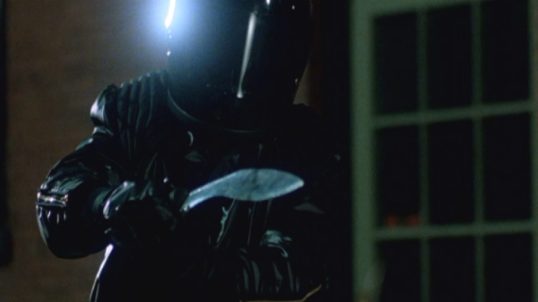
Because the murderer wears a motorcycle helmet and a full black leather bodysuit, we’re not sure who the killer is.  However, Lt. Austin promptly comes to the conclusion that the murderer is probably anthropology professor Vincent Millett (Drew Snyder), an unlikely lothario who is notorious for sleeping with his students and who has a collection of skulls in his apartment.  Austin’s attitude is that no normal person would teach anthropology and since it also stands to reason that no normal person would run around Boston chopping off people’s heads, Millett must be the murderer.  Millett doesn’t help himself by continually coming across as being a bit of an arrogant prick.

But is Millett the murderer?  There are other suspects!

For instance, there’s Millett’s teaching assistant (and lover) Eleanor Adjai (Rachel Ward), on whom Millett performs some sort of odd blood ritual while the two of them are taking a shower together, the better so that director Ken Hughes can toss in a playful homage to Psycho.

And then there’s Gary (Bill McCann), the obviously disturbed busboy at the local diner who tries to follow Eleanor home one night.

And let’s not forget the dean of students, Helene (Annette Miller), who is portrayed as being a predatory lesbian because this movie was made in 1981.

And then there’s….

Well, actually, that’s it.  One of the problems with Night School is there there really aren’t enough suspects.  For a film like this to really work, you need a lot more red herrings.  Savvy filmgoers already know that the most likely suspect isn’t going to be guilty because they never are.  Unfortunately, that wipes out 50% of Night School‘s suspects and only leaves two others, one of whom is soon murdered.  It all leads up to a surprise ending that’s not much of a surprise.

Night School is usually described as being a part of the slasher boom of the early 80s.  While it’s true that Night School probably would never have been made if not for the financial success of Halloween and Friday the 13th, the film itself, with its whodunit plot and it’s gloved and masked killer, is more an American giallo than a traditional slasher film.  That said, Night School never reaches the over-the-top, operatic heights of an Italian giallo.  Instead, it’s a rather subdued version of the genre, happy to efficiently do it’s job without getting too caught up in issues of guilt, sin, and absolution.  At the same time, some of the murders are cleverly staged and Rachel Ward brings some class to a film that could obviously use it.  Night School gets the job done, even if it’s ultimately not that memorable.

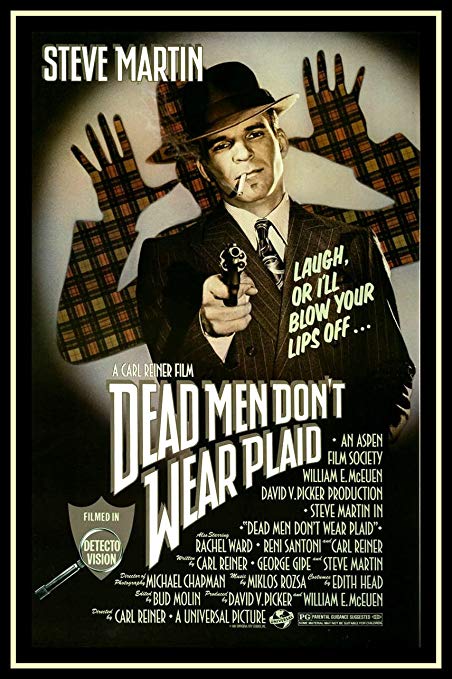
The Dork Knight: Steve Martin in DEAD MEN DON’T WEAR PLAID (Universal 1982)


gary loggins's avatarcracked rear viewer

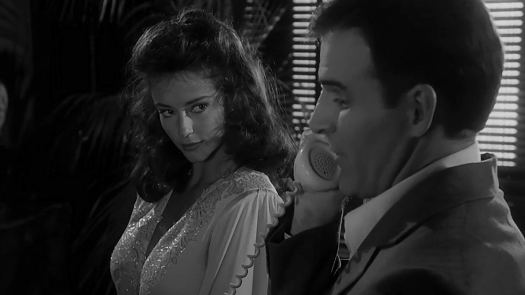
Quick, name a film noir that stars Humphrey Bogart, James Cagney, Joan Crawford, Bette Davis, Ava Gardner, Cary Grant, Veronica Lake, Alan Ladd, Vincent Price, and… Steve Martin? There’s only one: 1982’s DEAD MEN DON’T WEAR PLAID, the second collaboration between that “wild and crazy guy” Martin and comedy legend Carl Reiner. I remember, back in 1982, being dazzled by editor Bud Molin’s seamless job of incorporating classic film footage into the new narrative while simultaneously laughing my ass off. Things haven’t changed – the editing still dazzles, and I’m still laughing!

Martin and Reiner’s first comedy, 1979’s THE JERK, was an absurdist lover’s delight, and this time around the two, along with cowriter George Gipe, concocted this cockeyed detective saga after combing through old black and white crime dramas (we didn’t call ’em film noir back then) and cherry picking scenes to build their screenplay around. Martin plays PI…

View original post 376 more words

Music Video of the Day: Take A Look At Me Now (Against All Odds) by Phil Collins (1984, dir by Taylor Hackford)


On the one hand, I know that the critics have never exactly embraced the songs of Phil Collins.  I mean, there’s a reason why it’s such a brilliant joke that, in American Psycho, the vacuous wannabe serial killer Patrick Bateman is a rabid Phil Collins fan.  On the one hand, Collins’s music is representative of an era.  On the other hand, it’s often used to illustrate everything that was supposedly wrong with that era.

But you know what?

Screw it.  I like this song.  It’s effective.  It works.  It’s fun to listen to and I’ll probably find myself singing it sometime tonight.  Earlier, I watched a 1984 film called Against All Odds and, when this song played over the final freeze frame, it was a perfect moment.

The video for Take A Look At Me Now was directed by the same guy who directed Against All Odds, Taylor Hackford.  Of course, the video itself is mostly made up of clips from the film.  In between Phil doing his thing, we get scenes of Jeff Bridges looking young and sexy, Rachel Ward looking sultry, and James Woods looking dangerous.

The song itself was nominated for an Oscar, though it lost to I Just Called To Say I Love You from The Woman In Red.

Enjoy!

A Movie A Day #7: Sharky’s Machine (1981, directed by Burt Reynolds)


220px-sharkys_machine_ver3After a drug bust goes wrong, Atlanta police detective Tom Sharky (Burt Reynolds, who also directed) is transferred from narcotics to the vice squad, the least desirable assignment in the Atlanta police department.  Despite all of his honors and commendations, Sharky finds himself reduced to busting hookers with Papa (Brian Keith) and Arch (Bernie Casey).  But then Sharky discovers evidence of a prostitution ring being run by Victor D’Anton (Vittorio Gassman), one that services the wealthiest and most powerful men in Georgia.

Working with Papa, Arch, and a burned-out bugging expert named Nosh (Richard Libertini), Sharky begins a surveillance of Domino (Rachel Ward), one of Victor’s girls.  As the days turns into weeks, Sharky falls in love with Domino, who doesn’t even know that she’s being watched.  Sharky also discovers that Domino is sleeping with Hotckins (Earl Holliman), who is about to be elected governor of Georgia.  At the same time, a heroin-addicted assassin named Billy Score (Henry Silva) is assassinating anyone who could reveal Victor’s crimes.

There are two great sequences in Sharky’s Machine.  One is the opening credits scene, in which a bearded Burt Reynolds walks through the roughest parts of Atlanta while Randy Crawford sings Street Life.  This scene lets everyone know from the start that this is not another Burt Reynolds good ol’ boy comedy.  The other is a cat-and-mouse chase through an Atlanta skyscraper, as Sharky and his partners try to track down Billy Score, who is so doped up on painkillers that he barely flinches whenever he’s shot.  Billy Score is one of the most frightening movie villains of all time, seemingly indestructible and capable of moving like a ghost.

henry-silvaWith the exception of maybe Deliverance, Sharky’s Machine is Burt Reynolds’s darkest movie.  There are moments of humor and appearances by the usual members of the Burt Reynolds stock company, like John Fiedler and Charles Durning.  But overall, this is one dark movie.   Likable characters die.  Sharky cries and loses two fingers when they are graphically chopped off by the bad guys.  A woman’s face is literally blown off.  Even when Sharky starts to talk about his childhood, a sentimental moment the occurred in almost every Burt Reynolds film, Domino tells him that she doesn’t care.

In other words, this ain’t The Cannonball Run.

Burt Reynolds’s first cut of Sharky’s Machine reportedly ran for 140 minutes.  Twenty minutes were cut before it was released into theaters and, as a result, Sharky’s Machine sometimes seems to be rough around the edges.  (One important supporting character is killed off-screen and if you don’t pay close attention to the dialogue, you might never know what happened to him.)  Still, this violent film noir, which Reynolds once called “Dirty Harry in Atlanta,” is one of Burt’s best.

sharky-machine

What Lisa Marie Watched Last Night #54 (Horror Edition): Fortress (dir. by Arch Nicholson)


Yesterday morning, after I woke up at 3 in the morning and simply could not get back to sleep, I ended up watching a 1985 film from Australia on Cinemax.  The name of that film?  Fortress.

Why Was I Watching It?

The main reason I ended up watching it was because I woke up way too early and couldn’t get back to sleep.  Once I accepted the fact that 1) I wasn’t going to get back to sleep and 2) I was going to be a very tired girl by the time I got off work, it just made sense to watch a movie.  While there were over a 100 films playing on TV around three in the morning, I ended up watching Fortress because it was the only one I had never heard of.  Add to that, the cable guide both identified the film as a horror film and told me that the film was released the same year I was born.  Seriously, how couldn’t I watch?

What’s It About?

Fortress tells the story of what happens when a teacher (played by Rachel Ward) and her class are kidnapped by a bunch of a mask-wearing thugs.  When Ward and her students manage to escape from their captors, they find themselves being pursued through the Australian outback.  Finally, both the teacher and her students start to fight back and, in the best tradition of a 70s grindhouse film, eventually reveal themselves to be just as a savage as their enemies.

What Worked?

I have to admit that I was actually surprised that I had never heard of Fortress  before because it’s a surprisingly well-made film.  Ward gives an excellent performance in the lead role and the actors playing her students are all natural and very believable.  Best of all, the film’s villains are completely believable and sincerely frightening.  The gimmick of having them all wear masks actually works surprisingly well.  Their leader wears a Father Christmas mask and the contrast between his harsh manner and his jolly mask makes for some chilling moments.

I have to admit that, at first, I was wondering why this film was classified as being a horror film.  After all, there were no supernatural monsters and, even if the bad guys were wearing masks, they were still obviously human.  But, as the film progressed, I realized that the film was a true horror film.  It was scary because it was real.  It was scary because, unlike so many other horror films, it dealt with the type of situation that could happen to anyone unlucky enough to be in the wrong place at the wrong time.

Also, there was a scene where Rachel Ward was attempting to swim to safety and her character nearly drowned.  As regular readers of the site may know, I have a very intense fear of drowning and, needless to say, the sight of Ward underwater and frantically struggling to reach the surface made me go, “Agck!”

What Didn’t Work

It all worked.  Some of that, undoubtedly, had to do with the fact that I was watching the film at 3 in the morning.

“OH MY GOD!  JUST LIKE ME!” Moments

I would like to hope that, if I ever found myself in a similar situation, I would be as strong and courageous as the teacher was in this film.  That’s probably wishful thinking on my part but I like to think that I would at least try to make the effort.

That said, I mostly identified with the poor girl who, while hiding from the kidnappers, bursts into tears and explains to Ward, “Sorry, miss, it’s the curse.” Seriously, that would be just my luck.

Lessons Learned:

I need to work on my swimming.