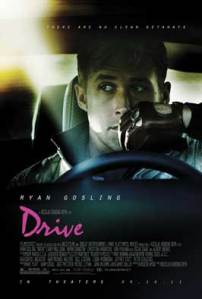
Quick Review: Drive (dir. by Nicolas Winding Refn)


Here at the Shattered Lens, we’ve been eagerly awaiting Nicolas Winding Refn’s Drive, which has picked up some major buzz over the last few months. So note that this will not be the only review you’ll see for the film. As the other reviews come in, I’ll update this paragraph to link to them.

Addendum: 

Leonth3duke has added his Drive Review, which examines the film from a lens closer to the director’s point of view and remains spoiler free. Definitely worth reading!

Arleigh has also added his Drive Review – which compares the film to both Michael Mann and David Cronenberg’s styles.

*  *   *   *  *

I was so excited by Drive that I treated my extended family to it (just in case the film went sour, it would be easy to apologize). This is going to be a quick review, because I’m going to ramble.

To quickly sum it up, Drive is a beautiful, artistic film that hits all the right buttons when it comes to the crimes it showcases. It occasionally explodes between quiet reflection and ultra violent action. Even the music was sweet. It’s just a shame though that all that coolness is wrapped up in dialogue and scenes where the pacing……moves……as……………slow…………..as………………this. Honestly, the book this was adapted from felt like it must have been about 50 pages, at best.

Drive is the tale of Driver (Ryan Gosling), a stuntman for the movies by day, and a Wheelman by night. His partner, Shannon (a nice performance by Breaking Bad’s Bryan Cranston) gets involved with a mobster (Albert Brooks) on a business venture. After getting caught up in a heist that goes awry, Driver has to try to protect himself along with the woman and child he’s recently befriended.

Drive has a fantastic sequence before we actually see the opening credits. Everything about that opening is downright sharp and creative. I haven’t seen that cool an opening to a film in quite a while. What a way to hook the audience in.

Overall, the film feels great and unique, but it suffers from one problem that I’ve only seen a few people actually mention. It feels like there’s this pause between every statement between Driver and Irene (Carey Mulligan). Imagine having one character say “Hello”, and then having someone pause the movie for a few minutes before picking it up from there. Drive ended up doing this quite a bit.  I can understand if Driver is a soft spoken, man of action,  but there were moments where I wanted to shake both Gosling and Mulligan to communicate more. I’m not saying they had to move in a particular direction, but they had a lot of patience waiting for replies from each other.  There were other scenes where I felt Refn should have considered adding just a few cuts to the film to increase the speed of the film. The slow pace keeps it from becoming The Transporter, but most of this movie felt like that 3rd act in Heat after the robbery (or the multiple endings in Return of the King) to me. The film felt more like it was in love with itself than anything.

I understand that Drive is an independent film, and with independent filmmaking, there’s a bit more freedom to do things artistically instead of having movie marketers breathe down your throat. While I may lack the film appreciation skills to effectively grasp the artistic impact of Drive on screen, I can say that as a dialog or story driven piece, the movie suffers that one hiccup. Others may see the movie differently than I did.

Pacing aside, Drive is easily worth seeing, and is in some ways similar to some of Michael Mann’s films like Thief and the aforementioned Heat. Ryan Gosling was cool, but knowing that you’re not going to get the kind of emotion from his character compared to maybe Blue Valentine helps to brace you. Working from Mann’s concept of movies, you could relate Driver to a Neil McCauley. In Heat, DeNiro’s McCauley took action when he needed to. If someone forced his hand, the response was harsh. Driver felt like he had something of the same approach, which I really did like.

Visually speaking, I loved it, but it just has areas where Refn appears to be in love with a shot so much that he lingers longer than he needs to. If you never told me who directed this, I might assume it was David Lynch.  The driving scenes themselves are done very well, and the action is also explosive, breaking the silence in the film a number of times. The silence is so strong that something as simple as a gunshot caused most of the audience to jump, which I found interesting.

The other performances in Drive are interesting, especially Albert Brooks and Oscar Issac, particularly. I didn’t even recognize him in this film, compared to his bad guy role in Sucker Punch. Christina Hendricks, though nice to see, didn’t really do too much here.

So with Drive, you can go see it. I may see it again myself. I’m not saying you shouldn’t, but if you yawn somewhere down the line, don’t say I didn’t warn you.

One other thing I had to add here. The Marketing for this film a few months ago (including the original trailer) is closer to the impact of the actual film than some of the marketing that’s being done now. Most of the recent posters and tv ads push Drive as something of an action piece. I would consider it more of a Drama with action occasionally spliced in.

Quick Review: Contagion (dir. by Steven Soderbergh)


Note that this isn’t the only review for Contagion.

Arleigh has an in-depth review of the film, which is also available to see, whereas this is more of a summary. As it’s for the same film, I’ve used the same tags that were in Arleigh’s post.

Before I start, I have to say that I haven’t had a theatre be so quiet during a film since I went to see Mirrors, and that was because there was no one there. My showing for Contagion was packed, but no one made a sound throughout the film. I coughed twice (because I had to), and you wouldn’t believe how many heads turned in my general direction. If nothing else, it shows that the movie had some impact to the audience, and that’s always (okay, usually) interesting to see. By the time the movie is over, you will probably pay attention to how many times you touch your face or the objects around you.

If there’s one thing I can give director Steven Soderbergh, it’s that he has a great ability to work with ensemble casts. He did a great job in getting everyone to work together on the Oceans Eleven remake and sequels. He also walked away with a Best Director Oscar for Traffic. His films have the ability to avoid having his stars chew up enough screen time that they appear to be an actual center character. Catherine Zeta-Jones’ had a character who’s story was just as strong as Benecio Del Toro’s.

On this, Contagion is no different. In essence, it’s almost like watching cameos in a miniseries.

Although the film is peppered with various actors, no one person can be considered the main character of the film. Soderbergh is able to get them all to play their roles well. He and Scott Z. Burns – one of the writers on The Bourne Ultimatum and a collaborator with Soderbergh – give us a number of perspectives for this story and damn, the whole thing is very tight overall. The movie has very little wasted space.

Like the story itself, the movie moves at a great pace, opening with Elizabeth Emhoff (Gwenyth Paltrow) on her second day after exposure to the virus after returning from a trip to Hong Kong. This eventually escalates to other infections reported in other areas around the world. In an effort to contain and understand what they’re dealing with, the Center for Disease Control starts an investigation. Lead by Dr. Ellis Cheever (Lawrence Fishburne), he sends Dr. Erin Mears (Kate Winslet) to Minnesota to determine the scale of the problem.

In addition to the CDC’s efforts, the World Health Organization also gets involved, sending their own field agent to Hong Kong, played by Marion Cotillard. Both doctors come up with information that appear to be helpful for the overall investigation in various ways.

The other two angles in the film are through a conspiracy theory blogger / investigative reporter played by Jude Law and Mitch Emhoff (Matt Damon), who has to deal with the impact of his wife’s sickness. Enrico Colantoni, Brian Cranston, Sanaa Lathan, Elliot Gould and Jennifer Ehle round out the cast. It should be noted that Ehle is the daughter of Kenneth Branaugh’s Hamlet actress Rosemary Harris, who looks remarkably like her mother. That’s just something that caught my eye.

In terms of the Kid Factor, I would be hesitant to take kids to see this unless they had a pretty clear handle on death or getting sick. Teens and adults could probably handle the film, but anyone under than that may freak out a little. Mind you, there’s very little gore in this film. When I think about it, there’s not even a whole lot of blood. There is some violence though as the story escalates and humanity goes wild, but it’s not that far a cry from many zombie movies. It’s up to the parents discretion on whether their kids should see this.

I should also point out that the music in this film is also very good. Cliff Martinez, who also worked on the score for Drive (also out this month) did an impressive job with an electronic score that sits in the background of the film, but also fits the pacing of the film well. It’s worth giving it a listen if at all possible. This quick review was actually written to the Contagion score.

Contagion is definitely worth seeing, easily recommended, but if you happen to be particular about germs, note that this may not be the most comfortable film to watch. Don’t be shocked if you end up hugging yourself while watching this in the theatre. With Soderbergh moving away from film directing to pursue other interests, Contagion is a nice final bow to his career.

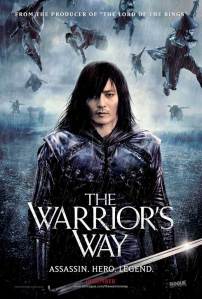
Quick Movie Review: The Warrior’s Way (dir. by Sngmoo Lee)


I’ll admit that I didn’t give The Warrior’s Way that much thought when we picked it up from the rental store the other day. At first glance, it didn’t seem to have much of an identity to it. Was it trying to be something serious like a House of Flying Daggers or something more humorous like Kung Fu Hustle? I guess one could say that it’s really a little of both and although the movie may be a little too strange for it’s own good, it was really worth going through the first hour or so just to get to the last 30 minutes. The film really picks up steam from there going forward.

In the film, Yang (Jang Dong Gun) becomes the Greatest Swordsman in the World after defeating the original Greatest Swordsman ever. After doing so, he’s given an order to kill a family by his clan. Managing to kill everyone but a young baby named April, Yang decides to let it live and to take care of it, giving the movie a Lone Wolf and Cub / Shogun Assassin feel.

And basically, what the film boils down to is Yang trying to leave behind the life he had in order to protect the baby he’s found. He finds himself in a Wild West town and meets a number of individuals who help him hide his identity. In return, he helps them gain the courage to find themselves. Kate Bosworth’s character, Lynne, is a knife thrower with a bit of talent, but without any focus. Geoffrey Rush is something of a drunkard, but in watching what Yang is doing in the town, he sets aside his drinking ways in place of sniper rifle. Both actors are okay in their roles, but I found myself wondering why they went with these, honestly.

One of the standouts of this film (if one could say there’s a standout, because the movie really could be better than what it was) was Danny Houston. Despite some of the bad movies he’s been in (X-Men Origins: Wolverine instantly comes to mind), he carries his characters with this really weird style – his voice has this sense of authority, much like a Liev Schreiber – his villain is the classic evil cowboy, which normally would do him a lot of justice. Here, he does okay in his scenes, but doesn’t really have a whole lot to work with.

Yang is also being pursued by his former master, Saddest Flute, named after the sound one’s throat makes when it’s cut. Saddest Flute and his ninjas manage to make their way to the town, which culminates in a really cool battle which is one part Rango, one part Ninja Scroll and even a little like Samurai Jack. And all of that really needs to be seen, all 25 to 30 minutes of it, even if it happens to be just as a clip.

Overall, The Warrior’s Way is the kind of movie you end up watching if you’re planning to take a nap on a Sunday afternoon or if you really like cinema of this type. It’s not worth taking the whole ride for, but it ends with such a bang that one may not consider it a total loss.

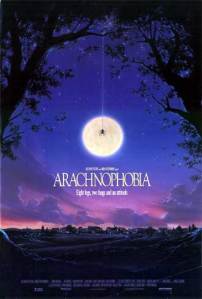
Quick Movie Review: Arachnophobia (dir. by Frank Marshall)


When I was a kid, my grandmother used to keep this clear shower curtain of a large black web, complete with a big red spider on it. It scared me so bad that I was actually more willing to brave the darkness of the basement bathroom than to have to deal with that monstrosity in the well-lit one. Between that, my brother’s EC comics and the original “The Fly” with Vincent Price, it’s how I developed Arachnophobia. It’s a fight or flight reflex that occurs when anything spider related appears. It seems fitting that as I’m writing this from a location that’s full of Black Widows, Arachnophobia is the topic for this review.

Arachnophobia marked the first directing attempt by Frank Marshall, long time producer of many of Steven Spielberg’s films. The film turned out to be a success when released, and manages to feature one the greatest Human vs. Tarantula battles ever filmed.

Although the film has some horror elements, it’s kind of hard to classify Arachnophobia as an actual horror film, despite the deaths that are in the film. There are some humorous moments (particularly from John Goodman), and the scares don’t come too often. For anyone who’s bothered by spiders, though, there are a number of jumpy moments that occur without being excessively gory. The story is a little misleading. It starts in Venezuela, South America, where a deadly tarantula manages to sneak its way on board a trip back to California. You’d think that from here, the Tarantula would end up finding another Tarantula, and thus pull a Kingdom of the Spiders with a whole town full of spiders. The writers, however, end up making a mistake in having a Tarantula mate with a common house spider, thus breeding dozens of other smaller spiders.

That’s like a Tiger trying to mate with a house cat. I’m not exactly sure if that’s even possible, but I’m getting off track. This actually ends up helping the story because now the town has to deal with all of these smaller spiders that are easy to hide around. I always considered that to be pretty effective.

Jeff Daniels character, Dr. Ross Jennings suffers from Arachnophobia in the worst way. Moving to the town of Canaima with his family, he trades the big city for a more relaxed, rural setting. Of course, it’s a happy ideal situation until various deaths start happening around town. Eventually, he and the authorities come to realize just how bad things really are. John Goodman’s character was an interesting touch as a funny exterminator, but really wasn’t used as much as he could have in this film. Then again, when he does tend to steal the scenes he’s in. Arachnophobia has a number of other supporting actors, but the film mainly belongs to Daniels, Goodman and the the spiders.

Chris Walas, who won an Oscar for his effects and make up work in The Fly helped to create some of the more mechanical spiders and close-ups when necessary. While you can tell where you’re dealing with real tarantulas and their synthetic counterparts, he did a great job in getting the fear factor out there, especially during the final standoff of the film. Without giving much away, the last 20 minutes of the movie are brilliant in that the final battle is much more than the simple “find it and squash it” scenario from Kingdom of the Spiders. It’s almost a violent chess match.

Arachnophobia is a treat. It may not be the best film about spiders in general, but if you do suffer from the condition or know someone who does, it definitely worth seeing, just to jump and squirm now and then. It’s much better than knowing there are real Black Widows to contend with.

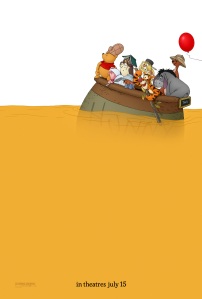
Quick Review: Winnie the Pooh (dir. by Stephen J. Anderson & Don Hall)


With Harry Potter and the Deathly Hallows Part 2 running at full steam, and Captain America: The First Avenger opening this weekend, Winnie the Pooh still remains an option for younger kids who may not be ready for these two films (at least until The Smurfs is released). There’s really very little in the way of negative comments that I can give to Winnie the Pooh, expect perhaps that running at just 69 minutes, it’s very short. It’s for kids.

Working off the original story by A.A. Milne, Winnie the Pooh re-introduces us to the title character, along with his friends from the Hundred Acre Wood – Tigger, Rabbit, Piglet,  Kanga and her son Roo, Owl, and Eeyore. They are the treasured toys of Christopher Robin, who has an active imagination.

One of the cute elements of this story, narrated by John Cleese is how everyone breaks the fourth wall and occasionally has interactions with the paragraphs of the story. Stepping on a few words here, using a few as a ladder, it came across as being quite worthy of a few smiles.

I used to watch “The New Adventures of Winnie the Pooh” on Saturday Mornings, and it was a treat to return to these characters. For the movie, we are given the “Busy Backson” story, where Eeyore has lost his tail and the team come up with ideas on new and interesting ones for him. Each character has their own way of figuring this out. Of course, Pooh has something of a difficult time with his constantly rumbling tummy, but he manages to help in his own way. In their search, Owl misreads a note left behind by Christopher Robin stating that he’ll be busy, but will be back soon. This conjures up the great and terrible “Backson” in everyone’s imagination, responsible for everything from stealing your left socks to making your milk spoil. The team decides to set a trap for the Backson, with wild results. The scenes with the Backson maybe a little frightening to the youngest of viewers, but it’s not that bad. We’re not dealing with Heffalumps or Woozles here.

In the end, as always, everything turns out well. I liked that Friendship was the big factor here. All of Eyeore’s friends tried to help him find his tail, and Pooh even puts his honey chasing ways on hold (as best he can, anyway) to aid his friend. Those familiar with the animated series will instantly recognize Jim Cummings as the voice of both Winnie the Pooh and Tigger. I would have liked to have seen Peter Cullen come back as Eyeore, but he was pretty busy voicing Optimus Prime while the movie was being made. All of the other voice actors are new, including late night tv host Craig Ferguson as Owl. The kids won’t even care.

Musically, there are a few interesting songs. Actress / Singer Zooey Deschanel lends her voice to the title song, along with a few others. Most of the other songs are sung by the cast themselves, and the kids may find themselves singing along (at least I could hear singing in my audience, anyway). The film moves fast, extremely fast. By the time the antsy factor kicks in, the movie’s done, which makes that a treat by itself.

Overall, Winnie the Pooh may not have the magnificence of say a Kung Fu Panda 2 or How to Train Your Dragon, but for very young viewers, it should do just the trick.

Quick Review: John Carpenter’s The Thing


When I was little, my family used to have this cable service called WHT. I can’t remember what it stood for, but recall that it was a one channel station that would constantly show movies. It was like Starz for anyone who didn’t want to pony up the extra money for actual HBO at the time. Since it was set up at my Grandparents house (where I lived), sometimes we’d all gather around for a Movie Night on Saturdays. This is something my family’s done often during the years, and the current part of my family does this on Sundays now, premiering films we haven’t seen yet.

It was one of these Saturday nights that I first witnessed John Carpenter’s The Thing. I had to go to bed for it, being as young as I was for the film, but with the door open I could hear the music and sounds from my bed. At one point, I climbed out of the top bunk and snuck to the stairs, watching the film in my PJ’s. My family would get pretty engrossed with movies, so they never bothered to glance in my direction. After all, this was the first time any of them were seeing this film, and they all loved the original.

I was doing fine until that Husky’s head split open. If I just kept my mouth shut, I could have seen the whole film. After that, I couldn’t stop screaming, “Omigod! The doggie!!” I was met with cries of “Go to Bed!!” from just about everyone. Even though I climbed back into bed, there was no way I was able to fall asleep. Every gunshot, every yell caused me to bundle myself under my blankets with my eyes wide open.

Since then, The Thing has become a family favorite, a reliable go to film for any time it’s cold or rainy or dark. I even showcased it for my friends in Oregon who hadn’t seen it before and they also had almost the same reaction to that poor dog.

So, what is The Thing?

Other than maybe being John Carpenter’s strongest film (which many will argue, because there’s always a place for Big Trouble in Little China for me), it’s a great example of a work in progress that was just done and put to print. Like Jaws, the film ran into some problems. Special FX member Rob Bottin suffered from exhaustion from working so hard on the film. They had some issues with coming up with the final representation of The Thing that wouldn’t appear too cartoon-like or animatronic. There was even a fire during the taping of a huge effect shot involving a body ripping open because of the chemicals that were put into the latex workup. Even though the movie takes place in Antarctica (which I believe roughly 6 months of night), the film actually has a day and night cycle, having filmed in Juneau, Alaska. On top of that, with all of the money thrown at the film, it pretty much tanked at the box office. As quirky as all those elements are, the movie just works because of both the isolation of the characters, the trust issues that occur as a result of the events, and the claustrophobic space they live in. In some ways, it’s very similar to Ridley Scott’s Alien to me (sans the trust issues), but with much better lighting. The Thing is pretty much a cult classic at this point.

The story of The Thing is boosted if you’ve seen the original The Thing From Another World with the late James Arness, but it’s not a requirement. It starts off with a dog being chased by a helicopter, who manages to reach a Research Outpost in Antarctica, occupied by Twelve members. The crew soon discovers that that things aren’t exactly what they seem, but neither are they. Unlike the original movie, the creature in this film has the ability to absorb and mimic whatever organism comes into contact with (which actually is pretty creepy in its own right, that sense of violation). Trust plays a huge part in the story as the crew fight to save themselves while still trying to keep a close eye on who’s walking among them.

The atmosphere of the film is really augmented by the sound. As old as the film is, the sound quality holds up incredibly well on a surround system. The wind from the snow, bullets ricocheting, the panting of dogs and of course the dripping of blood all sound like someone put a microphone right up to all of them to capture it as best they could. The outpost, as big as it is, actually has a lot of narrow hallways with canisters stacked to the sides in many places, giving the place a cramped feel. Add to that Ennio Morricone’s haunting theme and you’ve got a recipe for horror. I mean, for someone who’s scored fantastic Westerns, one would think that Morricone and a Carpenter film might not gel well, but it really does.

Visually, compared to films today, The Thing is pretty tame for it’s effects, and some (the final rendering of the Thing itself, in particular) can be a little dated, but not so much that you should groan about it. At the time, however, it was considered gory (and I guess when you’re in shock on seeing a dog’s face split open, there’s someone smiling somewhere saying to themselves..”Yeah, that worked right there”).

The Thing marks another John Carpenter / Kurt Russell pairing. Russell’s R.J. MacReady is the figure we follow through the film. It’s through him that we try to make sense of everything going on. In one scene that involves him huddled in a corner with a flamethower and some dynamite, defending himself from his friends, you get the notion that you want to be on that guy’s side. Even if following him means getting blown up to a million pieces, because it really becomes difficult to trust anyone in this film. Paranoia plays a huge role.

The cast is rounded out by a few other notable members. Richard Dysart (L.A. Law, Prophecy) plays Doc Copper, and is actually pretty good here. Keith David (Requiem for a Dream, They Live) plays Childs, who really doesn’t believe in any of that “voodoo bullshit”. Thomas Waites (The Warriors) is Windows, who for me, represents the scared kid of the group. He’s not sure what’s up, he just wants to be away from it. Then, of course, you have Wilford Brimley, who seems to realize the problem but takes measures in his own hands rather telling the others just how bad things could get.

Overall, The Thing is highly recommended. I know there’s a remake in the works, and part of me is a little excited for it, hoping that it’s done well. I can’t imagine the filmmakers today running into half of the issues they had in the original.

The Thing also marks one of the best Director commentaries I’ve heard. If you have a chance to watch the film with the Director track on (which I believe Russell also has a hand in with Carpenter in talking about the film), it’s pretty interesting what they elaborate on. Also noteworthy (and funny) is Rob Bottin’s story on the effect sequence that started a fire.  That’s definitely worth a listen.

Quick Review: In the Mouth of Madness (dir. by John Carpenter, 1995)


In the Mouth of Madness is one of those films that in essence seems like a good idea, but later becomes strange and unwieldily to the point that you have to ask yourself “What am I watching, and why did I do so?”

Jumping right of of Memoirs of an Invisible Man, In the Mouth of Madness reunites Sam Neill (Jurassic Park) with Carpenter. Neill plays John Trent, an Insurance Investigator whose latest case deals with a horror writer named Sutter Cane (Jurgen Prochnow). Cane’s novels have the strange ability to affect anyone who reads them. After Cane’s own agent/publicist falls his influence and is abruptly killed, Trent is sent to find Cane (who is missing) and help bring back his latest story , “In the Mouth of Madness” to the agency. When he sets off on his mission, he slowly finds his sense of reality unraveling.

If Neill’s character is the Scully, Julie Carmen (Fright Night Part II) plays the Mulder in this equation. Sent along with Trent, her character witnesses more of the horror than he does. She’s the audience witness for a while and proves Trent wrong when he’s ready to disbelieve what’s occurring. She good here, but her reactions, mixed with Trent’s had me slapping my forehead. I’ll get to that in a moment.

I’m told that the film is something of a homage to H.P. Lovecraft’s stories. While I’ve never read Lovecraft, I’m somewhat familiar with the Cthulhu myths and there does seem to be some tentacled beasts near the last third of the film.  Overall, some of those references escape me. The movie’s fun in a Donnie Darko mind bending way and it’s that strangeness that actually helps the film a little.

I hate the fact that Sam Neill’s character simply  won’t accept that what’s happening is real. I’m not a big fan of stuffing square pegs into round holes. If it doesn’t fit – you’re being told “This is how it goes”, and you’re seeing that’s how it’s happening – then why in the world are you still holding on to the same train of thought that isn’t working / fitting the situation? I found that extremely annoying. It’s almost the opposite of Slither, where it didn’t take long for the characters to recognize that:

1.) People were becoming zombies.

-And-

2.) It just wasn’t normal for the situation. Accept and adjust. Cover your mouth.

Overall, it was okay, but it really needed something. I’m just not sure what.