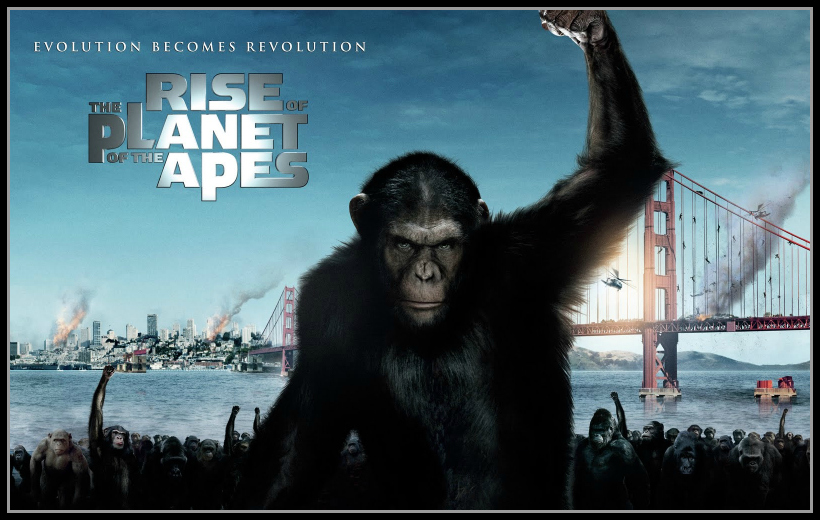
Review: Rise of the Planet of the Apes (dir. by Rupert Wyatt)


In 2001, Tim Burton released his highly-anticipated remake of the classic 1968 film adaptation of Pierre Boulle’s sci-fi novel which would ultimately be called, Planet of the Apes. Fans of the series were excited to see what idiosyncrasies Burton would add to the series which had petered out decades before. What people were hoping for and what they ended up getting were polar opposites. The film in of itself wasn’t an awful film, but it wasn’t a good one and many saw it as average at best and bad at it’s worst. Any plans to sequelize this remake fell by the wayside. It took almost a decade until a decision was made to continue the series in a different direction.

British filmmaker and writer Rupert Wyatt would be given the task to rejuvenate for a second time the Planet of the Apes franchise. He would be working with a screenplay written by Rick Jaffa and Amanda Silver which would take the 4th film in the series, Conquest of the Planet of the Apes, and rework it for a much more current setting. The film was to be called Rise of the Apes and would star James Franco, John Lithgow and Frieda Pinto. As time went by the film would be renamed Rise of the Planet of the Apes. Despite having such an awkward sounding titles the film would end up to be one of the best films of the summer of 2011, if not one of the best of the year.

The film begins with a harrowing sequence in the jungles of Central Africa as poachers capture several chimpanzees to be sold as medical test subjects. Some of these chimps end up at a genetics research lab outside of San Francisco where one Will Rodman (James Franco) is working to find a cure to Alzheimer. He sees the encouraging result in one chimp he has named “Bright Eyes” (due to the side-effect to the test subject’s eyes taking on green flecks to their irises) and pushes for the next step and that’s human testing. The ensuing pitch to the company’s board of directors doesn’t go as planned as Bright Eyes goes on a violent rampage leading to her being put down and the project shelved. Her reaction they soon find out has less to do with the breakthrough treatment and more of a maternal instinct to protect her baby she secretly gave birth to. Will takes the baby chimp home in secret temporarily, but soon becomes attached to it as does his Alzheimer stricken father (John Lithgow) who names it Caesar.

The first third of the film sees Caesar showing an inherited hyper-intelligence from his genetically-treated mother. Caesar becomes an integral part of the Rodman household even to the point that Will has taught Caesar to call him father. It’s a family dynamic which would help mold Caesar into something more than just a wild animal. He begins to show signs of humanity which would become bedrock of his decision later in the film to turn become the revolutionary that the film has been leading up to the moment Caesar gets sent to a primate sanctuary after a violent encounter with a boorish neighbor to end the first reel of the film.

It’s during the second reel which sees Caesar realize that while he may as smart (maybe even smarter) than the humans he would never be a part of that world. In the sanctuary he learns that his very uniqueness has set him apart from the other primates. He sees the abuse inflicted on his fellow primates and longing to be back to his “home” with Will turns to a focus need to free himself and his people. He does this in the only fashion he knows would succeed. With the help from a couple canisters containing the aerosol-based treatment which increased his mother’s intelligence, Caesar frees everyone from the sanctuary and takes the fight to the humans as they make for the wilds of the Muir Redwood Forest north of San Francisco.

Rise of the Planet of the Apes might look to be an action-packed film from how the trailers and tv spots has been pushing the film, but it actually only has three major action sequences and they’re integral to each third of the film in helping advance the story. These were not action for the sake of having action on the screen. Writers Jaffa and Silver do a great job in figuring out that the real strength of the film would be Caesar’s journey from precocious ape child, rebellious teen and then his final unveiling as the leader of a people who have shaken off the shackles of medical research and their forced sacrifice for the greater good.

The film was never about the humans played by Franco, Pinto and Lithgow. It was always about Caesar and the film hinged on the audience believing Caesar as a character. In that regard, the work by WETA Digital should be commended as should Andy Serkis’ performance as Caesar. Serkis’ motion capture performance goes beyond just mimicking the movement of an ape. His own acting as Caesar comes through in even in the digital form of Caesar. In fact, the film never had a real ape used during filming. From Caesar right up to the scarred ape Koba every ape in the film was the work of WETA Digital’s furthering the motion capture work they had done in Peter Jackson’s Lord of the Rings trilogy and James Cameron’s Avatar. Never once during the two hour running time of the film did I ever not believe I was watching apes on the screen. Every emotion Caesar goes through during the film was able to show through facial expressions and body language.

It’s the strength of Serkis’ mo-cap work and the overall execution of Caesar’s character by WETA which also highlighted the one major weakness of the film through it’s underdeveloped human characters. Whether it was Franco’s benevolent Dr. Frankenstein-like Will Rodman right up to his greedy, amoral boss in the company (played by David Oyelowo), all the human’s in the film were very one-note and mostly served to propel Caesar’s story forward. At times, Franco actually seemed to be just as he was during his hosting gig during the Academy Awards earlier in the year. These were not bad performances by the actors involved. They were just there and part of it was due to how underwritten their characters were.

To help balance out this flaw in the film’s non-ape character would be the beautiful work by the film’s cinematographer in Andrew Lesnie. He has always been well-known for beautiful, majestic panoramic shot of the world as he had demonstrated in Jackson’s Lord of the Rings trilogy. He does the same for this film as we see some beautiful shots of the Muir Redwood forest, of San Francisco’s skyline and in the climactic battle on the Golden Gate Bridge. The city of San Francisco and it’s iconic red-hued bridge and the surrounding area has never been shot as gorgeous as Lesnie has done with his DP work on this film.

Even with some of the characters in the film being underwritten the film succeeds through Rupert Wyatt’s direction which keeps the film moving efficiently, but also bringing out the emotional content of the film’s script in an organic way. Film has always been about manipulating the audience’s  emotions. It’s when a director does so and make it seem normal is when such manipulation doesn’t come through for those watching to feel. Then add to this Serkis’ exceptional work as Caesar with some major digital artistry from the folks over at WETA Digital and Rise of the Planet of the Apes does rise above it’s B-movie foundation into something that should live beyond the summer and for years to come.

Rise of the Planet of the Apes does a great job and a long way towards wiping off the bad taste left behind by Tim Burton’s failed attempt to remake the franchise. We didn’t need something exotic and idiosyncratic to give the franchise a fresh breath of life. It seems all it needed was a very good story, some exceptional work from Andy Serkis and WETA Digital and a filmmaker knowing how to tell the story in a natural fashion and not fall into the temptation to go into shock and awe to tell it. Rise of the Planet of the Apes is a film that could stand-alone, but it does something that many trying to create film franchises never seem to do right: it makes people want to see what happens next in the lives of Caesar and his apes.

A Quickie With Lisa Marie: Battle for the Planet of the Apes (dir. by J. Lee Thompson)


And so, we reach the end of the original series of Planet of the Apes films.  Battle for the Planet of the Apes was the cheapest of the Apes films and most critics agree that it’s also the worst.  Sad to say, I happen to agree with them.  If nothing else, Battle For The Planet of the Apes is the only one of the original Apes films that fails to even reach the meager level of quality of Tim Burton’s remake.

The film begins a decade after the end of Conquest of the Planet of the Apes.  A nuclear war has destroyed what was left of human society.  It’s never made clear if that war was between apes and human or between humans and humans.  All that is clear is that the Apes are now firmly in charge of the world.  Caesar (Roddy McDowall) leads the Apes civilization.  Humans, while clearly second class citizens, are treated relatively well by the Apes.  Early on in the film, Caesar views archival footage of his parents and learns of what the future holds.  He immediately makes move to try to prevent that future from occurring.

However, all is not well.  Gorilla general Aldo (Claude Akins) hates humans and is secretly plotting a military coup to overthrow Caesar.  Meanwhile, over in the Forbidden City (a.k.a. New York), there’s a tribe of radiation-scarred humans who are being led by Kolp (Severn Darden), the sadistic torturer from Conquest of The Planet of the Apes.  Driven mad by the ravages of war, Kolp and his followers are plotting to launch their own last-ditch attack on Caesar and the apes.

So much of this film can be legitimately criticized, from the cheap look (the apes are no longer characters but instead just actors in rubber masks) to the predictable storyline.  So, instead of focusing on what’s wrong with this film, I’m going to highlight the handful things that actually did work.  While few of the performers make any effort to invest their characters with any sort of life, both McDowall and Darden give strong performances.  Darden, in particular, makes a great villain and it’s a shame that he didn’t get a better film in which to show off.  Predictable as the film is, there’s a few memorable touches, my favorite being Kolp and his followers converting a bunch of school busses into armored attack vehicules.

As well, Battle for the Planet of the Apes may ultimately feel like an unnecessary chapter in the whole Planet of the Apes saga but the film, at the very least, makes the effort to provide some sort of continuity with the other films in the series.  Kolp and his followers are obviously meant to be the ancestors of the bomb-worshipping mutants from Beneath the Planet of the Apes and, in one of my favorite little touches, Kolp’s assistant is named Mendez.  If you’ll remember, the leader of the mutants in Beneath was named Mendez the Tenth. 

It’s those little touches that show that the filmmakers, at the very least, respected their viewers enough to maintain the continuity of the series.  As bad a film as Battle is (and it’s definitely not very good), it can still teach a valuable lesson to today’s filmmakers.

A Quickie With Lisa Marie: Conquest of the Planet of the Apes (dir. by J. Lee Thompson)


(WARNING: SPOILERS BELOW)

Released in 1972, Conquest of the Planet of the Apes was the fourth film in the original Planet of the Apes saga.  Taking place two decades after the end of Escape from the Planet of the Apes, Conquest details how Caesar, the son of Cornelius and Zira, eventually rallies his fellow apes to overthrow humanity.   Caesar, in this film, is played by Roddy McDowall and Conquest features what is probably his best performance of the series.

Conquest of the Planet of the Apes is definitely the most radical film of the series and it’s probably one of the most radical films of the 1970s.  Once you peel away the sci-fi/fantasy wrapping, you’re left with one of the few “mainstream” studio films to ever promote the idea of overthrowing society with a violent revolution.  Even when viewed today, it’s odd to consider that this violent and rather dark film was actually given the same G rating that was otherwise exclusively given to children’s films.  Obviously, the poor critical reputation of the Planet of the Apes series kept the Hollywood censors from really paying attention to what they were watching.

Director J. Lee Thompson goes for a far different direction from the previous more television-orientated directors involved with the series.  Thompson emphasizes that savage, totalitarian aspect of future human civilization.  This is a film in which the most sympathetic human character (the circus owner played by Ricardo Montalban) is graphically tortured and murdered within the first few minutes of the film.  This is followed by Caesar being given electro-shocked treatment by the cheerful torturer Kolp (Severn Darden, who is a chilling villain) and finally, Caesar and his fellow apes violently overthrowing society while the futuristic city burns in the background. 

Director Thompson reportedly based the ape uprising on contemporary news reports about the Black Panthers and it brings a real sense of urgency to the film.  What sets this film apart is that director Thompson is clearly on the side of the Apes and by the end of the film, so is the audience.  McDowall’s passionate performance is neatly contrasted with an equally impassioned performance from Don Murray (who plays Breck, the racist leader of the humans) and the audience is firmly on McDowall’s side by the end of the film, cheering as their own civilization is destroyed.

Originally, Thompson wanted to end the film with McDowall giving a fiery speech announcing that the time of man was finished.  However, this finally proved to be too much for the film’s producers and, at the last minute, the scene was clumsily redubbed to allow Caesar to suddenly — out of nowhere — have a change of heart and call for a peaceful co-existence.  This revised ending — though it did leave things open for yet another sequel — is an undeniable weakness.  It just doesn’t feel right.

With that in mind, here’s Thompson’s original, unseen ending, in which Caesar watches as his apes followers murder Don Murray.  It gives you a feeling of the type of film that Thompson was going for:

A Quickie With Lisa Marie: Escape From The Planet of the Apes (dir. by Don Taylor)


(Warning: Potential Spoilers, especially if you’re good at reading between the lines of my attempts to be all mysterious-like)

Continuing with our look at the original Planet of the Apes films, we come to 1971’s Escape from The Planet of the Apes.

Escape From The Planet of the Apes starts out with a huge problem — how do you make a sequel to a film that literally ended with the entire planet being destroyed?  Escape handles this problem by reversing the plotline of the original film.  Instead of a group of humans going into the future and landing on a planet dominated by apes, this film features three apes going into the past and landing on a planet dominated by the past.  It’s a premise that the film handles with a surprising amount of cleverness and the end result is probably the best of the various Planet of the Apes sequel.  Certainly, it is the only one that can stand alone as a film separate from the rest of the series.

Using Taylor’s old space capsule, Zira (Kim Hunter), Cornelius (Roddy McDowall), and Milo (Sal Mineo, who you know is doomed because he’s the only one of the three who hasn’t appeared in either of the two previous films) escape Earth shortly before Charlton Heston blows the planet up at the end of Beneath the Planet of the Apes.  Slipping through the same vortex as Heston did in the first film, they end up crash landing on Earth in the year 1974. 

At first, Cornelius and the outspoken Zira become media celebrities.  They do interviews with the press, appear on the covers of magazines, and are generally celebrated like simian Kardashians.  However, one scientist — played by a very handsome Eric Braeden (seriously, he has gorgeous hair in this film) — isn’t as charmed by Zira and Cornelius.  Instead, he views them as threats to the future of the human race, especially after he discovers that Zira is pregnant.

The character that Braeden plays, by the way, is named Dr. Otto Hasslien and attentive viewers will recognize the name from a throw-away reference made by Taylor (Charlton Heston) in the original Planet of the Apes.  One of the more interesting subtexts in this film is that, much as chimpanzees Zira and Cornelius are this film’s equivalent to the human Taylor, Braeden’s Hasslien is this film’s version of Dr. Zaius.  Much as Maurice Evans did for Dr. Zaius, Braeden brings a certain ambiguity to his villianous character.  Though Braeden’s actions are ultimately hateful, it’s also made clear that they’re more motivated by fear than by evil.  Indeed, when Braeden first appears in this film, he’s almost likable.  It’s only at the film’s conclusion that we become fully aware of the irony that the human, “civilized” Dr. Hasslien ultimately shows less mercy and empathy to Zira and Cornelius than the ape Dr. Zaius showed to Taylor.  The moral ambiguity of Braeden’s performance makes this a far more resonant film than most mainstream critics are willing to admit.

 As for, Zira and Cornelius, the once-fawing public eventually turns against them as it becomes apparent that for the two of them to exist, humanity has to be wiped out.  Zira and Cornelius find themselves hunted fugitives, fleeing for their lives while the whole planet — with the exception of a zoo keeper played by Ricardo Montalban and another scientist (played by Bradford Dillman — what a great name for an actor) — seems to be determined to destroy them.

Escape From The Planet of the Apes starts out as a likable, rather breezy social satire (much like Pierre Boulle’s Monkey Planet, the novel that Planet of the Apes was loosely adapted from) and that makes it even more surprising when, about halfway through, the movie shifts gears and becomes a rather dark and bleak action film.  It all ends, like many films from the early 70s, in a brutal act of violence that carries a surprising punch to it.  It’s after the end of the film that we truly become aware just how involved we had become with Zira and Cornelius.  A lot of that has to do with the strong performances of McDowall and Hunter who both created characters that came across as real and worthy, regardless of how many layers of makeup they were acting under.  Their chemistry as a couple makes this underrated film one of the surprising gems of the early 70s.

A Quickie With Lisa Marie: Beneath the Planet of the Apes (dir. by Ted Post)


(WARNING: SPOILERS)

Continuing my look at the original Planet of the Apes film series, we now come to the first sequel, 1970’s Beneath the Planet of the Apes.  Rather blandly directed by Ted Post and featuring only a cameo performance from Charlton Heston, Beneath the Planet of the Apes is rarely given the credit it deserves.  Yes, the first half of the film is rather forgettable but once you get through it, you discover one of the darkest films of the 1970s.

Beneath the Planet of the Apes begins with yet another human astronaut crash landing on the Earth of the future.  This astronaut is Brent and, as played by James Franciscus, he comes across as a slightly more earnest, far less charismatic copy of Charlton Heston’s Taylor.  Brent has been sent in search of Taylor.  Anyway, once he lands on the planet, he is quickly arrested by the apes, meets Zira (Kim Hunter) and Cornelius (David Watson, stepping in for Roddy McDowall), and then escapes with the still-mute Nova (Linda Harrison).  With Nova, Brent makes his way to the Forbidden City where he comes across the ruins of Grand Central Station and discovers that he’s actually on Earth. 

Yes, that’s right.  The first hour of this 95 minutes film is essentially just the first movie all over again.   And yes, this film’s (many) critics are correct when they say that this first hour drags and tests the audience’s patience.  Obviously, Brent may be shocked to discover he’s on Earth but it’s old news to us and many viewers are probably tempted to give up on this film before Brent even figures it out.

But don’t give up!  No, because if you stick with this film you’ll discover that, once Brent figures out where he is, things get really, really fucked up.

Essentially, Brent discovers that the ruins of New York City are now underground.  And in this underground city, there are people.  But they’re not people like Brent or Nova.  No, these are people who have been horribly scarred by radiation.  They’ve also mutated to the extent that they’ve developed the powers of telepathy and mind control.  Under the leadership of Mendez the Tenth (Paul Richards), they spend their time singing hymns to the Alpha/Omega nuclear bomb, or as they call it “The Holy Bomb.”  They keep the Holy Bomb in St. Patrick’s Cathedral.

These mutants capture both Nova and Brent.  Brent is tossed into a cell and who else is there but Taylor?  And Taylor, believe it or not, has become even more sarcastic and scornful than before!  Seriously, Charlton Heston frequently spoke about how much he hated this film and it’s obvious in his performance.  Heston might not have been happy about being there but the audience is because, even if he is busy hating himself, Taylor brings a jolt of life to the film.

And just in time because the Apes, led by Urko (James Gregory), have invaded the forbidden city!  They gun down all the mutants.  Brent , Taylor, and Nova manage to escape their prison and all three of them are promptly gunned down as well.  As he dies, Taylor manages to set off the Alpha/Omega bomb.  We see a blinding white light followed by a somber voice over that tells us: “In one of the countless billions of galaxies in the universe, lies a medium-sized star, and one of its satellites, a green and insignificant planet, is now dead.”

And that’s it!  There’s no final credits, not even a black-out. Instead, on that note, the movie just stops.

Now, seriously, tell me that’s not a great movie.

A Quickie With Lisa Marie: Planet of the Apes (dir. by Franklin J. Schaffner)


(BEWARE!  SPOILERS!)

With Rise of the Planet of the Apes coming out in August, I figured why not go ahead and review the original Planet of the Apes films.   No, I don’t mean the terrible Tim Burton film.  I’m talking about the old school sci-fi series from the early 70s.  For the next five days, I’ll be reviewing each installment of this landmark series of monkey-centric  Let’s start at the beginning with 1968’s Planet of the Apes.

The plot of Planet of the Apes is pretty well-known.  Arrogant earthman takes off from Earth, goes through some sort of time portal, and crash lands at some point in the far future.  Our “hero” finds himself on a planet where all the humans are mute savages and society is dominated by equally arrogant, talking apes.  (“A planet where apes evolved from man!?”)  Eventually, the Earthman reveals that he can speak, he escapes captivity, and — accompanied by his mute concubine — he enters what the Apes call the forbidden zone.  And, once in the forbidden zone, he discovers “his destiny” as old Dr. Zaius puts it.

It’s difficult to review a film like the original Planet of the Apes because the film itself has become a part of American culture.  Even if you’ve never seen the film, you feel as if you have.  Whether you’ve seen the famous ending or not, you know that it features Taylor (Charlton Heston) on his knees in front of the ruins of the Statue of Liberty, raving and cursing while the mute and confused Nova (Linda Harrison) watches.  Everyone understands the significance of such famous lines as: “Take your stinking paws off of me, you damn, dirty ape!” and “Goddamn you all to Hell!” regardless of whether they’ve actually seen them delivered.

Of course, it can be argued that the fact that the film has become such a part of our culture is proof of the film’s quality.  However, I would argue that the proof of the film’s quality comes from the fact that it remains a watchable and entertaining film despite having become such a part of the culture.  It says a lot that a film can stay enjoyable despite being respectable.

Why does the film still work despite  the film’s main selling point — the surprise ending — being neautralized by the passage of tinme?  A lot of the credit, I think, has to go to the apes themselves.  Even under all that makeup, Roddy McDowall as Cornelius, Kim Hunter as Zira, and especially Maurice Evans as the iconic Dr. Zaius all manage to create interesting and intriguing characters who just happen to be apes.  Before long, you forget about the makeup and instead, you’re more interested in seeing how Zaius is going to handle this latest challenge to his society.

That challenge, of course, comes from Charlton Heston.  Everyone is always quick to make fun of Heston as an actor and it’s true that his range was limited.  Frequently, the men he played came across as the type of chauvinistic, pompous heroes that were never quite aware of the fact that everyone was secretly laughing at him.  And it is true that Heston has several of those moments here in Planet of the Apes.  Even his famous final scene is, to be honest, almost painfully over the top. 

And you know what?

In this film, it works perfectly.  I don’t know if an actor has ever been more perfectly cast than Charlton Heston was in Planet of the Apes.  In the role of Taylor, Heston basically spends the entire movie acting like a complete and total pompous ass.  Whether he’s recording a “fuck you” message for Earth at the beginning of the film or if he’s arrogantly dismissing Zaius before entering the Forbidden Zone, Heston comes to epitomize every single thing that we tend to dislike in our fellow human beings.  As played by Heston, Taylor is the perfect clueless hero and a lot of the film’s perverse pleasure comes from watching this paragon of masculinity and superiority repeatedly humbled.

And that, ultimately, is why Planet of the Apes remains a watchable film so many decades after it was made.  Good satire never goes out of style.