Horror Film Review: Salem’s Lot (dir by Gary Duberman)


The new version of Salem’s Lot, which has finally been released on Max after sitting on the shelf for nearly three years, is not very good.

At the same time, it’s definitely not terrible.  There are a few effective scenes.  The finale, which is a bit different from what happens in the book, is enjoyably berserk.  The film made good use of Gordon Lightfoot’s Sundown and, as a history nerd, I appreciated the fact that the movie used the book’s original 70s setting as opposed to trying to update the whole thing.  When writer Ben Mears (Lewis Pullman) wants to investigate the history of the old Marsten House, he has to go to the library.  People looking up stuff on microfiche is always, from a cinematic point of view, more compelling than them pulling up Wikipedia.

Ultimately, the movie is just kind of forgettable.  It’s mediocre in the bland way that so many recent horror films have tended to be.  The movie’s style has far more in common with David Gordon Green’s unfortunate forays into horror than to anything done by Mike Flanagan.  While it may not have originally been meant for a streaming release, streaming is where it begins because it feels like something that would get dumped on Netflix without much fanfare.

It’s a shame because Salem’s Lot really is one of Stephen King’s better novels, written at a time when King was still embracing his pulpy side and without any of the self-important commentary that’s come to mar some of King’s more recent works.  The novel is essentially a small town soap opera, documenting the often sordid lives of the citizens of Jerusalem’s Lot.  King introduces a vampire to the mix and most of the town’s problems are solved by folks dying and then coming back from the dead.  Ben Mears is a typical King protagonist, a writer from Maine who is trying to deal with a childhood trauma and who discovers that ‘Salem’s Lot has a long and apparently cursed history.  In both the book and the movie, Ben teams up with a group of vampire hunters to battle Kurt Barlow (played here by Alexander Ward) and his human servant, Straker (Pilou Asbaek).

The book works because it takes the time to turn Salem’s Lot into a vivid community and, as such, it’s hard not to feel the loss as the town dies off as a result of Barlow’s vampiric invasion.  Clocking in at less than two hours, the movie really doesn’t have time to do that.  The movie’s version of the town just comes across as being another stereotypical New England town, full of flinty characters and mudrooms.  The community never comes to life and, as such, there’s not much emotional resonance as the community dies off.  (It’s not a coincidence that the most successful adaptation of Salem’s Lot was a miniseries.)  Add to that, the 2024 film features some truly unfortunate acting, which again makes it difficult to accept the town as a community with its own traditions and culture.

There are certain character types and themes that seem to appear in all of Stephen King’s novels and the subsequent adaptations.  At its worst, the new Salem’s Lot feels like it’s quickly going through a checklist of all of the expected Stephen King elements.  It’s like, “Main setting — check!  Writer protagonist — check!  Schoolyard bully — check!  Child in danger — check!”  The end result is a film that feels almost like a parody Stephen King, containing all of his familiar tropes without any of the literary flair that made the original book a classic of vampire literature.

The good thing is that the Tobe Hooper adaptation holds up well and it’s also available on Max.  Check it out this weekend.
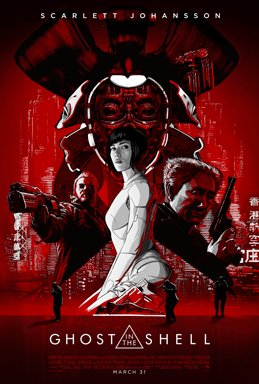
Film Review: Ghost in the Shell (dir by Rupert Sanders)


Last night, I finally saw Ghost in the Shell.

Now, before I start in on this review, I should admit that I’m hardly an expert on the manga on which Ghost in the Shell was based.  (In fact, as soon as I wrote that previous sentence, I called my boyfriend over and had him read it, just to make sure that I was using the term manga correctly.)  A few years ago, I did watch Mamoru Oshii’s 1995 film version.  And while I don’t remember a whole lot about the animated Ghost in the Shell, I do remember that I was never bored while watching it.  I wish I could say the same about the live action Ghost in the Shell.

Don’t get me wrong.  The live action, Westernized Ghost In The Shell is truly a visually impressive film.  It takes place in the near future, in the fictional Japanese city of New Port City.  New Port City basically looks like the city from Blade Runner, just with a somewhat more colorful visual scheme.  Everywhere you look, there are gigantic holographic advertisements and sleek, neon buildings.  But, as advanced as New Port City may look at first sight, it’s also full of dark allies, cramped apartments, and gray cemeteries.  Visually, it’s a perfect mix of  outlandish science fiction and brooding film noir.

Or, at least, it is the first time that you see it.  Unfortunately, director Rupert Sanders has a habit of using the visuals as a crutch.  It seemed as if, every time a new plot point was clumsily introduced, we would suddenly cut to another shot of New Port City at night, as if the film was saying, “Don’t worry about narrative coherence!  Look at the city!”

After about 15 minutes, I decided to take the film up on its suggestion.  I stopped paying attention to the slow-moving story and I focused almost exclusively on the visuals.  That’s a shame really because, from what I understand, both the manga and the original film are deeply philosophical works that balance style with thematic depth.  Unfortunately, since there’s no real depth to the live action Ghost in the Shell, you really have no choice but to focus almost exclusively on the style.

Ghost in the Shell takes place in a world where the line between human and machine has become blurred.  Everyone is getting cybernetic upgrades done.  One character, Batou (Pilou Asbæk), even gets new eyes halfway through the film.  Major (Scarlett Johansson) is unique because, while her brain is human, her body is totally cybernetic.  She is a member of Section 9, an anti-terrorism task force.  Major has only vague flashes of memory of who she used to be.  She’s been told that her parents were killed by terrorists but she doesn’t know if that’s true or if that’s just more manipulation from Cutter (Peter Ferdinando).  (It’s no spoiler to say that Cutter turns out to be a not nice guy.  He’s the CEO of a Hanka Robotics and when was the last time you saw a movie where a robotics CEO didn’t turn out to be a not nice guy?)  After Section 9 thwarts a cyberterrorist attack against Hanka Robotics, Major starts to wonder who she is and who she can trust.  Everyone tells her that, because she has a human brain, she’s also a human.  But Major still feels lost and without an identity.  When she starts to get too close to discovering her past, Cutter sets out to not only destroy her but all of Section 9 as well…

There’s a really good movie in which Scarlett Johansson plays a lost soul looking for her identity in Japan.  It’s called Lost in Translation.  Or, if you just want to see Scarlett playing someone who is learning more and more about herself and what she’s capable of, you could go watch Lucy.  (I don’t care much for that movie but some people seemed to like it.)  Or, if you want to see Scarlett play an enigmatic being who explores the world while hiding her true form in a human shell, you can always go watch Under the Skin.

(I highly recommend Under the Skin, which is as thought-provoking as Ghost in the Shell is shallow.)

This is what’s frustrating.  Scarlett Johansson gives a really good performance in Ghost in the Shell but she’s continually let down by a script that refuses to take the time to really explore anything.  We get a scene or two of Major wondering what it means to be truly human but the movie is always more interested in getting to the next action scene.  There’s a lot of talk about what it means to be human but there’s no real exploration.  Ghost in the Shell has all the depth of one of those old sci-fi shows where aliens (and, occasionally, androids) approach bemused humans and ask, “What is this thing that you call laughter?”

Ghost in the Shell ends with the hint of more films to come.  Personally, I’d rather see Scarlett Johansson in a Black Widow solo film.  When is that going to happen, Marvel Studios!?  Let’s get to it!  As for the live action Ghost in the Shell, it’s just frustrating and forgettable.

But the city looks really good!