Spring Breakdown: Age of Summer (dir by Bill Kiely)


Earlier this week, Spring Break get derailed in both the real world and here on the Shattered Lens.  I had like four reviews left to go in my Spring Breakdown series before the whole Coronavirus panic broke out and I missed a few days of posting.

Well, fear not.  I’m never one to give up easily and hey, I’m working at home for the next month!  So, I should have time to watch a lot of movies, including at least four more movies to close out Spring Breakdown!  For instance, this morning, I decided to clean out my DVR by watching the 2018 film, Age of Summer!

Now, I guess I should start things out by admitting that Age of Summer is not really a Spring Break film.  In fact, it takes place during the summer.  However, the entire movie pretty much takes place on the beach and really, that’s just as good as being about Spring Break.  I mean, there’s a scene where a bunch of lifeguards spray beer on each other in slow motion and there’s some oddly gratuitous nudity and there’s whole big subplot about stealing a big marijuana plant.  So, it’s a Spring Break movie in spirit, if not in plot.

Unfortunately, it’s not a particularly good movie.  This is one of those movies that left me wanting to throw stuff at the TV and I probably would have if Jeff hadn’t pointed out that, if I broke the screen, it might be a while until I could get a new one.  The film is about a kid called Minnesota (Percy Hynes White), because that’s where he’s from.  (Fortunately, he wasn’t from Walla Walla.)  Minnesota has moved to California and he wants to become a life guard.  He also wants to get a girlfriend and retrieve his bike, which is stolen from him at the start of the film.  A grown-up Minnesota provides us with voice-over narration, assuring us that we’re watching the most important summer of his life and that, as a result of what happened during that summer, he would always love the ocean.  The problem with the narration is that, far too often, it tells us what we should be seeing.  Instead of visually making us fall in love with the ocean, the most just tells us that we should love the ocean.

Oddly, the main theme of this film seems to be that everyone in California is a jerk.  I’m sure that wasn’t what was originally intended but everyone that Minnesota meets is so obnoxious that you’re just kind of like, “Get that kid to Walla Walla!”  Eventually, Minnesota is sent on a quest to get wisdom from the mysterious Rock God (Peter Stomare) who lives on the beach and who some people say is just a local legend.  I’m not really sure what Minnesota got from his visit to the Rock God but at least Peter Stomare’s in the film.

Anyway, Minnesota does eventually become a lifeguard.  All of the lifeguards spray beer on each other in slow motion.  How are they going to save my life if they’re all drunk?  Where the Hell’s David Hasselhoff?  Someone needs to whip these boys into shape!

So, no, Age of Summer didn’t really work for me.

The TSL’s Grindhouse: Clown (dir by Jon Watts)


Clown, a gory horror film, sucks.

I can’t say that I was particularly surprised to discover that it sucked but still, I was hoping that it would be better than it turned out to be.  That’s largely because the film itself has a fairly compelling backstory.  In 2010, director Jon Watts and his co-writer, Christopher D. Ford, uploaded a fake trailer for Clown to YouTube, in which they stated that the film would be produced by Eli Roth.  Roth saw the trailer and was so impressed that he actually did decide to produce the film.

Filming began in 2010 and the film spent a while playing the festival circuit, where it got the type of vaguely respectable reviews that are usually given to low-budget horror films made by amateur filmmakers that no one is ever expecting to hear from again.  In 2012, Dimension Films and FilmNation Entertainment acquired the rights to distribute Clown.  What followed was an agonizing wait as Clown was basically released in almost every other country in the world. except for the USA.  In fact, it wouldn’t be until 2016 that Clown would get an American release.  During that time, Jon Watts received deserved acclaim for directing Cop Car and he was hired by Marvel to direct Spider-Man: Homecoming.

As an admirer of Watts’s subsequent films, I was really interested in seeing Clown.  So, yesterday afternoon, I sat down and I watched Clown on Netflix.

Clown is the story of a stupid guy named Kent McCoy (Andy Powers) who tries to save his son’s birthday party by dressing up like a clown.  What Kent doesn’t know is that the clown makeup is cursed and that, by putting it on, he’s now allowed himself to be possessed by a demon that feeds on children!  What a dumbass!  Kent tries to wash the makeup off his face but it won’t come off.  He tries to take off his rainbow wig, just to discover that it’s now permanently attached to scalp.  His wife uses a screw driver to try to pop off the red nose but, instead, she just rips his real nose to pieces.  (The family dog eats the red nose and promptly becomes possessed.)  Kent keeps telling everyone that he’s been possessed by a demon but no one believes him.  Everyone just thinks that he’s a weirdo in clown makeup.

It sounds more interesting than it is.  For all the promise in the idea of a possessed clown, Clown doesn’t do much with it.  Clown is 90 minutes long but it only has enough plot for 30 minutes.  The remaining hour is basically made up of characters repeating what we already know.  We watch as Kent learns that the clown makeup is cursed.  Then, we have to follow his wife as she does her own research and discovers that the clown makeup is cursed.  Then, Peter Stomare shows up and starts explaining to everyone that the clown makeup is cursed.  By this point, I was yelling at the screen, “I KNOW THIS ALREADY!”

Throughout the film, there are hints of the Jon Watts’s talent but, for the most part, they remain merely that.  There’s an effective scene that takes place in a jungle gym at Chuck-E-Cheese’s and occasionally, there will be a line of dialogue or a movement of the camera that actually lives up to the plot’s subversive potential.  However, especially when compared to Cop Car and Spider-Man, Clown is an abysmally paced film.  It’s also terribly acted with Andy Powers neither sympathetic nor compelling as the possessed man in clown makeup.  Not even a reliable character actor like Peter Stomare can bring much to the material.

The general rule of most horror films is that, no matter what the threat, dogs and children usually survive.  The film not only breaks that rule but it breaks it multiple times.  In fact, there’s so much blood spilled in the film that I actually found myself getting depressed watching it.  Lacking both a satiric edge and any real interest in subverting the horror genre, Clown instead comes across as being unnecessarily mean-spirited.  It’s just not much fun to watch.

When it comes to killer clowns, stick with Pennywise.

http://www.youtube.com/watch?v=M25cDzZ2DwY

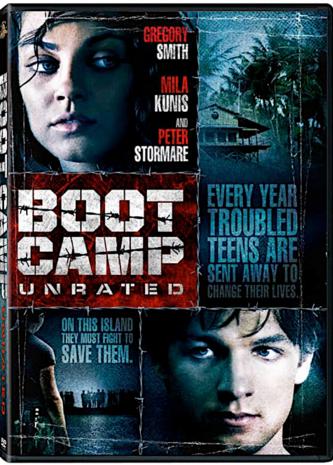
Film Review: Boot Camp (dir by Christian Duguay)


Occasionally, if you’re lucky, you come across a film that so totally and completely conforms to your own worldview that you’re forced to wonder if maybe you wrote the script and then somehow forgot about it.

That was certainly the case, for me, when I recently watched 2008’s Boot Camp, a teen melodrama with an anti-authoritarian subtext.  Check out the trailer:

http://www.youtube.com/watch?v=WLzdRTKgFrc

In Boot Camp, Mila Kunis plays Sophie.  Sophie is rich and, in the eyes of her parents, out of control.  She talks back.  She sneaks out of the house.  She hangs out at all the wrong clubs and with all the wrong people.  You know the story.  We’ve all seen the talk shows.  Sophie’s parents are convinced that the only way that they can get Sophie under control is to exile her to what the film calls a “tough love boot camp.”

The boot camp is located on an island, just a few miles away from a luxurious resort.  From the minute Sophie arrives, she is told that escape is impossible and she can only leave after the facility’s founder, Dr. Arthur Hall (Peter Stomare), says that she can.  Some people have been at the camp for years, waiting for Dr. Hall to announce that they’re rehabilitated.

The rest of the film follows Sophie and several other inmates as they try to survive boot camp without surrendering their free will.  It’s not easy.  Though he is more than happy to take their money, Dr. Hall resents the parents and his program is mostly designed to brainwash the inmates into thinking of him as being their new father figure.  The camp is staffed with brutes, sadists, and rapists.  When one inmate drowns, the staff tries to cover up his death.  Eventually, like the inhabitants of the Island of Dr. Moreau, Sophie and the other inmates have no choice but to rise up in rebellion against their masters.

“Tough love boot camps” are a real thing.  They used to be hugely popular with daytime talk show audiences and I know that Dr. Phil still has a ranch to which he sends “out of control” teens.  (I put “out of control” in quotes because, often times, it seems that “out of control” is code for “thinking for yourself.”)  The idea is that rebellious teenagers are sent to the camp, where they get yelled at until they agree to stop being so rebellious.  Over the years, there’s been a lot of debate over whether boot camps actually work.  If I had been sent to a boot camp, I think I would have just lied about my feelings and put on a repentant good girl act just to get the yelling to stop.  I’d be perfectly humble and contrite for three months and then, as soon as I got out of the camp, I’d go back to sneaking out of the house, skipping school, shoplifting, doing drugs, and whatever else got me sent to the camp in the first place.  From what I’ve seen of the whole boot camp experience, it seems to be more about brainwashing than anything else.  What’s the point of having well-behaved children if they can’t think for themselves?

But, then again, boot camps have never really been about  helping the teenagers sent to them.  Instead, they’ve always been about making lousy parents feel better about themselves.  Parents who have spent the last 14 years totally fucking up their children get to pat themselves on the back because they sent their kids to boot camp.  Other adults, bitter over having lost their youth, get to say, “It’s time to teach those ungrateful children to respect authority.”  As for the people who run the boot camps, it’s less about the inmates and more about power and money.

That’s certainly the message of Boot Camp.  In fact, I was taken by surprise to discover just how much Boot Camp conformed to my own thinking on … well, on just about everything.  Make no mistake, Boot Camp is a flawed film.  There’s nothing subtle about Christian Duguay’s direction and, with the exception of Mila Kunis, none of the performances are as memorable as you might hope that they would be.  Peter Stomare is way too obvious in his villainy, giving a performance that belongs in the Overacting Hall Of Fame.  (You’ll find Stomare’s Dr. Hall in the villain wing, right next to Christoph Waltz in SPECTRE.)

But, even with all that in mind, it was impossible for me not to get excited when Sophie and her fellow out-of-control teens finally made their move against their tormentors.  The final third of Boot Camp turns into a celebration of disobedience and rebellion and it was impossible for me not to be thrilled by it.  Considering the increasingly Orwellian nature of American culture, we need more movies that celebrate revolution and individual freedom.  At a time when we’re being told that we “have to do this” or “have to do that,” Boot Camp says, “Nobody has to do anything, beyond what they choose.”

It’s an important message and one that people need to start heeding.


Scenes That I Love: “And It’s a Beautiful Day” in Fargo


As I sit here typing this at nearly 2 in the morning, this is what our front yard currently looks like:

SnowNow, admittedly, this is nothing compared to what fellow TSL writers Pantsukudasai56 and Leon The Duke are having to deal with up in Massachusetts.  However, Erin and I live in Texas, where we consider 90 to be a cold front.  So, to us, that is a lot of snow!

(Add to that, it’s still coming down…)

As I watched the flakes fall and I realized that our cat’s outside water bowl had now disappeared under a mountain of snow, I couldn’t help but think of one of the best (and most snow-filled) films ever made, 1996’s Fargo.  Fargo is a film about many things: greed, love, home, fate, guilt, and innocence.  It’s also a film that’s full of snow.

And tonight’s Scene That I Love comes from Fargo.  When people talk about Fargo, they always seem to mention the woodchipper scene, the accents, and maybe the scene where William H. Macy flees the interview.  However, for me, the film’s best scene comes towards the end.  As Marge Gunderson (Frances McDormand) drives Gaer Grismund (Peter Stomare) to jail, she reflects on everything that’s happened.

Even though I’ve seen Fargo several times, this scene still always gets to me.  First off, there’s always a part of me that’s scared that Grismund is somehow going to attack Marge from the backseat.  But, beyond that, this is the scene where Marge reminds us that, for all the bad in the world, there’s still good as well.

And, of course, there’s all that snow…

In Memory of Robin Williams #3: Awakenings (dir by Penny Marshall)


Awakenings

The 1990 Best Picture nominee Awakenings is exactly the type of film that seems to have been designed to make me cry.

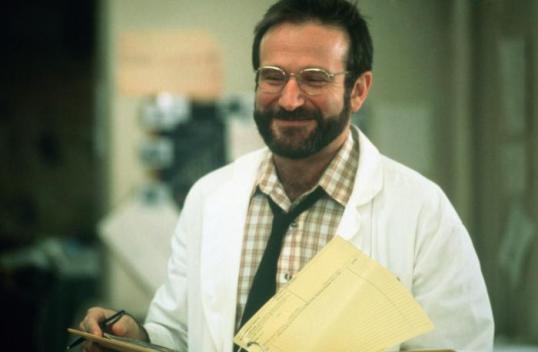
Taking place in 1969 and based (very loosely, I assume) on a true story, Awakenings features Robin Williams as Dr. Malcolm Sayer.  Dr. Sayer is a dedicated and caring physician but he also suffers from an almost crippling shyness.  He’s at his most comfortable when he’s dealing with a group of patients who have spent the last 40 years in a catatonic state, suffering from a tragic disease known as encephalitis lethargica.  (One thing that I learned from watching this film was that, from 1917 to 1928, there was an epidemic of this disease, with millions either dying or being left catatonic.)  While the rest of the medical establishment (led by John Heard, who always seems to be the embodiment of the establishment in films made in the 90s) assumes that the patients are destined to spend the rest of their lives in a vegetative state, Dr. Sayer is convinced that the patients can be awakened.  He soon discovers that, even in their catatonic state, the patients will react to certain stimulii.  One woman can catch a baseball.  Another appears to react well to music.  And finally, Leonard Lowe (Robert De Niro) — who fell ill with this disease when he was a child — tries to communicate with a Ouija board.

Over the objections of his supervisors, Dr. Sayer treats the patients with an experimental drug.  Leonard is the first one to get the drug and is also the first one to wake up.  While the rest of the patients wake up, Dr. Sayer tries to help Leonard adjust to the 1960s.  At first, everything seems to be going perfectly.  Leonard even manages to strike up a sweet romance with a woman named Paula (Penelope Ann Miller).  However, it soon becomes obvious that the awakening is only going to be a temporary one as Leonard and all the other patients start to descend back into their catatonic states…

It’s easy to criticize a film like Awakenings for being manipulative and sentimental.  And the fact of the matter is that the film is manipulative and it is sentimental and undoubtedly, it probably is a massive simplification of the true story.  (The character played by John Heard is such an obvious villain that he might as well have a mustache to twirl.)  And yes, you know even before it happens that there’s eventually going to be a montage of an amazed Leonard staring at a girl in a miniskirt while Time of the Season plays on the soundtrack.

But, no matter!  It’s a tremendously effective film and it earned the tears that I shed while watching it.  Both De Niro and Williams give excellent performances which add a good deal of depth to scenes that could otherwise come across as being overly sappy.  De Niro has the more showy role but it really but it’s the performance of Robin Williams that really carries the film.  As played by Williams, Dr. Sayer is a fragile soul who hides from the world behind his beard and his professional determination.  When he finally asks a nurse (Julie Kavner) out to dinner, it’s impossible not to cheer for him.

It’s also impossible not to cheer a little for Awakenings.

MCDAWAK EC015