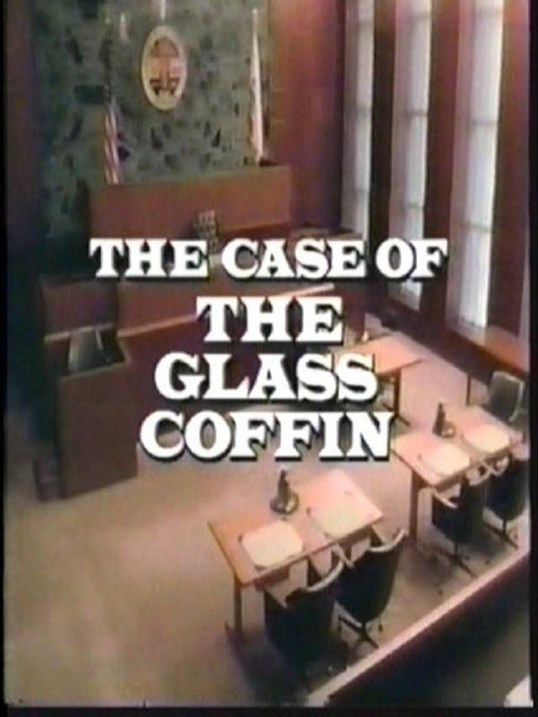
World famous magician David Katz (Peter Scolari) is accused of murdering his assistant (Nancy Lee Grahn) while performing a trick at a charity show. The prosecution says that David killed her to cover-up a pregnancy that was the result of a drunken, one-night stand. However, Perry Mason (Raymond Burr) and Ken Malansky (William R. Moses) discover that there were many people who might have a motive for killing the victim.
After the previous emotionally-charged Perry Mason movie, this entry felt pretty bland. I liked Peter Scolari as the accused magician but otherwise, this was a little boring. I guessed who would be playing the murderer as soon as I saw their name during the opening credits. I did find it amusing that Perry and the prosecutor (played by Bob Gunton) seemed to sincerely dislike each other. That added some bite to the courtroom scenes but I really do miss David Ogden Stiers’s as Perry’s regular courtroom opponent.
At the end of the movie, Perry took the jury to the theater where the murder occurred and then cross-examined the witnesses in the theater. I guess the movie’s producers were trying to do something new but it just didn’t feel right for Perry to get his confession anywhere other than in a courtroom.
Talk To Me, a made-for-television film that first aired on ABC in 1996, takes viewers behind the scenes of daytime talk show.
The Howard Grant Show has built a strong audience based on airing stories that appeal to the more prurient interests of viewers. Howard Grant (Peter Scolari) may have started out hosting a show about “issues” but now his show features wives who strip, girlfriends who cheat, and the occasional fist fight. While Howard presents himself as being a smooth-talking, compassionate advocate for society’s forgotten victims, the truth of the matter is that he’s a puppet who reads from a teleprompter and who wears an earpiece so that he can be told which questions to ask. Sadie (Veronica Hamel) is the one who is in charge of the show and she’ll exploit anyone and anything to get ratings.
Idealistic Diane Shepherd (Yasmine Bleeth) is hired to work as a segment producer for Howard’s show. Diane used to work on a talk show called “Margolis.” Margolis was cancelled because it was too concerned with “issues.” Still, Diane is hoping that she can bring the same earnest approach that she learned at Margolis to The Howard Grant Show. Why does Diane believe this? Why does it not occur to her that an approach that got her previous show canceled might not be appreciated at her new show?
Because Diane is kind of an idiot.
The movie doesn’t want us to think of Diane as being an idiot. We’re supposed to be on Diane’s side and we’re supposed to be just as shocked as she is when Sadie reveals just how manipulative the talk show game is. Unfortunately, Diane comes across as being so incredibly naive that it’s hard to really take her or her concerns seriously. It’s one thing to be upset at the way Sadie manipulates the show’s guests. It’s another to consistently be surprised by it. Diane spends so much of the movie being shocked that I eventually lost all respect for her. Diane cross the line from idealism into stupidity. Yasmine Bleeth’s wide-eyed performance doesn’t help matters. I watched this movie and wondered how Diane could even survive living in New York, let alone working there.
Jenny Lewis plays Kelly, a drug-addicted prostitute that Diane recruits to appear on the show. Talk to Me does a good job of showing how the show manipulates Kelly and then essentially abandons her once her episode has been filmed but, again, there’s nothing particularly surprising about any of it. I would have to imagine that, even in 1996, most people understood that Jerry Springer wasn’t a paragon of virtue and that his show was more interested in exploiting than helping. Talk To Me feels like an expose of something that had already been exposed.
The best thing about the film is Peter Scolari’s performance as Howard Grant. Scolari does such a good job as the unctuous talk show host that it’s actually a shame that the character didn’t get more screentime. (That said, there is a neat twist involving his character towards the end of the film.) Scolari perfect captures Howard’s fake but superficially appealing concern for his guests. He asks the most exploitive of questions but he does so in a gentle voice and his television audience loves him for it. Howard is remote and quiet off-camera but on-camera, he comes alive. He was born to talk to people. It’s just too bad that the conversation often ruins their lives.
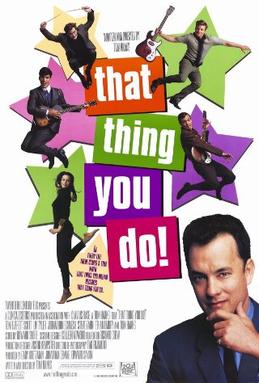
That Thing You Do! is the story of a one-hit wonder.
In 1964, an aspiring Jazz drummer named Guy (Tom Everett Scott) is a last minute addition to the a local band called the Oneders. (It’s meant to sound like Wonders but almost everyone mispronounces it as O-Needers.) The band’s egotistical leader, James (Jonathon Schaech) has written a slow ballad called That Thing You Do! but when Guy’s drumming causes the band to perform the song at a faster tempo, they end up with a local hit on their hands. That local hit becomes a national hit when The Oneders are signed by Play-Tone Records. First, Mr. White (Tom Hanks), their new manager, officially changes the name to The Wonders. Secondly, he makes sure that every teen in America is dancing to That Thing You Do! Third, he tells Guy to always wear sunglasses. Fourth, he tells James that he will record and perform what Play-Tone tells him to. Guitarist Lenny (Steven Zahn) and the unnamed Bass Player (Ethan Embry) are happy to be along for the ride but James chafes at his lack of artistic freedom. Guy, meanwhile, falls for James’s girlfriend (Liv Tyler, at her loveliest) and dreams of meeting his idol, jazzman Del Paxton (Bill Cobbs).
That Thing You Do! was Tom Hanks’s directorial debut and, with its careful recreation of a bygone era and its collection of authentic sounding early 60s rock on the soundtrack, it was obviously a labor of love. Considering the number of times that the song is played in the movie, it helps that it is a very good song. That Thing You Do! is a catchy tune, one that you can’t help but tap your feet to. At the same time, it also sounds like a one hit wonder. It’s good but not so great as to make you expect much else from The Wonders.
Not surprisingly, Tom Hanks gets great performances from the entire ensemble cast. Johnathon Schaech and Tom Everett Scott have never been better. Liv Tyler is lovely and vulnerable as James’s unappreciated girlfriend. Familiar faces like Peter Scolari, Kevin Pollak, Chris Isaak, and Clint Howard make welcome appearances. Hanks himself is surprisingly intimidating as Mr. White. When he says that the band will cover something the Play-Tone catalogue, it’s obvious that he’s not making a request.
The film is a tribute to being young and to loving music bit it’s also a study in the disillusionment of discovering that everything is ultimately a business. James is frequently an arrogant jerk and he treats his girlfriend terribly but it’s hard not to sympathize with him when he says that he wants to do more than just cover songs from the Play-Tone catalogue. To James and Guy, the Wonders are about self-expression and their love of music. To Mr. White, the Wonders are just another band that came up with one catchy tune and who probably aren’t ever going to be heard from again. That Thing You Do! pays tribute to all of the one-hit wonders out there, the bands who you forget about until you just happen to hear that one song on the radio or in a movie and suddenly, all the memories come flooding back.
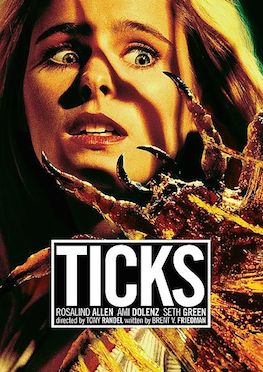
Don’t go in the wood alone, kids! There are giant ticks out there that can attach themselves to you, lay their eggs under your skin, and then cause your face to explode when the eggs hatch! It’s all because of the steroids that local farmer Jarvis Tanner (Clint Howard) has been using to enhance his marijuana crop. The end result may be good weed but you will be dead from a tick bite before you get to enjoy it. That’s bad news for Jarvis, who keeps stepping in bear traps and who, at one point, has a dozen tick eggs drop on him. It’s even worse news for the group of juvenile delinquents who have been sentenced to spend a weekend camping in the woods.
Mostly because the film featured the beautiful Ami Dolenz as one of the delinquents, Ticks used to be a mainstay on late night HBO. It combines the basic features of a 50s monster movie with the gore-filled style of a 90s splatter film. What Ticks may have lacked in originality, it made up for in scenes of people’s faces exploding. Make no mistake about it. This one is for splatter fans.
Ticks has an interesting cast. If you have ever wanted to see Alfonso “Carlton” Ribiero play a gangbanger, this is the movie for you. The nerdiest juvenile delinquent is played by Seth Green while TV regular Peter Scolari plays an idealistic social worker and Rance Howard (father of Ron and Clint) plays the local sheriff who loses his legs. And finally, there’s Clint Howard, giving it his all in yet another straight-to-video horror film. Clint suffers even more indignities than usual in Ticks but he never gives up hope. Clint’s scenes were directed by the film’s executive producer, Brian Yuzna, and added after the first cut of the film was judged to be missing something. That was a good decision on Yuzna’s part because Clint Howard is easily the best part of the film.
Today, the appeal of Ticks is mostly one of nostalgia. This is the type of mind-warping stuff that we used to watch when we were growing up. This is what we used to rent at Blockbuster while our parents were looking for the latest Oscar nominees. This is what late night cable used to be all about.
 Through the Shattered Lens