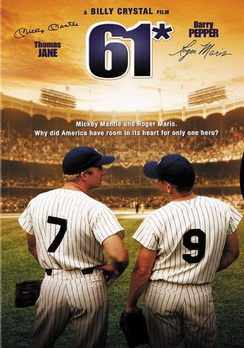
I Watched 61* (2001, Dir. by Billy Crystal)


61* is about two baseball player and two friends who couldn’t seem to be more different.

Roger Maris (Barry Pepper) is an introverted family man who doesn’t like it when reporters show up at his house in search of a story or a quote.  He’s a good ball player, one of the best, but he doesn’t want to be a celebrity.  Mickey Mantle (Thomas Jane) is a larger-than-life personality, a beloved figure on the field and in the dugout.  Mickey loves being famous and the fans love him.  Both Maris and Mantle are members of the New York Yankees.  Because Mantle is struggling with his drinking, he becomes Maris’s roommate when they’re on the road.  In 1961, the two friends both go after Babe Ruth’s record of 60 home runs in a season.  The press presents their season as a battle, a race to see who will be the first to hit the sixty-first home run of the season.  Mantle and Maris, though, are just swinging the bat and making plays.

I really enjoyed 61*, which is a baseball film made by and for people who love baseball.  I liked the contrast between the quiet Maris and the charismatic Mantle.  Even though Maris is a hard worker and a good ballplayer, Mantle is the fan favorite and the one that people actually want to break the record.  I appreciated that Maris and Mantle remained friends even when the press tried to turn them into rivals.  That’s what teamwork is all about.  Barry Pepper and Thomas Jane were great as Maris and Mantle and the movie showed how each man dealt with the stress of possibly breaking Babe Ruth’s record.

(Why is there an asterisk in the title?  Babe Ruth set his record in a season that only had 154 games.  The 1961 baseball season was 8 games longer.  The asterisk was added as a reminder that Maris and Mantle had 8 more games than Ruth did to try to break the record.  Baseball fans understand how important accurate statistics are to a player’s career and a team’s season.)

61* celebrates the way baseball used to be, a game played by athletes who had to depend on skill and teamwork instead of performance enhancing drugs.  The movie opens with Maris’s family watching as Mark McGuire closes in on breaking the record.  McGuire would only briefly hold the record.  He would lose it, for 48 minutes, to Sammy Sosa and then, three years after winning it back, he would lose it a second time to Barry Bonds.  Of course, Roger Maris won the record without using steroids so, as far as I’m concerned, it still belongs to him.

If you’re a baseball fan, 61* is a film that you have to see.
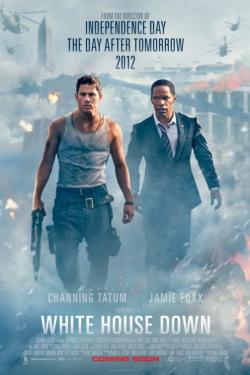
Shattered Politics #92: White House Down (dir by Roland Emmerich)


White_House_Down_poster_with_billing_block

To say that the 2012 film White House Down is stupid is probably unnecessary.  After all, the film was directed by Roland Emmerich and Emmerich specializes in making stupid films.

And, in many ways, White House Down is prototypical Emmerich film, a long and self-important collection of mayhem and heavy-handed pontification.  In the case of this film, liberal President Sawyer (Jamie Foxx) is pushing for a treaty that will magically bring about world police.  Naturally, a bunch of evil right-wingers (including characters played, somewhat inevitably, by James Woods and Richard Jenkins) don’t want world peace so they hire a bunch of mercenaries who attack the White House.  It’s all a part of a plot to force Sawyer to launch a nuclear attack on Iran because … well, why not?  Fortunately, aspiring secret service agent (and kick-ass combat veteran) John Cale (Channing Tatum) is there to work with the President and save the country.

And, since Emmerich is from the bigger is always better school of filmmaking, many familiar landmarks are blown up and it takes the film well over two hours to tell its simplistic story.  To be honest, if your action movie can’t get the job done in under two hours, then you’re going to have problems.  Once a viewer has spent two hours watching one movie, it’s inevitable that he or she will start to question the film’s logic.  If the film’s clever enough, all lapses and inconsistencies can be forgiving.  If the film is White House Down, it’s a lot less easy to be forgiving.

Of course, from a political point of view, Emmerich tries to have it both ways.  For anti-government types like me, it’s always fun to watch Washington D.C. blow up.  For those on the right, White House Down presents a situation that can only be solved by heroes with guns.  And, of course, Democrats can view White House Down as wish fulfillment, an alternative timeline where Barack Obama actually is as sincere and effective as they wish him to be.

In fact, if anything saves White House Down, it’s the chemistry between Foxx and Tatum.  Wisely, neither one of them appears to be taking the film that seriously and both of them seem to be having a lot of fun blowing things up.  Channing Tatum, in particular, deserves some sort of award.  How many bad films have been made tolerable by Tatum’s willingness to laugh at himself?  I’ve lost count but White House Down definitely benefits from his presence.  He and Foxx make Emmerich’s style of filmmaking as tolerable as it will ever be.

http://www.youtube.com/watch?v=4AXbiCdmXgw

Review: The Midnight Meat Train (dir. by Kitamura Ryuhei)


There’s a certain number of books when I was much younger that I thought would’ve made for some great horror films. They were the early works by Clive Barker. Short stories collected into several volumes aptly dubbed his Books of Blood. While several short stories from these volumes were adapted to film in the intervening years most were not worth the time to watch them. So, lo and behold that when I finally saw the latest short story adapted from these collections I was genuinely surprised at how well-made and entertaining it turned out to be. The Midnight Meat Train by Japanese filmmaker Kitamura Ryuhei was a fine piece of horror filmmaking that dripped in atmosphere and a growing sense of existential dread right up to it’s very surprising end.

The Midnight Meat Train is quite a simple story when one really breaks it down to it’s component parts. It’s a crime thriller wrapped in the bloody layers of an extreme horror film. There’s a certain noirish quality to it’s storytelling as we see the film’s protagonist in Leon (Bradley Cooper). He’s a photographer struggling to find the inspiration for his next set of photographs and decides to wander the train stations at midnight to find that inspiration. It’s during one visit at night that he begins to suspect that he might’ve come across one of the latest missing persons who might’ve become a victim of the so-called “Subway Butcher”. The film shows his growing obsession in finding out if the urban legend of this so-called serial killer is actually true.

His mental state only deteriorates as the reality about the “Subway Butcher” (Vinnie Jones in one of his best roles to date) catches up to the truth on one midnight ride on the subway train. His witnessing of the killer at work brings him into a hidden world the rest of the city seems unaware or incapable of acknowledging despite the hundreds of people who go missing year in and year out for almost a hundred years. His girlfriend Maya (Leslie Bibb) and best friend Jurgis (Roger Bart) soon become drawn into Leon’s nightmarish situation and must confront the very boogeyman who has begun to haunt Leon’s waking life.

The film is Kitamura Ryuhei’s first Hollywood film and it doesn’t diminish the talent for some creative visuals he earned while directing horror and genre films in his native Japan. He makes great use of the nighttime setting and the stark environs of the subway trains at midnight to give The Midnight Meat Train an almost black and white look punctuated by vivid splashes of visceral red during the many inventive killings by Vinnie Jones’ mute Mahogany character. Kitamura showed that he was able to squeeze as much as was possible from a script that was average at best. Especially considering that the script had to adapt one of Barker’s shorter tales.

The performances by the ensemble group led by Bradley Cooper ranged from good to excellent with the aforementioned Vinnie Jones leading the pack. Even Bradley Cooper as the tormented protagonist Leon handled the role well. I’ve never warmed to Cooper as an actor as he always came across as a smirking douchebag in almost every role he played prior to this one. He quickly shed some of that reputation for me with his performance in this film and continues to do so with every one since this film. The smirk is still there but he has managed to drop the douchebag aspect of it. I also must point out a nice turn by veteran genre actor Tony Curran as the train conductor who exuded a sense of the otherworldly and a character who held the answers to the questions brought up by the film.

Since this is a horror film one must mention it’s horrofic aspects and this film fills it’s quota of horror. The scenes where Jones’ Mahogany dispatches the unwary last riders of the train at midnight were shot extremely well and with some visual flairs Kitamura has gained a reputation for. There’s nothing cartoony about these kills unlike other slasher films of it’s type. The kills are done in a brutal fashion as meat tenderizers smash into skulls and backs. Then there are the dressing of the kills which gives meaning to the film’s title. The only part of this film which seemed so out of place, but was necessary in the film’s overall narrative was the make-up effects in the end of the dead-end tunnel where Leon finally sees the truth of why Mahogany has been killing passengers on the subway train. It’s here that the film’s budget shows. At least Kitamura was smart enough to film these scenes in very low light to hide some of the zippers and laces on the costuming.

Overall, The Midnight Meat Train was one horror film in 2008 that deserved to have been seen by more people. It’s a shame that the handling of this film’s distribution by Lionsgate bordered on the criminal as it failed to be screened  by many theaters which led to it’s failure in the box-office. This was a horror film that delivered on the goods without pandering to the torture porn crowd who had begun to dominate the scene due to the popularity of the Saw franchise. Kitamura’s first work in America showed that he brings a fresh new voice to Western horror. The film also ends up becoming the best of all the Books of Blood short story adaptations and shows that Barker’s earlier grand guignol writing phase could be adapted well to the bigscreen.

Here’s to hoping that the failure of this film in the box-office (Again, I say fuck you Lionsgate) doesn’t keep other up-and-coming horror filmmakers from tapping into Barker’s volumes of short stories for their projects. There’s horror gold to be found there and Kitamura’s The Midnight Meat Train was one gleaming example of it.