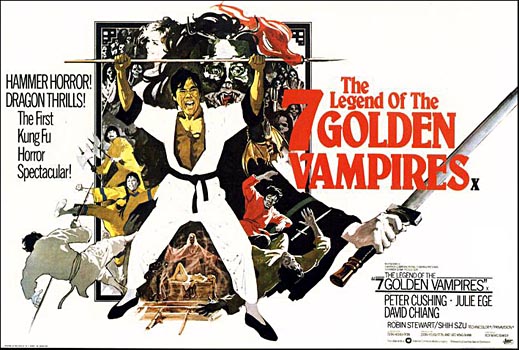
Today’s horror movie is from Hammer films and, needless to say, it’s lot of fun. In The Legend of the 7 Golden Vampires, an ennui-stricken Count Dracula (James Forbes-Robertson) leaves his castle and travels all the way to China. Once in China, he resurrects the legendary 7 golden vampires and uses them to raid a nearby village. One villager (played by David Chiang) goes to the legendary Prof. Van Helsing (Peter Cushing, of course) for help. Van Helsing, along with his son (Robin Stewart) and a wealthy widow (Julie Ege, who decorated several Hammer films), goes to the village to battle the vampires. Providing protecting for Van Helsing’s group is Chiang’s sister (Szu Shih) and six other brothers.
First released in 1974, The Legend of the 7 Vampires was Hammer’s attempt to revive the failing fortunes of their most iconic monster by collaborating with Hong Kong film producer Sir Run Run Shaw. The result is an entertaining hybrid of a traditional Hammer vampire film and a Hong Kong kung fu movie. While James Forbes-Robertson makes for a poor replacement for Christopher Lee, Cushing is perfect as always.
The Hammer Mummy films never get as much respect as the old Hammer Dracula and Frankenstein films. This is mostly because the Mummy films tend to drag and the Mummy never quite had the charisma of a Christopher Lee or a Peter Cushing. Still, mummies are pretty freaky. I’d probably be more scared of them if I lived in an area with a larger concentration of archeological digs.
Tonight, as I watched the premiere of The Walking Dead’s 2nd season, I found myself thinking about some of my favorite zombie films. One which came to mind immediately was Ken Wiederhorn’s low-budget but effectively disturbing 1977 film, Shock Waves.
In Shock Waves, a group of tourists find themselves shipwrecked off the Florida coast. As they wander through the isolated, swampy terrain, they happen to come across a decaying mansion that is inhabited by one very mad scientist (Peter Cushing). It turns out that Cushing is a Nazi war criminal who, during World War II, created the Death Corps., an elite unit of zombie super soldiers. As World War II came to an end, Cushing somehow ended up in Florida and, unfortunately for the living, he brought the Death Corps. with him. And now, with the arrival of the castaways, the Death Corps. has reawakened…
Shock Waves is considered by many (like me, for instance) to be the best example of the small genre of film known as the Nazi Zombie film. (Though I have to admit that it’s not my favorite Nazi zombie film. That honor would have to go to Jean Rollin’s delightfully weird Zombie Lake. For another example of the genre, check out Arleigh’s review of Dead Snow.) Admittedly, once you get past the idea of underwater zombies, the film is pretty predictable plot-wise. But a certain predictability goes along with any zombie film. One reason why zombies are so scary is the very fact that they are very simple and predictable. Zombies exist solely to destroy and, beyond running and hiding, there’s not a whole lot of options available for dealing with them. Vampires and werewolves are almost ludicrously vulnerable to all sorts of defensive moves (seriously, people, how difficult is it to wear a crucifix around your neck?) but zombies are pretty much an unstoppable force and for a zombie film to succeed, the zombies must truly seem unstoppable. This is where Shock Waves truly succeeds because seriously, these zombies are brutal. There’s a lengthy montage where the zombies literally tear apart a building, searching for the castaways and it’s probably one of the most chilling sequences of destruction ever caught on film. It helps that these Nazi zombies are truly frightening to look at, with their hair plastered to the sides of emotionless faces and their eyes hidden behind dark goggles. Add to that, they’re Nazis. Seriously, nothing’s scarier than Nazis. Perhaps the most enduring image from this film is of the members of the Death Corp. emerging from the water, one after another. It’s a remarkable sequence and probably one of the most striking “zombie mob” scenes ever.
The Shock Waves DVD also features an audio commentary with director Ken Wiederhorn and a few other crew members. It’s actually probably one of the more interesting DVD commentaries I’ve ever heard, as Wiederhorn is very honest about not being happy with how the final film turned out. And certainly, this is one of those low budget B-films that you can pick to death. As Wiederhorn himself points out, lead actress Brooke Adams often seems to just be going through the motions and, as effective as the Nazi zombies are, the film never explains how 1) they ended up off the coast of Florida or 2) how they haven’t been discovered before this. But so what? Shock Waves is one of those films that manages to be quite a bit more than the sum of its parts. Wiederhorn might not be happy with the film but that doesn’t change the fact that he manages to create a true sense of menace and danger during the film’s first half and the second half features some of the scariest zombies ever. Ultimately, Shock Waves is a genuinely scary and effective zombie film and one that the director has every right to be proud of.
One final note — Shock Waves opens up with one of those “This film might be based on a true story” narrations and it’s all the better for it. I’m including a clip of it below because 1) it’s just so grindhouse that I can’t help but love it and 2) it also features a bit of the film’s brutally effective score.
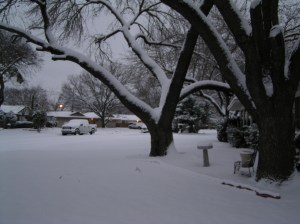
If you’re following the news then you probably heard that Dallas got hit with like a 100 inches of snow yesterday. Seriously, more snow fell yesterday than has even fallen in recorded history (or, at the very least, in my recorded history). You want to talk about Snowmageddon? Well, we had a Snowpocalypse.
The neighborhood on Friday morning (picture taken by Erin Nicole Bowman)
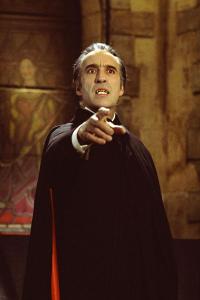
So, I spent most of yesterday cooped up inside with my sister and our cat and once we got over the whole fun of being able to go outside and scream, “SNOW DAY!” at the top of our lungs, there really wasn’t much to do. So, in an attempt to fight off cabin fever, I raided my DVD collection and we ended up watching one of the old Christopher Lee-as-Dracula-films from Hammer Studios. Specifically, we ended up watching Dracula A.D. 1972.
The film opens in 1872 with a genuinely exciting fight on a runaway carriage that ends with the death of both Count Dracula (Christopher Lee) and his nemesis, Prof. Van Helsing (Peter Cushing). However, as Van Helsing is buried, we see one of Dracula’s disciples (played by Christopher Neame, who had an appealingly off-kilter smile) burying Dracula’s ashes nearby. The camera pans up to the clear Victorian sky and, in a sudden and genuinely effective jumpcut, we suddenly see an airplane screeching across the sky.
Well, it’s all pretty much downhill from there. Suddenly, we discover that a hundred years have passed and we are now in “swinging” London. The city is full of red tourist buses, hippies wearing love beads, and upright policemen who always appear to be on the verge of saying, “What’s all this, then?” We are introduced to a group of hippies that are led by a creepy guy named Johnny Alculard (also played — quite well, actually — by Christopher Neame). One of those hippies (Stephanie Beacham) just happens to be the great-great-granddaughter of Prof. Van Helsing. Apparently, she’s not really big on the family history because she doesn’t notice that Alculard spells Dracula backwards. Then again, her father (played by Peter Cushing, of course) doesn’t either until he actually writes the name down a few times on a piece of a paper.
Anyway, the film meanders about a bit until finally, Alculard convinces all of his hippie friends to come take part in a black mass. “Sure, why not?” everyone replies. Well, I don’t have to tell you how things can sometimes get out-of-hand at black mass. In this case, Dracula comes back to life, kills a young Caroline Munro, and eventually turns Johnny into a vampire before then setting his sights on the modern-day Van Helsings.
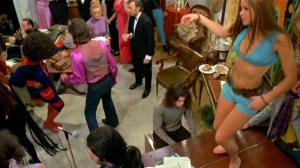
Dracula A.D. 1972 was Hammer’s attempt to breathe some new life into one of its oldest franchises and, as usually happens with a reboot, its critical and (especially) commercial failure ended up helping to end the series. Among even the most devoted and forgiving of Hammer fans, Dracula A.D. 1972 has a terrible reputation. Christopher Lee is on record as regarding it as his least favorite Dracula film. And the film definitely has some serious flaws. Once you get past the relatively exciting pre-credits sequence, the movie seriously drags. There’s a hippie party sequence that, honest to God, seems to last for about 5 hours. As for the hippies themselves, they are some of the least convincing middle-aged hippies in the history of fake hippies. You find yourself eagerly awaiting their demise, especially the awkward-looking one who — for some reason — is always dressed like a monk. (Those crazy hippies!) But yet…nothing happens. All the fake hippies simply vanish from the film. Yet, they’re so annoying in just a limited amount of screen time that the viewer is left demanding blood. Add to that, just how difficult is it to notice that Alculard is Dracula spelled backwards? I mean, seriously…
To a large extent, the charm of the old school Hammer films comes from the fact that they’re essentially very naughty but never truly decadent. At their heart, they were always very old-fashioned and actually quite conservative. The Hammer films — erudite yet campy, risqué yet repressed — mirrors the view that many of my fellow Americans have of the English. For some reason, however, that Hammer naughtiness only works when there’s the sound of hooves on cobblestone streets and when the screen is populated by actors in three-piece suits and actresses spilling out of corsets. Dracula A.D. 1972 did away with the support of the corset and as a result, the film is revealed as a formless mess with all the flab revealed to the world.
Still, the film isn’t quite as bad as you may have heard. First off, the film — with its middle-aged hippies — has a lot of camp appeal. It’s the type of film that, once its over, you’re convinced that the term “groovy” was uttered in every other scene even though it wasn’t. As with even the worst Hammer films, the film features a handful of striking images and Christopher Neame is surprisingly charismatic as Alculard.
As with the majority of the Hammer Dracula films, the film is enjoyable if just to watch the chemistry between Christopher Lee and Peter Cushing. Both of these actors — so very different in image but also so very stereotypically English — obviously loved acting opposite of each other and whenever you see them on-screen together, it’s difficult not to enjoy watching as each one tried to top the other with a smoldering glare or a melodramatic line reading. As actors, they brought out the best in each other, even when they were doing it in a film like Dracula A.D. 1972. In this film, Cushing is like the father you always you wished you had — the stern but loving one who protected you from all the world’s monsters (both real and cinematic).
As for Lee, he’s only in six or seven scenes and he has even fewer lines but, since you spend the entire film wondering where he is, he actually dominates the entire movie. Lee apparently was quite contemptuous of the later Hammer Dracula films and, oddly enough, that obvious contempt is probably why, of all the Draculas there have been over the years, Lee’s version is the only one who was and is actually scary. F0rget all of that tortured soul and reluctant bloodsucker crap. Christopher Lee’s Dracula is obviously pissed off from the minute he first appears on-screen, the embodiment of pure destructive evil. And, for whatever odd reason, the purity of his evil brings a sexual jolt to his interpretation of Dracula that those little Twilight vampires can only dream about. Even in a lesser films like Dracula A.D. 1972, Christopher Lee kicks some serious ass.
So, in conclusion, I really can’t call Dracula A.D. 1972 a good film nor can I really suggest that you should track down a copy of the DVD. I mean, I love this stuff and I still frequently found my mind wandering whenever Cushing or Lee wasn’t on-screen. However, it’s not a terrible movie to watch if you happen to find yourself trapped in the house by a mountain of snow.
How can you not be enthusiastic about a film with a title like “The Sinful Dwarf?” That said, I think Peter Dinklage could kick this guy’s ass. This was apparently a “lost film” until a copy was found in a janitor’s closet in Denmark. “What do you think of the blonde?” “hahahahahahaha”
This is actually a rather depressing rip-off of Maniac. The trailer makes it look a lot more interesting (and fun) than it actually is. Which, of course, is what a trailer is supposed to do. (The DVD, by the way, features a pretty interesting interview with the star of this film, Dan Grimaldi.)
3) Corruption
“No women will dare go home alone after seeing Corruption!” That’s right, boys, go see Corruption and you will get laid! You can say a silent prayer of thanks to Peter Cushing after…By the way, I’m planning on seeing Corruption on DVD but I’ll be sure to watch it at a male’s house or apartment in order to make sure that I have someone to escort me home afterward. So, if any of you guys out there have an hour or two to kill (so to speak)…
I like this trailer and I have a feeling I might find something to enjoy in the actual film is just because I come from a long line of swamp girls. That said, I don’t think I could be one myself. There’s too many little buggies and things flying around the swamp.
Is the haunting Theme From Swamp Girl stuck in your head now?
In previous editions of Lisa Marie’s Favorite Grindhouse and Exploitation Trailers, I haven’t highlighted any of the several hundred mondo film trailers that are out there because I kind of agree with something that Giovanni Lombardo Radice said: mondo movies are a remnant of fascism. And they are. But, I had to include Journey Into The Beyond here because how can you not enjoy listening to John Carradine?
If you happen to watch an Italian or Spanish slasher film made between 1979 and 1983, there’s a fairly good chance that Edmund Purdom will turn out to be the killer. Well, I guess Purdom got sick of being typecast because, in 1983, he directed a film of his own and it’s a holiday film!
Masters of Horror has been good but very uneven in its execution during it’s two season run on Showtime. Haeckel’s Tale is the last episode for Season One (Takashi Miike’s episode never got an official airing) and it sure ends the season on a disturbingly kinky compilation of twisted grotesqueries. The story is from a Clive Barker short story that’s been adapted by Mick Garris (fellow Masters of Horror director and also its brainchild) and produced by George A. Romero to be directed by John McNaughton.
One wonders why Romero would be producing instead of directing the piece. Scheduling conflicts prohibited Romero from taking the director’s chair and he instead recommended John McNaughton (his one film which earned him Master of Horror status is one of the best horror films of the last quarter century: Henry – Portrait of a Serial Killer). The fact that Romero was originally chosen to direct Barker’s Garris adapted short story means there’s got to be zombies or some form of undead within. I, for one, was glad that Romero decided that he wouldn’t be able to direct and chose another in his stead. Barker’s short story does indeed include zombies but it also has a heavy sense of the old classic technicolor Hammer Films vibe to it. Haeckel’s Tale under the capable hands of McNaughton takes those Hammer Films conventions and ramps it up into overdrive.
Even though John McNaughton really has only one true horror film under his belt (he also directed a little-known cult scifi-horror called The Borrowers which had fledgling effects shop KNB EFX still doing things guerilla-style), but his work in Henry: Portrait of a Serial Killer more than earned him his horror creds. In Haeckel’s Tale, John McNaughton clearly has a bit of fun making the only true period piece in the whole Masters of Horror series. McNaughton goes for the classic Hammer Films look for this episode and it shows in the gothic, fog-shrouded atmosphere in the outdoor scenes. The look of the costumes and even the dialogue harkens back to those Christopher Lee and Peter Cushing Hammer Films.
The story is a mixture of the Frankenstein tale with a some Cemetary Man (aka Dellamorte Dellamore) mixed in. Haeckel’s Tale begins somewhere around the 1800’s and I’m assuming close to the end of it from the costume worn by Steve Bacic who played Mr. Ralston who arrives to seek the help of Miz Carnation who is purported to be a necromancer who can grant him his wish to have his dead wife brought back to life for him. Miz Carnation rebuffs Ralston, but after some begging she makes a deal with him to hear Haeckel’s Tale. If he still wants his wife brought back to life after hearing it then she would do so.
Ernst Haeckel (played by Derek Cecil)is a young medical professor whose obsession to conquer death mirrors that of a certain eccentric European scientist he so admires. Unlike his idol, Haeckel’s attempt to use electricity to put the spark of life back into a corpse fails dramatically. He’s soon investigating the rumor of a certain traveling necromancer who goes by the name of Montesquino (played by Joe Polito) who he thinks to be a fraud, but he soon finds out that Montesquino is all he says he is when Haeckel stumbles upon Wolfram (played by Stargate SG-1‘s own Maybourne, Tom McBeath) and his stunning young wife Elise (the drop-dead gorgeous Leela Savasta).
Haeckel quickly lusts after the young Elise, but as Wolfram will later tell him as the story nears it’s climax (in more ways than one), Elise cannot be satisfied by him or Haeckel. Her obsession with a dead husband she loves and cannot let go brings Haeckel to a scene that he cannot comprehend nor accept as something she truly wants. I must say that Leela Savasta’s performance as the dead-obsessed Elise is only surpassed by Anna Falchi’s own work as “She” in Dellamorte Dellamore. Leela’s pretty much spending most of her screentime fully naked and writhing around in an orgy not typical of most horror movies. It’s also in this orgy scene where we get the biggest Clive Barker feel to the story. Anyone how has read Barker earlier work knows the man can mix horror and sex like no other.
The ending of the episode brings to it a slight twist with Miz Carnation being more than she says she is. This Masters of Horror episode is not the best of the lot, but it is one of the better looking ones in terms of cinematography and it’s leads. It also doesn’t have much in terms of genuine scares. The story gradually builds up the dreads and disturbing images but never anything that will put a genuine heart-stopping scare on the viewer. Like McNaughton’s own foray into horror with Henry, Haeckel’s Tale lets the story’s own disturbing themes on obsession and the darker side of love put the horror in the story. It does have a nice gore-laden sequence courtesy of Howard Berger and Greg Nicotero and their KNB FX team.
In the end, Haeckel’s Tale is a very good episode which has its flaws like the rest of the Masters of Horror episodes. What sets it apart from the rest of the series entries is its unique Hammer Films look and the return of McNaughton back in the director’s chair as a horror filmmaker. It’s no Henry: Portrait of a Serial Killer, but Haeckel’s Tale will have enough disturbing images to burn itself to its audiences’ minds.



 Through the Shattered Lens