One thing that I’ve come to realize is that Irish-Americans (like myself) have been guilty of idealizing the Irish Republican Army in the past.
We tend to view the IRA as being freedom fighters, battling against the occupation and standing up against religious bigotry. The truth of the matter is that the IRA was a violent organization whose actions often made things even worse for the Catholics in Northern Ireland. While the IRA’s American supporters always tended to present the IRA as plotting actions against the British army, the truth of the matter is that many of the IRA’s victims were Irish citizens who were judged to either be collaborators or to not be properly enthused about the IRA in general. The popular excuse for the IRA’s terrorism is to say that the IRA usually called and gave advanced warning before a bomb went off but really, that’s kind of a weak excuse when you think about it. Really, the only thing that the IRA had going for it was that the British were often just as bad and even more heavy-handed when it came to dealing with the Irish.
In 1993’s In The Name of the Father, Daniel Day-Lewis plays Gerry Conlon, who is sent to London by his father, Giuseppe (Pete Postlethwaite), specifically to keep him from falling victim to the IRA. Of course, once Gerry arrives in London, he supports himself through burglaries and spends most of his time in a state of stoned bliss with his friends. It’s while Gerry is in London that an IRA bomb blows up a pub in Guildford. When Gerry later returns to Belfast, he is promptly arrested and accused of being one of the four people responsible for the bombing.
Gerry protests that he’s innocent and we know that he’s innocent. We know that, when the bomb was placed, Gerry was busy getting high with Paul Hill (John Lynch). Paul has also been arrested and the British police are determined to get a confessions out of both him and Gerry. The interrogation stretches for hours. Though exhausted, Gerry refuses to confess. Suddenly, Inspector Robert Dixon (Corin Redgrave) enters the room. He walks up to Gerry and whispers in his ear that if Gerry doesn’t confess, “I will kill your Da.”
It’s a shocking moment because the threat is delivered without a moment of hesitation on the part of Dixon. Dixon’s voice is so cold and so direct that, when I watched this film, I actually gasped at the line. An exhausted and terrified Gerry confesses. Soon, Gerry is thrown in prison. He’s joined by his sickly father, who has been accused of being a co-conspirator. At first, Gerry resigns himself to never being free again. He meets Joe (Don Baker), who says that he’s the one who set the bomb and that he confessed after Gerry, Giuseppe, Paul Hill, and the other members of the so-called Guildford Four had been given their life sentences. With Giuseppe’s health faltering, Gerry finally steps up and, with the help of an attorney (Emma Thompson), fights for his freedom.
In The Name of the Father is a powerful film, one that was based on a true story. Gerry and his father come to represent every victim of a biased justice system and an authoritarian-minded police force. Gerry starts the movie trapped between the two sides of the Troubles. The IRA doesn’t trust him because he’s not a bomb-thrower. The British distrust him because he’s Irish. Despite his innocence being obvious, Gerry finds himself sent to prison because letting him go would be viewed as a sign of weakness. Daniel Day-Lewis gives a passionate and charismatic performance as the impulsive and somewhat immature Gerry but the film’s heart really belongs to the late Pete Postlethwaite, playing a father who refuses to give up on either his freedom or his son.
In The Name of the Father received seven Oscar nominations, including Best Picture, Director, Actor, Supporting Actor, and Supporting Actress (for Emma Thompson). That was also the year of Schindler’s List, which took the Oscars for both Picture and Director. Daniel Day-Lewis lost to Philadelphia’s Tom Hanks while Postlethwaite lost to Tommy Lee Jones for The Fugitive and Thompson lost to Anna Paquin for The Piano. 1993 was a good year for movies and the Oscars, though I would have voted for Day-Lewis over Hanks.
Since Sunday is a day of rest for a lot of people, I present #SundayShorts, a weekly mini review of a movie I’ve recently watched.
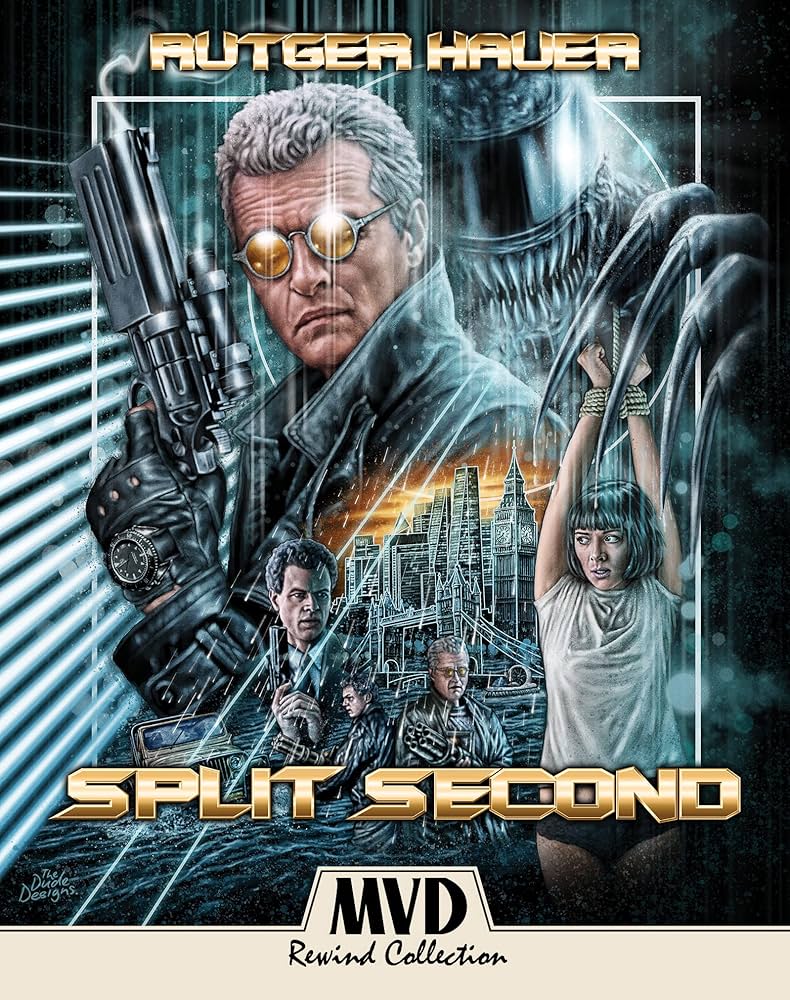
Rutger Hauer chews the scenery in grand style as a badass London cop on the trail of a serial killer who rips the hearts out of the chest of its victims, is about 10 feet tall, and whose teeth appear to be that of a beastly monster. SPLIT SECOND is a fun mishmash of genres….part action, part horror, part comedy, and all entertainment! It’s especially enjoyable for fans of Hauer like me. It’s currently streaming on Amazon Prime, Pluto and Tubi.
Fast Facts:
I saw SPLIT SECOND in a movie theater in Conway, Arkansas in 1992. I was the only person in the theater. It’s a fun movie, but it did not perform well at the box office, only earning $5.4 Million on a $7 Million budget.
1992 was a good year for Rutger Hauer. Not only did he star in SPLIT SECOND, he also starred as the head vampire Lothos in the movie version of BUFFY THE VAMPIRE SLAYER. Written by Joss Whedon, Hauer’s co-stars included Kristy Swanson, Luke Perry, Donald Sutherland & Paul Reubens (PeeWee Herman).
Detective Dick Durkin is played by actor Alistair Duncan. When the movie was originally released in 1992, he was credited as Neil Duncan. Whatever his name, Mr. Duncan is absolutely hilarious in the film. His reaction when he first sees the creature is so good… “We need to get bigger guns. BIG F’ING GUNS!”
The original script took place in Los Angeles and involved a ritualistic serial killer who murders five people every five years during the last quarter-century. The producers decided the script needed to be changed because the story was too similar to a film called THE FIRST POWER starring Lou Diamond Phillips. The script that was ultimately used for the movie was set in London, which was half under water due to global warming.
If you like Kim Cattrall from SEX AND THE CITY, she’s in this. My wife thought that was interesting.
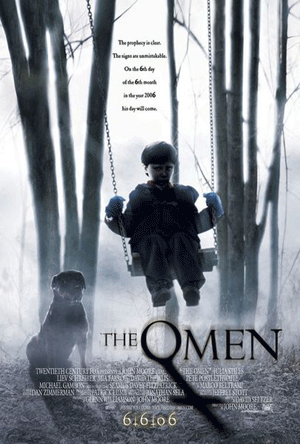
There’s really only one reason to see the 2006 remake of The Omen and that’s the fact that the priest who convinces Ambassador Thorn to adopt the Antichrist is played by the great Giovanni Lombardo Radice.
If you’re a fan of Italian horror, you’ll immediately know who Radice is and, whenever he appears in The Omen, you’ll be momentarily excited. After all, Radice is an actor who has given memorable performances in films made by iconic directors like Lucio Fulci, Ruggero Deodato, Antonio Margheriti, Michele Soavi, and Martin Scorsese. He’s appeared in everything from City of the Living Dead to Cannibal Apocalypse to The House On The Edge of the Park toStagefright to Gangs of New York. As both a horror icon and an excellent actor who has always been gracious and friendly to his fans, Giovanni Lombardo Radice is one of those actors who movie bloggers like me are always happy to see in any film.
(And, if anyone deserves a role in a Quentin Tarantino film, it’s Giovanni Lombardo Radice.)
And Radice gives a really great performance in The Omen. He plays the role with just the right combination of menace and regret. When he first appears, you can tell that he’s determined to get Robert Thorn to adopt Damien but that he’s not particularly happy about having to do it. He may be one of the bad guys but he’s a bad guy with a conscience. Later, when Radice makes a second appearance, it momentarily re-energizes the film. He’s just got such a unique screen presence that, whenever he’s on-screen, Radice reminds you of the film that you want The Omen to be.
As for the rest of the remake — well, it’s all kind of pointless. The film is largely a scene-by-scene remake of the first Omen and, unfortunately, it never quite answers the question of why the film needed to be remade in the first place. The Gregory Peck role is played by Liev Schrieber while his wife is played by Julia Stiles. The doomed photographer is played by David Thewlis. Mia Farrow shows up in the role of the sinister nanny and Mia actually does a pretty good job but whenever she was delivering her lines, it was impossible for me not to imagine a remake of The Final Conflict where Ronan Farrow plays Damien.
Otherwise, the same characters die as in the original film and, often times, they die in the exact same way. It’s really almost lazy how little the remake changes from the original. And, ultimately, it makes the entire movie feel more than a little pointless. You’re left with the feeling that the only reason the Omen was remade was so that it could be released on June 6th, 2006 (a.k.a. 6-6-06).
So, when it comes to The Omen, stick with the original but watch the remake for Giovanni Lombardo Radice.
If someone just five years ago told me that Ben Affleck would turn out to be a director whose work has been some of the better crime drama/thrillers of the past decade then I would declare shenanigans on that individual. Ben Affleck might have won an Oscar for helping write the screenplay for Good Will Hunting, but his career since could be labeled as being one of a joke (Gigli) interspersed with huge paycheck projects (Armageddon) that showed his range as an actor.
This is not to say that Affleck has no talent in front of the camera. I just believe that early in his career after winning his Oscar he got fooled into thinking that everything else since would be Easy Street paved in gold (financially and critically). To say that it hasn’t turned out to be that way (though he did make a ton of money) would be an understatement. But one thing happened while Affleck’s acting career was heading nowhere but down. He got behind the camera as a director and his very first time directing a feature-length film he would make one of 2007’s best films. I speak of his film adaptation of the Dennis Lehane crime drama, Gone Baby Gone. He didn’t just direct the life out of that film, but he also the screenplay with the help of Aaron Stockard.
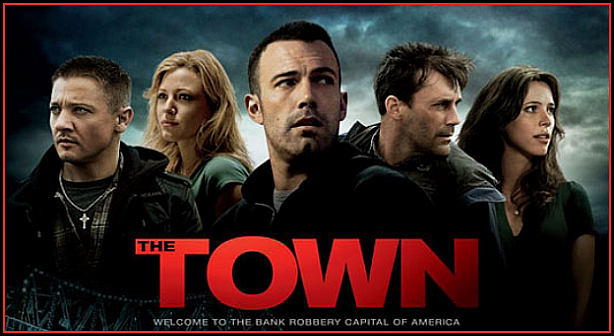
The two of the them would collaborate once again on Affleck’s latest Boston-based crime drama, The Town. He wrote the screenplay and directed the film and pulled in some wonderful performances from an ensemble cast which included Jeremy Renner, Jon Hamm, Rebecca Hall, Blake Lively, Titus Welliver and Pete Postlethwaite. Fellow site writer Lisa Marie already reviewed the film in detail and her review pretty much put down into words exactly what I thought of the film. I will say that I would swerve slightly away from what she considered some of the flaws in the film.
The Town was adapted from Chuck Hogan’s novel, Prince of Thieves. I would consider the screenplay and dialogue as a major strength of the film. While at times it did seemed to follow the step-by-step and by-the-numbers heist thriller story the screenplay itself didn’t ring false. I liken this film to another heist film which shared some themes and similarities. Michael Mann’s Heat also dealt with the cops-and-robbers foundation. Where Mann’s film had a much larger and epic scope to its storytelling it still boiled down to two groups of determined men playing a dangerous game of cat-and-mouse. The women in both film were written just enough that they had distinct personalities, but in the end they were motivations for the men in the film.
Affleck shows that he doesn’t just know how to direct, but continues is reputation as being one very good screenwriter. One just has to be reminded that he is now 3-for-3 when it comes to screenplays he has written which have turned out to be great ones. While he doesn’t have the same flair for words as Tarantino or Mamet when it comes to the screenplay. What he does well was to create an efficient script which flowed from scene to scene. Tarantino’s screenplays are great, but at times he does allow himself to overindulge his inner-film geek and create dialogue that might be Sorkin-like in execution. What I mean is that as great as the dialogue sound there’s no way people really spoke like this to each other. Affleck’s screenplay for The Town felt very natural and even with Jon Hamm’s less than great performance the film had a natural and genuine sound to it’s dialogue.
That’s one flaw pointed out by Lisa Marie that I would disagree with her on. The other two I can see her point, but it bothered me none. Though if I ever took on a life of crime I would hope I find someone just like Rebecca Hall’s Claire. Now there’s a woman who stands by her man no matter what.
I think in the long run this film might just be seen as one of the best of 2010 and some critics have already dubbed it so. While it’s prospects come awards season time is still up in the air I wouldn’t be surprised if it ends up nabbing one of the ten Best Picture nominations when the Oscar nominations get announced. It would be well-deserved and would just prove that Affleck’s career in the film industry might just be hitting its stride. Who would’ve thought it would be as a writer-director and not as an actor.
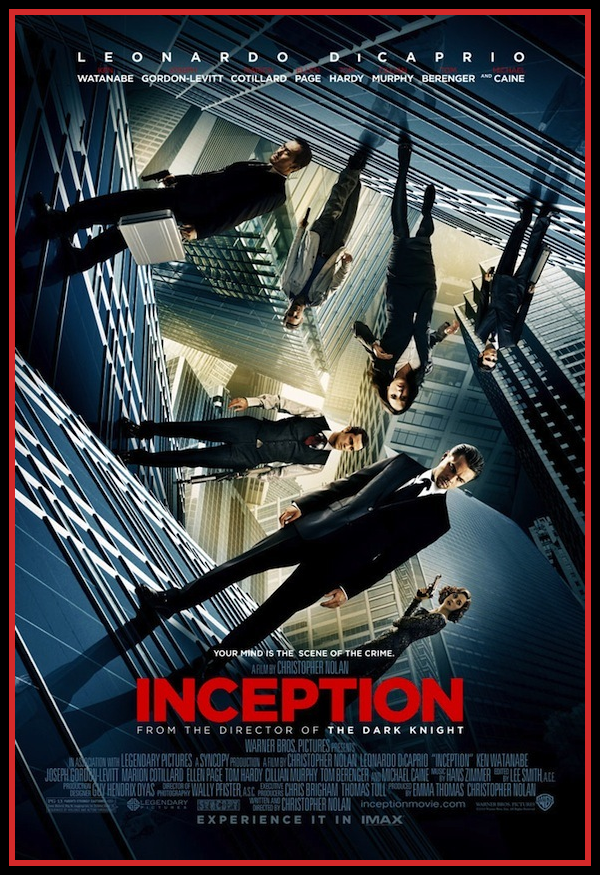
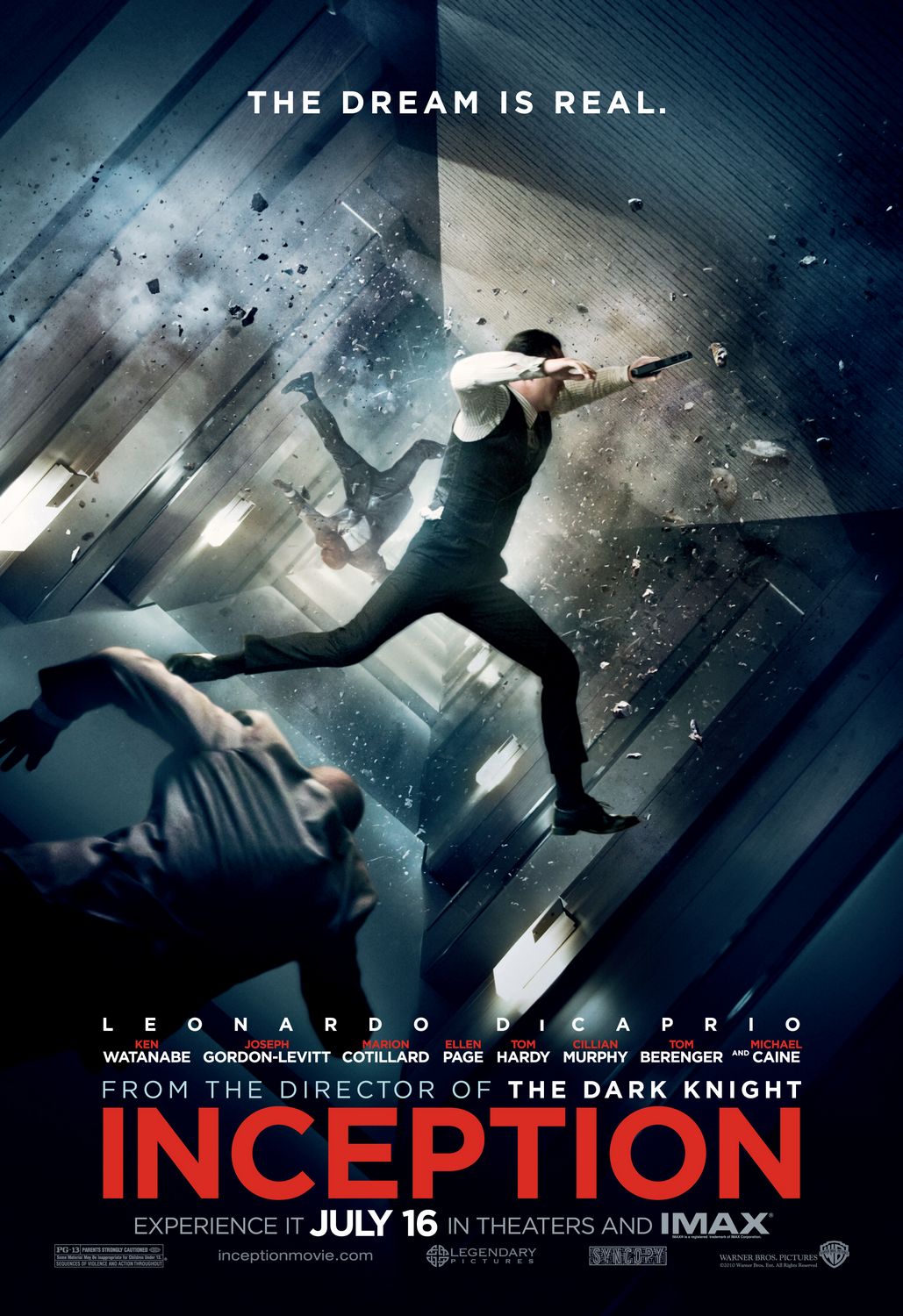
The summer of 2010 has been quite a disappointment. While the films released during this major blockbuster season has been good most have not been able to be that one stand-out which defines a summer season. We’ve had the typical tentpole sequels like Iron Man 2 (good but not great) and Toy Story 3 (also good but not great) to remakes like The Karate Kid to The A-Team. To say that the 2010 summer blockbuster season has been lackluster would be an understatement. Even original films like Splice hasn’t taken in the audience. It now falls to one of the biggest titles for the summer to try and save the season. Whether it will do so financially is still in doubt, but critically the latest from Christopher Nolan may just become the event film of the summer to actually deliver on its hype and the promise of an audience seeing something new, fresh and daring in a sea of mediocrity. Inception comes into the 2010 summer season and delivers on its promises and more than lives up to the hype heaped upon it by critics and fans alike.
A film almost a decade in the making, Christopher Nolan’s epic and sweeping tale of dreams and reality wrapped around a heist film brings the filmmaker one-step closer to becoming the genius filmmaker some of his most ardent followers have dubbed him to be. Nolan as a filmmaker and, more importantly, as a storyteller has always had a fascination with shattered reality and how the subconcious directly affect his protagonists’ sense of the real. We’ve seen this in his film-style of using a disjointed and non-linear structure to his films which goes to creating a sense of confusion in the inattentive viewer. Some have called this style of his as being a gimmick to make a simple story more complex than it really is. I disagree with these individuals and say that Nolan has never done anything to trick an audience with his storytelling style and choices. His films have all the facts laid out before the audience, but in a way that asks the audience to participate in putting the jumbled pieces together. I’ve never seen a red herring used by Nolan in his more personal projects and even in the populist titles he’s done under the rebooted Batman franchise.
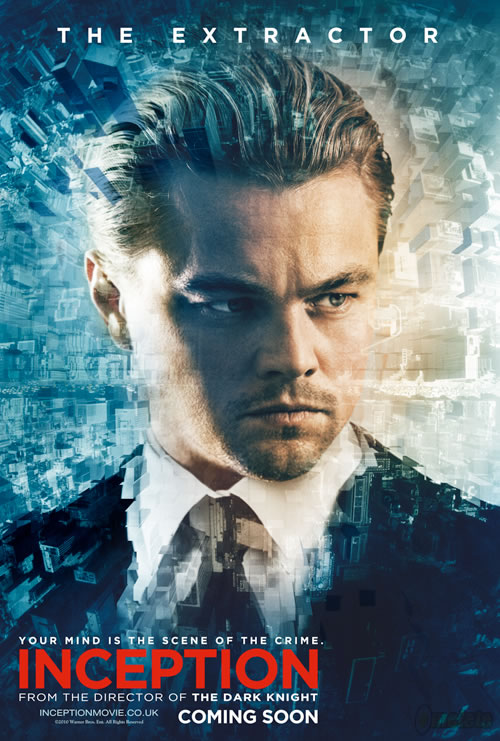
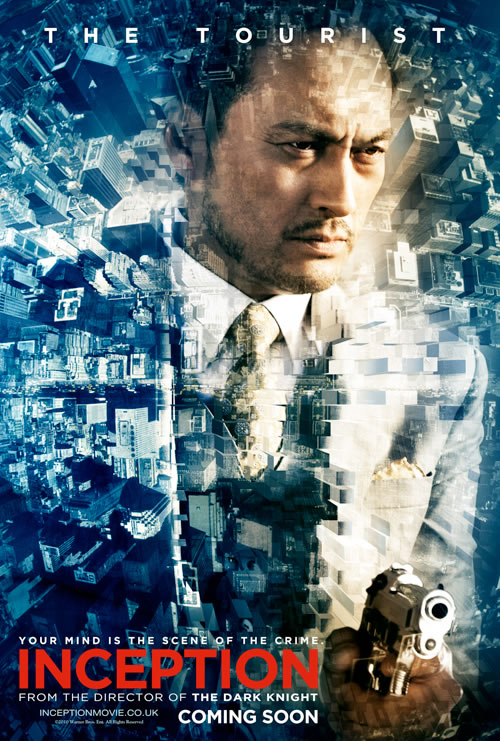
In his latest film, Nolan has refined his non-linear style and used it to successfully create the main setting of the film. Inception is set mostly in the dream world shared by the characters and those they’ve targeted. It is in this shared dream state that the audience learn the rules governing the world of Inception. It is in this dream state that we’re introduced to the first people who would make up an incredible ensemble cast put together by Christopher Nolan and his casting crew. We first meet dream extractor Dom Cobb (played by Leonardo DiCaprio) and his pointman Arthur (Joseph Gordon-Levitt) as they attempt to steal something valuable and important from within the dream of their Japanese-industrialist mark in Saito (Ken Watanabe). We see hints of the rules that will become important for the audience to help them follow the film’s main story as it unfolds. We learn that Saito has already known in advance that he’s in a dream constructed and being shared by Dom and Arthur in their contracted heist by parties unknown. As good as Dom and Arthur are at their job os stealing ideas from a mark through their dreams they have no chance when someone from Dom’s past inserts herself in their plans to sabotage what they’ve worked to accomplish.
It’s in this introductory sequence that we learn of the backstory of Dom and why his latest heist-job didn’t work out too well and has now endangered not just himself but those he has been working with. Saito gives Dom and Arthur a way out of their problems after failing in this job to steal from him by doing a job for him. But unlike previous dream heists Dom and Arthur have done in the past this time Saito doesn’t want something stolen from someone’s mind but to have an idea planted so deep within a mark’s subconscious that the mark believes it to be their very own and not one planted by an outsider. The job doesn’t require Dom to be an extractor of ideas. He’s now to find a way to successfully plant an idea. A job known as “inception” which Arthur and others deem near-impossible to pull off and one quite dangerous not just to the mark but to those involved in the process.
To say anymore about the plot of the film would be to spoil it. Inception works best when as little as possible about the film is known going in. The surprise and awe of the story unfolding is half the fun. It’s like an intricate puzzle or game one tries to solve. It’s ok to know ahead of time how to solve things, but not as fun. While for some people the way Nolan uses non-linear storytelling can be confusing all he asks his audience is to pay attention to the details and clues he’s planting in every scene and piece of dialogue. Let’s be honest this film is not for the inattentive. I won’t say stupid since that implies having low intelligence. It doesn’t take intelligence to pay attention and I’ve known that some of the more intelligent people have a tendency to let their attention wander.
Inception is a film about big ideas and grandiose themes. While the story in of itself when broken down to its simplest common denominator is just a heist film done in a new way, the film allows for layers upon layers of ideas to wrap itself around this simplistic premise. Nolan doesn’t just play with disjointing time for audience. He’s gone and went towards manipulating reality within the subconscious thought to ask the audience a simple question.
Are what we seeing a dream or is it reality?
The film doesn’t trick us using red herrings to make us think one way or another. Everything Nolan has put up on the screen is quite literal and remembering the rules he had set-up in the first hour lays the groundwork for each individual audience to answer that question for themselves. There’s no right or wrong answer to the question, but for some who have seen the film their disappointment seem less to do with the quality of the film, the acting and the direction but more on some of the ambiguous nature of the ending which becomes a dealbreaker for some. Again while I respect their take on this film I find their reasoning for negative criticism to be grounded on thin to non-existent ground. I will get to that ending soon.
While some have called Inception as the anti-Avatar I believe the two filmmaker share similar traits not just in how they create their film, but also in their two latest film. Both Nolan and Cameron are quite known to be very controlling of how their films are made to the point they dabble in every aspect of it. In their latest films they’ve also gone a long way into building a world for their story and characters to inhabit and play around in. While Cameron’s latest was an otherworldly kind in the most literal sense the same could be said for Nolan’s latest but instead inhabits the mind and how anything is possible. From the look of things both film will also share the same sort of near-universal acclaim from the film-going audience with a small, albeit very loud, minority calling Nolan’s film unoriginal, boring and, a word I have loathed for its overuse when something becomes very popular, overrated.
Where the two filmmakers diverge is the way they go about their films. Where Cameron leans heavily in pulling at the emotional strings of the audience through narrative and film sequences in his films, Nolan plies the audiences intellect instead. Cameron for all his technical genius both within the filmmaking sphere and outside of it can be quite the sappy filmmaker and all his films have shown this whether it’s The Terminator or Avatar. For Nolan his films have always felt like an intellectual exercise. An exercise everyone was invited to participate in no matter their level of intellect. He’s been able to marry both his indipendent arthouse sensibilities with the blockbuster the masses seem to crave year in and year out. With Inception he has moved one-step closer to achieving a perfect meshing of the two. This film has all the makings of a great heist and sci-fi thriller wrapped around so many pieces of profound and thoughtprovoking ideas that even after several viewings an audience will find something new to think about. Only one other film I can think of in the last decade or so has accomplished this and that was 1999’s The Matrix by The Wachowski Brothers. While that film was a kick-ass sci-fi action film it also dared to mix in a liberal dose of philosophy both Eastern and Western not to mention subjecting it’s audience to rethink how they see reality.
Christopher Nolan has gone beyond just trying to question the nature of reality. His goal with this film is to deconstruct the nature of the subconscious itself and show how such a thin line separates the dream from the real that at first and, even several glances, one cannot tell the difference. It’s a good thing for the audience watching Inception that Nolan has given them the tools and the rules to follow if they dare. And that’s where I think Nolan will disnguish himself apart from other great directors of his generation and put him up on the level of the true masters in film history. He doesn’t just make films that has worldwide appeal but able to do them while still able to engage his audience to open up their minds to the infinite possibilities his stories offer. While this does make his film a tad cold and distant for some that shouldn’t detract from the high-quality of his work, especially with Inception. The film has heart. It just doesn’t pluck on those particular beats to engage the audience.
I think filmblogger Devin Faraci said it best on his Twitter feed while discussing the film with others. While not exactly verbatim what I got out of it was that he thought it was always easy to engage and/or manipulate the audience through emotional factors, but much harder to engage their intellect. While some have accomplished the former to a great extent and vice versa I think with Inception Nolan has stepped closer than anyone to engage both the heart and the mind of the audience.
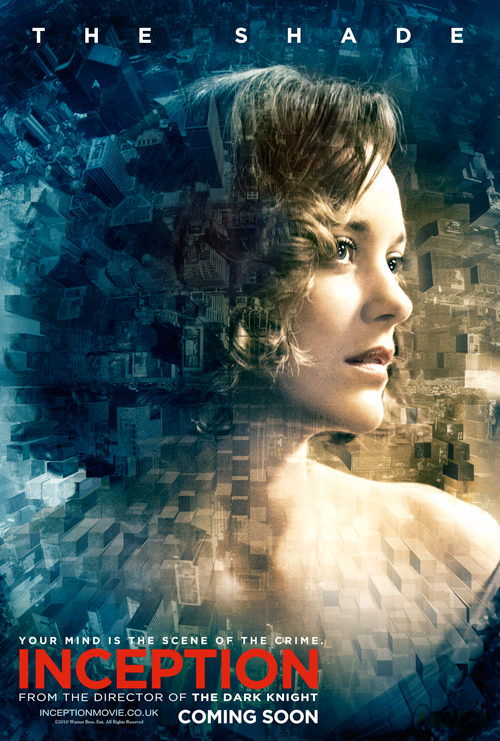
This review cannot be too much of a review if I just spoke about the ideas, themes and the inner workings of Nolan’s mind. The film is actually very good. Good enough to that’s close to being perfect. Pick any aspect of the film and those involved have done some of their best work and grown in their craft. As I stated earlier the film sports one incredible ensemble cast. I’ve already mentioned Leonardo DiCaprio and Joseph Gordon-Levitt who both do very great work in their roles. DiCaprio continues to be the go-to-guy when it comes to playing the tortured individual. Similar to his other role in Scorsese’s Shutter Island, DiCaprio as Cobb was quite believable in his personal-made hell in regards to a past event which involved his wife Mal (played with beautiful elegance and malice by Marion Cotillard). But unlike Scorsese’s film Nolan doesn’t reveal this personal issue through a twist in the plot, but let’s it come out naturally with the help of another cast member providing the impetus for Cobb to come clean. This individual is the team’s new dream architect in the form of Ariadne (Ellen Page in her most mature role to date and one that should go a long way from helping her shed the label of being Juno-esque).
Ariadne becomes the proxy by which the audience learns the in’s and out’s of Cobb’s job as a dream extractor and, very soon, inceptor. Through some inventive use of CGI and practical effects we see throught Ariadne’s eyes how the shared dream-state behaves. How specific rules actually exist within this state no matter how many levels of dreams an individual or group goes down into a mark’s subconscious. Some of these scenes people have seen glimpses of in the trailers and tv spots, but even seeing some of them in advance doesn’t detract from how incredible they look when seen on the bigscreen, especially for those lucky enough to see them on IMAX.
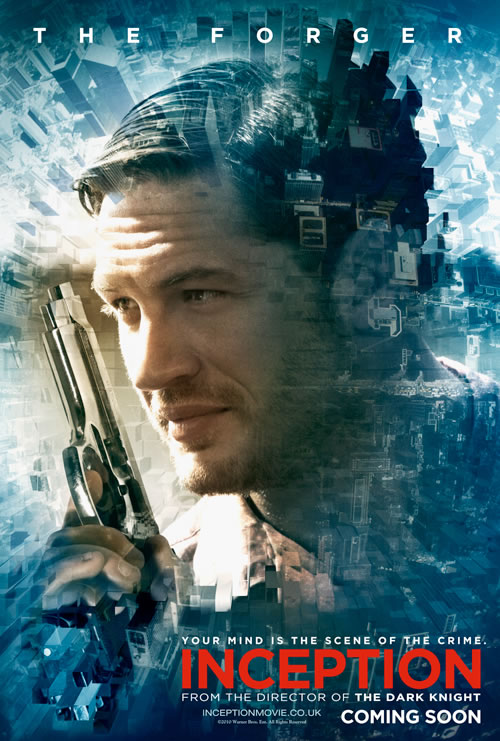
The rest of the cast rounded out by Tom Hardy as Eames the team’s Forger, Dileep Rao as the Chemist in charge of fabricating the compounds needed for the team to enter their mark’s subconscious. Cillian Murphy (starting to become one of Nolan’s regulars) plays Robert Fischer, Jr. their target and mark throughout the film with veteran actors Tom Berenger, Michael Caine and Pete Postlethwaite providing the wise-men roles in the film. It’s Tom Hardy as Eames which stood out in a cast full of extraordinary young and veteran performers. His recent fame as an actor due to his brutal and daring performance in Bronson has made Hardy a hot commodity in Hollywood. His playful character of Eames serves to provide some levity in an otherwise very serious film which allows the audience to come closer to the characters and story instead of remaining distant as Nolan’s detractors like to point out. He nearly pulls off stealing the film from everyone everytime he’s on-screen. It’s a testament to all the actors that he doesn’t as each and everyone have their moments to shine without overshadowing their fellow co-stars.
It would be difficult to review this film without pointing out how beautiful it looks and sounds. The visual part of the film has to go to Walter Pfister who works his magic behind the cameras on this film. Every shot is clear, concise and free of tricks some cinematographers these days have come to rely on too often to make their shots look more dynamic than it really should be. The editing by Lee Smith makes sure that Nolan’s style doesn’t confuse the audience and keeps the non-linear narrative structure easy to comprehend. As for the score one has to look to Hans Zimmer’s growing rapport with Nolan. He’s scored two of Nolan’s film and it looks that Zimmer has tapped into what Nolan wants his film score to sound like. not to dominate or overemphasize particular scenes or beats, but to act as an accompaniment. All three individual do their part as does the actors into making Nolan’s vision of Inception come to life. As great a filmmaker as Nolan is turning out to be these support players have made sure his path towards that goal is done so on smoother ground than not.
Now, there’s going to be some heated and long debates as to the nature of the film because of the final shot. The final shot is of a metal dreidel spinning in the foreground with the camera panning to it. The dreidel is spinning and spinning and looks to keep on doing so. The dreidel is shown earlier in the film as acting as some sort of anchor to tell Cobb whether he is in the real world or in a dream. If it continues to spin and not tip over and fall then he’s still in one. If it spins but ultimately tips over onto its side then he’s out of it. The film ends with the dreidel spinning and for a split second before the film suddenly fades to black we see it wobble.
Many have seen this final shot as being a cop-out by Nolan to play with the audience’s mind. I happen to disagree. I see it as a part of the story itself. nolan has been asking throughout the film what is real and what is a dream. This last shot just emphasizes this question and leaves it up to the audience to decide whether the dreidel continues to spin or eventually tips over. While I lean to the latter in the end it doesn’t detract from the film. The fact that some people have grabbed hold of this scene to negatively criticized the film as a whole tells me just how well-crafted a film Nolan has made that one little sequence lasting no less than 10 seconds becomes a dealbreaker for some when it should stimulate the mind into thinking what it actually means. I see that as the mark of an excellent storyteller.
In the end, Inception has done something this year which most film have so far been unable to do. It has delivered on its high-minded promises of a film that would challenge the audience and not just entertain them. It’s a film which has been overhyped for the last six month but has more than lived up to it and for some surpassed the hype itself. Inception looks to be one of those films which would forever define a filmmaker and this one will definitely define Nolan moving forward no matter what other projects he has in the future. This is a film that dares to appeal not just to the arthouse cineaste crowd but to the general audience who yearn to watch something exciting and original. I won’t say this is Nolan’s best film since he has years upon years to continue making films. Maybe one of those will be his masterpiece, but Inception definitely could be counted as being a nominee for that honor. If nothing else this film has saved what has been a very ordinary and lackluster 2010 summer film season.








 Through the Shattered Lens