Film Review: Scream (dir by Byron Quisenberry)


Since today is Friday the 13th, I decided to review a film called Scream….

No, not that Scream.

This Scream came out in 1981.  It’s a slasher film but instead of featuring the usual collection of teenage victims, the victims in Scream are largely a collection of middle-aged tourists who are played a motely collection of former sitcom stars and western veterans.  Even Ethan Wayne, the son of John Wayne, makes an appearance, playing a potential victim named Stan.

The film imagines what would happen if a bunch of tourists who were exploring the Rio Grande decided to spend the night in an apparently deserted ghost town.  Speaking for myself, I would have never decided to sleep in a deserted town, especially one that isn’t even on a map.  I mean, those places are called ghost towns for a reason.  Even if they’re not haunted by ghosts, they are probably home to snakes, spiders, and all sorts of bugs.  Considering that these people have camping gear with them, I’m not sure why they decided it would be smart to just sleep in an abandoned building.  This is where the film’s use of adult victims really backfires.  It’s easier to accept teenagers and 20-something doing something stupid.  When it’s a bunch of people heading towards 40 and 50 (and even older in some cases), you can’t help but feel that they have no one but themselves to blame.

The murders begin on the first night.  Needless to say, the survivors decide to find somewhere else to sleep but they discover that their rafts have been cut apart.  They’re trapped in the town.  Some of them leave to try to find a nearby ranch.  Everyone else stays in the town and tries not to fall victim to the unseen killer.

And then Woody Strode shows up.

Oh, poor Woody Strode.  Woody Strode was in his late 60 when he appeared in this film.  In his youth, he was one of the first black men to play in the NFL.  When he went into acting, he became a favorite of John Ford’s.  In The Man Who Shot Liberty Valance, he was John Wayne’s best friend.  In Sergeant Ruteledge, he had a rare lead role as man falsely accused of murdering a white woman.  In Stanley Kubrick’s Spartacus, he was the gladiator whose defiant death sparked Spartacus’s rebellion.  In Sergio Leone’s Once Upon A Time In The West, he was one of he gunmen waiting for Charles Bronson at the train station.  Woody Strode had a long career and he broke a lot of barriers.

In Scream, Woody Strode plays Charlie, who claims that he’s spent forty years searching for the invisible killer who is currently terrorizing the tourists.  It must be said that Strode gives the best performance in the film.  He delivers his dialogue with a natural authority and, if you needed someone to defend you from an invisible killer with a scythe, Charlie is definitely who you would want to call.  That said, Charlie wanders off for a good deal of the film.  We never really find out where Charlie went off to.  He returns eventually but not before the remaining survivors have managed to do several stupid things.

Scream is a pretty dull film, one that doesn’t even take advantage of its potentially atmospheric location.  Watching it, one gets the feeling that everyone involved just made it up as they went along.  It’s interesting to see a slasher film in which the victims are not a bunch of teenagers or camp counselors but otherwise, Scream is nothing to scream about.


A Movie A Day #10: The Longest Yard (1974, directed by Robert Aldrich)


longest-yard-burt-reynolds

Once, Paul “Wrecking” Crewe (Burt Reynolds) was a superstar NFL quarterback.  That was until he was caught up in a point-shaving scandal and kicked out of the league.  When a drunk Crewe steals his girlfriend’s car, gets into a high-speed police chase, and throws a punch at a cop, he ends up sentenced to 18 months at Citrus State Prison.

The warden of the prison, Rudolph Hazen (Eddie Albert), is a football fanatic who, at first, is excited to have Crewe as an inmate.  The prison guards have a semi-pro football game and Hazen wants Crewe to coach the team and help them win a national championship.  Though initially reluctant and just wanting to do his time, Crewe relents after witnessing and experiencing the cruelty of the prison system.  Crewe forms The Mean Machine, a team made up of prisoners, and agrees to play an exhibition game against the guards.

At first, the members of the Mean Machine are just looking for an excuse to hit the guards without being punished but soon, they realize that they have a chance to win both the game and their dignity.  But Hazen is not above blackmailing Crewe to throw the game.

When it comes to understanding the Tao of Burt, The Longest Yard is the place to start.  Starting with a car chase and ending with near martyrdom, The Longest Yard is the ultimate Burt Reynolds film.  Paul Crewe ranks alongside Deliverance’s Lewis Medlock and Boogie Night‘s Jack Horner as Reynolds’s best performance.  Before injuries ended his athletic career, Reynolds was a college football star and, on the prison’s playing field, he holds his own with the large group of former professional football players who were cast to play the guards and the prisoners.  The Longest Yard’s climatic football game takes up over an hour of screen time and reportedly, the action was largely improvised during shooting.  Unlike most movie football games, the one in The Longest Yard looks and feels like a real game.

The Longest Yard was directed by Robert Aldrich, who specialized in making movies about anti-authoritarians fighting the system.  The scenes of Crewe recruiting and training The Mean Machine are very reminiscent of Aldrich’s best-known movie, The Dirty Dozen.  With its combination of dark humor, graphic violence, rebellious spirit, and Southern-friend melodrama, The Longest Yard is a movie that could only have worked in the 1970s.  The Adam Sandler remake may have made a lot of money at the box office but it still comes nowhere close to matching the original.

For tomorrow’s movie a day, it’s the best film of 2016, which also happens to be about a football player in prison.

thelongestyard

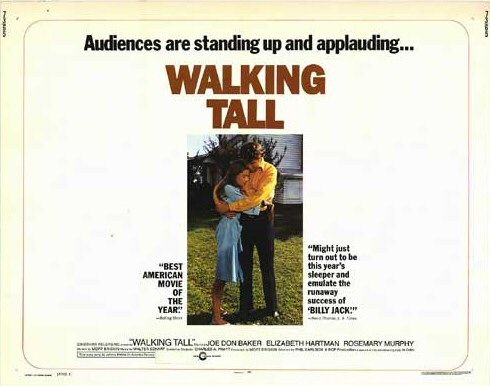
Embracing the Melodrama Part II #46: Walking Tall (dir by Phil Karlson)


Walking_Tall_(1973_film)About 50 minutes into the 1973 film Walking Tall (not to be confused with the 2005 version that starred Dwayne Johnson), there’s a scene in which newly elected sheriff Buford Pusser (Joe Don Baker) gives a speech to his deputies.  As the deputies stand at attention and as Pusser announces that he’s not going to tolerate any of his men taking bribes from the Dixie Mafia, the observant viewer will notice something out-of-place about the scene.

Hovering directly above Baker’s head is a big, black, almost phallic boom mic.  It stays up there throughout the entire scene, a sudden and unexpected reminder that — though the film opens with a message that we’re about to see the true story of “an American hero” and though it was filmed on location in rural Tennessee — Walking Tall is ultimately a movie.

And yet, somehow, that phallic boom mic feels oddly appropriate.  First off, Walking Tall is an almost deliberately messy film.  That boom mic tells us that Walking Tall was not a slick studio production.  Instead, much like Phil Karlson’s previous The Phenix City Story, it was a low-budget and violent film that was filmed on location in the south, miles away from the corrupting influence of mainstream, yankee-dominated Hollywood.  Secondly, the phallic implications of the boom mic erases any doubt that Walking Tall is a film about men doing manly things, like shooting each other and beating people up.  Buford does have a wife (Elizabeth Hartman) who begs him to avoid violence and set a good example of his children.  However, she eventually gets shot in the back of the head, which frees Buford up to kill.

As I said earlier, Walking Tall opens with a message telling us that we’re about to watch a true story.  Buford Pusser is a former football player and professional wrestler who, after retiring, returns to his hometown in Tennessee.  He quickly discovers that his town is controlled by criminals and moonshiners.  When he goes to a local bar called The Lucky Spot, he is unlucky enough to discover that the bar’s patrons cheat at cards.  Buford is nearly beaten to death and dumped on the side of the road.  As Buford begs for help, several motorists slow down to stare at him before then driving on.

Obviously, if anyone’s going to change this town, it’s going to have to be Buford Pusser.

Once he recovers from his beating, Buford makes himself a wooden club and then goes back to the Lucky Spot.  After beating everyone up with his club, Buford takes back the money that he lost while playing cards and $50.00 to cover his medical bills.  When Buford is put on trial for armed robbery, he takes the stand, rips off his shirt, and shows the jury his scars.  Buford is acquitted.

Over his wife’s objections, Buford decides to run for sheriff.  The old sheriff, not appreciating the competition, attempts to assassinate Buford but, instead, ends up dying himself.  Buford is charged with murder.  Buford is acquitted.  Buford is elected sheriff.  Buford sets out to clean up his little section of Tennessee.  Violence follows…

On the one hand, it’s easy to be snarky about a film like Walking Tall.  This is one of those films that operates on a strictly black-and-white world view.  Anyone who supports Buford is good.  Anyone who opposes Buford is totally evil.  Buford is a redneck saint.  It’s a film fueled by testosterone and it’s not at all subtle…

But dangit, I liked Walking Tall.  It’s a bit like a right-wing version of Billy Jack, in that it’s so sincere that you can forgive the film’s technical faults and frequent lapses in logic.  Walking Tall was filmed on location in Tennessee and director Phil Karlson makes good use of the rural locations.  And, most importantly, Joe Don Baker was the perfect actor to play Buford Pusser.  As played by Baker, Pusser is something of renaissance redneck.  He’s a smart family man who knows how to kick ass and how to make his own weapons.  What more could you ask for out of a small town sheriff?

In real life, Buford Pusser died in a mysterious car accident shortly after the release of Walking Tall.  Cinematically, the character of Buford Pusser went on to star in two more films.