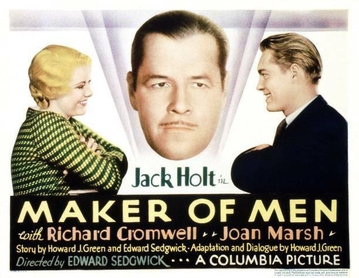
Maker Of Men (1931, directed by Edward Sedgwick)


Bob Dudley (Richard Cromwell) is the wimpy son of Coach Dudley (Jack Holt), who is in charge of the local college’s football team.  Bob joins the team out of a sense of family obligation but he turns out to be a cowardly player who would rather fumble the ball than take a hard hit.  Coach Dudley is disgusted with his son.  Bob’s girlfriend (Joan Marsh) dumps him.  Bob drops out of school and disappears for two years and no one seems to care. Then, on the day of a big game, Bob reappears playing for another college.  Despite Coach Dudley’s team being led by All-American Dusty Rhoades (John Wayne!), Bob leads the rival team to victory.  He’s won Coach Dudley’s respect.  Coach Dudley is probably going to get fired.

This was one of the weirdest sports films that I’ve ever seen.  Usually, you would expect Coach Dudley to bring out the best in his son or to understand that his son is just not meant to be a football player.  Instead, Bob is forced to drop out of college!  Bob returns just so he can defeat his father.  The slight Richard Cromwell is not a convincing football player.  On the other hand, John Wayne is a convincing football player but his role is tiny.  The movie is a little over an hour long and 20 minutes of that running time is taking up with grainy footage of an actual football game.

The best thing about the film?  It reminds us that everyone, even John Wayne, had to start somewhere.

Lisa Marie Reviews An Oscar Nominee: In Old Chicago (dir by Henry King)


One of the ten films to be nominated for Best Picture of 1937, In Old Chicago tells the story of the O’Leary family.

When we first meet the O’Learys, they’re riding across the Illinois frontier in a covered wagon.  After patriarch Patrick O’Leary (J. Anthony Hughes) is killed in a freak accident, Hazel O’Leary (Alice Brady) decides to settle in the bustling town of Chicago.  Hazel and her three sons build a life for themselves in a poor, largely Irish neighborhood known as the Patch.  Hazel makes a living as a laundress and soon, her home is big enough for her to take in a cow named Daisy.  Better not put that lantern too close to Daisy, Mrs. O’Leary….

As for the O’Leary boys, they all build a life of their own in 19th century Chicago.

Free-spirited Dion (Tyrone Power) hangs out in the saloon owned by sinister Gil Warren (Brian Donlevy) and, to his mother’s consternation, he falls for a singer named Belle (Alice Faye).  Eventually, Dion and Belle open up their own saloon and go into competition with Warren.  Dion soon emerges as one of the leaders of the Patch, a rogue with a charming smile and zero ethics but a total love for his family.

The youngest, Bob (Tom Brown), falls in love with a German immigrant named Gretchen (June Storey).  Bob asks Gretchen to marry him while Mrs. O’Leary’s cow stares straight at camera.

Finally, the oldest of the O’Leary boys is Jack (Don Ameche).  Jack become a crusading lawyer and eventually, he runs for mayor on a reform ticket.  With Dion’s help, Jack is able to defeat Gil Warren.  But now that Jack is mayor, he immediately sets his sights on tearing down the Patch and, in his words, “starting over.”

In Old Chicago has a two-hour running time and a lot happens in those two hours.  Not only is there all the drama between the brothers but also there’s a handful of production numbers featuring Alice Faye.  (Considering that she’s performing at a saloon in the slums of Chicago, it’s impressive that Belle can put on such an elaborate show.)  Of course, anyone with a knowledge of history knows that every minute of In Old Chicago is building up to the moment when Mrs. O’Leary’s cow kicks over that lantern and all the wooden buildings in Chicago go up in flames.  In Old Chicago is an early disaster movie and, talented cast aside, the main reason that anyone will be watching will be for the recreation of the Great Chicago Fire.  As flames roar around them and cattle stampede through the streets, hundreds of extras run for their lives.  As Alice Brady, Tom Brown, and Alice Faye stare off to the horizon, the city of Chicago explodes in front of them.  Even today, the scenes of the city on fire are impressive.

As for the rest of the film, I enjoyed the melodramatic excess of it all.  The stars weren’t exactly the most dynamic actors of the 1930s but Tyrone Power and Don Ameche were both handsome and likable enough to carry the film and it’s easy to see why In Old Chicago was, at the time of its production, the most expensive film ever made.  It’s a big film, with ornate sets, hundreds of extras, and elaborate production numbers.  It’s entertaining, even though I did occasionally find myself growing impatient as I waited for the fire to finally start burning.

One thing this film is not is historically accurate.  Not only is it now generally agreed that Mrs. O’Leary’s cow was innocent of starting the fire but Mrs. O’Leary’s son was never mayor of Chicago.  It is true that Chicago caught fire in 1871 and that the mayor turned to General Philip Sheridan (played here by Sidney Blackmer) for help in both putting out the fire and keeping order in the streets.  For the most part, though, In Old Chicago is total fiction.  That didn’t bother me but then again, I don’t live in Chicago.

In Old Chicago was nominated for Best Picture of the Year but lost to The Life of Emile Zola.  However, Alice Brady won the Oscar for Best Supporting Actress.

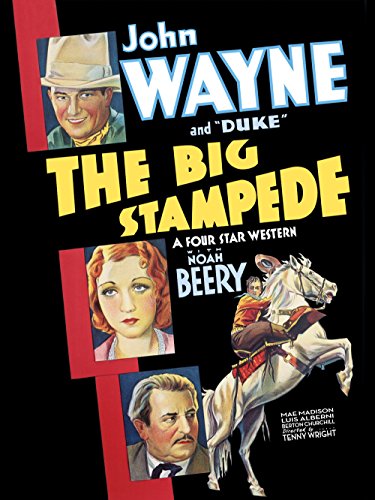
The Big Stampede (1932, directed by Tenny Wright)


On the New Mexico frontier, war is breaking out behind rancher Sam Chew (Noah Beery) and rustler Sonora Joe (Luis Alberni).  Both want to control the land and the cattle that graze upon it and innocent settlers are getting trapped in the middle!  The governor decides to send a young sheriff named John Steele to maintain order.  No sooner has Steele arrived then he meets a young woman (Mae Madison) and her father, who have both been attacked by and had their cattle stolen by Sam Chew.  After Sonora Joe and his gang save his life from Sam’s men, Steele realizes that Sam is more malicious and dangerous than Sonora Joe so he decides that the best way to handle the situation is to deputize Joe and team up with him to stop Sam and his men.  It’s a tall order but John Steele is just the man to handle it because John Steele is John Wayne!

This was one of the many B-westerns that the former Marion Morrison made in the decade before John Ford made him a star by casting him in Stagecoach.  Wayne was always a good hero, even in a 54-minute programmer like this one.  Though there is, as the title promises, an impressive stampede, Wayne is the main attraction here, with Noah Beery serving as a good heavy as always.  Perhaps the most interesting thing about this movie, if you’re a western or a John Wayne fan, is that Wayne’s horse is named Duke.  This was one of six films that Wayne made with Duke. Back in the 30s, the horses were often as a big a star as the men who rode them and, from the posters I’ve seen, it does appear that The Big Stampede was advertised as starring, “John Wayne and DUKE!”  At least Wayne was still able to get top billing.

The Big Stampede had previously been made as a silent film and the remake reuses a lot of old footage from the original.  John Wayne, needless to say, did not star in the original film, though he did wear the same costume that Ken Maynard wore in an attempt to keep people from noticing that the footage didn’t always match.  It’s not a totally successful ploy, though undemanding audiences in 1932 probably accepted it.  The Big Stampede would be remade one more time, in 1936, with Dick Foran taking the starring role.

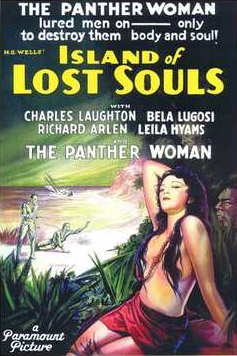
Horror Film Review: Island of Lost Souls (dir by Erle C. Kenton)


islandoflostsouls

In the 1932 film Island of Lost Souls, Ruth Thomas (Leila Hyams) has reason to be concerned.  She’s on the island of Samoa, awaiting the arrival of her fiancée, Edward Parker (Richard Arlen).  When Parker’s boat doesn’t show up, it can only mean one thing.  He’s been shipwrecked!  Did he survive or was he lost at sea?

Well, Ruth need not worry.  Parker did survive being shipwrecked.  He was picked up by a freighter carrying a wide selection of animals to an isolated island.  Unfortunately, when Parker complained about the way that Parker was abusing some of his admittedly odd-looking passengers, the captain responded by dumping Parker on that island as well.

On the island, Parker becomes the guest of Dr. Moreau (Charles Laughton) and his assistant, Montgomery (Arthur Hohl).  Parker also meets and finds himself becoming attractive to the seemingly naive Lota (Kathleen Burke).  Though Moreau seems to be a good host, Parker grows suspicious of him.  It turns out that there’s a room in Moreau’s compound, a room that Lota calls “the house of pain.”  At night, Parker can hear horrifying screams coming from the room.

Initially believing the Moreau is torturing the island’s natives, Parker soon discovers an even more disturbing truth.  Moreau has been experimenting with trying to transform animals into humans.  Lota, it turns out, was once a panther and the woods surrounding the compound are full of other Moreau creations.  Though Moreau claims that his intentions are benevolent, he rules his island like a dictator.  The animal-men are kept in line by the Sayer of the Law (Bela Lugosi) and any transgressions are punished in the House of Pain…

The Island of Lost Souls was the first cinematic adaptation of H.G. Wells’s The Island of Dr. Moreau.  (Perhaps the most famous adaptation came out in 1996 and is the subject of Lost Souls, a fascinating documentary that, I believe, can still be found on Netflix.)  I watched it last night on TCM and I have to admit that I had a mixed reaction to it.  On the one hand, the film’s atmosphere of mystery and danger is palpable and Charles Laughton’s performance definitely set a standard for all misguided scientists to follow.  The human-animals are fantastic creations and  the film’s ending still has some power.  Bela Lugosi’s performance of the Sayer of the Law was superior to his work as Dracula.  (As shown by both this film and Ninotchka, Lugosi was an outstanding character actor.)  Kathleen Burke also does a great job as Lota, which makes it all the more interesting that she was apparently cast as a result of winning a contest that was sponsored by Paramount Pictures.

(On a personal note, I always find it amusing that pre-code films always feature at least one scene of an actress removing her stockings, even if the scene itself has next to nothing to do with the rest of the film.  In this case, the legs belong to Leila Hyams.)

On the negative side, Richard Arlen is not a particularly interesting hero and, from a contemporary point of view, Island of Lost Souls is a rather slow-moving film.  Watching it today requires modern audiences to make a bit of an adjustment to their expectations.

With all that in mind, I still recommend Island of Lost Souls.  Watch it for Charles Laughton and Bela Lugosi.  Watch it as a valuable piece of cinematic history.

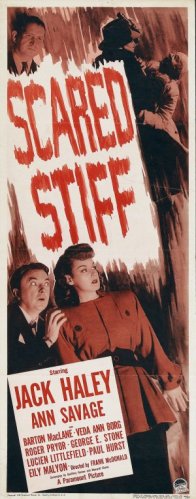
The Fabulous Forties #13: Scared Stiff (dir by Frank McDonald)


Poster_of_the_movie_Scared_Stiff

Last night, as a gentle rain fell outside, I watched the 13th film in Mill Creek’s Fabulous Forties box set, 1945’s Scared Stiff.  (The version in the box set appeared under the title Treasure of Fear, which was what the title was changed to when the film was later re-released.  However, the film was originally entitled Scared Stiff and that’s the title that I’m going to use.  Scared Stiff is just a better title and I happen to like the Scared Stiff film poster, featured above.  So, just remember that if you ever find yourself watching an old movie called Treasure of Fear, you’re actually watching Scared Stiff.)

As I attempted to watch Scared Stiff, I was reminded of some of the problems that occasionally come with watching a film that has slipped into the public domain.

On the one hand, the public domain is great because it makes it a lot easier to watch old movies.  And while it’s true that many public domain films aren’t exactly classics, there are a few gems to be found.  For instance, since I started watching the movies in the Fabulous Forties box set, I’ve discovered The Black Book, Trapped, and Jungle Book.

On the other hand, being in the public domain means that virtually anyone can duplicate and sell a copy of the film.  As a result, many of these films are available (and frequently viewed) in versions that are of an extremely poor quality and which have often been haphazardly edited.

That’s one reason why it’s going to be difficult for me to review Scared Stiff.  The version that I saw was, even for a public domain B-movie, rough.  The picture was slightly fuzzy and the sound quality was not the greatest.  I don’t think you can ever truly understand that importance of a clean soundtrack until you listen to a scratchy one.

As for Scared Stiff itself, it’s a comedic murder mystery and thankfully, it’s only 65 minutes long.  Jack Haley plays a reporter who covers chess tournaments for his uncle’s newspaper.  Unfortunately, Haley’s not a very good reporter so his frustrated uncle orders him to go to Grape City so that he can cover a beauty contest, apparently believing that there’s no way that Haley could possibly screw that up.

However, Haley manages to do just that.  He gets off the bus at Grape Center, instead of Grape City.  He finds himself stranded at an inn that’s run by two twins (both played by Lucien Littlefield).  The twins hate each other for reasons that aren’t clear.  However, they do possess a chess set that was once owned by Marco Polo!  One twin owns the white pieces while the other owns the black pieces!  Haley wants to buy all the pieces but things get complicated when it turns out that a gang of thieves are also in town and they want to steal the set for themselves.

But that’s not at all!  One of the passengers on the bus is found murdered and he has a chess piece in his hand.  Of course, everyone suspects Haley.  So, Haley has to get the chess pieces, clear his name, and hopefully get to Grape City before his uncle fires him.

Scared Stiff is way too frantic for its own good and I have a feeling that I would feel the same even if I had seen a version that didn’t sound scratchy or often look fuzzy.  That said, it is interesting to see Jack Haley, who is best known for being The Tin Man in The Wizard of Oz, play a human being.  Also of interest, to film noir fans, was that Haley’s girlfriend was played by Detour‘s Ann Savage.  Both Haley and Savage gave good performances but it was not enough to save this misbegotten little film.

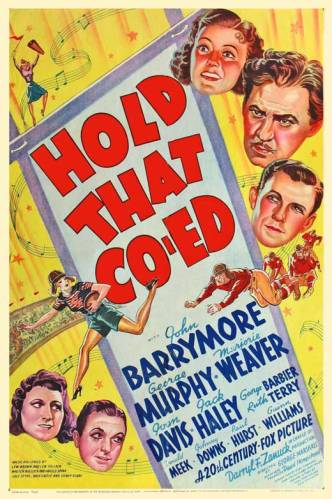
Shattered Politics #3: Hold That Co-Ed (dir by George Marshall)


hold-that-co-ed-movie-poster-1938-1020685724

“Americans will put up with bad government but they won’t stand for bad sportsmanship!” — A political consultant in Hold That Co-Ed (1938)

Rusty Stevens (George Murphy) is the new head football coach at State University.  (Which state?  We never learn for sure, though the implication is that it’s somewhere near Louisiana.)  From the minute that he arrives, Rusty discovers why State’s football program is so unheralded.  Not only are the majority of the students lazy and unmotivated but the college can’t even afford to buy the players uniforms.  The perpetually nervous Dean Thatcher (Donald Meek) is of no help when it comes to getting the university what it needs.  Even worse, the state’s Governor, Gabby Harrigan (John Barrymore), is running for the senate and he has sworn that he’s going to solve the state’s budget crisis by cutting the football program!

(Cue dramatic music.  Actually, not really.  There’s not a single dramatic moment to be found in Hold that Co-Ed.)

Well, what can Rusty be expected to do, other than lead all the students on a march down to the capitol building where they demand to see Gov. Harrigan.  However, Harrigan is busy giving an interview and he refuses to meet with the students.  Instead, he tells a fawning reporter how he is going to introduce a bill in the U.S. Senate that will guarantee all retired people, “Not one, not two, not three, but a sum of 400 dollars every month!”

After the reporter leaves, his cynical (Is there any other type?) secretary Marjorie (Marjorie Weaver) asks Harrigan how the government will ever be able to afford his plan.  Harrigan says that the government can’t but “isn’t it nice for” retired people “to have something to look forward to?”

(Gov. Harrigan sounds like he could be elected President in 2016.)

Meanwhile, the college students get rowdy in the front office and end up picking up the Governor’s aide, Wilbur (Jack Haley, who a year later would play The Tin Man in The Wizard Of Oz), and passing him around over their heads.  Naturally, this gets the attention of the press and suddenly, the fate of State’s football program is a campaign issue.

Upon discovering that most voters like football, Harrigan declares himself to be State’s biggest supporter and soon starts to play a very prominent role in the football program.  Not only does he arrange for Lizzie Olsen (Joan Davis) to become the only female to play on a college football team (When informed that Lizzie playing is against the rules, Harrigan replies, “I’ll change them!”) but he also pays players to come to State.  (When informed that paying players is against the law, Harrigan replies, “I’ll change the law!”)

It all eventually leads to Rusty romancing Marjorie and a bet between Harrigan and his opponent in the Senate race in which the outcome of the big game will determine who withdraws from the race.

Because of course it does.

First released in 1938, Hold That Co-Ed is one of those strange films that seems like it could only have come out in the 1930s.  Obviously, it’s primarily a college comedy.  Yet, at the same time, it’s also a musical which features Rusty randomly breaking out into song and dancing.  And then, on top of that, it’s a political satire.  (Reportedly, Harrigan was based on Huey Long, who also served as the basis for a far more sinister character in All The King’s Men.)

And, in its way, Hold That Co-Ed is a fun, little time capsule.  If anything, the film’s political satire feels just as relevant today as it probably did when it was first released.  As playing in grand theatrical fashion by John Barrymore, Gabby Harrigan could be any number of pompous, say-whatever-you-have-to-say demagogues.

What makes this film particularly interesting is just how much it’s on Harrigan’s side.  Whereas most political films always feel the need to at least pretend to be on the side of “good” government, Hold that Co-Ed cheerfully celebrates Harrigan’s casual corruption.  In this shrill day and age, there’s something refreshing about seeing a film that passes no judgment.

And speaking of politics, John Barrymore was never elected to political office.  However, the film’s other star, George Murphy, was.  He served in the U.S. Senate from 1965 to 1971.
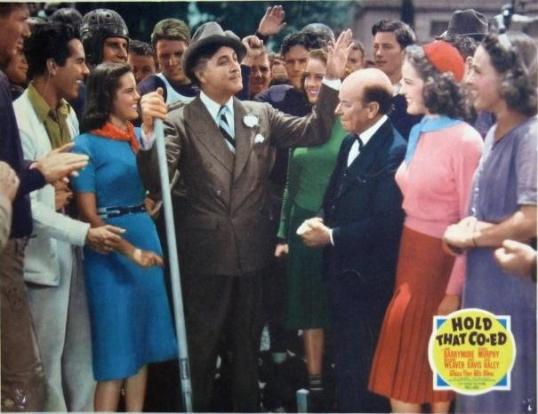
HoldthatCoed

Governor Gabby Harrigan (John Barrymore) in Hold That Co-Ed