Late Night Retro Television Review: Highway to Heaven 3.21 “Parents’ Day”


Welcome to Late Night Retro Television Reviews, a feature where we review some of our favorite and least favorite shows of the past!  On Thursdays, I will be reviewing Highway to Heaven, which aired on NBC from 1984 to 1989.  The entire show is currently streaming on Tubi and several other services!
This week, Mark and Jonathan become narcs!

Episode 3.21 “Parents’ Day”

(Dir by Michael Landon, originally aired on February 25th, 1987)

Robert Culp plays one of the worst characters ever in this week’s episode of Highway to Heaven.

Culp plays Ronald James, a news anchor who is known for his fiery anti-drug editorials.  His teenage son, David (Lance Wilson-White), is a student at an exclusive boarding school.  When a joint is found in David’s dorm room, Ronald comes down hard on his son.  Ronald says David should be ashamed of himself.  Ronald says that David has brought dishonor to the family.  Ronald grounds David for four weeks.

After attending an anti-drug lecture delivered by newly hired narcotics detective Mark Gordon, David decides to call the police and tell them about the cocaine that is hidden in his family’s garage.  The cocaine belongs to Ronald but, when Ronald is confronted by the police, he announces that it must belong to David.  When it becomes obvious that Ronald’s job is at risk, he tells David to take the blame.  David says he’ll do it if Ronald promises to stop using.  Ronald agrees.

David takes the blame….

….and Ronald keeps on using!

Seriously, what a scumbag!

While Ronald is disappointing everyone, Jonathan — who is also working as a narcotics detective — pressures the local boarding school drug dealer, Brad Dietrich (Bill Calvert), to stop dealing.  Brad laughs off Jonathan’s threat.  Come back with a warrant, Brad says.  Then Brad’s girlfriend overdoses on the cocaine that Brad gave her.

Finally, after David nearly drinks himself to death, Ronald goes on the news and admits that he’s a drug addict.  He then says that parents have to step up and do a better job.  That’s fine, Ronald, but you know what?  YOU’RE A DRUG ADDICT WHO FRAMED YOUR OWN SON!  You don’t get to be a moral authority!

As you can probably guess, there was not a subtle moment to be found in this episode.  On the one hand, the message was obviously heartfelt.  That’s kind of a given when it comes to Highway to Heaven.  With every episode, it’s obvious that Michael Landon was sincerely trying to make the world a better place.  On the other hand, this episode was so heavy-handed that it sometimes verged on camp.  Culp was very believable as someone who was totally coked up.  The kid playing his son, on the other hand, was considerably less convincing.  It also doesn’t help that there’s a massive hole in the middle of the plot.  If the police were really unsure about who had brought the cocaine into Ronald’s house, they could have just drug-tested both Ronald and David to see who was snorting.  As well, seen from a modern perspective, it’s hard to really buy into the show’s argument that parents and children should be constantly calling the police on each other.  Today we know that the attempt at a zero tolerance war on drugs made the situation even worse.  This episode’s suggestion that snitching on loved ones is the answer reminded me of the worst excesses of the COVID era.

As I mentioned earlier, the episode ends with Ronald making an impassioned plea to parents to get serious about teenage drug use.  Hopefully, he was arrested as soon as the cameras were turned off.


Late Night Retro Television Review: Highway to Heaven 2.23 “Children’s Children”


Welcome to Late Night Retro Television Reviews, a feature where we review some of our favorite and least favorite shows of the past!  On Thursdays, I will be reviewing Highway to Heaven, which aired on NBC from 1984 to 1989.  The entire show is currently streaming on Freevee and several other services!

This week, Jonathan and Mark find themselves in a Douglas Sirk-style melodrama.

Episode 2.23 “Children’s Children”

(Dir by Victor French, originally aired on April 30th, 1986)

When I watched this episode, I saw that the script was credited to David Thoreau and I immediately assumed that it had to be a pseudonym for the actual writer.  Fortunately, for once, I actually did some research and I discovered that the writer’s name actually was David Thoreau.  He wrote a few scripts that were produced in the 80s and 90s and, in fact, this was the first of seven scripts that he wrote for Highway to Heaven.  He’s also credited as writing the screenplay for the classic beach volleyball film, Side Out.

As for this episode, it finds Mark and Jonathan working at a home for unwed mothers.  Just the term “home for unwed mothers” brings to mind the 50s melodramas of Douglas Sirk and I found myself thinking about just how old-fashioned Highway to Heaven must have seemed even in the 80s.  I did a google search and I discovered that homes from unwed mothers do still exist, though they’re now called “maternity homes.”

The manager of the home for unwed mothers is Joyce Blair (Bibi Besch), who finds herself being hounded by a reporter named Dan Rivers (Robert Lipton).  Dan is determined to take Joyce down and, to do so, he brings up a past incident in which Joyce was arrested.  Dan twists the facts to make Joyce look like a criminal and soon, Joyce finds that she might not be able to keep the home open.  Why is Dan doing this?  Like most reporters on Highway to Heaven, he’s just plain evil.  But when one of the girls at the home suggests that Dan might be the father of her child, Dan learns what it’s like to be falsely accused.

Meanwhile, evil businessman Jack Brent (James T. Callahan) hopes for a chance to foreclose on the home so that he can bulldoze it and replace it with condominiums.  (Bad guys in the 80s always wanted to build condos.)  But how will he react when he discovers that his teenage son (Scott Coffey) is going to be a father and that the girl he impregnated in currently living at the home?

This episode is the type of episode that most people think of when they dismiss Highway to Heaven as just being an old-fashioned and slightly preachy melodrama.  There’s not a single subtle moment or particularly nuanced moment to be found in this particular episode.  It’s note quite as heavy-handed as that episode where Mark begged the President to talk to the Russians and reduce amount of nuclear missiles but it’s close.

Late Night Retro Television Review: CHiPs 2.2 “The Volunteers”


Welcome to Late Night Retro Television Reviews, a feature where we review some of our favorite and least favorite shows of the past!  On Mondays, I will be reviewing CHiPs, which ran on NBC from 1977 to 1983.  The entire show is currently streaming on Freevee!

This week, we’ve got ourselves a convoy!

Episode 2.2 “The Volunteers”

(Dir by John Florea, originally aired on September 23rd, 1978)

After a high-speed chase causes a robbery suspect to crash his car into a chemical storage facility (which subsequently explodes), three truckers have to get their trucks full of chlorine gas to the next available facility.  Unfortunately, it’s a 170-mile drive over rough terrain and it’s a very hot day.  If the gas gets to hot, it’ll explode.  If It doesn’t get to the storage facility in time, it’ll explode.  In fact, it appears that just about anything can make chlorine gas explode.  Californians might love chlorine for their pool but they don’t want it in the air.

Getraer assigns Ponch, Baker, Baricza, and Jane Turner to escort the trucks to the facility.  Jane Turner (Rana Ford) is a new member of the highway patrol.  She drives a squad car and she’s the first woman and only the second black person who we’ve seen working for the highway patrol on this show.  She doesn’t really do much in this episode and, about halfway through, she breaks off from the main group to help deal with a highway pile-up.  For that matter, Getraer and Baricza end up vanishing as well.  As usual, it’s all on Ponch and Baker.

Despite the danger of a chemical spill killing the population of Los Angeles county, Ponch spends most of this episode trying to get laid.  The episode opens with him leering at a jogging stewardess (Anna Upstrom) and then bragging about how he has a date with her later that night.

“She doesn’t smoke, drink, or dance,” Ponch says.

“What are you two going to do?” Baker earnestly asks.

Ponch arches his eyebrow and grins.

But Ponch is soon distracted by one of the truck drivers, a woman named Robbie Davis (Katherine Cannon), who is quick to yell that not only can she drive a truck but she can vote as well.  Ponch arches his eyebrow and grins.  Baker gets in on the action by saying, “Prettiest little truck driver I’ve ever seen.”

Robbie’s father (Tige Andrews) and the other trucker (Sam Brodie) all totally think Robbie should hook up with Ponch but they’re still amused when, late in the episode, Ponch accepts a ride from a blonde in a convertible.  Ponch arches and eyebrow and grins as he gets in the car.  WE GET IT, PONCH!

It’s not easy transporting chlorine gas.  Along with rough desert terrain, there’s also a group of beer-drinking rednecks who drive by in a pickup truck and threaten to shoot one of the tanks.  All of that drunk driving leads to another multi-car pile-up.  For some reason, one of the vehicles in the pile-up was transporting a tiger, which promptly gets loose and enters a grocery store.  Ponch and Baker grab raw meat from the butcher’s station and use it to trick the tiger into entering an office.  After they shut the door, the owner of the store yells at them for wasting meat.  There’s also a town puts up a roadblock to keep the trucks from coming through because they don’t want chlorine gas getting into the air.  And then there’s an avalanche, which causes chlorine gas to leak out of Robbie’s truck, sending her to the hospital.

Considering everything that happens in this episode, it’s odd that it all feels rather boring.  The best episodes of CHiPs focus on fast motorcycles and beautiful scenery.  This episode featured slow-moving trucks and the desert.  Bleh.  I hate the desert.  This episode also featured a lot of interaction between Robbie, her father, and their friend.  In fact, they were so prominently featured that it wouldn’t surprise me if this episode was meant to be a backdoor pilot for a trucking show.  (This episode aired in 1978, which was a big year for trucker movies.)  But the Davis family just wasn’t that interesting.

This episode didn’t really capture my attention.  Hopefully, next week will see a return of fast bikes and nice scenery.

Bronson’s Back!: Death Wish II (1982, directed by Michael Winner)


To quote John McClane, “How can the same shit happen to the same guy twice?”
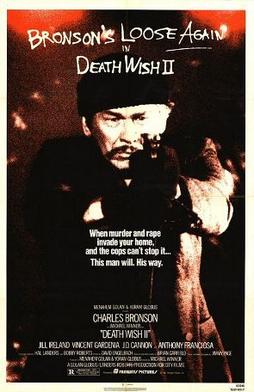
It has been eight years since Paul Kersey (Charles Bronson) lost his wife and single-handedly cleaned up New York City.  The first Death Wish ended with Paul in Chicago, preparing to gun down a new group of criminals.  I guess Chicago didn’t take because, at the start of Death Wish II, Paul is in Los Angeles and he’s working as an architect again.  He has a new girlfriend, a bleeding heart liberal reporter named Geri (Jill Ireland, Bronson’s real-life wife) who is against the death penalty and who has no idea that Paul used to be New York’s most notorious vigilante.  Having finally been released from the mental institution, Carol (Robin Sherwood) is living with her father but is now mute.

Crime rates are soaring in Los Angeles and why not?  The legal system is more concerned with the rights of the criminals than the victims and Paul has retired from patrolling the streets.  But when a group of cartoonish thugs rape and kill his housekeeper and cause his daughter to fall out of a window while trying to escape them, Paul picks up his gun and sets out for revenge.

Death Wish II was not the first sequel to Death Wish.  Brian Garfield, the author of the novel on which Death Wish was based, never intended for Paul to be seen as a hero and was disgusted by what he saw as being the film’s glorification of violence.  As “penance,” he wrote a sequel called Death Sentence, in which Paul discovered that he had inspired an even more dangerous vigilante.  When Menahem Golan and Yoram Globus bought the rights to produce a second Death Wish film, they decided not to use Garfield’s sequel and instead went with a story that was co-written by Golan.

It’s the same basic story as the first film.  Again, Paul is a mild-mannered architect who is a liberal during the day and a gun-toting reactionary at night.  Again, it’s a home invasion and a death in the family that sets Paul off.  Again, Paul gets help from sympathetic citizens who don’t care that the police commissioner (Anthony Franciosa) wants him off the streets.  Jeff Goldblum played a rapist with a switch blade in the first film.  This time, it’s Laurence Fishburne who fills the role.  (Fishburne also carries a radio, which he eventually learns cannot be used to block bullets.)  Even Detective Ochoa (Vincent Gardenia) returns, coming down to Los Angeles to see if Paul has returned to his old ways.

The main difference between the first two Death Wish films is that Death Wish II is a Cannon film, which means that it is even less concerned with reality than the first film.  In Death Wish II, the criminals are more flamboyant, the violence is more graphic, and Paul is even more of a relentless avenger than in the first film.  In the first Death Wish, Paul threw up after fighting a mugger.  In the second Death Wish, he sees that one of the men who raped his daughter is wearing a cross, leading to the following exchange:

“Do you believe in Jesus?”

“Yes, I do.”

“Well, you’re going to meet him.”

BLAM!

Death Wish II is the best known of the Death Wish sequels.  It made the most money and, when I was a kid, it used to show on TV constantly.  The commercials always featured the “You believe in Jesus?” exchange and, every morning after we saw those commercials, all the kids at school would walk up to each other and say, “You believe in Jesus?  Well, you’re going to meet him.”  It drove the teachers crazy.

Overall, Death Wish II is a lousy film.  Michael Winner, who was always more concerned with getting people into the theaters than anything else, directs in a sledgehammer manner that makes his work on the first film look subtle.  He obscenely lingers over every rape and murder, leaving no doubt that he is more interested in titillating the audience than getting them to share Paul’s outrage.  The script is also weak, with Geri so poorly written that she actually gets more upset about Paul going out at night than she does when she learns that Paul’s daughter has died.  When Paul sets out to track down the gang, his method is to merely wander around Los Angeles until he stumbles across them.  It doesn’t take long for Paul to start taking them out but no one in the gang ever seems to be upset or worried that someone is obviously stalking and killing them.

There are a few good things about the film.  Charles Bronson was always a better actor than he was given credit for and it’s always fun to watch Paul try to balance his normal daily routine with his violent night life.  Whenever Geri demands to know if he’s been shooting people, Paul looks at her like he is personally offended that she could possibly think such a thing.  Also, the criminals themselves are all so cartoonishly evil that there’s never any question that Paul is doing the world a favor by gunning them down.  For many otherwise sensible viewers, a movie like Death Wish II may be bad but it is also cathartic.  It offers up a simple solution to a complex issue.  In real life, a city full of Paul Kerseys would lead to innocent people getting killed for no good reason.  But in the world of Death Wish II, no one out after nightfall is innocent so there’s no need to worry about shooting the wrong person.

Finally, the film’s score was written by the legendary Jimmy Page.  The studio wanted Isaac Hayes to do the score but Winner asked his neighbor, Page.  Page took the film, retreated into his studio, and returned with a bluesy score that would turn out to be the best thing about the movie.  The soundtrack was the only one of Page’s solo projects to be released on Led Zeppelin’s record label, Swan Song Records.

Tomorrow, Bronson returns with Death Wish 3!

Horror Film Review: Cape Fear (dir by J. Lee Thompson)


There are two versions of Cape Fear out there.

The one that most people seem to know and which regularly shows up on cable is the 1991 version.  This version was directed by Martin Scorsese and features Oscar-nominated performances from Robert De Niro and Juliette Lewis.  This is the version that has De Niro speaking in a broad Southern accent and attacking people while speaking in tongues.  If you’ve ever watched a rerun of an old sitcom and wondered why the laugh track was going wild at the sight of a tattooed prisoner lifting weights in a cell while portentous music boomed in the background, it’s because you were watching a parody of Scorsese’s Cape Fear.

That, however, is not the first version of Cape Fear.

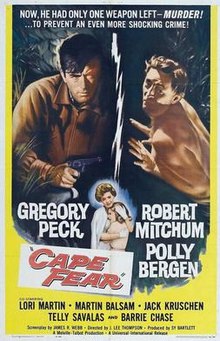
The first version of Cape Fear came out in 1962.  It was a black-and-white film that was directed by J. Lee Thompson.  In this version, the recently released rapist, Max Cady, is played by Robert Mitchum.  Sam Bowden, the attorney that Cady blames for his incarceration, is played by Gregory Peck.  Whereas the Scorsese version was highly stylized, the original Cape Fear is brutally straight forward.  (While Scorsese’s Cape Fear goes on for over two hours, the original Cape Fear tells its story in a brisk 100 minutes.)  While I think that Scorsese’s Cape Fear has its strong points, the original Cape Fear is superior in almost every way.

The original is certainly far more frightening than the remake.  What the original may lack in stylization, it makes up for in plausibility.  It’s scary because you can imagine everything in the film actually happening.  Robert Mitchum and Gregory Peck may both be iconic film stars but they’re also believable as human beings.

For modern audiences, it’s easy to smirk at Peck with his upright image and his sonorous voice but what made Peck a great actor was his ability to make it all seem natural.  Peck never seemed like he was acting like an honest man who always tried to do the right thing.  Instead, he simply was that man.  It’s perhaps significant that Peck played Sam Bowden the same year that he played another honest lawyer, Atticus Finch, in To Kill A Mockingbird.  The only real difference between them is that, whereas Atticus was always confident and sure of himself, Sam is frequently helpless.  He knows that Max is stalking him and his family and he’s just as aware that there’s nothing he can do about it.  When Max rapes a woman (Barrie Chase) that he meets at a bar, she refuses to testify against him.  When Sam’s dog turns up dead, everyone knows that Max killed him but there’s no way to prove it.  When Sam hires three men to intimidate Max, Max beats them up and promptly tries to get Sam disbarred.  When Sam finally resorts to plotting Max’s murder, we’re seeing Atticus Finch pushed beyond his limit.

As for Robert Mitchum, his animalistic performance is frightening precisely because it feels very real.  Everyone has known a Max Cady, even if they didn’t realize it at the time.  Max gives a fiercely physical performance, often appearing shirtless and strutting through his scenes with a sexual arrogance that’s both frightening and, at times, far more tempting than anyone would want to admit.  The scenes in which Max attacks Barrie Chase and Polly Bergen (who plays Peck’s wife) are absolutely terrifying but, for me, the most disturbing moments in Cape Fear are the moments when Max is silent.  Even when he’s not speaking, Mitchum allows you to see every depraved thought going through is head.

What’s the scariest moment for me?  When the camera catches Max watching Sam’s teenage daughter (Lori Martin).  It’s not just that I know what’s going on in Mitchum’s mind as he stares at her.  It’s because I know what it’s like to be watched.  It’s a scene that’s unsettling because it makes me consider just how many Max Cadys are out there right now.

The battle between Max and Sam is a fascinating one.  In prison, Max studied enough law to become as knowledgeable about how to manipulate it as Sam.  Under pressure, Sam grows more violent and more willing to circumvent his oath to uphold the same law that Max is now using against him.  It makes for a frightening  film, one that will stick with you long after you watch it.

Horror on TV: The Twilight Zone 2.18 “The Odyssey of Flight 33”


TheTwilightZoneLogo

Remember how this morning’s movie — Robot Monster — featured dinosaurs?

Well so does tonight’s episode of The Twilight Zone!  In The Odyssey of Flight 33, a commercial airline flight somehow flies straight into the past, where they see …. dinosaurs!  Now, I’ll be honest here.  These are not dinosaurs like the dinosaurs in Jurassic World.  But I imagine for 1961, those dinosaurs were pretty impressive!

And this episode holds up as well.  I especially love the ambiguous ending.

The Odyssey of Flight 33 originally aired on February 24th, 1961.