Icarus File No. 22: Revolution (dir by Hugh Hudson)


1985’s Revolution opens on July 4th, 1776.  The Declaration of Independence has just been published.  The streets are full of people celebrating.  A statue of King George is pulled down.  In her carriage, the wealthy Mrs. McConnahay (Joan Plowright) turns up her nose to the enthusiastic rebels, including the fanatical Liberty Woman (Annie Lennox).  Mrs. McConnahay’s daughter, Daisy (Nastassja Kinski) is intrigued by this idea of freedom and equality.

Fur trader Tom Dobbs sails his boat into Hudson Harbor.  Tom is Scottish, illiterate, and very much a man of the 18th Century.  However, he’s played by Al Pacino, who was none of those things.  After Revolution was released to desultory reviews, Pacino took four years off from the movies and watching this film, one can see why.  Pacino is miscast as Dobbs and, as a result, he gives the type of truly bad performance that can only be given by a great actor.  Unable to disguise the fact that he had the accent of a modern-day New Yorker, Pacino resorts to mumbling the majority of his lines.  Tasked with playing a character who has no idea how to deal with the history-making events in which he finds himself, Pacino alternates between a blank look and with bulging his eyes like a madman, proving that it’s far more difficult to play an uneducated character than an educated one.  Why cast Pacino, who can be one of our most exciting actors, as a character who can barely speak and who has neither the intensity of Michael Corleone or the subversive wit of Tony Montana?  Due to Pacino and Kinski having zero chemistry, the scenes where Tom falls in love with Daisy are almost painful to watch.

The film follows Tom as he and his son, Ned (Simon Owen when the film begins, Dexter Fletcher by the time the action moves to Valley Forge), as they find themselves conscripted into the Revolutionary Army.  Eventually, Ned is abducted into the British army and serves as a drummer boy under the sadistic watch of Sgt. Major Peasy (Donald Sutherland).  The idea behind the film isn’t a bad one.  It attempts to portray the American Revolution through the eyes of the average citizen.  Instead of focusing on the Founding Fathers, Revolution tries to tell the story of the everyday people who found themselves in the middle of the war.  Tom loses his boat and (temporarily) he loses his son.  Fortunately, this is one of those films where people are constantly running into each other by chance, regardless of whether it makes any sense or not.  Daisy goes from seeing Tom in New York to randomly coming across him in a field to eventually finding him in Valley Forge.  It’s not because she’s specifically looking for him.  Instead, he just happens to be there.

Why does Revolution fail?  A lot of it comes down to Pacino’s performance, though Pacino certainly isn’t the only talented actor to give a not-quite good performance in Revolution.  (Donald Sutherland has never been more wasted in a film.)  The script is full of dialogue like, “My mouth belongs where I place it.”  (Pacino gets stuck with that one.)  Hugh Hudson directs in a leaden manner.  Towards the end of the film, there is one brilliant sequence where Tom wanders through the streets of New York and, for a few minutes, the film comes to like with a spontaneity that was previously lacking.  Unfortunately, it’s just one sequence in a very long movie,

To be honest, we could use some good films about the American Revolution and I’m not talking about elitist nonsense like Hamilton.  No taxation without representation.  It’s still a good message for us all.

Previous Icarus Files:

  1. Cloud Atlas
  2. Maximum Overdrive
  3. Glass
  4. Captive State
  5. Mother!
  6. The Man Who Killed Don Quixote
  7. Last Days
  8. Plan 9 From Outer Space
  9. The Last Movie
  10. 88
  11. The Bonfire of the Vanities
  12. Birdemic
  13. Birdemic 2: The Resurrection 
  14. Last Exit To Brooklyn
  15. Glen or Glenda
  16. The Assassination of Trotsky
  17. Che!
  18. Brewster McCloud
  19. American Traitor: The Trial of Axis Sally
  20. Tough Guys Don’t Dance
  21. Reach Me

Film Review: A Dry White Season (dir by Euzhan Palcy)


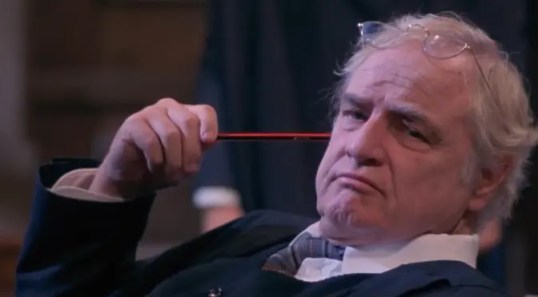
In 1990, Marlon Brando received his final Academy Award nomination when he was nominated for his supporting performance in 1989’s A Dry White Season.

Brando played Ian McKenzie, a human rights lawyer who lives and work in South Africa at the height of the Apartheid regime.  When we first see McKenzie, he’s sitting in his office and complaining about how all the flowers surrounding him have given him a permanent allergy.  When Ben Du Toit (Donald Sutherland) explains that he’s trying to learn the truth about why his gardener and his gardener’s son both died in the custody of South Africa’s “special branch,” McKenzie replies that bringing the case would be a waste of time.  McKenzie makes several dismissive comments about the case and tells Du Toit that pursing the matter would lead to Du Toit becoming a pariah himself.  Only when Du Toit says that he’ll just find another lawyer to pursue the manner does McKenzie agree to take the case.  His comments may have seemed callous but they were McKenzie’s way of testing Du Toit’s commitment to actually getting to the truth.

Up until the death of his gardener, Ben Du Toit was someone who blindly believed in the system.  A former rugby star and a teacher, Ben grew up in South Africa and is proud to call himself a “true African.”  (In one of the film’s best scenes, Ben’s driver, Stanley — played by Zakes Mokae, — informs Ben that being an African in South Africa means not being allowed to vote and having to carry identification papers everywhere with him.)  When the gardener’s son is first arrested, Ben repeatedly says, “He must have done something.”  When Ben’s gardener is arrested, Ben believes that it’s all just a terrible mistake and that he’ll be released soon.  Even after the gardener is killed, Ben initially believes the official story that the death was a suicide.  It’s only after Stanley takes Ben to the funeral home and shows him the gardener’s tortured body that Ben finally comes to realize that he was tortured to death by Captain Stolz (Jurgen Prochow).

Still, Ben is naive enough to assume that McKenzie will be able to get some sort of justice.  In court, McKenzie easily exposes the flaws in Stolz’s story.  When Stolz claims that the dead man’s injuries were the result of the man throwing himself against the bars of his cell, McKenzie mentions that the man’s back was injured and then asks if he was throwing himself backwards.  Stolz smirks and says that the man was “an animal.”  McKenzie may be a brilliant lawyer but it’s a foregone conclusion that he’s going to lose the case.  Stolz is exonerated and the expression on McKenzie’s face is one that indicate that he is not surprised at all.

It’s a small role.  Brando gets less than ten minutes of screentime but he makes perfect use of them and shows that, even in the latter half of his career, Brando could still give a good performance when he cared about the material.  Both Brando and Susan Sarandon took small roles in this anti-Apartheid drama because they believed in the message.  Sarandon’s casting is a bit distracting.  She never becomes the journalist she’s playing, instead she just seems like a movie star lending her name to a cause that she believes in.  But Brando becomes Ian McKenzie and he expertly reveals the absurd lengths to which the Apartheid government will go to excuse its actions.

The majority of the film deals with Ben Du Toit and his slow-awakening about the truth of the country that he calls home.  Upon realizing the truth about the country’s government and its actions, Du Toit declares that he can no longer go back to being who he once was and it costs him his family, his home, and ultimately his life.  Donald Sutherland does a wonderful job, portraying Du Toit’s growing understanding of what’s actually happening in South Africa.  Wisely, the film doesn’t portray Du Toit as being a saint.  It fully understands that Du Toit only started to care about Apartheid when it effected somebody that he knew and fortunately, Stanley is always there to call Du Toit out whenever he starts to forget about his own role in supporting the system that he now opposes.  It’s a powerful and heartfelt film, one that is well-known for Brando’s performance but works just as well when Brando is off-screen as well.

A Movie A Day #28: Scandal (1989, directed by Michael Caton-Jones)


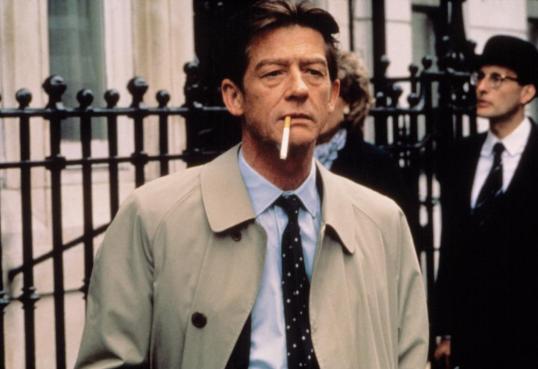
scandal-posterLondon.  1961.  Doctor Stephen Ward (played by John Hurt) is an artist and an osteopath.  He counts among his patients some of the most distinguished men and women in British society, including the Minister of War, John Profumo (Ian McKellen).  After meeting two young dancers, Christine Keeler (Joanne Whalley) and Mandy Rice-Davies (Bridget Fonda), Stephen becomes their mentor, the Henry Higgins to their Eliza Doolittle.
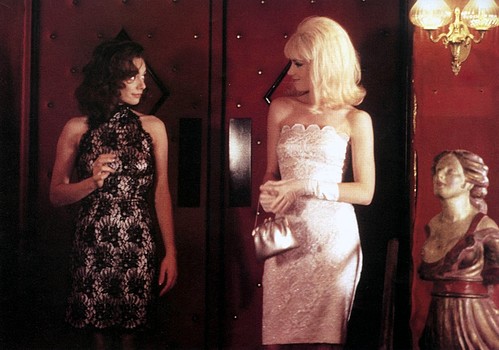
Under Stephen’s watchful eye, both Christine and Mandy are soon having affairs with some  of the most powerful members of Harold Macmillan’s Conservative government.  Christine becomes the mistress of both Profumo and KGB agent, Yevgeny Ivanov (Jeroen Krabbe), along with maintaining off-and-on relationships with drug dealer Johnny Edgecombe (played by singer Roland Gift) and musician Lucky Gordon (Leon Herbert).

When a disagreement leads to Johnny slashing Lucky’s face and then getting arrested for firing a gun at Stephen’s flat, the public learns the details of Christine’s affair with Profumo.  With the scandal rocking the British government, Stephen is a convenient scapegoat and soon finds himself on trial, charged with making a living off of “immoral earnings.”

Based on the real life scandal that led to the eventual fall of Harold Macmillan’s government, Scandal is remarkably faithful to the facts of the Profumo Affair, even if it did leave out some of the more interesting allegations.  (For instance, no mention is made of an alleged encounter between Mandy Rice-Davies and President Kennedy.)  Though it may seem tame by today’s standards, when Scandal was first released in 1989, it was considered to be something of a scandal itself and it initially got an X rating when it was released in the United States.  (The scandal over Scandal is one of the things that led to the MPAA adopting the NC-17 rating to distinguish between films for adults and “adult” films.  Of course, it didn’t work as a potential NC-17 still carries the same stigma as the X rating did.)

scandal

Scandal holds up well as both a recreation of London on the verge of the sexual revolution and a look at contrast between private and public mores.  Both Joanne Whalley and Bridget Fonda are excellent in the roles of Christine and Mandy.  Fonda gets to deliver the most famous line of the whole Profumo Affair when Mandy is told that Lord Astor has denied having had an affair with her.  “He would, wouldn’t he?” she says.  After I watched Scandal last night, I did some checking and I discovered that Bridget Fonda has not made a film since 2002.  She is missed.

Not surprisingly, Scandal‘s best performance comes from John Hurt, who plays Stephen Ward as a naive and well-meaning social butterfly who ultimately gets in over his head and pays a steep price for trusting that his friends would remain his friends.  Scandal is just one of many movies that proves what a great talent was lost when the world lost John Hurt.

RIP.

SCANDAL, John Hurt, 1989