Doctor Who — The Three Doctors (1972-1973, directed by Lennie Manye)


For the tenth season of Doctor Who, the BBC knew that they needed to start things off with a bang.  The first serial of season ten, The Three Doctors, brought together the first three actors who had played the Doctor.

A crisis was needed to explain why the Time Lords would decide to break their owns laws by bringing the Second Doctor and then the First Doctor out of their respective time zones.  Writers Dave Martin and Bob Baker came up with a story about the Doctor’s homeworld having its energy drained through a black hole.  If Gallifrey is destroyed then all of time and space will unravel.  (Everyone who has seen an episode of the original Doctor Who knows the drill.)  The villain is Omega (Stephen Thorne, who also played Azal in The Daemons), the first Time Lord, who has never forgiven his fellow Time Lords for abandoning him in an anti-matter universe that looks like a quarry.  The story is silly in the way that Doctor Who often could be but I think anyone watching will understand that the story is not that important.  Omega, the black hole, the energy blob that is sent to Earth to capture the Third Doctor, all of it was really just an excuse to bring back Patrick Troughton and William Hartnell.

Hartnell does not get to do much.  He was in increasingly poor health when he returned as the First Doctor and was also suffering from memory problems.  Sadly, this prevented him from sharing the same physical space as Troughton and Jon Pertwee.  Instead, it’s explained that the First Doctor is caught in a time eddy and can only communicate via the TARDIS’s viewscreen.  Even if he isn’t physically present, the First Doctor reveals himself to be the smartest of the three Doctors.  When he isn’t scolding the Second and Third Doctors, he’s figuring out how to enter Omega’s universe.  It’s not always easy to watch Hartnell looking frail and clearly reading some of his lines from cue cards but, even when ill, he still had the natural authority that he brought to the first two and a half  seasons of Doctor Who.

Patrick Troughton and Jon Pertwee are a delight to watch.  Their bickering is one of the highlights of the serial and both Troughton and Pertwee appear to have really enjoyed their scenes together.  The show also gets mileage from including the Brigadier (Nicholas Courtney) and Sgt. Benton (John Levene) along with the three Doctors.  I’ve always enjoyed how both of them come to accept the strangest of things with barely a shrug.  This is the episode where Benton enters the TARDIS and, when the Third Doctor asks if Benton’s going to point out that it’s bigger on the inside than the outside, replies, “It’s pretty obvious, isn’t it?”

The Three Doctors is hardly a perfect Doctor Who adventure.  (If any adventure needed the presence of the The Master, it was this one.)  It is, however, a tribute to the men who played the first three Doctors and the role they all played in making the show an institution.  The Three Doctors was also the final acting role of William Hartnell, who passed away two years after the serial was broadcast.

Doctor Who — The War Games (1969, directed by David Maloney)


The War Games is an episode of firsts and lasts.

It featured the last regular appearance by Patrick Troughton as the Second Doctor.  (Troughton would return for three guest appearances.)  Having played the role for three years, Troughton feared getting typecast and felt it was time to leave.  It was also the last episode to feature Frazer Hines (as Jamie) and Wendy Padbury (as Zoe) as companions.  (Hines holds the record for appearing in the most episodes as a companion.)  Finally, this episode was the last to be broadcast in black-and-white.

The War Games also featured a very important first.  This episode featured the first appearance of the Time Lords and the first trip to their home planet.  This was the first episode that showed the society that the Doctor fled when he stole his TARDIS and went to Earth.

At ten episodes, The War Games was either the second or third-longest serial in Doctor Who history, depending on whether or not you count The Trial of the Time Lord as just one long (and regrettable) serial.  The serial opens with the Doctor and his companions apparently landing in No Man’s Land during World War I.  As things progress, the Doctor notices anachronistic technology and Jamie is shocked when a redcoat shows up in a World War I prison.  The Doctor discovers that an alien known as The War Lord (Philip Madoc) has determined that humanity is the most bloodthirsty race in the universe and that he has abducted soldiers from Earth’s bloodiest wars.  They are fighting war games on The War Lord’s planet and the survivors will become the members of the War Lord’s army.  Helping the War Lord is the War Chief (Edward Brayshaw), a renegade Time Lord.

(Just as with The Time Meddler‘s Monk, there’s a fan theory that the War Chief was an early incarnation of The Master.  I don’t believe it, myself.  The Master was far more cunning than The War Chief.)

Despite running for four hours, The War Games is a rare Doctor Who serial that doesn’t have any slow spots and the scenes where the characters cross from war zone to war zone are creatively realized.  The serial starts out as if it’s going to be yet another dry historical episode and then it gradually reveals that all is not as it seems.  I especially liked the performance as Jane Sherwin as Lady Julia, an ambulance driver in the World War I zone.  (Jane Sherwin was also the wife of Doctor Who’s then-produccer Derek Sherwin.)

What really makes The War Games stand out is the final episode.

Having brought an end to the War Games, the Doctor is faced with the impossible prospect of returning the soldiers to their proper times.  He is forced to call upon The Time Lords for help.  Bernard Horsfall, Trevor Martin, and Clyde Pollitt appear as the Time Lords, who dematerialize the War Lord and send the soldiers back home with no memory of what happened.  Unfortunately, The Time Lords are not just going to let the Doctor off the hook for violating their police of non-interference.

First, Jamie and Zoe are sent back to their original times, both with no memory of their life on board the TARDIS.  The Doctor is then put on trial for having stolen his TARDIS and interfering in time and space.  The Doctor argues that he has been fighting evil.  The Time Lords accept his argument and then say that his punishment is to be sent to 20th Century Earth.  He’ll keep his TARDIS but he won’t be able to use it.  And, because the Doctor is well-known on Earth, he’ll have to regenerate.  He’s given five faces and told to pick one.  The Doctor refuses them all.  The Time Lords pick one.  “That’s the worst one!” the Doctor says before he finds himself spinning through space and time.

It’s a poignant ending to the Second Doctor’s adventures.  The Time Lords do not come across as being as bad as the Doctor often made them out to be but it is easy to see why an adventurer like the Doctor would feel constrained by their society.  That the Second Doctor called them for help despite knowing what the consequences would be not only shows how dangerous The War Lord’s plan was but also how the Doctor would always do the right thing even when it was dangerous for him to do so.  The Time Lords could have just as easily dematerialized The Doctor as punishment for stealing his TARDIS.  Jamie and Zoe are spared punishment but they lose their memories of the amazing adventures they shared.  And the Doctor changes once again.

For viewers like me, who got to know Doctor Who from the episodes that were broadcast late at night on PBS, The War Games is a bridge between “old” Doctor Who and the classic era of Jon Pertwee and Tom Baker.  In America, we didn’t get to see much of Patrick Troughton’s Doctor but what we got established him as one of the best to ever play the role.


Doctor Who — The Tomb of the Cybermen (1967, directed by Morris Barry)


In 1966, Doctor Who changed forever.

William Hartnell was in failing health and having difficulty remembering his lines.  He was also not getting along with the current production team and was unhappy with the direction of the show.  (He felt that it was getting too violent and dependent upon the bug-eyed monsters who he had originally been told would have no part of the show.)  It became obvious that Hartnell would not be able to continue as the Doctor.  At the same time, Doctor Who was an unqualified hit and one that the BBC wanted to keep going.

Producer Innes Lloyd and story editor Gerry Davis decided that since the Doctor was an alien, they could just say that he could transform himself physically at will, which would allow them to recast the role.  Hearing the news, Hartnell is said to have replied, “There’s only one man in England who can take over, and that’s Patrick Troughton.”

William Hartnell was correct.  Patrick Troughton, 46 at the time, was a stage-trained character actor who had become a television mainstay.  As opposed to Hartnell, whose Doctor was stern and stubborn, Troughton played the Doctor as being “a comic hobo,” (to quote show creator Sydney Newman).  The Second Doctor enjoyed his travels and had an unquenchable curiosity.  Like an interstellar Lt. Columbo, The Second Doctor often played the fool to get the better of his enemies.  He also become a father figure to many of his companions, a role that Troughton also played offscreen as well.

Unfortunately, many of the Second Doctor’s adventures are missing or are only available in audio form.  When I was growing up, my father and I would watch Doctor Who on PBS.  PBS started with the Fourth Doctor and the Fifth Doctor before then going back to the Third Doctor and then finally broadcasting what they had of The First and Second Doctor.  There were so few of the Second Doctor’s serials available that it only took PBS a month and a half to finish up with Troughton.  People like me got to know Troughton’s Doctor more through his later guest appearances (The Three Doctors, The Five Doctors, The Two Doctors) than through his original adventures.

The Tomb of the Cybermen is the earliest serial known to exist in its entirety to feature Troughton as the Second Doctor.  In this 4-epiosde serial (which also launched the show’s fifth series), The Doctor and his companions Jamie (Frazer Hines) and Victoria (Deborah Watling) materialize on the desolate planet Telos and discover an expedition of humans are trying to enter the Tomb of the Cybermen.

In those days before The Master, The Cybermen were one of the Doctor’s main recurring enemies.  Former humanoids who sacrificed their emotions and individual personalities to become cyborgs, the Cybermen were relentless and ruthless and just as dangerous as the Daleks.  (The Cyberman also had something Daleks lacked, the ability to climb stairs.)  In Tomb of the Cybermen, the expedition assumes that the Cybermen buried in the underground tomb are no longer functioning.  It turns out that the Cybermen are just waiting for someone to revive them.

Tomb of the Cybermen is a classic Doctor Who serial.  The plot borrows considerably from the legends about mummies and cursed Egyptian tombs.  The expedition arrogantly enters the tomb, despite being warned not to.  It turns out that the expedition’s leaders want to use the Cybermen as their own army and their willing to sacrifice everyone with them to try to achieve that goal.  The revived Cybermen aren’t interested in an alliance.  The Doctor and his companions try to escape the crypt while also ensuring that the Cybermen will never escape again.  The plot is simple but exciting.  The Second Doctor pretends to be baffled by the tomb and its technology but later reveals that he always understood more than he let on.

The Tomb of the Cybermen is not only a great Troughton showcase.  It’s also historically important as one of the first serials to really upset Britain’s moral guardians.  Reportedly, British children were left terrified and unable to sleep after witnessing the Cybermen bursting forth from their tombs.  The infamous Mary Whitehouse would often cite Doctor Who as being detrimental programming for children.  The Tomb of the Cybermen was one of the serials that she often cited as just being too violent and frightening.

It’s a shame that we don’t have more of Patrick Troughton’s serials to watch because The Tomb of Cybermen reveals him to be the prototype for almost every Doctor who would follow.  (There’s a small moment where The Doctor, Jamie, and Victoria hold hands while stepping into the Tomb and it says so much about who the Doctor was, post-Hartnell.)  I’m glad, though, that we do have this showcase of the Second Doctor at his best.

Film Review: The Gorgon (dir by Terence Fisher)


Medusa, who is probably the best-known of the Gorgons who haunt Greek mythology, is a scary creation.

That may seem like a rather obvious statement to make but seriously, let’s consider just how scary Medusa is.  First off, there’s the fact that her hair is made out of snakes.  Snakes are frightening in general.  The other day, Doc caught a grass snake and tried to give it to me by dropping it at my feet.  I have never been quicker to jump away from a cat.  It’s not just Texas grass snakes that frighten me, though.  There’s the rattlesnakes that I used to see when my family was living in New Mexico.  There’s the water moccasin that I once saw swimming in Boggy Creek when I was up in Arkansas.  I’m pretty sure that I once saw a cobra slithering through downtown Denton but all of my friends insist that it was just a water hose that somebody left out.  Well, no matter!  Snakes are scary on their own but they’re even scarier when they’re growing out of someone’s head!

And then there’s the fact that if you look at Medusa or any of her sisters, you turn to stone!  I mean, it just takes one look and boom!  You’re a statue!  I imagine the process of transforming would feel terrible.  Can you even imagine?  Even worse would be someone trying to move your body and accidentally dropping you.  I mean, you could lose a finger!  I guess it wouldn’t matter since you would be dead but still, that would totally suck to lose a finger that way.

First released in 1964 and having since achieved a certain immortality based on frequent TCM showings, The Gorgon is a production of Hammer Film.  The usual Hammer monsters are replaced by Mageara (played by Prudence Hyman), a Gorgon who has somehow found herself in a typical, isolated Hammer village.  Neither Dracula nor Baron von Frankenstein are present in this film, though the actors who played them do have roles.  Christopher Lee is Prof. Karl Meister.  Peter Cushing is Dr. Namaroff.  Together, they solve crimes and hunt the monsters!

Villagers are getting turned to stone and innocent artists are being condemned to die.  We know that it’s all due to the Gorgon but it takes everyone else in the film a while to figure it out.  For instance, Paul (Richard Pasco) has to dig up his father’s grave in order to be convinced that the old man died from being turned to stone.  At first, the only person who truly seems to believe in the Gorgon is Namaroff’s assistant, Carla (played by Hammer films regular, Barbara Shelley).  By the end of the film, of course, everyone knows that Gorgons are real!  Of course, almost everyone has been turned to stone, as well.  Even by the standards of Hammer, the body county is high and the monster is merciless in The Gorgon.

It’s an effective Hammer film, though it’s never quite as much fun as Hammer’s Dracula or Frankenstein films.  The Gorgon takes itself perhaps a tad too seriously but, at the same time, you have to love any film that features both Lee and Cushing working together for once, as opposed to trying to kill each other.  Christopher Lee especially seems to be enjoying himself as Dr. Namaroff.  Lee reportedly grew quickly tired of playing Dracula and his joy of having a different type of role is palpable and perhaps the most likable thing about The Gorgon.  As for the Gorgon herself, she’s properly frightening.  I mean, she has snakes in her hair, after all.

When this movie last aired on TCM, there were technical difficulties during the last seven minutes of the showing.  The screen went blank and then viewers were treated to several different takes of one of the Gorgon’s victims trying to write a letter as he turned to stone.  It kind of freaked everyone out, to be honest.  Had the Gorgons taken over TCM?  Fortunately, order was restored in time for everyone to watch Plague of the Zombies.  Thankfully, things worked out.

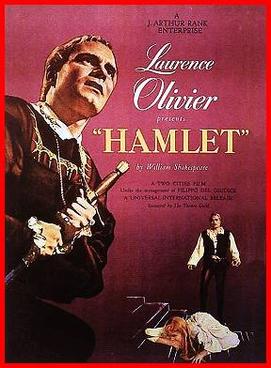
Lisa Reviews An Oscar Winner: Hamlet (dir by Laurence Olivier)


(With the Oscars scheduled to be awarded on March 4th, I have decided to review at least one Oscar-nominated film a day.  These films could be nominees or they could be winners.  They could be from this year’s Oscars or they could be a previous year’s nominee!  We’ll see how things play out.  Today, I take a look at the 1948 best picture winner, Hamlet!)

Hamlet is a film of firsts.

It was the first British production to win the Oscar for Best Picture.  In winning, it beat out three American films (Johnny Belinda, The Snake Pit, and The Treasure of the Sierra Madre) and one other British film (The Red Shoes).

It was also the first adaptation of Shakespeare to win Best Picture.  Of course, it wasn’t the first Shakespeare adaptation to be nominated.  That honor would go to 1935’s A Midsummer Night’s Dream.  Adaptations of Romeo and Juliet would be nominated in 1936, 1961, and 1968.  Henry V (which, like Hamlet, was directed by and starred Laurence Olivier) was a 1946 nominee.  Then there was 1953’s Julius Caesar.  The Dresser featured scenes from Shakespeare.  Shakespeare in Love imagined the circumstances behind the writing of Romeo and Juliet.  However, Hamlet was the first to win.

It also remains the only traditional Shakespearean adaptation to win.  West Side Story updated Romeo and Juliet while Shakespeare in Love … well, let’s just not get into it.

It was the first Best Picture winner to be directed by the man starring in the movie.  Laurence Olivier was nominated for both Best Director and Best Actor.  He lost the directing Oscar to John Huston but he won for his performance as Hamlet.  In winning, he became the first actor to direct himself to an Oscar.

Finally, Hamlet was the first of 24 films to feature both Peter Cushing and Christopher Lee!  In fact, this was Lee’s film debut.  Now, before anyone gets too excited, I should point out that Cushing and Lee don’t actually interact.  In fact, Lee doesn’t even speak in the film.  He appears in the background as a Spear Carrier and it’s pretty much impossible to spot him.  He has no dialogue and wasn’t even listed in the final credits.  From what I’ve read, I don’t think Lee and Cushing even knew each other at the time and, when they later met, they were surprised to learn that they had both appeared in the film.  For his part, Cushing plays Osiric, the courtier who everyone remembers because he had such a cool name.

It’s always fun to play “what if.”  Rosencrantz and Guildenstern do not appear in Olivier’s adaptation of the play.  To modern audiences, that might seem strange but, really, that’s just because we’re all familiar with the two characters from Tom Stoppard’s Rosencrantz and Guildenstern Are Dead.  When Olivier filmed Hamlet, he excised portions of the play in the interest of time.  (Hamlet uncut runs over four hours.  Olivier’s version clocks in at nearly three.)  Rosencrantz, Guildenstern, Fortinbras, and the second gravedigger are all dropped from Olivier’s version and, to be honest, none of them are particularly missed.

And yet … as I watched Hamlet, I found myself wondering what would have happened if Olivier had kept Rosencrantz and Guildenstern around and had cast Cushing and Lee in those roles.  It probably wouldn’t have happened, of course.  Cushing maybe but Lee was a total unknown at the time.  Still, how amazing would that have been?

As for the actual film, Olivier’s Hamlet turned out to be far more cinematic than I was anticipating.  Olivier’s camera snakes through the darkened hallways of Elsinore Castle while Olivier’s Hamlet veers between self-righteous fury and apparent madness as he seeks revenge on his Uncle Claudius (Basil Sydney).  As Hamlet grows more obsessed with death and vengeance, the castle seems to grow darker and the hallways even more maze-like, as if the castle’s changing shape to conform with the turmoil in Hamlet’s mind.  Among the cast, Jean Simmons is poignantly fragile as Ophelia while Eileen Herlie is the perfect Gertrude, despite being 12 years younger than the actor playing her son.  Olivier gives a wonderfully physical performance as Hamlet, killing Polonious with a demented gleam in his eye and literally leaping towards his uncle at the end of the film.

If you’re one of those people who thinks that Shakespeare is boring … well, Olivier’s Hamlet probably won’t change your mind.  One thing I’ve noticed about the “Shakespeare is boring” crowd is that nothing can change their minds.  But, for the rest of us, Olivier’s Hamlet is an exciting adaptation of Shakespeare’s more difficult play.

You won’t miss Rosencrantz and Guildenstern at all.  And seriously, Fortinbras who?

http://www.youtube.com/watch?v=9G8LjlR60bw

Horror Film Review: The Omen (dir by Richard Donner)


The Omen

A few days ago, Arleigh shared the theme song from 1976’s The Omen as Monday’s horror song of the day.  As I sat there and listened to Jerry Goldsmith’s award-winning hymn to Satan, it occurred to me that I happen to have all five of the Omen films sitting in my movie collection.  Seeing as how this is Halloween and how the world seems to be getting closer to ending with each passing day, I decided that this would be the perfect time to rewatch the entire franchise and consider whether or not The Omen films are truly as scary as a lot of people seem to think.

So, that’s what I did.

How did things turn out?

Well, in the long history of sequels and remakes, The Omen franchise is one of the more uneven collections.  This is one of those franchises where things tend to get less impressive with each subsequent entry.  However, 38 years after its initial release, the first Omen remains effective and, in its way, genuinely scary.

If you’re a horror fan, you probably know the general plot of The Omen regardless of whether you’ve actually watched it or not.  It’s one of those films that has been so frequently imitated that it’s almost possible to watch it by osmosis.

The film opens in Rome with diplomat Robert Thorn (Gregory Peck) being rushed to the hospital where his wife, Kathy (Lee Remick), has just given birth.  A priest (Martin Benson) tells him that his son died shortly after being born but that he can always just go home with an orphaned newborn that he just happens to have handy.  Robert agrees and decides not to tell his wife the truth about the child.  Robert and Kathy raise the boy and they name him Damien.  Four years later, the politically ambitious Robert is named as Ambassador to the Court of St. James.

The Thorns move to London and soon, odd things start to happen.  Damien (now played by Harvey Spencer Stephens) is a quiet boy with a piercing stare who throws a fit whenever he’s taken inside of a church.  When Kathy takes Damien to the zoo, they’re attacked by angry baboons.  A large Rottweiler mysteriously appears on the grounds of the Ambassador’s estate.  A mysterious and sinister nanny (Billie Whitelaw) shows up and explains that she’s been sent by an “agency.”  A crazed priest (Patrick Troughton) starts to stalk the Ambassador, demanding a chance to speak with him and insisting that Damien’s mother was actually a jackal.

Even more mysteriously, people start dying in the strangest of ways.  A young woman (Holly Palance) smiles as she shouts, “Damien, it’s all for you!” and then hangs herself, thoroughly ruining Damien’s fifth birthday party.  A freak lightning storm leads to a man being impaled by a weather vane.  Another person who suspects that there might be something wrong with Damien ends up losing his head in a graphic sequence that — even in this age of Hostel and Saw — is difficult to watch.

The Ambassador is contact by Keith Jennings (David Warner), a nervous photographer who fears that Damien may be planning on killing him.  Soon, Thorn and Jennings are flying to Italy and to the Middle East and discovering evidence that five year-old Damien might very well be the Antichrist.  Speaking of Damien, he and that nanny have been left alone with poor, victimized Kathy.

(“Oh, leave her alone,” I muttered as Damien attempted to kill Kathy for the hundredth time…)

As I watched The Omen, I tried to figure out why this film has held up so well.  It certainly wasn’t due to the performance of Gregory Peck who, quite frankly, seemed to mostly be going through the motions.  David Warner, on the other hand, gave such a good performance that it was almost difficult to watch.  (Don’t get attached to any character who appears in an Omen film.)   Some of the film’s effectiveness was undoubtedly due to Jerry Goldsmith’s intense score.  Anything’s scary when you’ve got a hundred voice shouting “Ave Satani” at you.

But, ultimately, I think the reason why The Omen still works is because the film generates such a palpable sense of doom.  This is one of those films that leaves you convinced that anyone can die at any minute and, considering that happens to be true in both this movie and in real life, that makes the horror of The Omen feel very real.  By the time the film ends, you’re left with little doubt that nobody in the film had the least bit of power or control over his or her own destiny.  Instead, they were all just pawns in a game that they had no hope of ever winning or understanding.  Is there anything scarier than feeling powerless?

All I know is that, having rewatched The Omen, I will never look at a plane of glass the same way again.

http://www.youtube.com/watch?v=vVK42hD9IaY


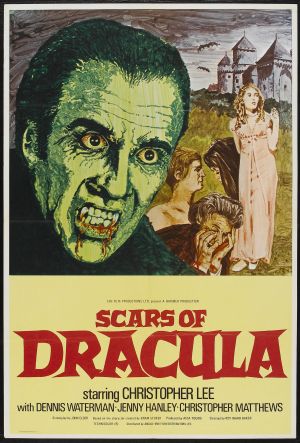
Horror Film Review: Scars of Dracula (dir by Roy Ward Baker)


Scarsofdracula

As I watched the opening of 1970’s Scars of Dracula, I found myself wondering several things.

First off, why do people even bother with trying to kill Dracula?  At the end of every Hammer film, Dracula would end up dying but then, just as surely, he would be revived in the sequel.  Now, I do think that Hammer deserves some credit for, at the very least, trying to maintain some sort of continuity over the course of its 9 Dracula films.  At least they didn’t have Dracula just mysteriously show up alive at the beginning of each sequel.  Instead, there was always someone or something who would show up at the beginning of the film for the exact purpose of bringing Dracula back to life.  Scars of Dracula, for instance, opens with a rubber bat hovering over the red dust that was once Dracula.  The bat spits up some blood and, before you know it, Dracula’s back and, once again, he’s being played by Christopher Lee.

Secondly, what happens to old vampire hunters?  Dracula shows up in film after film but, for the most part, his antagonists only show up once and then disappear, with the notable exception, of course, of Peter Cushing’s Van Helsing.  Then again, seeing as how they probably know that Dracula never stays dead for more than two years, it’s totally understandable that his enemies would probably leave town while they had the chance.

I mentioned Peter Cushing’s Van Helsing.  Interestingly enough, Cushing doesn’t appear in as many Dracula films as you probably think.  However, whenever we think of Christopher Lee’s Dracula, we also think of Cushing’s Van Helsing.  Peter Cushing was one of the few Hammer actors who had a screen presence as memorable as Christopher Lee’s.  As a result, Cushing’s Van Helsing was always seen as a worthy and credible opponent.

The downside of that is that is, when you watch a Dracula film that doesn’t feature Cushing, you find yourself very much aware of just how boring and bland most of Dracula’s other opponents truly were.  For the most part, Lee’s Dracula had to deal with an increasingly generic band of “nice” young men and women, none of whom could come close to matching Lee’s dominance of the screen.

Sometimes, of course, that didn’t matter.  But often times, as with Scars of Dracula, it’s really hard not to wish that Dracula was spending his time dealing with another Van Helsing instead of the film’s forgettable heroes.

In Scars of Dracula, Simon Carlson (Dennis Waterman) drops by Dracula’s castle while searching for his missing brother Paul (Christopher Matthews).  Accompanying Simon is Paul’s fiancee, Sarah (Jenny Hanley).  Naturally, Dracula wants to make Sarah into his bride.  Complicating matters is the fact that Dracula’s servant, Klove (Patrick Troughton), has also fallen in love with Sarah.  There’s plentiful gore, a little nudity, a lot of rubber bats, and Hammer mainstay Michael Ripper shows up playing yet another inn keeper.  Christopher Lee is, as always, an intimidating and cruel presence of Dracula and Patrick Troughton has a lot of fun as Klove.  But whenever the film focuses on its bland young leads, it comes to a halt.

Scars of Dracula is okay without being particularly memorable.  It’s not one of the best of the Christopher Lee’s Dracula films but it has enough of the Hammer style to, if you’re in the right mood, enjoyable.