Made-For-Television Film Review: Hogan’s Goat (dir by Glenn Jordan)


1971’s Hogan’s Goat opens in Brooklyn in the 1890s.  This was when Brooklyn itself was still a separate city, before it become a borough of the unified New York City.  If you’ve watched the video that I include with most of my Welcome Back Kotter reviews, you’ll notice the boast: “Fourth largest city” on the Welcome to Brooklyn sign.  And indeed, if Brookyln had remained independent, it would now be the fourth most populated city in America, behind New York, Los Angeles, and Chicago.  Sorry, Brooklyn.

(However, Houston thanks you.)

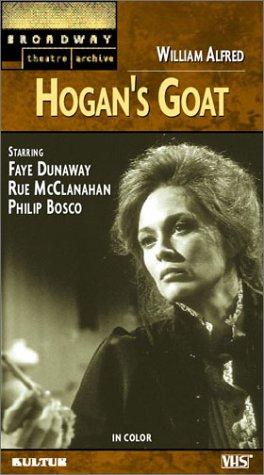
Local ward boss Matt Stanton (Robert Foxworth) heads home with what he thinks is exciting news.  He tells his wife, Kathleen (Faye Dunaway), that he is finally going to be mayor of Brooklyn.  The current mayor, a man named Quinn (George Rose), has been caught up in some sort of corruption and the Democratic political machine is ready to abandon him.  Matt Stanton is about to become one of the most powerful men in New York.  That’s not bad for a relatively young man who came to America from Ireland in search of a better life.  Adding to Stanton’s happiness is the fact that he’ll be defeating Quinn, a canny politician towards whom Stanton holds a grudge.  Kathleen, however, is worried.  An immigrant herself, Kathleen met Stanton while the latter was in London.  They were married in a civil ceremony and, ever since Stanton brought her back to Brooklyn, she has been lying and telling everyone that they were married in a church.  Kathleen feels that she and Stanton have been living in sin and she wants to have a convalidation ceremony.  Stanton refuses because doing so would mean admitting the lie in the first place and he can’t afford to lose the support of the Irish Catholic voters of Brooklyn.

However, it turns out that there are even more secrets in Stanton’s past, ones that Kathleen doesn’t know about but Quinn does.  When those secrets start to come out, Kathleen comes to realize that there’s much that she doesn’t know about her husband.  Stanton, with political power in his grasp, desperately tries to hold on to the image that he’s created of himself and Kathleen, leading to tragedy.

Hogan’s Goat was an Off-Broadway hit when it premiered in the mid-60s and its success led to Faye Dunaway getting her first film offers.  The made-for-television version of Hogan’s Goat, which premiered on PBS and featured Dunaway recreating her stage role, is essentially a filmed play.  Little effort was made to “open up” the story and, as a result, the film is undeniably stagy.  It’s clear from the start the film was mostly shot to record Faye Dunaway’s acclaimed performance for posterity.  Indeed, she’s the only member of the theatrical cast to appear in the film version.  Dunaway does give a strong performance, easily dominating the film with her mix of nervous intensity and cool intelligence.  The rest of the cast is a mixed bag.  Robert Foxworth is appropriately driven and ambitious as Stanton but his Irish accent comes and goes.  Philip Bosco does well as a sympathetic priest and George Rose is appropriately manipulative as Quinn.

In the end, the story of Hogan’s Goat is probably of the greatest interest to Irish-American history nerds like me, who have read and studied how Irish immigrants, especially in the 19th century, faced tremendous prejudice when coming to the United States and how they reacted by building their own political machines and dispensing their own patronage.  In Hogan’s Goat, the conflict is less between more Stanton and Quinn and more between Kathleen’s traditional views and her devout Catholicism and Stanton’s own very American ambition.  Whereas Kathleen still fights to retain her faith, pride, and her commitment to who she was before she married Stanton, Stanton fights for power and to conquer the man who Stanton feels has everything that he desires.  In the end, Stanton’s hubris is not only his downfall but Kathleen’s as well.
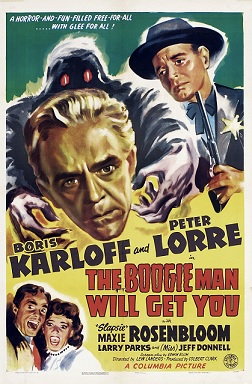
Horror on the Lens: The Boogie Man Will Get You (dir by Lew Landers)


Today’s horror on the lens is a short horror comedy from 1942.  In The Boogie Man Will Get You, Winnie Slade (Miss Jeff Donnell) buys an old house from Prof. Billings (Boris Karloff) with plans to covert it into a hotel.  However, one of the conditions of the sale is that Prof. Billings and his servants be allowed to live on the property.  What Winnie doesn’t know is that Prof. Billings had been conducting experiments on traveling salesman.  He hopes to turn them into supermen who, much like Captain America, can then be sent overseas to fight the Nazis.  However, his experiments have yet to be successful and have mostly just resulted into a lot of salesman being buried out in the rose garden.

However, things start to look up for Prof. Billings when he meets Dr. Lorencz (Peter Lorre), who is not only a doctor but also a mayor, sheriff, and dog catcher.  Seriously, Dr. Lorencz can do it all!

The Boogie Man Will Get You is a fun little time capsule of the time in which it was made.  For horror fans, it is mostly interesting because it features both Boris Karloff and Peter Lorre.  Both Karloff and Lorre appear to be having a lot of fun parodying their usual screen images.

Enjoy!

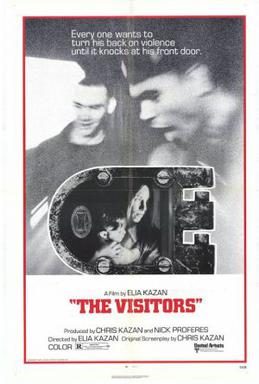
The Visitors (1972, directed by Elia Kazan)


Haunted by his experiences in Vietnam, Bill Schmidt (James Woods) lives in an isolated farmhouse with his girlfriend, Martha (Patricia Joyce), their young son, and Martha’s tyrannical father, Harry Wayne (Patrick McVey).  Harry is a hard-drinking writer who is proud of his previous military experiences and who is frustrated by Bill’s reluctance to talk about his time in Vietnam.  Harry views Bill as being a wimp who lost a war that America should have won.

One wintry night, two visitors show up at the house.  Mike (Steve Railsback) and Tony (Chico Martinez) served in Bill’s platoon.  The three of them were once friends but then something happened in Vietnam that changed all that, something that Bill refuses to talk about.  Harry is happy to welcome Mike and Tony into the household and he enjoys hearing their war stories.  While the hapless Bill watches, Mike flirts with Martha.  However, as the night continues, it becomes obvious that Mike and Tony aren’t paying an innocent visit on a friend.  Instead, they’re looking for revenge.  Bill testified against Mike at a court-martial and, in the process, ruined both of their lives.

The idea of “bringing the war home” was a popular one in the late 60s and the early 70s.  Radical groups like the Weathermen justified their terroristic actions by saying that they were forcing complacent Americans to face what every day was like in Vietnam.  Books like David Morrell’s First Blood featured psychologically damaged vets waging war on an America that they felt had abandoned them while the new wave of counterculture filmmakers made films that were groundbreaking in their portrayal of death and violence.  The Visitors, which features one traumatized vet being victimized by two other angry vets, was one of those films that was meant to bring the war home.

Directed by Elia Kazan and written by Kazan’s son, Chris, The Visitors is a simple film that sometimes seems more like a stage play than a movie.  The script is talky and heavy-handed, the characters are thinly drawn, and the film’s portrayal of Martha comes close to being misogynistic.  Chris Kazan’s script is openly critical of the United States’s role in the Vietnam War but Elia Kazan is more concerned with presenting Bill as a martyr.  Elia was a former communist who infamously named names during the McCarthy era and, from On the Waterfront on, every film that he made was more or less an attempt to justify his actions.  Like Waterfront‘s Terry Malloy. Bill loses everything because he testifies.  Unlike Malloy, no one comes to Bill’s aid afterwards, which suggests Kazan’s bitterness only grew over the years following his testimony.

The Visitors is a lesser film in Kazan’s filmography but notably, it was the first film for both James Woods and Steve Railsback.  Railsback plays Mike as a charismatic brute, giving a performance that owes more than a little to Marlon Brando’s performance as Stanley Kowalski in Kazan’s A Streetcar Named Desire.  James Woods brings his nervous intensity to the role of Bill, making him a far more intelligent but no less victimized version of Brando’s Terry Malloy.  Though The Visitors was Kazan’s second-to-last film, both Woods and Railsback would go on to emerge as two of the most interesting character actors in Hollywood.

Netflix Noir #2: The Big Caper (dir by Robert Stevens)


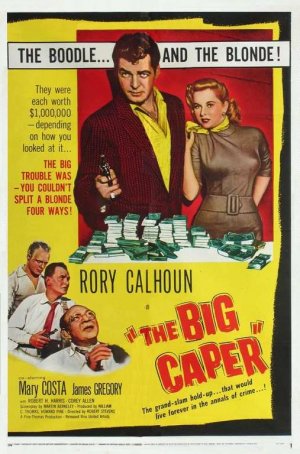
The Big Caper Poster

For our next Netflix Noir, we take a look at a heist film from 1957, The Big Caper.

Frank (Rory Calhoun) is a small time criminal with a plan.  He knows that there’s a Marine base near the small town of San Felipe, California and he also knows that, during the weekend before payday, the San Felipe bank will be holding a million dollar payroll for those Marines.  He proposes  to Flood (James Gregory), a wealthy crime boss whom Frank idolizes, that they should find a way rob that bank over the weekend.  Flood agrees to the plan.

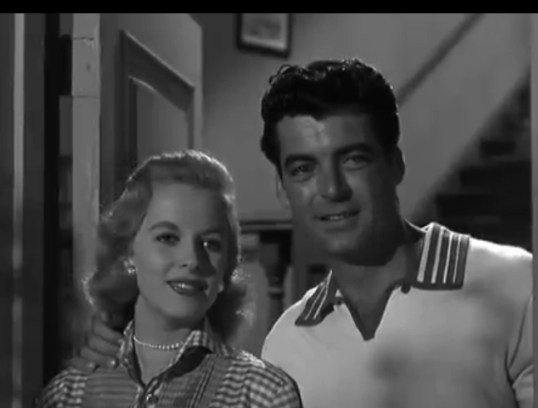
While Flood recruits some help for the robbery, Frank and Flood’s girlfriend, Kay (Mary Costa), move into the town and set themselves up as a part of the community.  Using Flood’s money, Frank buys a gas station and he and Kay move into a nice suburban house.  At first, Frank resents being forced to live like a “square.”  He bitterly complains that the local San Felipe newspaper doesn’t even tell him “how the horses did.”

But then something odd happens.  Frank starts to enjoy being a member of the community.  Soon, the gas station is making a profit and Frank is even thinking about buying a second one.  Oddly enough, his becomes best friends with the local cop.

As for Kay, she transitions to respectability even before Frank does.  As she eventually confesses to Frank, she’s tired of being treated like Flood’s property.  She wants to stay in San Felipe and make a life for herself.  Wearily, Frank tells her that she better hope that Flood doesn’t find out…

Meanwhile, Flood has recruited together his gang and they’re not exactly the most impressive bunch of criminal masterminds.  There’s Roy (Corey Allen), a physical fitness fanatic who is almost childlike in his devotion to Flood.  There’s Harry (Paul Picerni), who demands that his girlfriend Doll (Roxanne Arlen) be a part of the scheme.

And then there’s Zimmer (Robert H. Harris), a bald, sweating pyromaniac who spends most of his time begging for alcohol and lighting matches.  Zimmer arrives at Frank’s house unannounced and Frank is forced to pretend that Zimmer is his uncle.

Once Flood and the rest of the gang arrive, Frank starts to prepare for the robbery but he soon discovers that he’d rather be barbecuing with the neighbors.

The Big Caper is a clever little film, one that features excellent performances (especially from Gregory, Calhoun, Allen, and Harris) and tons of hard-boiled dialogue.  What makes this film especially memorable is the way that it contrasts the fake respectability of the wealthy Flood with the newfound, but genuine, respectability of Frank and Kay.

If The Big Caper was made today, it would probably be directed by the Coen Brothers and Ben Affleck and Ray Liotta would play Frank and Flood respectively.  However, the film works just as well with Rory Calhoun and James Gregory and is totally worth seeing.

The Big Caper

Horror on the Lens: The Boogie Man Will Get You (dir by Lew Landers)


Today’s horror on the lens is a short horror comedy from 1942.  In The Boogie Man Will Get You, Winnie Slade (Miss Jeff Donnell) buys an old house from Prof. Billings (Boris Karloff) with plans to covert it into a hotel.  However, one of the conditions of the sale is that Prof. Billings and his servants be allowed to live on the property.  What Winnie doesn’t know is that Prof. Billings had been conducting experiments on traveling salesman.  He hopes to turn them into supermen who can then be sent overseas to fight the Nazis.  (Kind of like Capt. America, when you think about it…)  However, his experiments have yet to be successful and have mostly just resulted into a lot of salesman being buried out in the rose garden…

However, things start to look up for Prof. Billings when he meets Dr. Lorencz (Peter Lorre), who is not only a doctor but also a mayor, sheriff, and dog catcher.  Seriously, Dr. Lorencz can do it all….

The Boogie Man Will Get You is a fun little time capsule of the time in which it was made.  For horror fans, it is mostly interesting because it features both Boris Karloff and Peter Lorre.  Both Karloff and Lorre appear to be having a lot of fun parodying their usual screen images.

Enjoy!

http://www.youtube.com/watch?v=MWEvKYhKc2U