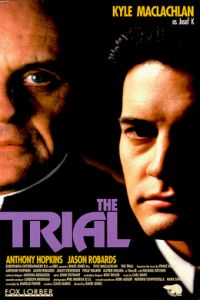
One morning, in turn of the century Prague, Josef K. (Kyle MacLachlan) wakes up to discover that two detectives are in his room. They tell him that he is under arrest but they do not tell him the charges. Josef remains free to go about his everyday life but he must report to the court whenever the court deems to see him. No matter where Josef turns or who he talks to, he cannot get any answers concerning what he has been charged with. Even his disinterested attorney (Jason Robards) can not give him a straight answer on why he is being prosecuted. No matter how much Josef protests that he is innocent of whatever has been accused of, his fate has already been decided.
On paper, this film version of Franz Kafka’s classic novel sound like it should be a masterpiece. The film was shot on location in Prague, the script was written by Harold Pinter, and Kyle MacLachlan seems like the perfect choice for Josef K. Unfortunately, director David Jones takes a very straightforward approach to the material and does not exploit the story’s nightmarish qualities. This is a version of Kafka that could easily play on Masterpiece Theater. (The perfect choice to direct The Trial would have been MacLachlan’s frequent director, David Lynch.) MacLachlan does well as Josef K. but he is overshadowed by a steady and distracting stream of cameos from actors like Anthony Hopkins, Alfred Molina, and David Thewlis.
Despite not being totally faithful to its source material, Orson Welles’s 1962 adaptation, which stars Anthony Perkins as Josef K., remains the version to see.
(For those following at home, Lisa is attempting to clean out her DVR by watching and reviewing 38 films by the end of today!!!!! Will she make it? Keep following the site to find out!)
Poor Cecil Vyse.
The 1986 film A Room With A View is a love story. It’s about a young woman who meets a young man in Florence, Italy and then, upon returning to England, she discovers that the same young man and his father are now her neighbors. From the minutes they meet, it’s obvious that the young man and the young woman are destined to be together. The only thing that’s standing in their way is the strict culture of conformity of Edwardian England. That and the fact that the young woman is engaged to Cecil Vyse.
Cecil represents the establishment. He comes from a good family. He’s well-educated. He talks about the right subjects. He holds all the right opinions. He’s not an exciting man but he’s a good man who is destined to have successful but not very interesting life. From the minute that we meet him, we know that our heroine is not meant to stay with Cecil.
And it’s heart-breaking because the film goes out of its way to show that Cecil is not a bad person. In his own befuddled way, he’s one of the most likable people in the entire film. He may not have an interesting mind but he does have a good heart. When the moment comes that Cecil’s heart is broken, the film treats him with respect.
Of course, it helps that Cecil was played, in one of his first roles, by Daniel Day-Lewis. Day-Lewis plays the role with a quiet dignity. Instead of just turning Cecil into a mere nuisance that has to be pushed out of the way in the name of love, Day-Lewis emphasizes Cecil’s humanity. There’s a quiet scene where the recently heart-broken Cecil ties his shoes that is an example of truly great acting.
As for the two young lovers, Lucy Honeychurch is played by Helena Bonham Carter while George Emerson is played by Julian Sands. Both of them are achingly beautiful and, even more importantly, they both look as if they belong in Edward England and with each other. Still, seeing this film today, it takes a little while to adjust to seeing both Bonham Carter and Sands playing such … normal characters. We’re so used to seeing Helena killing people in Tim Burton movies that it’s nice to see her getting to rather sweetly fall in love for once.
The entire film is full of great British actors, all at their best. Denholm Elliott plays George’s father and gets to deliver a rousing defense of both true love and free thought. Maggie Smith plays Lucy’s overprotective aunt while Rosemary Leach is Lucy’s supportive mother. And then you’ve got Simon Callow as an eccentric vicar. (Because every British film needs an eccentric vicar.) Lucy’s younger brother is played by an actor named Rupert Graves and he’s so adorable that I kind of found myself wishing that he could have had a spin-off movie of his own.
A Room With A View is a wonderfully romantic film, one that I could easily see myself spending days just watching over and over again. A Room With A View was nominated for best picture but it lost to the far less romantic Platoon.
(For those following at home, I now have one more review to go to reach my goal of reviewing 38 films in 10 days!)
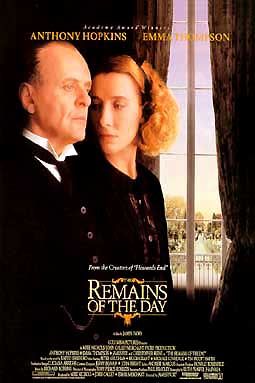
The 1993 Best Picture nominee The Remains of the Day is a love story. Actually, it’s a series of love stories. Every character in the film is in love with something or someone. It’s just that, with one exception, they’re all so extremely British that it’s sometimes hard to tell.
The one exception is an American congressman named Trent Lewis (Christopher Reeve). As the film opens in the 1950s, he’s just purchased Darlington Hall, which is one of those country manors that hold so much history and romance for those of us who regularly watch Downton Abbey. Lewis is excited to have a British manor of his very own. It even comes with its very own butler, a Mr. Stevens (Anthony Hopkins).
As we see in flashback, Stevens previously worked at Darlington Hall when it was owned by Lord Darlington (James Fox). In the 1930s, Lord Darlington may have loved Britain but he was also dangerously naive about the rise of Nazi Germany. Actually, to say that he was naive might be letting Lord Darlington off too easily. When we first meet Lord Darlington, he seems like a well-meaning but hopelessly out-of-touch aristocrat. He has so little understanding of the real world that he even asks Stevens to have the sex talk with his godson (played, somewhat inevitably, by Hugh Grant), who happens to be close to 30 years old at the time and, one would presume, far beyond the age when the talk is really necessary. When we first see Lord Darlington, who is hosting a conference on how to best deal with the rise of the Nazis, arguing that Britain should ignore the rise of Hitler, it’s easy to assume that he’s just as clueless about Germany as he is about his godson. But then, eventually, Lord Darlington orders Stevens to fire two Jewish maids and you’re forced to reconsider everything that you previously believed about him.
And then there’s Ms. Kenton (Emma Thompson), who worked as a housekeeper for Lord Darlington. She loves the repressed Mr. Stevens but continually finds herself frustrated by Stevens’s professional detachment. Unlike Stevens, Ms. Kenton doesn’t hold back on her opinions but, when she finally has a chance to stand up for her beliefs and defy the status quo at Darlington Hall, she backs down.
And then there’s Mr. Stevens. Mr. Stevens may be one of the most emotionally repressed characters in the history of the movies but the entire film revolves around trying to figure out what or who Stevens loves. It’s a little too easy to assume that he’s in love with Ms. Kenton, even though that will be the natural instinct of most viewers. While he obviously feels affection towards her, he can never bring himself to truly express it. (That said, getting a letter from her appears to be the only thing that can actually inspire him to leave the safety of Darlington Hall and venture into the outside world.) While it seems, at times, that he might love Lord Darlington, Stevens himself prefers to say that he respected Lord Darlington and, after the war, Stevens seems to have no trouble staying on at Darlington Hall even after its bought by Congressman Lewis. Much like the ghosts in The Shining, Stevens has always been the butler and always will be.
Ultimately, Mr. Stevens loves his job. He loves being a butler. He’s a man so dedicated to his job that he even continues to work even while his father is dying in the next room. He loves making sure that everything’s perfect at Darlington Hall and he never bothers with worrying about how imperfect the world outside Darlington Hall may be. In that way, Stevens is a stand-in for all of the European leaders who willfully chose to ignore what was happening in Germany in the days leading up to World War II. And, much like those European leaders, he finds himself forced to work for an American in the aftermath.
As a film, The Remains of the Day can be frustrating but in a good way. Mr. Stevens is such a repressed and detached character that, much like Ms. Kenton, we’re always tempted to give up on him. Fortunately, Anthony Hopkins is one of those actors who can suggest so much with just a pause in his dialogue or a quick glance to the side. You look at his sad eyes and suddenly, you know everything that Mr. Stevens cannot bring himself to say. Emma Thompson has a somewhat easier role because Ms. Kenton at least gets to say what she’s thinking but she still bring a lot of depth to the role and has a lot of chemistry with Hopkins. And finally, you’ve got James Fox who is so comically befuddled that it’s all the more shocking to consider all of the pain that he — intentionally or not — is partially responsible for.
The Remains of the Day is a great film for all of us Downton Abbey-loving history nerds.
 One morning, in turn of the century Prague, Josef K. (Kyle MacLachlan) wakes up to discover that two detectives are in his room. They tell him that he is under arrest but they do not tell him the charges. Josef remains free to go about his everyday life but he must report to the court whenever the court deems to see him. No matter where Josef turns or who he talks to, he cannot get any answers concerning what he has been charged with. Even his disinterested attorney (Jason Robards) can not give him a straight answer on why he is being prosecuted. No matter how much Josef protests that he is innocent of whatever has been accused of, his fate has already been decided.
 Through the Shattered Lens