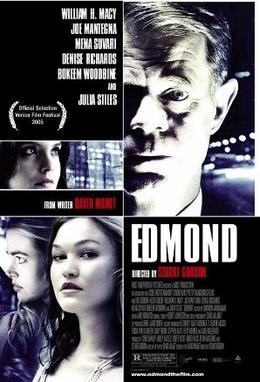
Days of Paranoia: Edmond (dir by Stuart Gordon)


Based on a one-act play by David Mamet, 2005’s Edmond tells the story of Edmond Burke (William H. Macy).

Edmond shares his name (if not the actual spelling) with the philosopher Edmund Burke.  Edmund Burke was a strong believer that society had to put value in good manners to survive and that religious and moral institutions played an important role in promoting the idea of people treating each other with respect and decency.  Edmund Burke knew what he believes and his writings continue to influence thinks to this day.  Edmond Burke, on the other hand, doesn’t know what he believes.  He doesn’t know who he wants to be.  All he knows is that he doesn’t feel like he’s accomplished anything with his life.  “I don’t feel like a man,” he says at one point to a racist bar patron (played by Joe Mantegna) who replies that Edmond needs to get laid.

On a whim, Edmond steps into the shop of a fortune teller (Frances Bay), who flips a few Tarot cards and then tells Edmond that “You’re not where you’re supposed to be.”  Edmond takes her words to heart.  He starts the night by telling his wife (played by Mamet’s wife, Rebecca Pidgeon) that he’s leaving their apartment and he won’t be coming back.  He goes to the bar, where he discusses his marriage with Mantegna.  He goes to a strip club where he’s kicked out after he refuses to pay $100 for a drink.  He goes to a peep show where he’s frustrated by the glass between him and the stripper and the stripper’s constant demand that he expose himself.  He gets beaten in an alley by three men who were running a three-card monte scam.  Edmond’s problem is that he left home without much cash and each encounter leads to him having less and less money.  If he can’t pay, no one wants to help him, regardless of how much Edmond argues for a little kindness.  He pawns his wedding ring for $120 but apparently, he just turns around and uses that money to buy a knife.  An alley-way fight with a pimp leads to Edmond committing his first murder.  A one-night stand with a waitress (a heart-breaking Julia Stiles) leads to a second murder after a conversation about whether or not the waitress is actually an actress leads to a sudden burst of violence.  Edmond ends up eventually in prison, getting raped by his cellmate (Bookem Woodbine) and being told, “It happens.”  Unable to accept that his actions have, in one night, led him from being a businessman to a prisoner, Edmond says, “I’m ready to go home now.”  By the end of the film, Edmond realizes that perhaps he is now where he was meant to be.

It’s a disturbing film, all the more so because Edmond is played by the likable William H. Macy and watching Macy go from being a somewhat frustrated but mild-mannered businessman to becoming a blood-drenched, racial slur-shouting murderer is not a pleasant experience.  Both the play and the film have generated a lot of controversy due to just how far Edmond goes.  I don’t see either production as being an endorsement of Edmond or his actions.  Instead, I see Edmond as a portrait of someone who, after a lifetime of being willfully blind to the world around him, ends up embracing all of the ugliness that he suddenly discovers around him.  He’s driven mad by discovering, over the course of one night, that the world that is not as kind and well-mannered as he assumed that it was and it all hits him so suddenly that he can’t handle it.  He discovers that he’s not special and that the world is largely indifferent to his feelings.  He gets overwhelmed and, until he gets his hands on that knife, he feels powerless and emasculated.  (The knife is an obvious phallic symbol.)  It’s not until the film’s final scene that Edmond truly understands what he’s done and who he has become.

Edmond is not always an easy film to watch.  The second murder scene is truly nightmarish, all the more so because the camera remains on Edmond as he’s drenched in blood.  This is one of William H. Macy’s best performances and also one of his most disturbing characters.  That said, it’s a play and a film that continues to be relevant today.  There’s undoubtedly a lot of Edmonds out there.
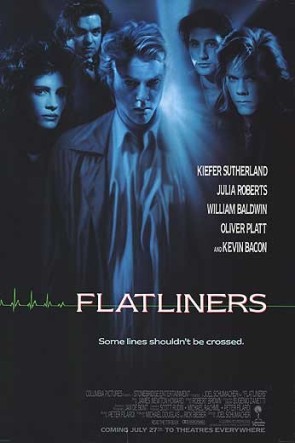
Horror Film Review: Flatliners (dir by Joel Schumacher)


“Our sins have come back in a physical form … and they’re pissed!”

That one line pretty much sums up the original 1990 version of Flatliners.  It’s a good line in that it’s one that you remember and it’s a line that you can use in almost any situation.

Have you gotten a phone call from an unknown caller?  “Our sins have come back in physical form … and they’re pissed!”

Have you and your boyfriend recently been driving across Texas and suddenly noticed that a car has been following you all the way from Lake Dallas to the border of Oklahoma.  “Our sins have come back in physical form … and they’re pissed!”

Have you ever had a stranger fail to hold a door open for you?  There’s only one possible reason for that rudeness.  “Our sins have come back in physical form .. and they’re pissed!”

And don’t even get me started on people who leave negative comments under my reviews.  We all know what’s going on with that!  “Our sins have come back in physical form … and they’re pissed!”

It’s a line that is both oddly memorable and also deeply stupid.  The same description can be applied to Flatliners.  It’s a film about a group of medical students (played by Julia Roberts, William Baldwin, Oliver Platt, and Kevin Bacon) who help Kiefer Sutherland investigate whether or not there’s actually an afterlife.  Sutherland believes that there is but he needs an atheist to be a part of the group, that’s where Kevin Bacon comes in.  And he needs a potential love interest and a Baldwin brother to be a member of the group as well, that’s why Julia Roberts and William Baldwin are there.  And, of course, someone has to provide comedic relief whenever things start to get too dark.  Say hello to Oliver Platt!  Anyway, Sutherland’s plan is to die for a minute or two and then have his fellow medical students bring him back to life.  It sounds like kind of a dumb idea but everyone agrees to it.

Anyway, it turns out that the afterlife looks a lot like an overproduced student film, full of weird camera angles, tinted lighting and disembodied voices.  When Sutherland dies, he sees a boy that he used to bully.  Julia Roberts sees her father, who committed suicide when she was younger.  Kevin Bacon sees a little girl that he used to bully.  (There are a lot of bullies in this movie.)  William Baldwin, a sex addict who is chronically unfaithful to his fiancée, sees hundreds of women, all saying, “But you said you loved me.”  Oliver Platt never actually gets to die and therefore, he sees nothing.  He does make a joke about how his vision would probably involve an angry babysitter.  I laughed.

What happens next?  “Our sins have come back in physical form … and they’re pissed!”

Flatliners has an intriguing premise but oh my God, is it ever a silly film.  It’s not really a spoiler to tell you that all of these returned sins want the characters to either atone for their mistakes or make peace with their past.  For Kevin Bacon, this means tracking down the girl that he used to bully and allowing her to bully him.  For Julia Roberts, it means getting an apology from her Dad and understanding that he was addicted to heroin.  For William Baldwin, it means making peace with never being as well-known as either Alec or Steven.  As for Kiefer … well, things are a bit more complicated for Kiefer Sutherland.

Flatliners starts out as a horror film but then it turns into a squishy movie about letting go of bitterness and learning how to forgive oneself.  It’s kind of annoying that the film couldn’t just stick to being scary because the first half of the film does have some effectively tense moments.  However, it all gets lost as the film’s plot sinks into sentimental, New Age-y quicksand.

Flatliners was directed by Joel Schumacher, who generally does well with shallow films that 1) don’t really mean anything and 2) don’t involve super heroes.  And really, the only film that I can think of that’s more shallow than the original Flatliners is the remake.  (But we’ll talk about that later…)  Schumacher’s direction here is not particularly bad — everyone looks good and the film is never boring.  It’s a very, very pretty film and one that doesn’t add up to much.

I would suggest watching it with your sins, especially after they take physical form.  Maybe they’ll be a little less pissed off afterward.