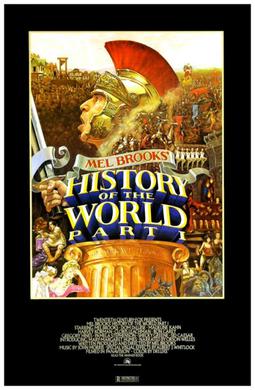
The History of the World, Part I (1981, directed by Mel Brooks)


Overlong, wildly uneven, gimmicky too a fault, and often laugh out loud funny with a mix of jokes that range from the crude to the sublimely clever to the surprisingly sentimental, The History of the World, Part I is the ultimate Mel Brooks films.

Narrated by Orson Welles and featuring five historical stories and a collection of coming attractions, The History of the World Part I follows man from his caveman origins to the French Revolution and the thread that ties it all together is that humanity always screws up but still finds a way to survive.  Moses (Mel Brooks) might drop and break one of the three tablets listing the 15 Commandments but he’s still able to present the other ten.  Stand-up philosopher Comicus (Mel Brooks) might make the mistake of poking fun at the weight of Emperor Nero (Dom DeLuise) but he still makes his escape with Josephus (Gregory Hines), Swiftus (Ron Carey), and Miriam the Vestal Virgin (Mary-Margaret Humes) and ends up serving as the waiter at the Last Supper.  (“Jesus!”)  The Spanish Inquisition may have been a catastrophe but it also gave Torquemada (Mel Brooks) a chance to show off his performance skills.  The French Revolution may have been a bloodbath but the future still held promise.  Ask for a miracle and he’ll show up as a white horse named Miracle, no matter what era of history you’re living in.

The humor is very Mel Brooks.  During the Roman Empire sequence, Madeline Kahn plays Empress Nympho.  Jackie Mason, Harvey Korman, Cloris Leachman, Spike Milligan, Jan Murray, Sammy Shores, Shecky Greene, Sid Caesar, Henny Youngman, and Hugh Hefner all make cameo appearances.  Carl Reiner is the voice of God.  John Hurt plays Jesus.  The film ends with the promise of a sequel that will feature “Jews in Space.”  Not every joke lands.  The entire caveman sequence feels forced.  But when the film works — like during The Inquisition production number — it’s hard not get caught up in its anything-goes style.  The entire Roman Empire sequence is probably more historically accurate than the typical Hollywood Roman epic.  That’s especially true of Dom DeLuise’s naughty performance as Emperor Nero.

Mel Brooks is 99 years old today and he says that he has at least one more film to give us, a sequel to Spaceballs.  I’m looking forward to it!  I’m also looking forward to rewatching and enjoying all of the films that he’s already given us.  The History of the World, Part I may not have initially enjoyed the critical acclaim of his earlier films but, in all of its anarchistic glory, it’s still pure Mel Brooks.

Film Review: Buffalo Bill and the Indians, or Sitting Bull’s History Lesson (dir by Robert Altman)


1976’s Buffalo Bill and the Indians, or Sitting Bull’s History Lesson takes place in the waning years of the Old West.  Civilization is coming to America and the “wild” west’s days are numbered.  And yet, even as the days of outlaws and gunslingers come to an end, America is already in the process of building up its own mythology.

Buffalo Bill (Paul Newman) owns a popular wild west show, one where his stars put on a show that claims to recreate the great moments of western history.  The show is made up of a motely collection of performers, some of whom are more talented than others.  This is a Robert Altman film and, as usual, the emphasis is more on watching how his large ensemble of actors interact as opposed to highlighting any one actor.  Indeed, it can be hard to keep everyone in the film straight and one gets the feeling that this was intentional on Altman’s part.  Buffalo Bill and the Indians may be a revisionist western and a satire of American history but it’s also a showbiz film.  The emphasis is on people continually coming and going, sticking around long enough to either prove their worth as a performer or moving on to a hopefully more receptive audience.

Geraldine Chaplin plays Annie Oakley, the sharp shooter who takes joy in firing her gun and who barely seems to notice that her husband (John Considine) is terrified of getting shot.  Joel Grey serves as the unflappable manager of the show while Harvey Keitel is miscast as Buffalo Bill’s somewhat nerdy assistant.  (Keitel, with his natural intensity, seems like he’s desperately waiting for a chance to explode, a chance that never really comes.)  Burt Lancaster plays Ned Buntline, the writer who made Buffalo Bill into a celebrity and who provides a somewhat sardonic commentary as Bill’s current activities.  Shelley Duvall shows up as the wife of President Grover Cleveland (played by Pat McCormick), who comes to the show and is amused until an Indian points a gun towards the president.

Throughout it all, Buffalo Bill enjoys his fame and pushes his vision of the Old West on those who come to see his show.  Newman plays Bill as being a blowhard, an eccentric who is obsessed with opera and whose entire persona is a fake.  He can’t shoot straight.  He can barely ride a horse.  His trademark long hair is actually a wig.  The only people who take Bill seriously as those who come to see his show.  Those who know him view him as being a buffoon but they also understand that he’s a very successful and very famous buffoon and that ultimately matters more than any sort of historical truth.

What conflict there is in the film occurs when Sitting Bull (Frank Kaquitts) and his translator (Will Sampson) arrive on the scene.  Sitting Bull has agreed to appear in the show but only under his own terms.  Buffalo Bill grows frustrated with Sitting Bull and his refusal to pretend to be a savage but he also knows that this audience wants to see the last remaining great Indian chief.

It’s a big and sprawling film and it’s really not entirely successful.  Altman was an intelligent director who was willing to take risks and no one deserves more credit for popularizing the idea of the ensemble film.  That said, he could also be a bit heavy-handed and that’s certainly the case here.  It takes a certain amount of courage to cast a star like Paul Newman as a thoroughly unlikable character and it also took a bit of courage on Newman’s part to give the performance that he did.  At the same time, neither the shallow Buffalo Bill nor the dignified Sitting Bull are really compelling enough characters to carry a film that runs for more than two hours.  The film’s message is an obvious one and it’s also one that Altman handled in a much more memorable way with Nashville.

That said, the film is a memorable misfire.  It’s at its best when it abandons the politics and just concentrates on the community of performers that popular Buffalo Bill’s show.  The film’s best moments are not the ones with Paul Newman growling but instead the ones with John Considine hoping that Geraldine Chaplin won’t accidentally shoot him.  As with many of Altman’s film, Buffalo Bill and the Indians works best when it focuses on the misfit community at the center of its story.


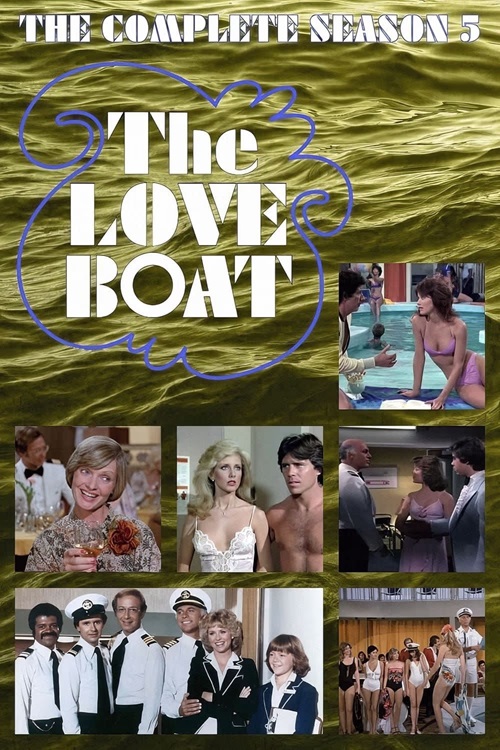
Retro Television Review: The Love Boat 5.15 “I Don’t Play Anymore/Gopher’s Roommate/Crazy For You”


Welcome to Retro Television Reviews, a feature where we review some of our favorite and least favorite shows of the past!  On Wednesdays, I will be reviewing the original Love Boat, which aired on ABC from 1977 to 1986!  The series can be streamed on Paramount Plus!

This week, Gopher thinks that he recognizes a passenger!

Episode 5.15 “I Don’t Play Anymore/Gopher’s Roommate/Crazy For You”

(Dir by Bob Sweeney, originally aired on January 23rd, 1982)

When Rachel (Mackenzie Phillips) boards the ship, Gopher is sure that they’ve met before.  Rachel tells Gopher that he must be mistaken and, in fact, she goes out of her way to avoid him.  Since no one on this ship has ever stopped to consider that getting the cruise line sued would be bad for their career, Gopher continues to follow Rachel around.  Rachel finally tells Gopher the truth.

She does know him.

In fact, they were once quite close.

In college, Rachel was Gopher’s roommate and she played for the football team.  However, after graduating college, she had gender-affirmation surgery and now, she goes by the name of Rachel.  Gopher is stunned and I know what you’re probably thinking.  You’re probably looking at the 1982 air date and assuming that the whole storyline becomes consumed with gay panic as Gopher grapples with having been attracted to his former roommate.  (Doc also hits on her but then again, Doc hits on anyone.)  Well, believe it or not, The Love Boat handles this storyline with a surprising amount of sensitivity.  Yes, Gopher is stunned at first.  But he soon comes to respect and support Rachel’s decision, even if he doesn’t fully understand it.  Physically, the rather slight Mackenzie Phillips is not particularly believable as a former football player but still, both she and Fred Grandy gave good performance in the story.  This week was a case of The Love Boat really taking me by surprise.

Meanwhile, psychiatrist Lisa Lessing (Joanna Cassidy) boards the boat to observe David Jackson (Dick Shawn), an exec who is asking for worker’s compensation because he claims to be mentally ill.  Lisa (hey!) is on board to check on David’s sanity.  Lisa comes to believe that David is not faking but — surprise! — David actually is faking and now he feels bad because he and Lisa have fallen in love.  Lisa decides to pretend to be crazy too.  Uhmmm, okay.

Pianist Paul Krakauer (James MacArthur) has retired from playing because of the crippling arthritis in his hands.  When he meets Irene (Donna Pescow), a maid on the ship, he falls in love and decides to give one last performance so that he can make a quick $25,000 and give it to Irene so she can get an operation to fix her ankle.  Turns out that Doc has some ‘medicine” that allows Paul to play the piano but it takes several hours to take it effect so Paul misses a date that he previously set up with Irene.  Irene is ready to dump David until she finds out why he stood her up.

So, this episode had one surprisingly sensitive and two kind of bland storylines.  (The pianist storyline was ultimately saved by Donna Pescow’s performance as Irene.)  And I’ve got a massive headache and a cold.  Bleh.  That said, this was actually an above-average cruise, featuring some good performances on the part of the passengers and the cruise.  This week’s trip on The Love Boat was worth it.

The Further Adventures of Smokey and the Bandit


The first Smokey and the Bandit is a classic.  What about the sequels?
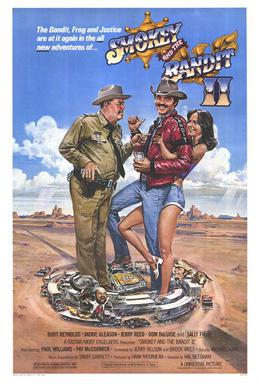
Smokey and the Bandit II (1980, directed by Hal Needham)

The gang’s all back in this sequel to Smokey and the Bandit!  Burt Reynolds is the Bandit!  Jackie Gleason is Sheriff Buford T. Justice and his two brothers, Reginald and Gaylord!  Jerry Reed is Snowman!  Sally Field is Carrie!  Pat McCormick and Paul Williams are Big and Little Enos!  Mike Henry is Junior!  Dom DeLuise is an Italian doctor!  Terry Bradshaw and Mean Joe Greene play themselves!  There’s an elephant!

You get the idea.  Smokey and the Bandit II promises more of the same.  In some ways, it delivers.  There are some entertaining stunts.  The finale features what was, at the time, the biggest car chase ever filmed.  But Smokey and the Bandit II fails at the most important part.  It fails to recreate the fun of the first film.  Everyone is just going through the motions.  Burt Reynolds later said that he only made the film as a favor to Hal Needham while Sally Field said that she agreed to appear in the film as a favor to Burt Reynolds.  Jackie Gleason did the movie because he needed the money but, because he was also in poor health, he requested that his scenes be filmed first and that they be filmed quickly.  That the three stars didn’t have much enthusiasm for the project is obvious while watching the movie.

This time, Big Enos wants the Bandit to transport an elephant to the Republican National Convention in Dallas.  The Bandit, however, has been an alcoholic wreck ever since Carrie left him to, for some reason, get back with Junior.  Snowman manages to sober up the Bandit and, after they help Carrie run out on her wedding for a second time, it’s time to transport an elephant.

In hot pursuit, Sheriff Justice gets help from his brothers, all of whom are also played by Gleason.  Reginald Justice is a Canadian Mountie who speaks with a posh accent that is in no way Canadian.  Gaylord Justice is a flamboyant state patrolman.  Whenever the brothers talk to each other, doubles are used.  There are a few split screen shots that are so ineptly handled that it ends up looking like a page from a comic book with each Gleason standing in a separate panel.  The end credits list Gaylord as having been played by “Ms. Jackie Gleason,” just in case you’re wondering the level of this film’s humor.

Dom DeLuise gets some laughs as an Italian doctor who is recruited to take care of the elephant but otherwise, this is a depressing movie.  Burt Reynolds and Sally Field were on the verge of breaking up when this film was made and neither one of them acts their scenes with much enthusiasm.  Watching the movie, it’s impossible not to compare their strong chemistry in the first movie to their total lack of it in the second movie.  There’s a subplot about the Bandit trying to prove that, even though he’s getting older, he’s still a legend and, for those who know anything about Burt Reynolds’s career, it hits too close to home.  Combining that with the sight of an obviously unwell Jackie Gleason and you’ve got a surprisingly depressing comedy.

There is one cool thing about Smokey and the Bandit II.  After the critics thoroughly roasted the film, Hal Needham took out a one-page ad in Variety.  The ad was a picture of Needham sitting in a wheel barrow full of money.  That’s one way to answer your critics!

Smokey and the Bandit 3 (1983, directed by Dick Lowry)

Smokey and the Bandit 3 is even more depressing than the second film.  Not surprisingly, Sally Field is nowhere to be found.  She had broken up with Burt after the second film and was busy pursuing a career as the type of actress who didn’t appear in car chase films.  Burt does appear in the film but he only makes a cameo appearance, showing up for a few minutes at the end with a resigned look on his face as if he realized that he was never going to escape being typecast as an aging good ol’ boy.  Also not returning was Hal Needham.  Needham was busy directing Stroker Ace so he was replaced by Dick Lowry.  What type of director was Dick Lowry?  Other than Smokey and the Bandit 3, Lowry’s best known credit is for Project Alf.

Jackie Gleason, Jerry Reed, Pat McCormick, Mike Henry, and Paul Williams all return but none of them look happy to be there.  The plot is that Sheriff Buford T. Justice has retired to Florida but he just can’t turn down a challenge from Big Enos and Little Enos to drive a stuffed shark from Miami to Dallas.  Smokey is the Bandit!  (That was originally the title of this film.)  When it looks like Buford is doing too good of a job of transporting the shark, the Enoses hire Snowman to chase Buford and slow him down.  It doesn’t make any sense and Jerry Reed and Jackie Gleason don’t share any scenes together despite co-starring in the film.  Supposedly, Gleason was originally cast as two characters — Buford and the man hired to slow Buford down — but when preview audiences were confused by the film, the studio demanded reshoots.  Jerry Reed was brought back and all of the scenes featuring Gleason as the new Bandit were reshot with Reed.  Reed even grew a mustache, wore a red shirt, and broke the fourth wall just like Burt did in the first film.

Not surprisingly, Smokey and the Bandit 3 is a disjointed mess that doesn’t even have any spectacular car crashes to justify its existence.  Jerry Reed is as amiable as he was in the first two films but Jackie Gleason’s Buford Justice was never meant to be a lead character.  In small doses, he was funny but Buford was too one-dimensional of a character to build an entire film around.

Smokey and the Bandit 3 was a failure with critics and at the box office so the Bandit’s adventures came to a temporary end.  Years later, Hal Needham produced four made-for-TV prequels the starred Brian Bloom as a young Bandit.  I haven’t seen them.  If I ever do, I’ll review them.

A Movie A Day #323: Ted & Venus (1991, directed by Bud Cort)


Strange movie, Ted & Venus.

Actor Bud Cort (you remember him from Harold and Maude) both directs and stars as Ted.  Ted is a homeless poet who lives on the beach and only has one friend, a mellow beach bum named Max (Josh Brolin).  Kim Adams plays Linda, who is the Venus of the title, a social worker who has a bodybuilder jerk for a boyfriend (Brian Thompson, who you might remember as the main villain in Cobra).  When Ted sees Linda, it is love at first sight and at first, the movie seems like it is going to be a quirky romantic comedy where Ted eventually wins Linda over.  When Linda turns down Ted’s advances, Ted does not give up.  Instead, Ted starts following her everywhere and making harassing phone calls.  Ted starts out as a nuisance and goes on to become a full-out stalker.  Everyone, even Max, tells Ted to stop bothering Linda but he is convinced that he can make her fall in love him.  He’s wrong.

Because of the presence of Cort both in front of and behind the camera, Ted & Venus sometimes seems like Harold and Maude: The Later Years.  Harold, the iconoclast that everyone loved, has grown up and become Ted, the unemployable stalker.  It’s an interesting idea and Cort pulls it off as an actor but not as a director.  You have to admire Cort’s devotion to his vision but it’s impossible to be certain what that vision was because the film’s tone is all over the place.  Cort gets a far better performance from himself than he does from the rest of the cast.

Speaking of the cast, the movie is full of familiar faces.  In fact, there are almost too many familiar faces.  It’s hard not to get distracted by all of the cameos.  If you somehow see this obscure movie, keep an eye out for: Woody Harrelson (who gets two lines and five seconds of screen time), Rhea Pearlman, Carol Kane, Martin Mull, Gena Rowlands, Pat McCormick, Vincent Schiavelli, Cassandra Peterson, and Andrea Martin.  When Ted is hauled into court, charged with stalking, the judge is played by LSD guru Timothy Leary.  I am not sure what Ted & Venus was trying to say but Bud Cort assembled an impressive cast to say it.

A Movie A Day #114: Scavenger Hunt (1979, directed by Michael Schultz)


When game designer Milton Parker (Vincent Price) dies, all of his greedy relatives and his servants gather for the reading of his will.  Parker’s lawyer, Benstein (Robert Morley), explains that Parker is leaving behind a $200 million dollar estate to whoever can win an elaborate scavenger hunt.  Dividing into five teams, the beneficiaries head out to track down as many items as they can by five o’clock that evening.  Among the items that they have to find: a toilet, a cash register, an ostrich, a microscope, and an obese person.  Hardy har har.

The five teams are made up of a who’s who of sitcom and television actors who had time to kill in 1979.  The Odd Couple‘s Tony Randall is Henry Motely, who is Parker’s son-in-law and who works with his four children.  Soap‘s Richard Mulligan plays a blue-collar taxi driver named Marvin Dummitz (because funny names are funny) who teams up with his friend, Merle (Stephen Furst).  The Mary Tyler Moore Show‘s Cloris Leachman (an Oscar winner, no less) gets stuck with the role of Milton’s greedy sister, Mildred.  She works with her conniving lawyer (Richard Benjamin) and her stupid son (Richard Masur).  Maureen Teefy plays Milton’s niece while his nephews are played by Willie Aames and Dirk Benedict.  Cleavon Little, James Coco, Roddy McDowall, and Stephanie Faracy play the servants.

It doesn’t stop there, though.  Avery Schreiber plays a zookeeper.  Meat Loaf plays a biker who beats up Richard Benjamin.  Ruth Gordon, Stuart Pankin, Pat McCormick, and Scatman Crothers all have cameos.  Even Arnold Schwarzenegger makes an appearance as a gym instructor who knocks Tony Randall out of a second story window.

There are a lot of famous people in Scavenger Hunt.  It’s just too bad that the movie itself is barely watchable and not at all funny.  It tries to go for the zaniness of It’s A Mad, Mad, Mad, Mad World but, unless watching Willie Aames steal a clown head from Jack in the Box is your idea of hilarity, the film never comes close to succeeding.  Michael Schultz directed some classic films (like Car Wash) during the 1970s but, unfortunately, he also directed Sgt. Pepper’s Lonely Hearts Club Band and this.

Scavenger Hunt used to show up on a late night television, where it was always advertised as starring Arnold Schwarzenegger.  (He barely has five minutes of screentime.)  It was released on DVD/Blu-ray earlier this year but watching for the cameos is the only reason to take part in this Scavenger Hunt.