Horror Film Review: The Return of the Vampire (dir by Lew Landers)


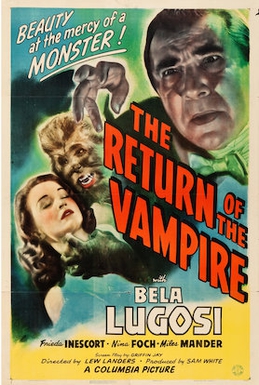
1943’s The Return of the Vampire opens in 1918.

Lady Jane Ainsley (Frieda Inescort) and her colleague, Dr. Walter Saunders (Gilbert Emery), suspect that there might be a vampire active in London.  After reading a book on vampirism that was written by Dr. Armand Tesla, they manage to find the vampire’s coffin.  As the vampire’s servant — a werewolf named Andreas (Matt Willis) — watches, Lady Jane and Dr. Saunders drove a metal stake through the vampire’s heart.  It turns out that the vampire was none other than Armand Tesla himself!  Andreas turns back into a normal person and becomes Lady Jane’s assistant.

Jump forward to the 1940s.  During an attack by the Germans, a bomb explodes over Tesla’s grave and exposes not just his coffin but also the metal pole in the middle of his skeleton.  Two workmen assume that the pole is just bomb debris and they remove it.  Tesla (Bela Lugosi) promptly comes back to life and Andreas turn back into a werewolf.  Tesla sets out to get revenge on Lady Jane and the daughter of Dr. Saunders, Nicki (Nina Foch).

The Return of the Vampire is an interesting film.  Since the film was not made by Universal Pictures, it could not use the name “Dracula” for its vampire but it’s obvious from the start that Armand Tesla is meant to be Dracula.  Tesla wears his Dracula costume, speaks in his Dracula voice, and gives his Dracula performance.  To his credit, Lugosi actually gives a very strong performance in The Return of the Vampire.  His anger towards the people who staked him feels very real and there’s nothing of the intentional campiness that marred some of Lugosi’s later performances.  Lugosi leaves little doubt that Tesla is not only evil but he’s someone who truly enjoys being evil.  He can’t leave England until he gets his revenge on the people who previously defeated him.  For all the talk of stakes, sunlight, and crosses, the vampire’s true weakness is its own vanity and its inability to let go of a grudge.

As a history nerd, I found myself fascinated with how the film worked the then-current Blitz into its story.  The main villain may have been played by Bela Lugosi but the Germans definitely played their role as well, launching the bombing raids that distracted the authorities from the vampire in their midst.  Indeed, it’s probably not coincidence that it was a German pilot who brought Tesla back to life in the first place.  The German pilot is shot down but not before he drops a bomb on Tesla’s crypt.  The film says to be aware of the outside threat but to also be aware that threats can come from the inside as well.  While the Germany terrify the citizens of London, the vampire coolly moves through the night.

Clocking in at a fast-paced 69 minutes, The Return of the Vampire also features a stiff upper lip Scotland Yard inspector (Miles Mander) who, of course, is skeptical of the existence of vampires.  At the end of the film, he asks his subordinates if they believe in vampires.  They reply that they do.  He then looks at the camera and asks us, “And do you, people?”

Well, do you?
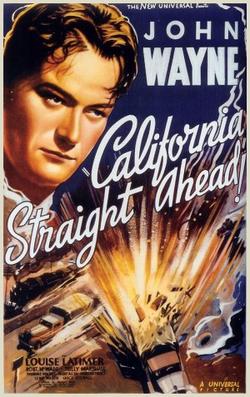
California Straight Ahead! (1937, directed by Arthur Lubin)


Biff Smith (John Wayne), fired from his job as a school bus driver, becomes a partner in a trucking company.  In order to show-up the railroads that are determined to put any potential competitors out of business, Biff and his fleet race a train to the Pacific Coast, where a boat needs to be unloaded before a labor strike begins.  Making this personal for Biff is that he’s in love with Mary Porter (Louise Latimer), the sister of Biff’s late business partner.  Embittered by her brother’s death in a trucking accident, Mary is now working for the head of the railroad, James Gifford (Theodore van Eltz).  Biff not only wants to prove that his small trucking firm can compete with the big boys but also wants to show Mary that her new boss is nothing but a smooth-talking weasel.

This film is from John Wayne’s B-movie star period, before John Ford cast him in Stagecoach and made him one of the biggest stars in the world.  California Straight Ahead! features Wayne in a contemporary role, though the movie still has a western sensibility.  There’s not much difference between a wagon train and Wayne’s fleet of trucks and, as in so many westerns, the greedy railroad baron is the villain.  This is one of Wayne’s better B-movie performances.  He was clearly comfortable in front of the camera by the time he made this movie and was no longer as stiff as he was in his earlier films.  California Straight Ahead! is a crowd-pleasing film that finds Wayne standing up for small businesses and their workers.  Though this may just be a 61-minute B flick, California Straight Ahead! reveals the movie star that Wayne would soon become.

Horror Film Review: The Ghost of Frankenstein (dir by Erle C. Kenton)


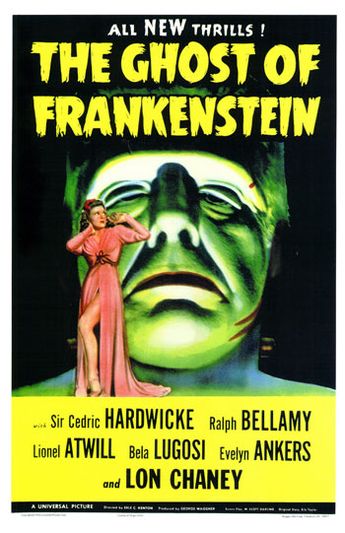
the_ghost_of_frankenstein_movie_poster

In 1942, three years after Son of Frankenstein, Universal Pictures continued the story of the Frankenstein family with The Ghost of Frankenstein!

However, The Ghost of Frankenstein was a far different film from the three that came before it.  The budget was lower.  The story was less complicated.  The running time was much shorter.  Whereas the previous films in the franchise clearly took place in Germany, the setting for The Ghost of Frankenstein is less easily defined.  (Considering that the film was made during World War II, this isn’t surprising.)  The biggest change is that, in The Ghost of Frankenstein, the monster is not played by Boris Karloff.  Instead, the role is taken by Lon Chaney, Jr.  Chaney’s hulking frame was perfect for the monster but his face is never as expressive as Karloff’s.  Whereas Karloff turned the monster into as much of a victim as a victimizer, Chaney plays the monster like a … well, a monster.

Returning from Son of Frankenstein, Bela Lugosi is back as Ygor.  At the start of the film, we learn that Ygor actually wasn’t killed at the end of Son of Frankenstein.  Instead, he was just wounded.  He’s spent the last few years hiding out in the old castle, trying to once again revive the monster.  When the villagers attempts to blow up the castle, he and the monster flee.

It turns out that there’s one other Frankenstein son.  His name is Ludwig and he’s played by a very dignified Sir Cedric Hardwicke.  Ludwig, who has been hiding his identity and denying the family legacy, has a successful medical practice in another village.  Working with his assistants, Dr. Kettering (Barton Yarbrough) and the bitterly jealous Dr. Bohmer (Lionel Atwill, who played a far different role in Son of Frankenstein), Ludwig has developed a procedure in which a damaged brain can be removed from the skull, repaired, and then stuck back inside the skull…

Uhmmm … wow, I have no idea what to say about that.  That’s quite a medical breakthrough, though…

When Ygor and the monster show up in the village, searching for Ludwig, the monster ends up getting arrested.  The local prosecutor (played by Ralph Bellamy, Cary Grant’s romantic rival in both The Awful Truth and His Girl Friday) asks Ludwig to examine the prisoner.  Ludwig is shocked to discover that the prisoner is his father’s creation!

Ygor wants Ludwig to perform a brain transplant on the Monster.  At first, Ludwig is hesitant but then he’s visited by Henry Frankenstein’s ghost.  (Since Colin Clive died 5 years before Ghost of Frankenstein went into production, Hardwicke plays both Ludwig and Henry.)  The ghost asks Ludwig to perfect the monster.

Ludwig finally relents and agrees to give the monster a new brain.  Ludwig wants to use the brain of kindly colleague but Ygor has different plans…

The Ghost of Frankenstein is only 67 minutes long but, oddly, it still feels just a little bit draggy.  Director Erle C. Kenton does a workmanlike job but, at no point, does Ghost feature the wit that distinguished James Whale’s films or Rowland V. Lee’s work on Son of Frankenstein.  Chaney is not a particularly interesting monster but Bela Lugosi is a lot of fun as Ygor.  With Chaney showing even less emotion than he usually did and Hardwicke appearing to be occasionally embarrassed by the whole film, it falls to Lugosi to keep the audience awake and he manages to do just that.  Lugosi’s performance may be overly theatrical but that’s exactly what The Ghost of Frankenstein needed.

The Ghost of Frankenstein is occasionally entertaining but ultimately forgettable.  It’ll best be enjoyed by Universal horror completists.

Cleaning Out The DVR #22: The Good Earth (dir by Sidney Franklin)


(For those following at home, Lisa is attempting to clean out her DVR by watching and reviewing 38 films by this Friday.  Will she make it?  Keep following the site to find out!)

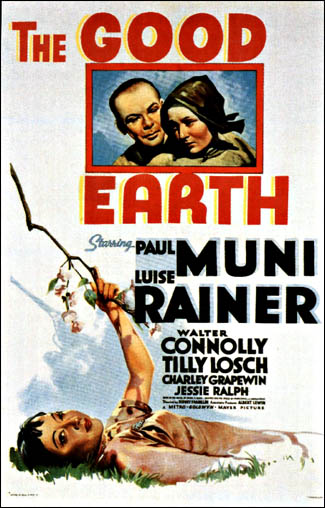
Good_earth_(1937)

The 1937 film The Good Earth is a strange one.

It’s a big, epic film about life in China in the years before World War I.  It opens with a poor farmer named Wang (Paul Muni) marrying a servant girl named O-Lan (Luise Rainer).  O-Lan is quiet but strong and, with her support, Wang eventually starts to prosper.  He buys land and they have children.  Together, Wang and O-Lan manage to survive both famine and a political upheaval.  In fact, it’s China’s volatile politics that occasionally allow the family to survive.  When a revolutionary mob loots a mansion, O-Lan joins in just long enough to come across a bag of diamonds that the Wang uses to eventually buy the biggest house in town.  Once he’s become wealthy and complacent, Wang ends up taking on a younger, second wife (Tilly Losch) and O-Lan finds herself competing for his attention.  Ultimately, it’s only when Wang is again forced to tend to the Earth that he understands what is really important.

So, here’s the weird thing about The Good Earth.  It’s a film about China.  It covers several years of Chinese history and the story itself is rooted in Chinese culture.  All of the characters are meant to be Chinese.  When the movie was filmed, China was at war with Japan so it’s not surprising that the film was shot in California.  But what is interesting (though not really surprising when you consider the history of Hollywood) is that there are very few Chinese people in the cast and none of them play any of the major roles.

Instead, Wang was played by Austria-born, Chicago-raised Paul Muni.  O-Lan was played by German Luise Rainer.  Wang’s comic relief uncle was played by American character actor Walter Connolly while his father was played by a former vaudeville star from Ohio named Charley Grapewin.  All of the actors are heavily made up so that they’ll look Chinese but none of them act or sound Chinese.  It makes for a very strange viewing experience.

And it’s a bit unfortunate because there are some very good scenes in The Good Earth.  Technically, it’s a very strong film.  Towards the end, there’s a locust invasion that is still thrilling to watch.  The sets look great.  The costumes look great.  If you’re a history nerd like me, the story has the potential to be interesting.  But, whenever you start to get sucked into the film’s story, Wang starts to speak and sounds totally like a guy from Chicago and it takes you out of the movie.  The uneven mix of quality and miscast actors makes for a rather disjointed viewing experience.

As a big epic, it’s probably not surprising that The Good Earth was nominated for best picture.  However, it lost to another Paul Muni film, The Life of Emile Zola.

http://www.youtube.com/watch?v=3iEREqQjjzU

Embracing the Melodrama Part II #6: Berkeley Square (dir by Frank Lloyd)


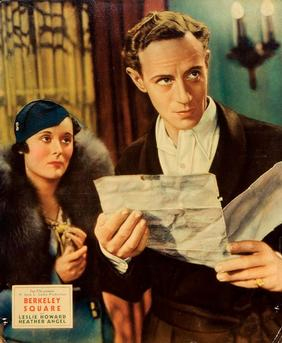
Berkeley_Square_(1933,_Lobby_Card)For today’s final entry in Embracing the Melodrama Part II, we take a look at the 1933 film, Berkeley Square.

Berkeley Square opens in 1784.  An American named Peter Sandish (Leslie Howard) has come from New York to England.  Stopping off at an inn, he explains that he’s on his way to London.  He has distant relations who live in a mansion located in Berkeley Square and it’s been arranged that Peter is going to marry his cousin, Kate Pettigrew (Valerie Taylor).  As Standish talks, he’s interrupted by another man who excitedly announces that a Frenchman has flown across the English Channel in something called a “balloon.”

“It’s beginning,” Peter says, “A new age of speed and innovation…”

Suddenly, the film jumps forward over a hundred years.  In 1933, Standish’s descendant — also named Peter and also played by Leslie Howard — has inherited the family’s old house at Berkeley Square.  He’s spent several days locked away in the mansion, obsessively reading the first Peter’s diary and refusing to see his fiancée, Marjorie (Betty Lawford).

It turns out that Peter — much like Owen Wilson in Midnight in Paris — is frustrated with the modern world and desperately wants to live in the past.  He believes that if he continues to stay in the house, he will eventually be transported back to 1784.  When a friend points out that, even if time travel was possible, Peter would end up changing the past, Peter explains that he’s memorized the first Peter’s diary and, therefore, he knows everything that he needs to say and do.

And then, one night, Peter suddenly does find himself in 1784.  Having taken his ancestor’s place, he meets the Pettigrews, makes plans to marry Kate, and attempts to adapt to 18th century London society.

Unfortunately, this turns out to be not as easy as he thought.  Despite his best efforts, Peter keeps using 1930s slang and alluding to events that will happen in the future.  At first, he explains away his habit of using modern phrases by saying that he’s using common New York expressions.  However, the increasingly suspicious Kate takes a list of Peter’s phrases to the U.S. Ambassador (who is none other than future President John Adams) and is informed that nobody in New York speaks that way.  As well, Peter’s insistence on regular bathing is viewed as odd by the members of upper class London society.  (“I heard he used three buckets of water,” someone accusingly whispers.)  Soon, Kate is convinced that Peter has been possessed by a demon.

An even bigger problem for Peter is that he’s not in love with Kate.  Instead, he’s fallen in love with Kate’s headstrong younger sister, Helen (Heather Angel).  When Helen discovers that Peter is from the future, Peter is forced to decide whether to continue to stay among the “living ghosts” or whether to return to his own time.

Berkeley Square shows on up on TCM fairly frequently and I absolutely love it.  To a certain extent, of course, this is because I’m a secret history nerd and there’s a part of me that will always wish that I could travel in time and experience the past firsthand.  (That said, after watching Berkeley Square, I don’t think I could handle 18th century hygiene.  Agck!)  But the main reason that I love Berkeley Square is because I love a good romance.  And this is such a romantic film!  Heather Angel and Leslie Howard have a really sweet and likable chemistry and, with his performance here, Howard shows why he would be the perfect choice to play the earnest, well-meaning, and ultimately tragic Ashley Wilkes in Gone With The Wind.

Keep an eye out for Berkeley Square.  You won’t be sorry.