4 Shots From 4 Films is just what it says it is, 4 shots from 4 of our favorite films. As opposed to the reviews and recaps that we usually post, 4 Shots From 4 Films lets the visuals do the talking!
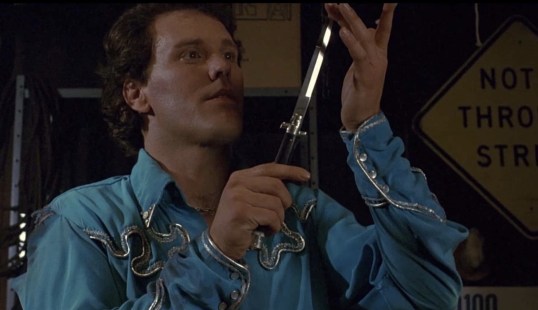
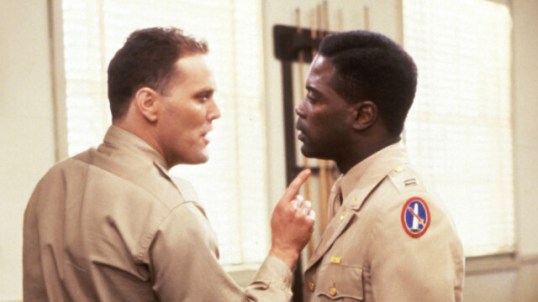
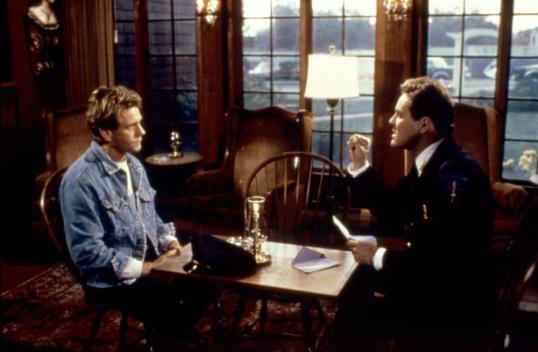
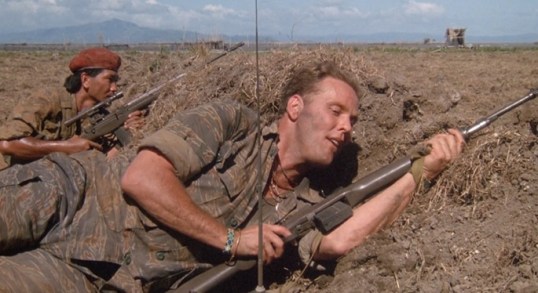
Today would have been the birthday of Wings Hauser. It’s time for….
4 Shots From 4 Wings Hauser Films
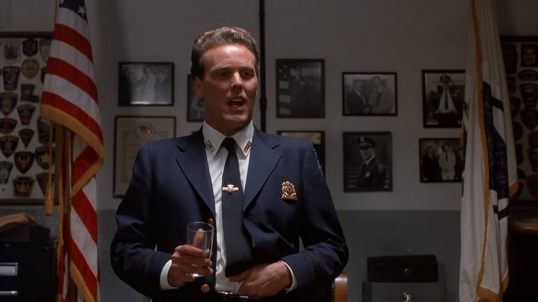
Vice Squad (1982, dir by Gary Sherman, DP: John Alcott)
A Soldier’s Story (1984, dir by Norman Jewison, DP: Russell Boyd)
Tough Guys Don’t Dance (1987, dir by Norman Mailer, DP: Mike Moyer)
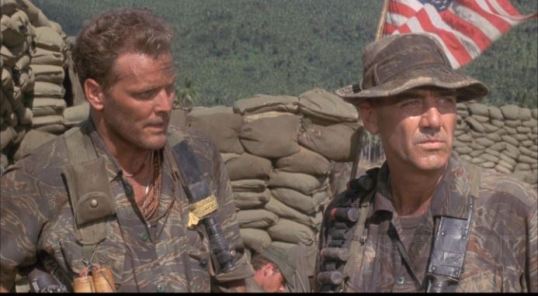
The Siege of Firebase Gloria (1989, dir by Brian Trenchard-Smith, DP: Kevin Lind)
The 1987 film, Tough Guys Don’t Dance, opens with Tim Madden (Ryan O’Neal) talking to his father, tough Dougy (Lawrence Tierney). Dougy has stopped by Tim’s New England home to let Tim know that he has decided stop chemotherapy and accept his eventual death from cancer because, as Dougy puts it, “Tough guys don’t dance.” The tone of Dougy’s voice is all we need to hear to know that, in his opinion, his son has spent way too much time dancing.
Tim is an ex-convict turned writer and, when we first see him, he’s obviously had a few rough nights. He explains to Dougy that he woke up after a bender with his ex-girlfriend’s name tattooed on his arm, blood all over his jeep, and two heads dumped in his marijuana stash. Tim says that he’s hopeful that he’s not the murderer but he can’t be sure. He’s been drinking and doping too much. He suffers from blackouts. He’s not sure what happened.
The majority of the film is made up of flashbacks, detailing Tim’s affairs with a number of women and also his odd relationship with the town’s police chief, Luther Regency (Wings Hauser). Luther is married to Tim’s ex-girlfriend, Madeleine (Isabella Rossellini), who long ago accompanied Tim on a trip to North Carolina where they hooked up with a fundamentalist preacher (Penn Jillette) and his then-wife, Patty Lariene (Debra Sundland). (Tim found their personal ad while casually skimming the latest issue of Screw, as one does I suppose.) Patty Lariene eventually ended up married to Tim, though she has recently left him. As for Madeleine, she has never forgiven him for a car accident that they were involved in. Is Tim capable of loving anyone? Well, he does say, “Oh God, oh man,” repeatedly when he discovers that his wife has been having an affair.
Tim tries to solve the murders himself, finding that they involve not only him and Luther but also Tim’s old prep school friend, Wardley Meeks III (John Bedford Lloyd) and also some rather stupid drug dealers that Tim hangs out with. The plot is almost ludicrously convoluted and it’s tempting to assume that the film is meant to be a parody of the noir genre but then you remember that the film is not only based on a Norman Mailer movie but that it was directed by Mailer himself. Mailer, who was the type of public intellectual who we really don’t have anymore, was blessed with a brilliant mind and cursed with a lack of self-awareness. There’s little doubt that we are meant to take this entire mess of a film very seriously.
And the film’s theme isn’t hard to pick up on. By investigating the murders, Tim faces his own troubled past and finally comes to understand why tough guys, like his father, don’t hesitate to take action. Tough guys don’t dance around what they want or need. That’s a pretty common theme when it comes to Mailer. Tim Madden is not quite an autobiographical character but he is, by the end of the story, meant to represent the type of hard-living intellectual that Mailer always presented himself as being. Unfortunately, Ryan O’Neal wasn’t exactly an actor who projected a good deal of intelligence. And, despite his lengthy criminal record off-screen, O’Neal’s screen presence was somewhat docile. That served him well in films like Love Story and Barry Lyndon. It serves him less well in a film like this. It’s easy to imagine O’Neal’s Tim getting manipulated and, in those scenes where he’s supposed to be a chump, O’Neal is credible enough in the role. It’s far more difficult to buy the idea of Tim actually doing something about it.
Indeed, it’s hard not to feel that co-star Wings Hauser would have been far more credible in the lead role. But then, who would play Luther Regency? Hauser gives such a wonderfully unhinged and out-there performance as Luther that it’s impossible to imagine anyone else in the role. Maybe Hauser could have played both Tim and Luther. Now that would have made for a classic film!
Tough Guys Don’t Dance is weird enough to be watchable. The dialogue is both raunchy and thoroughly humorless, which makes it interesting to listen to, if nothing else. The moments that are meant to be funny are so obvious (like casting noted atheist Penn Jillette as a fundamentalist) that it’s obvious that the moment that feel like clever satire were actually all a happy accident. As far as Norman Mailer films go, this one is not as boring as Wild 90 but it also can’t match the unhinged lunacy of a frustrated Rip Torn spontaneously attacking Mailer with a hammer at the end of the unscripted Maidstone. It’s a success d’estime. Mailer flew too close to the sun but the crash into the ocean was oddly entertaining.
4 Shots From 4 Films is just what it says it is, 4 shots from 4 of our favorite films. As opposed to the reviews and recaps that we usually post, 4 Shots From 4 Films lets the visuals do the talking!
Today, it’s time for….
4 Shots From 4 Wings Hauser Films
Vice Squad (1982, dir by Gary Sherman, DP: John Alcott)
A Soldier’s Story (1984, dir by Norman Jewison, DP: Russell Boyd)
Tough Guys Don’t Dance (1987, dir by Norman Mailer, DP: Mike Moyer)
The Siege of Firebase Gloria (1989, dir by Brian Trenchard-Smith, DP: Kevin Lind)
Norman Mailer was better-known as a writer than a filmmaker but, over the course of his limited directorial career, he did come up with one scene that will never be forgotten. That scene is a scene that I love from 1987’s Tough Guys Don’t Dance.
Norman Mailer, running for mayor of New York City in 1969
4 (or more) Shots From 4 (or more) Films is just what it says it is, 4 (or more) shots from 4 (or more) of our favorite films. As opposed to the reviews and recaps that we usually post, 4 (or more) Shots From 4 (or more) Films lets the visuals do the talking.
Norman Mailer wasn’t just a writer and symbol of New York City. He was also an aspiring filmmaker, a director who made three experimental films in the 60s and one studio film in the 80s. And while none of his films could really be described as being a hit with either audiences or critics, they do — to a certain extent — epitomize an era. Plus, the story of Rip Torn hitting Mailer with a hammer during the filming of Maidstone will live forever.
In honor of Norman Mailer the director, here are….
4 Shots From 4 Norma Mailer Films
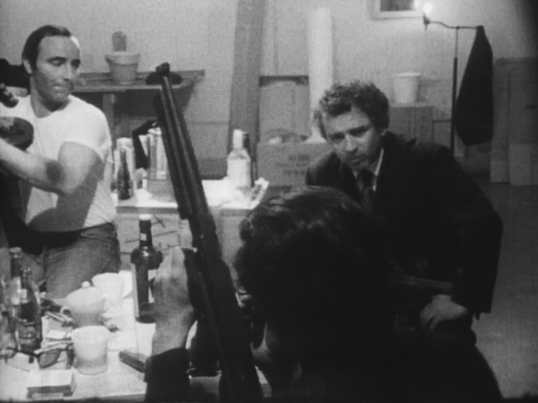
Wild 90 (1968, dir by Norman Mailer, DP: D.A. Pennebaker)
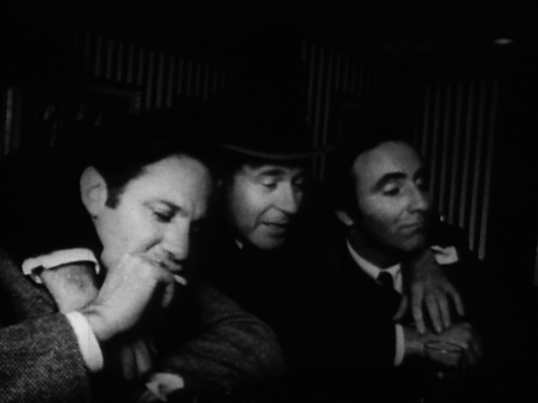
Beyond The Law (1968, dir by Norman Mailer, DP: D.A. Pennebaker)
Maidstone (1970, dir by Norman Mailer, DP: D.A. Pennebaker)
Tough Guys Don’t Dance (1987, dir by Norman Mailer, DP: Mike Moyer and John Bailey)
Produced, directed, financed by, and starring writer Norman Mailer, 1968’s Wild 90 is incomprehensibly bad. Words escape me when it comes to describing just how boring and pointless this film.
Over the course of four nights, Mailer and two of his friends were filmed in a shabby apartment. Norman Mailer played The Prince, a gangster who talks tough and is constantly doing stuff like punching the room’s only hanging lightbulb. Buzz Farber and Mickey Knox played Cameo and Twenty Years, the Prince’s partners in crime. Acclaimed documentarian D.A. Pennebaker served as cinematographer, using a hand-held camera to capture the three men as they drank, laughed, fought, and pretended to be gangsters.
The plot of the film is not easy to describe, both because the entire film was improvised and also because the soundtrack is so muddy that it’s often impossible to understand what anyone’s saying. As far as I can tell, the Prince’s latest criminal scheme has gone south and the Prince and his two cronies are hiding out in the apartment until the heat dies down. They don’t have much to do, other than drink and exchange profane dialogue. (The three men do their best to sound like real-life, poetically crude gangsters. It’s hard to judge how well they do any of that because the dialogue is often incomprehensible.) Some people drop by the apartment. Normally, that would liven things up but in this one, everyone just seems like they want to leave before Norman Mailer accidentally punches them. One man comes in a with a dog that start barking. Mailer barks back until the dog falls silent.
Making all of this interesting is the fact that, in the 1960s, Norman Mailer was one of America’s leading public intellectuals. Today, living in the age of influencers, it can be easy to forget that there were once public intellectuals, like Mailer, William F. Buckley, Gore Vidal, John Kenneth Galbraith, and Tom Wolfe, who disagreements were followed by the public and who made headlines when they showed up drunk on the daytime talk shows. Mailer was an acclaimed and often controversial writer, one who was as famous for his arrogance and his public feuds as for his novels and essays. Mailer was a New York fixture and a Pulitzer Prize winner He was one of the first writers to suggest that the Left and the Right could be united by a shared belief in individual freedom. A year after the release of Wild 90, Mailer ran an ill-fated campaign for mayor of New York City. His slogan was “No more bullshit!” and his campaign, which attracted some attention early on, was ultimately sabotaged by his habit of showing up drunk to his rallies and insulting his supporters.
What he was not was a very good filmmaker. Wild 90 was Mailer’s first film and it’s a nearly unwatchable disaster. (At least his later film, Maidstone, had Rip Torn around to liven things up.) With its low-budget, black-and-white look and it’s DIY aesthetic, Wild 90 may remind some of the Andy Warhol’s Factory films but Warhol (or, if we’re to be absolutely honest, Paul Morrissey) was at least trying to be subversive. Wild 90, on the other hand, is pure self-indulgence, a chance for Mailer to say, “Look how funny I am!” Farbar and Knox at least manage to give semi-believable performances. Mailer continually looks straight at the camera and seems to panic whenever either of his co-stars start to take the attention off of him. The entire film seems to be Mailer’s attempt to convince everyone that he really was a tough guy.
There is one moment of the film that does work. The film opens with some gorgeously shabby images of lower Manhattan. Norman Mailer was a proud New Yorker so it’s appropriate that the best part of the film is the part that highlights the city he loved.
Loosely based on a novel by Norman Mailer, the 1966 film, An American Dream, tells the story of Stephen Rojack (Stuart Whitman). Rojack’s a war hero, a man who has several medals of valor to his credit. He’s married to Deborah (Eleanor Parker), the daughter of one of the richest men in the country. He’s an acclaimed writer. He’s got his own television talk show in New York. He’s been crusading against not only the Mafia but also against corruption in the police department. He has powerful friends and powerful enemies. You get the idea.
He’s also got a marriage that’s on the verge of collapse. Deborah calls Rojack’s show and taunts him while he’s on the air. When Rojack goes to her apartment to demand a divorce, the two of them get into an argument. Deborah tells him that he’s not a hero. She says he only married her for the money and that she only married him for the prestige. She tells him that he’s a lousy lover. Being a character in an adaptation of a Norman Mailer novel, the “lousy lay” crack causes Rojack to snap. He attacks Deborah. The two of them fight. Deborah stumbles out to the balcony of her apartment and it appears that she’s on the verge of jumping. Rojack follows her. At first, he tries to save her but then he lets her fall. She crashes down to the street, where she’s promptly run over by several cars. The cars then all run into each other while Rojack stands on the balcony and wails. There’s nothing subtle about the first 15 minutes of An American Dream.
Actually, there’s nothing subtle about any minute of An American Dream. It’s a film where everything, from the acting to the melodrama, is so over-the-top and portentous that it actually gets a bit boring. There’s no relief from the screeching and the inauthentic hard-boiled dialogue. When a crazed Rojack starts to laugh uncontrollably, he doesn’t just laugh. Instead, he laughs and laughs and laughs and laughs and laughs and …. well, let’s just say it goes on for a bit. It’s like a 60s version of one of those terrible Family Guy jokes.
Anyway, the police don’t believe that Deborah committed suicide but they also can’t prove that Rojack killed her. Meanwhile, within hours of his wife’s death, Rojack meets his ex-girlfriend, a singer named Cherry (Janet Leigh). Rojack is still in love with Cherry but Cherry is also connected to the same mobsters who want to kill Rojack. Meanwhile, Deborah’s superrich father (Lloyd Nolan) is also on his way to New York City, looking for answer of his own.
An American Dream is a very familiar type of mid-60s film. It’s a trashy story and it’s obvious that the director was trying to be as risqué as the competition in Europe while also trying to not offend mainstream American audiences. As such, the film has hints of nudity but not too much nudity. There’s some profanity but not too much profanity. Rojack, Deborah, and Cherry may curse more than Mary Poppins but they’re rank amateurs compared to the cast of Who’s Afraid of Virginia Woolf? It’s an unabashedly melodramatic film but it doesn’t seem to be sure just how far it can go in embracing the melodrama with alienating its target audience so, as a result, the entire film feels somewhat off. Some scenes go on forever. Some scenes feel too short. The whole thing has the washed-out look of an old cop show.
All of that perhaps wouldn’t matter if Stephen Rojack was a compelling character. In theory, Rojack should have been compelling but, because he’s played by the reliably boring Stuart Whitman, Rojack instead just comes across as being a bit of a dullard. He’s supposed to be a charismatic, two-fisted Norman Mailer-type but instead, as played by Whitman, Rojack comes across like an accountant who is looking forward to retirement but only if he can balance the books one last time. There’s no spark of madness or imagination to be found in Whitman’s performance and, as a result, the viewer never really cares about Rojack or his problems.
Noman Mailer reportedly never saw An American Dream, saying that it would be too painful to a bad version of his favorite novel. In this case, Mailer made the right decision.
Norman Mailer, running for mayor of New York City in 1969
4 (or more) Shots From 4 (or more) Films is just what it says it is, 4 (or more) shots from 4 (or more) of our favorite films. As opposed to the reviews and recaps that we usually post, 4 (or more) Shots From 4 (or more) Films lets the visuals do the talking.
Norman Mailer wasn’t just a writer and symbol of New York City. He was also an aspiring filmmaker, a director who made three experimental films in the 60s and one studio film in the 80s. And while none of his films could really be described as being a hit with either audiences or critics, they do — to a certain extent — epitomize an era. Plus, the story of Rip Torn hitting Mailer with a hammer during the filming of Maidstone will live forever.
In honor of Norman Mailer the director, here are….
4 Shots From 4 Norma Mailer Films
Wild 90 (1968, dir by Norman Mailer, DP: D.A. Pennebaker)
Beyond The Law (1968, dir by Norman Mailer, DP: D.A. Pennebaker)
Maidstone (1970, dir by Norman Mailer, DP: D.A. Pennebaker)
Tough Guys Don’t Dance (1987, dir by Norman Mailer, DP: Mike Moyer and John Bailey)
If you ever find yourself on the campus of the University of North Texas and you need to kill some time, stop by the UNT Library, go up to the second floor, find the biographies, and track down a copy of Peter Manso’s Mailer: His Life and Times.
Back in December of 2007, at a time when I really should have been studying for my finals, I spent an entire afternoon in the library reading Manso’s book. I didn’t know much about Norman Mailer, the Pulitzer prize-winning writer and occasional political candidate, beyond the fact that he died that previous November and that a lot of older people who I respected apparently thought highly of his work. Though Manso’s book had been written 20 years earlier, it still provided an interesting portrait of the controversial author. It was largely an oral history, full of interviews with people who had known Mailer over the years. As I skimmed the book, it quickly became apparent that, among other things, Mailer was a larger-than-life figure.
For me, the book was at its most interesting when it dealt with Mailer’s attempts to be a filmmaker. In the 1960s, Mailer directed three movies. All three of them also starred Norman Mailer and featured his friends in supporting roles. All three of them were largely improvised. And, when released into theaters, all three of them were greeted with derision.
Maidstone, Mailer’s 3rd film, was filmed in 1970. In the film, Mailer played Norman Kingsley, an avante garde film director who is running for President. Over the course of one weekend, while also working on a movie about a brothel, Norman meets with potential supporters and debates the issues. And, of course, shadowy figures plot to assassinate Norman, not so much because they don’t want him to be President as much as they want him to be a martyr for their vaguely defined cause.
Just based on what I read in Manso’s book, it’s hard not to feel that the making of Maidstone could itself be the basis of a good movie. Mailer essentially invited all of his friends to his estate and they spent 5 days filming, with no script. It was five days of drinking, drugs, and bad feelings.
At one point, actor and painter Herve Villechaize (who would later play Knick Knack in The Man With The Golden Gun) got so drunk and obnoxious that he was picked up by actor Rip Torn and literally tossed over a fence. The unconscious Villechaize ended up floating face down in a neighbor’s pool. After fishing Villechaize out of the pool, the neighbor tossed him back over the fence and shouted, “Norman, come get your dwarf!”
Eventually, after five days, filming fell apart. Some members of the cast were okay with that. And one most definitely was not..
Fortunately, Maidstone is currently available on YouTube so I watched it last night. Unfortunately, the film itself is never as interesting as the stories about what went on behind the cameras. Maidstone is essentially scene after scene of people talking and the effectiveness of each scene depends on who is in it. For instance, Norman’s half-brother is played by Rip Torn, a professional actor with a big personality. The scenes with Torn are interesting to watch because Rip Torn is always interesting to watch. However, other scenes feature people who were clearly cast because they happened to be visiting the set on that particular day. And these scenes are boring because, quite frankly, most people are boring.
And then you’ve got Norman Mailer himself. For an acclaimed writer who was apparently quite a celebrity back in the day, it’s amazing just how little screen presence Norman Mailer had as an actor. Preening for the camera, standing around shirtless and showing off his hairy back along with his middle-aged man boobs, Mailer comes across as being more than a little pathetic. He’s at his worst whenever he tries to talk to a woman, giving off a vibe that’s somewhere between creepy uncle and super veiny soccer dad having a midlife crisis.
It’s an uneven film but, for the first half or so, it’s at least interesting as a time capsule. For those of us who want to know what rich intellectuals were like in the late 60s, Maidstone provides a service. However, during the second half of the film, it becomes obvious that Mailer got bored. Suddenly, all pretense towards telling an actual story are abandoned and the film becomes about Mailer asking his cast for their opinion about what they’ve filmed so far.
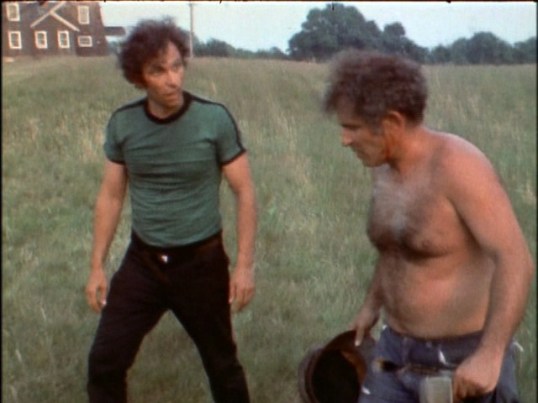
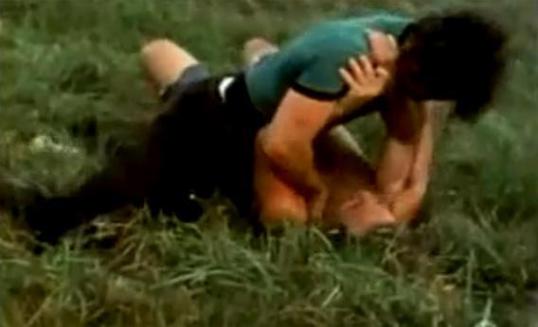
And then, during the final 15 minutes of the film, Norman Mailer decides to have the cameramen film him as he plays with his wife and children. This is apparently too much for Rip Torn who, after spending an eternity glaring at Mailer and undoubtedly thinking about everything he could have been doing during those five day if he hadn’t been filming Maidstone, walks up to Mailer, says, “You must die, Kingsley,” and then hits Mailer on the head with a hammer.
This, of course, leads to a long wrestling match between Mailer and Torn and, as the cameras roll, blood is spilled and insults are exchanged. There’s a lot of differing opinions about whether this final fight was spontaneous or staged. Having seen the footage, I get the impression that Mailer was caught off guard but that Torn probably let the cameraman know what he was going to do ahead of time.
Regardless, it’s hard to deny that the pride of Temple, Texas, Elmore “Rip” Torn, appears to be the one who came out on top. After the fight, Mailer and Torn have a lengthy argument that amounts to Rip saying that he had to do it because it was the only way that the film would make sense while Mailer replies with some of the least imaginative insults ever lobbed by a Pulitzer winner.
(So basically, Rip Torn won both the physical and the verbal rounds of the fight.)
Anyway, you can watch the entire Rip Torn/Norman Mailer confrontation below.
Now, while the fight is really the only must-see part of Maidstone, it still has considerable value as a time capsule of the time when it was made. You can watch it below!
I should admit that the title of this post is misleading. While it is true that listed below are 12 of my favorite non-fiction books of 2013, I’ve specifically limited my picks to books that dealt with entertainment, pop culture, and the creative process. With that in mind, here are my 12 favorite non-fiction books of 2013:





 Through the Shattered Lens