Retro Television Review: Night Partners (dir by Noel Nosseck)


Welcome to Retro Television Reviews, a feature where we review some of our favorite and least favorite shows of the past!  On Sundays, I will be reviewing the made-for-television movies that used to be a primetime mainstay.  Today’s film is 1983’s Night Partners!  It  can be viewed on Tubi.
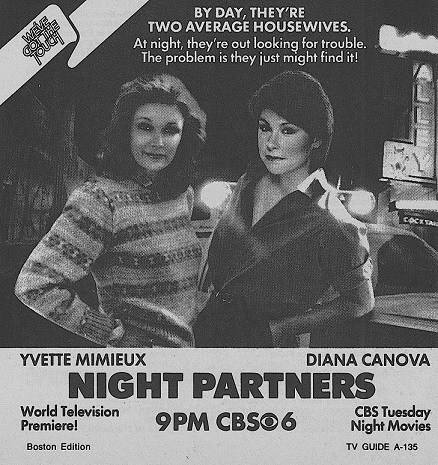
Lauren Hensley (Diana Canova) is a divorced mother who has a nice house in Bakersfield, California.  Her best friends and neighbors are housewife Elizabeth McGuire (Yvette Mimieux) and Elizabeth’s husband, a cop named Glenn (Arlen Dean Snyder).  One night, after spending the day with the McGuires, Lauren returns to her home and is attacked by three burglars.

For Lauren, the crime is not even the worst part of the night.  The worst part is when the police don’t even seem to care that much about her suffering and instead take a “just-the-facts” approach to getting the details to what she’s been through.  Glenn attempts to explain to both Lauren and Elizabeth that cops see terrible things every day and, if they seem desensitized to it all, that’s just their way to handling the stress of the job.  Lauren, however, feels that the cops need a unit that provides the same support for victims that the criminals receive from their lawyers and social workers.

At a community meeting, Lauren proposes her idea to the police chief, John Wilson (Larry Linville).  When Wilson replies that there is no money in the budget, Lauren suggests that maybe the program could be staffed by volunteers.  She then proceeds to volunteer herself and Elizabeth.  Wilson agrees, but on the requirement that Lauren and Elizabeth first attend the police academy and train with the officers.  Under the watchful eye of the gruff but kindly Joe Kirby (M. Emmet Walsh), the two middle-aged housewives run obstacle courses and learn about conflict resolution.  And while the conflict resolution lessons make sense, I’m not sure what the point of having them do the obstacle course was.

Eventually, Lauren and Elizabeth become quite good at their jobs, providing comfort to the victims and getting information that helps the police put away criminals, like the serial rapist (a young M.C. Gainey) who has been stalking the streets of Bakersfield.  Of course, it takes them a while to get good at the job.  When Elizabeth and Lauren are first sent out on the streets, they can’t even keep the police codes straight and they accidentally call in a robbery code when they’re instead just letting the dispatcher know that they’re on break.  Bizarrely, when Lauren and Elizabeth are not at a crime scene talking to a victim, they’re just supposed to drive around in a beat-up patrol car.  Neither one of them has the power to arrest anyone because they’re just volunteers.  In fact, they’re supposed to stay out of the way until the police specifically call for them to come to a crime scene.  So, why are they patrolling the city like real cops?  It seems like that would basically be a lawsuit waiting to happen.

Night Partners was obviously designed to serve as a pilot for a series where Laruen and Elizabeth would comfort victims and help to solve crimes.  The two lead actresses are likable and M. Emmet Walsh is particularly effective as their supervisor.  That said, the film itself can’t decide if it wants to be a hard-hitting crime drama or a comedy about two housewives trying to make it as cops.  Of course, there’s no reason why it couldn’t be both.  Some of the best cops shows have had elements of dark, gallows humor.  But this film’s tone is so inconsistent that the comedic scenes seem to be taking place in an entirely different universe from the dramatic scenes.

As someone who strongly believes that the right of the victims need to be given as much weight as the rights of the criminals, I appreciated the film’s message.  I just wish it had been delivered a bit more effectively.
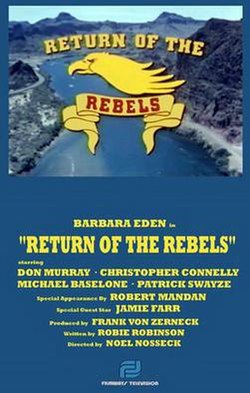
Retro Television Reviews: Return of the Rebels (dir by Noel Nosseck)


Welcome to Retro Television Reviews, a feature where we review some of our favorite and least favorite shows of the past!  On Sundays, I will be reviewing the made-for-television movies that used to be a primetime mainstay.  Today’s film is 1981’s Return of the Rebels!  It  can be viewed on YouTube!

Mary Beth Allen (Barbara Eden) used to be the wife of the leader of Rebels, Arizona’s toughest motorcycle gang.  She’s now a widow and she operates a Colorado River campground.  Her teenager daughter, Amy (Deanna Robbins), has got a crush on a local boy named K.C. Barnes (Patrick Swayze) and that’s a problem because K.C. is kind of a jerk.

Every weekend, K.C. and his gang descend on the campground and proceed to have a good time, redneck-style.  They set up a few kegs of beer.  They water ski.  They play loud music.  They get into fights.  They drive their vans all over the property.  They are so disruptive that Mary Beth is losing customers.  For reasons that are not quite clear, the police refuse to help her.  For some reason, K.C. seems to be determined to drive Mary Beth out of business.  And when I say “for some reason,” what I mean is that there’s absolutely no reason for K.C. to be as obnoxious as he is.  It’s not like he owns a rival campground or anything.  He’s not going to gain a thing by running Mary Beth out of business.  K.C.’s only motivation seems to be that he’s a jerk.  Unfortunately, he’s played by a young Patrick Swayze, who was a bit too likable to be believable as someone who would be a jerk just for the Hell of it. Swayze smirks and sneers and laughs whenever Mary Beth yells at him but, up until the last few moments of the film, he still comes across more as being an overgrown teenager who is too dumb to realize how annoying he’s being than a true villain.  When K.C. does suddenly reveal himself to be a true villain, it’s a bit jarring.  It’s like seeing the neighborhood bully suddenly pick up a gun and rob a bank.  Swayze’s character was definitely bad but he didn’t seem that bad,

Regardless of K.C.’s level of villainy, his antics are threatening to put Mary Beth out of business.  She goes into the city and pays a visit on Sonny (Don Murray).  Sonny used to be a member of the Rebels.  Now, he’s a fairly successful auto mechanic.  He’s also always been in love with Mary Beth.  When he finds out that Mary Beth needs help, he decides that it’s time to get the old Rebels back together so that they can put some young punks in their place. 

The problem, of course, is that some of the old Rebels are really, really old.  Al Williams (Robert Mandan) was once the most fearsome dude on a motorcycle but now he sells used cars and collapses after he’s challenged to run down to the end of the street.  Mickey Fine (Jamie Farr) is now more concerned with taking care of his family than riding motorcycles.  Jay Arnold Wayne (Christopher Connelly) is a wealthy businessman who …. well, he doesn’t get much of a personality beyond that.  “Wild” Bill Karp (Michael Baseleon) is still wild but he’s also middle-aged and out-of-shape.  

Can Sonny get the gang back together before K.C. takes over the campground?  And even if he can, will he able to gather enough former Rebels to take on K.C.’s surprisingly large gang?  Seriously, when K.C. and his gang show up at the campground, K.C. appears to be leading a convoy.  It’s almost as if the entire population of Arizona is following K.C. around for the weekend.

As you may have already guessed, Return of the Rebels struggles to find a consistent tone.  On the one hand, the battle between the old bikers and the young rednecks is a dangerous one and the film tries to generate some suspense over whether everyone will survive.  On the other hand, the film’s cast is full of sitcom veterans who often deliver their lines as if they’re waiting for a laugh track to punctuate their point.  On the one hand, Patrick Swayze’s gang is supposed to be dangerous.  On the other hand, they’re Patrick Swayze’s gang.  For a bunch of delinquents, it seems like all they really want to do is spend the weekend water skiing and drinking beer.  Obviously, beer and motorboats don’t always go well together but Swayze and his friends still never come across as being quite as dangerous as they’re supposed to be.

Return of the Rebels is a film about getting old.  The members of the Rebels have all found success but all of them are nostalgic for their days of being “outlaw” bikers and they get one final chance to show everyone what they can do.  It’s not a bad theme but again, the film can never quite make up its mind how seriously it wants us to take either the Rebels or Swayze’s gang.  It’s a bit of a mess.  That said, the scenery was gorgeous and I’m enough of a country girl that I definitely got a little thrill out of watching scenes of various pickup trucks and vans driving through the river.  I have a weakness for rebels and reformed bikers.  It’s an amiable film, even if it doesn’t make much sense in the end.

Lisa Cleans Out Her DVR: Dreamer (dir by Noel Nosseck)


(I am currently trying to clean out my DVR!  I recorded this 1979 sports film off of FXM on February 1st!)

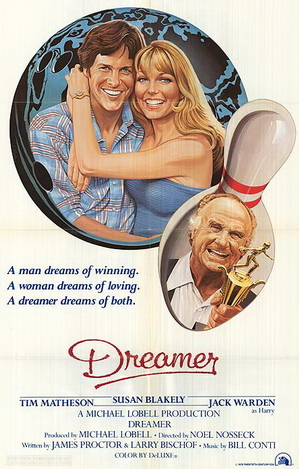
In Dreamer, Tim Matheson plays a character named Harold Nuttingham.  His nickname is Dreamer.  Do you think it’s possible that Harold has a dream!?  Well, it would probably be a really cruel nickname if he didn’t!

Dreamer lives in small town Illinois.  He loves to bowl.  He spends all of his time down at the local bowling alley, where everyone knows him and they all love him and his dreams of becoming a professional bowler.  His mentor is named Harry White (Jack Warden) and runs the pro shop.  Harry dreamed of being a famous, champion bowler but his dreams didn’t come true.  But now he can help Dreamer’s dreams work out.  Everyone loves the fact that Harry is helping Dreamer.  Dreamer’s girlfriend is named Karen Lee (Susan Blakely).  She loves that Dreamer loves bowling but she is frustrated because everyone keeps telling Dreamer that it would be a mistake to take her to his games.  Karen might bring bad luck.

Everyone in his hometown loves Dreamer but the Professional Bowling Association (which apparently is an actual thing) doesn’t love Dreamer.  They don’t want to let Dreamer compete on a professional level.  Or, at least, they don’t until Dreamer meets with them personally and shows off his amazing bowling skills.  Then they love Dreamer.

Even though Dreamer is the new guy on the professional circuit, the audiences love him.  And all the other professional bowlers love him, even when they lose to him.  Everyone loves Dreamer, perhaps because everyone loves a dreamer…

Are you getting the impression that Dreamer might be one of the most positive movies ever made?  Well, it is.  Hardly anyone says a bad word about anyone in Dreamer.  Nobody tells Dreamer to give up.  Dreamer never really suffers from any self-doubt, though he does injure his thumb at one point.  There is a moment of tragedy towards the end of the movie but it’s one of those tragedies that leads to better things.  You can’t have light without a little darkness, though Dreamer seems to suggest that you can come awfully close.

Normally, films get on my nerves when they’re overwhelmingly positive but I can’t really complain about a movie like Dreamer.  It’s just so earnest and sincere.  There’s no real conflict and there’s no real drama but everyone in the movie is just so damn likable that you almost feel guilty for wishing something unexpected would happen.  Dreamer struggles and fails to make bowling cinematic but Dreamer’s a nice guy so you wish him the best.

Perhaps the most interesting thing about Dreamer is that it was directed by Noel Nosseck, who also directed an incredibly odd little grindhouse film called Best Friends.  Best Friends, which I recommend tracking down, is almost the anti-Dreamer.  Watch Best Friends to have your faith in humanity destroyed and then follow it up with Dreamer so your faith can be restored.

Or don’t.  It’s really up to you.

Back to School Part II #33: No One Would Tell (dir by Noel Nosseck)


no_one_would_tell

Do you remember when Chris Brown performed The Man In The Mirror at the 2010 BET Awards?  It was during a tribute to Michael Jackson and Brown broke down crying while singing the song.  Afterwards, he accepted an award and he said, “I let you all down before, but I won’t do it again.  I promise you.”

This, of course, was about a year after Brown had pled guilty to physically abusing Rihanna.  I remember being on twitter during Brown’s performance and seeing literally thousands of tweets from people talking about how brave Chris Brown was and how amazing his performance had been.  Chris Brown was looking at the man in the mirror and asking him to change his ways.  Chris Brown was promising not to let anyone else down by nearly killing any future girlfriends.  A lot of people on twitter claimed this was amazing.  I thought it was disgusting and I tweeted out my opinion.  I really didn’t give a fuck if Chris Brown was asking the man in the mirror to change his ways.  The man in the mirror was (and is) an abusive asshole.  The man in the mirror beats women.  The man in the mirror is not capable of changing his ways.  “FUCK THE MAN IN THE MIRROR!” I tweeted.

And, oh my God, the reaction my little twitter rant inspired.  What was especially disturbing was that the majority of people who tweeted me in Brown’s defense were other women.  Yes, they all agreed, Chris Brown had beat Rihanna but he admitted what he had done, he was asking the man in the mirror to change his ways, and hey, Rihanna probably deserved it.

My favorite excuse — and this was used by quite a few of Brown’s defenders — was this: “Only God can judge Chris Brown.”  Well, you know what?  I asked God and he says Chris Brown’s an abusive asshole.

I’m tempted to say that it amazes me that Chris Brown still has fans but actually, it doesn’t.  Sadly, when it comes to a celebrity, people are willing to make excuses for almost anything.  If you ask most people, they’ll say that they’re against domestic abuse and they think abusers should suffer the worst punishment imaginable.  But when the abuser is someone who they know (or, in the case of a celebrity like Chris Brown, someone who they feel they know), the excuses start.  The equivocations are heard.  The blame is assigned to everyone but the abuser.  We start hearing bullshit about how people make mistakes and only God can judge.

In short, people are willing to talk but when it matters, they rarely act.

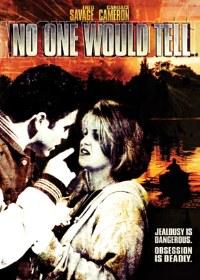
That’s also the theme of a powerful and sad movie called No One Would Tell.  No One Would Tell was originally made for television in 1996 and it still shows up fairly regularly on Lifetime.  Though the names and certain details have been changed, it’s based on a true story.  In fact, the film feels like it’s based on several true stories.  The plot of No One Would Tell is one that has occurred and continues to occur on far too regular of a basis.

Stacy Collins (played by Candace Cameron, before she added the Bure to her name) is a 16 year-old high school student.  She’s quiet, shy, and insecure.  When she first starts to date a popular jock named Bobby Tennison (Fred Savage), it seems like a dream come true.  But soon, Bobby starts to show another side.  He’s controlling and possessive.  He grabs her wrist hard enough to leave bruises.  He shoves her into a wall when they have an argument.  When she wears a skirt that he thinks is too short, he grabs her in the school hallway and demands that she change immediately.  When she isn’t home to answer his calls, he assumes that she most be cheating on him.  And, when she finally breaks up with him, he kills her.

What’s infuriating is that, throughout the film, Bobby’s abuse is witnessed by all of his and Stacy’s friends.  Everyone sees him push her.  Everyone sees the bruises.  Everyone knows that Bobby is unstable and that Stacy is afraid of him.  And yet, nobody says a word.  Nobody does a thing.  Instead, they just make excuses for Bobby’s behavior.  Some of them even blame Stacy.  No one is willing to get involved and it eventually costs Stacy her life.

For a TV movie from the mid-90s, No One Would Tell holds up surprisingly well.  Admittedly, Fred Savage overacts in the role of Bobby (and maybe it would have been better if the role had been played by Eric Balfour, who appears as Bobby’s best friend) but Candace Cameron does a perfect job as the tragic Stacy, capturing both her insecurity and her vulnerability.  Some of the film’s best moments are the ones shares by Cameron and Michelle Phillips.  In those scenes, we see how Stacy learned how to make excuses for Bobby’s behavior from watching the way that her mother made excuses for the men who similarly abused her.  No One Would Tell is a powerful film, one that offers an unflinching look at abuse and one that dares to demand that its audience take a stand.

No One Would Tell is a film that should be watched by anyone who thinks that the man in the mirror can change his ways.

Embracing the Melodrama Part II #52: Best Friends (dir by Noel Nosseck)


best-friends-lobby-3So, this is kind of a weird one.

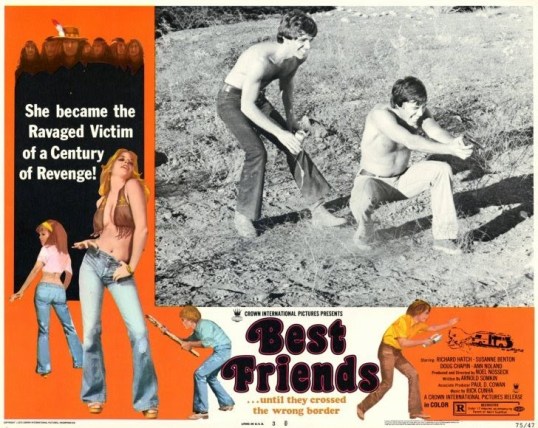
If the 1975 film Best Friends is known for anything, it’s probably the poster above.  As you can see, it features two women, being watched over by a shadowy group of Native Americans.  That tagline reads: “She became the ravaged victim of a century of revenge!”

Now, it’s often said that the above image has absolutely nothing to do with the actual film.  That’s actually not quite true.  There is a very brief scene where a woman and her boyfriend are at a bar and the boyfriend goads her into doing an impromptu striptease.  Sitting in the audience are some glowering American Indians.  There is a minor confrontation but otherwise, that’s it.  Nobody becomes “the ravaged victim of a century’s revenge.”  Instead, it was simply a marketing plot, used to draw audiences to a film that might otherwise have struggled to have been seen.

Perhaps not surprisingly, Best Friends is a Crown International Production.

CIP_LogoAs for what Best Friends actually is — well, it’s not easy to say.  It’s a very odd and very dark film, one that deals with characters who are ambiguous in more ways than one.  It’s one of those films that would be forgotten if it hadn’t, by chance, been included in a few dozen Mill Creek box sets and yet, from what I can tell, it has made an impression on just about everyone who has seen it.

In many ways, it’s a film that could only have been made in the 1970s.  Pat (Doug Chapin) and Jesse (Richard Hatch) served in Vietnam together and have remained close friends in America.  Jesse is serious and centered.  Pat is wild and impulsive.  Jesse has rented an RV and plans to drive across America with his fiancée, Kathy (Susanne Benton).  Pat suddenly announces that he’s engaged to and maybe he and Jo Ella (Ann Noland) could join Jesse and Kathy on their trip.  Even though Kathy would probably rather not have to share the RV with Pat’s old air force friend and his overly unstable girlfriend, Jesse readily agrees.

Now, I know this all sounds like the setup for a celebration of bromance but Best Friends actually has something else on its mind.  From the minute that Jesse and Pat get in that RV, it becomes obvious that they don’t have as much in common as they once did.  Jesse has matured.  He’s looking forward to the future and he wants to spend his time with Kathy.  Pat, however, is still obsessed with the past and wants to spend all of his time with Jesse.

As they drive across the country, Pat’s behavior starts to become more and more obsessive.  He cruelly breaks off his engagement with Jo Ella and then appears to be personally insulted when Jesse doesn’t do the same with Kathy.  He even buys a motorcycle so that he can ride behind, in front of, or next to the RV, as if the idea of even being inside of Jesse’s domesticated world would contaminate him.

And, since this is a Crown International Picture, Pat isn’t hesitant about using violence to try to keep Jesse and Kathy apart…

So, what is Pat’s problem?  A lot of reviewers have suggested that Pat is in love with Jesse and they’re probably right.  What’s interesting is that, consider that he’s the film’s nominal hero, Jesse isn’t that sympathetic of character.  If anything, he comes across as being a wimp, a guy who says he loves his fiancée but still won’t stand up for her.  As the film progresses, Jesse’s inherent impotence becomes both more obvious and more annoying.  By the end of the film, after all of the tragedy has played out, you can’t help but feel that Jesse and Pat don’t deserve any better than each other.

Best Friends is a deliberately paced and rather haunting little film.  It’s definitely one of the best of the many films to come out of Crown International Pictures.