Steve Anders (Peter Graves) and his teenage children, David (George O’Hanlon, Jr.) and Deborah (Kathleen Quinlan), are exploring a cave in the mountains of California when they experience a sudden earthquake. After managing to escape from the cave and meeting a man who tells them about how there was a bright flash of light in the sky before the earthquake, the three of them come down from the mountain and discover that there does not appear to be anyone around. Instead, where people once stood, there are now only piles of clothes and white dust. Where have all the people gone?
As the Anders try to make their way back home to Malibu, they discover that the entire world has changed. Towns are completely deserted and once friendly animals are now viscous and hostile. While Steve tries to keep his children from giving up hope, he also tries to find the answer to the question, where have all the people gone?
This film, which is only a little over an hour long, was made for NBC. Though the film’s short running time can sometimes make it feel rushed, Where Have All The People Gone? is still a effectively creepy movie from made-for-television specialist John Llewellyn Moxey. Though it’s always difficult to accept an actor like Peter Graves as being anyone other than Peter Graves, he actually did a pretty good job playing the confused father and there are some good scenes where both of his children deal with thing in their own way. (David refuses to get emotional. Deborah does the opposite. Only Steve understands the importance of mixing emotion with reason.) When they do finally find another survivor, she’s played by Verna Bloom and the scene where they come across her sitting in her car, apparently catatonic, is really well-handled.
Though the film does eventually explain where all the people have gone, it still has an unsatisfying, open-ended ending. It wouldn’t surprise me if this film was meant to be pilot for a potential televisions series because it ends with the promise of future adventures. A weekly tv series would have allowed the Anders family to find more survivors and more angry animals but instead, the story ends with everyone still unsure as to what type of world they’re about to inherit.
If you’re one of those who is stuck inside right now, Were Have All The People Gone? is reasonably diverting and is available on YouTube and Prime.
Today is Angie Dickinson’s 84th birthday. One of Angie’s best remembered films is Big Bad Mama, an entertaining and fast-paced gangster film that was produced by Roger Corman.
The year is 1932 and the setting is Texas. Wilma McClatchie (Angie Dickinson) is a poor single mother with two teenage daughters (Susan Sennett and Robbie Lee) to support. When Wilma’s bootlegger lover, Barney (Noble Willingham), is killed by the FBI, Wilma takes over his route. Wilma wants her daughters to be rich like “Rockefeller and Capone” and soon, they graduate from bootlegging to bank robbery. During one robbery, they meet and team up with Fred (Tom Skerritt). Wilma and Fred are lovers until Wilma meets alcoholic con man, Baxter (William Shatner). With Fred and Baxter competing for her affections and her youngest daughter pregnant, Wilma plans one final job, the kidnapping of a spoiled heiress (Joan Prather).
Big Bad Mama is one of the many Bonnie and Clyde rip-offs that Roger Corman produced in the 70s. (Corman also gave us Bloody Mama and Crazy Mama.) Big Bad Mama is a typical Corman gangster film, with fast cars, blazing tommy guns, Dick Miller, and plenty of nudity. Angie was in her 40s at the time and, justifiably proud of her body, her full frontal nude scenes created a lot of publicity for the film. William Shatner also strips down for the film and his sex scene with Angie is just as weird to watch as you would expect it to be.
The whole film changes as soon as William Shatner makes his first appearance. He may be speaking with a Southern accent and he may be playing a sniveling coward but he is still William Shatner, with all that implies. Watching Shatner, it is hard not to imagine that Big Bad Mama is actually a lost Star Trek episode where Kirk goes back in the past and meets special guest star Angie Dickinson. Far more effective is Tom Skerritt, who is thoroughly believable as a Dillinger-style bank robber.
In the style of Bonnie and Clyde, Big Bad Mama presents its outlaws as being counter-culture rebels. Every authority figure that Wilma meets — from a preacher played by Royal Dano to a corrupt sheriff to Dick Miller’s incompetent FBI agent — is presented as being hypocritical and arrogant. Angie plays Wilma as a strong-willed and sexually liberated woman who refuses to allow anyone to tell her how to live her life or raise her daughters. In the gang, both Fred and Baxter are subservient to her. Big Bad Mama’s tag line was “Hot lead! Hot legs! Hot damn!” and that is a perfect description of Angie Dickinson’s performance.
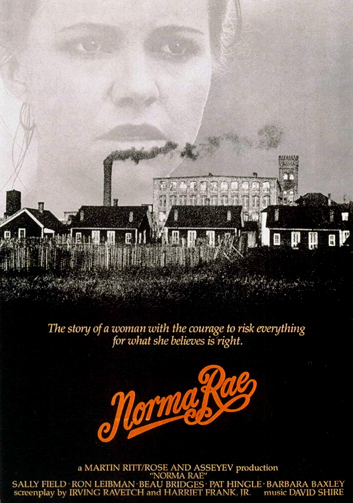
Earlier, in honor of Labor Day, I reviewed one of the most anti-labor union films ever made, the 1954 Oscar winner On The Waterfront. In the interest of fairness, it only seems right to now take a look at one of the most pro-union films ever made, the 1979 best picture nominee Norma Rae.
Norma Rae takes place in one of those small Southern towns that is defined by just one industry. In this case, almost everyone in town works for minimum wage at the local textile mill. Conditions are terrible, with the employees working long and brutal shifts in a hot and poorly ventilated factory. The overwhelming roar of the machines have left the majority of the workers deaf to reality, both figuratively and literally. The mill is run by the usual collection of slow-talking, tie-wearing rednecks who always seem to show up in movies like this.
One day, a union organizer from New York shows up in town. Brash and cocky, Ruben Warshowsky (Ron Leibman) is determined to unionize the mill but, at first, he struggles. Nobody wants to risk their job by being seen with him and his Yankee manners rub many of the townspeople the wrong way.
Eventually, Ruben does find one ally. Norma Rae (Sally Field) has worked at the mill her entire life. She’s tough and determined but she’s also regularly shunned because of her past. A widow who has three children (“She’s had a child out of wedlock!” a judgmental union organizer tells Ruben in a near panic), Norma channels her frustration into drinking too much and having an affair with a married (and abusive) salesman.
Two things happen that give Norma Rae a new purpose in life. First off, she meets and marries the well-meaning but chauvinistic Sonny (Beau Bridges). Secondly, she helps Ruben in his efforts to unionize the plant, even at the risk of going to jail and losing her job. With the mill’s management spreading untrue rumors about Norma’s relationship with Ruben, her dedication to the union soon starts to threaten her marriage to Sonny.
I have to admit that I have mixed feelings about Norma Rae. In many ways, Ruben is an annoying character. He’s so brash and so smugly out-of-place that I actually found it difficult to consider any of the points that he was making. I suppose that was partly intentional. Ruben can’t accomplish anything until he gets Norma Rae on his side. But, at the same time, there was something very condescending about Ruben as a character. Much like the villainous rednecks in charge of the mill, Ruben felt like a stock character. He was Super Yankee, bravely venturing below the Mason-Dixon Line to bring the truth to all of us stupid Southerners. Whenever Ruben smirked and started to complain about how dumb everyone else was, I was reminded of why I never wanted much to do with the whole Occupy Movement.
As well, Norma Rae is one of those films that technically takes place in the South but it’s the South of the Northern imagination. The accents were inconsistent and the dialogue often tried way too hard to sound “authentic.” Ultimately, Norma Rae lacked the artistry necessary to disguise its more heavy-handed moments.
And yet, I still liked Norma Rae. It had nothing to do with the film’s political message and everything to do with the character of Norma Rae. Sally Field gives such a good performance as Norma, making her both strong and vulnerable. The film’s best moments are the ones where Norma stands up for herself and does what she feels is right, despite the opposition from the mill’s management, Sonny, and her father (Pat Hingle). Towards the end of the film, there’s a simply incredible scene where Norma finally tells her children about her past and, at that moment, Norma Rae reveals itself to be a great and heartfelt tribute to the strength and resilience of women everywhere. At that moment, Norma’s strength reminded me of the greatest woman that I’ve ever known, my mom. It made me appreciate the struggles that my mom went through as she raised four strong-willed daughters on her own, while working crappy jobs and dealing with a society that is always threatened by and cruelly judges a woman who refuses to settle. Personally, I think Norma could have done better than Sonny and that Ruben should have been called out for constantly talking to down to her but what’s important, in the end, is that Norma never stopped standing up for what she believed. By the end of the film, Norma is standing in for every woman who has ever been underestimated or judged or told that her opinions didn’t matter. Norma is standing up for all of us.
Sally Field won an Oscar for her role in Norma Rae. Off the top of my head, I have no idea who she defeated for the award. (Yes, I know that I could just look it up on wikipedia but that’s not the point.) But, regardless of her competition, it’s an honor that she definitely deserved.


 Through the Shattered Lens