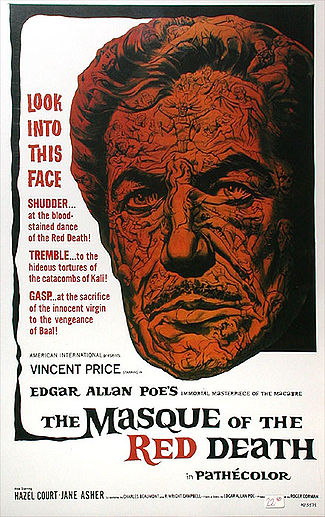
Horror Film Review: The Masque of the Red Death (dir by Roger Corman)


In 1964’s The Masque of the Red Death, Vincent Price stars as Prospero.

Prospero is a nobleman in medieval Italy, a decadent tyrant who rules his villages with an iron hand and who proudly and openly worships Satan.  When an old woman in one of the villages dies of the plague, Prospero orders the village to be burned to the ground.  He returns to his castle where, with his mistress (Hazel Court), he plans to throw a masquerade for the local nobility.  His plan is for everyone to hide out in the castle until Death has passed.  The problem, of course, is keeping Death from sneaking into the castle and claiming everyone within.

Prospero also abducts three villagers, Ludovico (Nigel Green), his daughter Francesca (Jane Asher), and Francesca’s boyfriend, Gino (David Weston).  The three villagers find themselves in a decadent world, where Prospero and his attendants are motivated by their own greed and petty jealousies.  Keeping Death from entering the castle would probably be a lot easier if the people in the castle would stop trying to kill each other.  It’s an odd atmosphere within the castle.  Everyone fears Death and yet, everyone seems to be doing all that they can do invite it in with them.  Can anyone, even a worshipper of the Damned liked Prospero, truly escape Death?

The Masque of the Red Death is not only the best of Roger Corman’s Edgar Allan Poe adaptations but it’s also the best film that Corman ever directed.  Working with cinematographer Nicolas Roeg (who was himself destined to have quite a career as a director of enigmatic films), Corman fills the screen with vivid colors and scenes of medieval decadence.  Price gives one of his best performances, playing Prospero as someone who is in love with his own amoral nature but whose arrogance quickly gives way to fear when he starts to suspect the Death has somehow managed to enter the castle.  The inhabitants of the castle are all memorably eccentric and, in many cases, evil.  A man in an ape costume is burned to death and hardly anyone seems to notice or care.  Prospero and his nobles think that they’re above death because of their wealth and their place in society but, of course, no one can escape Death.

David Weston and Jane Asher are both well-cast as the two lovers, though Asher is clearly more a product of the swinging sixties than medieval Italy.  Patrick Magee and Skip Martin are both memorable as members of Prospero’s court, with Skip Martin giving an especially diabolical performance as a murderous court jester.  In the end, though, this film truly belongs to Price, Corman, and Roeg.  Roeg’s cinematography is dazzling, with the use of red foreshadowing his later film, Don’t Look Now.  Corman’s direction puts the viewer right in the center of Prospero’s court.  And Vincent Price gives one of his best performances as the self-amused but unashamedly evil Prospero.  The Masque of the Red Death remains a classic of 60s pop art and the best of Corman’s many films.

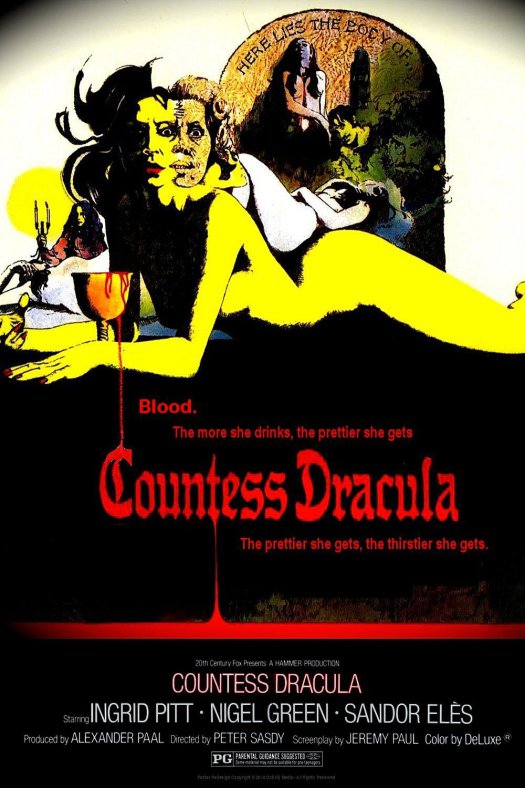
Forever Young: Ingrid Pitt in COUNTESS DRACULA (20th Century Fox/Hammer 1971)


gary loggins's avatarcracked rear viewer

Iconic Ingrid Pitt became a horror fan favorite for her vampire roles in the early 1970’s.  The Polish-born actress, who survived the horrors of a Nazi concentration camp as a child during WWII, played bloodsucking lesbian Carmilla in Hammer’s THE VAMPIRE LOVERS, based on the classic story by J. Sheridan LeFanu, and was a participant in the Amicus anthology THE HOUSE THAT DRIPPED BLOOD opposite Jon Pertwee in that film’s best segment. Finally, Ingrid sunk her teeth into the title role of COUNTESS DRACULA, a juicy part where she’s not really a vampire, but a noblewoman who gets off on bathing in blood, loosely based on the real life events of Hungarian Countess Elizabeth Bathory.

Portrait of the real Elizabeth Bathory

Bathory (1560-1614) was the most infamous female serial killer in history, officially found guilty of 80 murders, yet a diary allegedly found puts the count as high as 650!…

View original post 383 more words

Horror on The Lens: The Masque of the Red Death (dir by Roger Corman)


MasqueOfTheRedDeath(1964film)

So here we are, 24 days into October, and I have yet to share an old Vincent Price film!  It’s not October without at least a little contribution from Vincent.  Well, allow me to correct that with today’s horror on the lens, the 1964 Roger Corman film The Masque of the Red Death.

Based on the classic story by Edgar Allan Poe, this film features Vincent Price giving one of his best performances as the doomed and decadent Satanist Prince Prospero.  The film’s cinematographer was future director Nicolas Roeg and The Masque of the Red Death is probably one of the most visually impressive of all of Corman’s films.

Enjoy!

http://www.youtube.com/watch?v=uCazBlhBs_Q

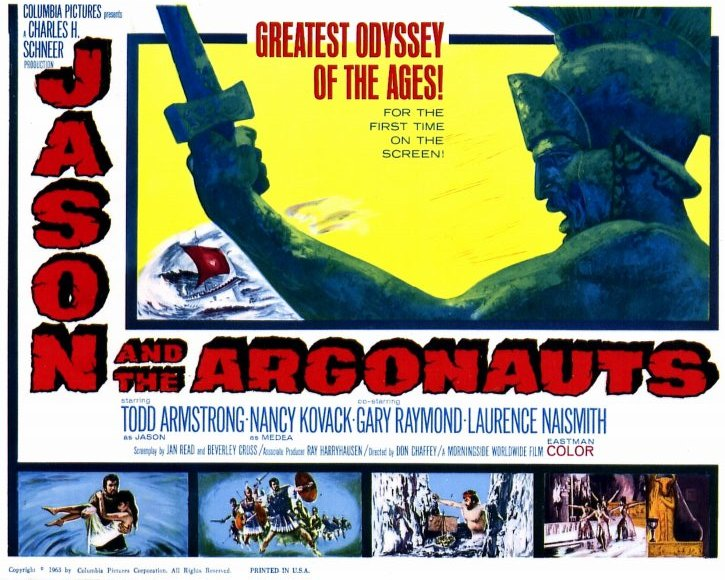
Quickie Review: Jason and the Argonauts (dir. by Don Chaffey)


While I have been buying and collecting dvds for some ten years now (collection around 2500-3000 titles) I have seen those purchases dwindle and wane to almost just a few a year now. I blame the convenience of Netflix and my resurgence in gaming with my Xbox 360 as the main cause for my slacking off in the dvd collecting. While  I still see myself collecting dvds and, most likely, moving onto blue-rays, I have seen why people love their Netflix accounts so much. Last night I was able to combine my love for my Netflix and my Xbox 360 and feed my need to always be watching a film. Using Netflix Instant I was able to watch streaming over my Xbox 360 one of the classic fantasy films ever made.

The film I speak of is the 1963 classic fantasy meets Greek mythology simply called Jason and the Argonauts. It is one of those films which has stood the test of time. I know of no film lover who hasn’t seen this at least once. It’s beloved and admired by millions of people of different generations for its simplicity and for the work of one man whose name overshadows everyone on the film from the director to the actors. This was the film which established for eternity the genius and imaginative creative of special effects guru Ray Harryhausen.

Jason and the Argonauts takes one of the more popular Greek myths about a son looking to re-take his father’s kingdom from a usurper but in the process goes through a journey that pits him against monsters, betrayers and the Gods themselves. The titular character and his crew must travel to the fabled island of Colchis at the edge of the world to find the legendary Golden Fleece purported to have magical properties of healing and even to grant peace throughout the land. I say that’s a piece of item worth fighting off a giant bronze warrior statue, screeching harpies, tempermental seaside cliffs and up to a many-headed hydra and skeleton warriors spawned from it’s teeth.

The acting is typical of most fantasy films of the 60’s and that’s they’re all bombastic, full of vigor and turns even the most simple dialogue into pronouncements of epic deeds to be done. Todd Armstrong leads a cast of British actors including such luminaries of their era like Nigel Green, Nancy Kovack, Honor Blackman and Douglas Wilmer. While the acting may seem quaint by today’s standards I still believe it’s what gives the film it’s timeless energy and quality. It makes the film flow like an epic poem that gave birth to it’s source material to begin with.

But what really makes this film stand out years after years and decade after decade since it’s release is the stop-motion animation effects created by the king of stop-motion effects himself, Ray Harryhausen. To say that the quieter moments where characters interact with each other almost feel like fillers to move the story along until it reaches one of several action sequences featuring Harryhausen’s work. It doesn’t diminish the work done by the actors or the efficient direction by filmmaker Don Chaffey. It just means that Harryhausen’s stop-motion work were so impressive that the audience just wants to see what new magic he has up next.

The climactic fight between Jason and his men versus skeleton warriors born from the teeth of a slain hydra (a stop-motion sequence which was in itself quite impressive) still goes down as one of the most impressive feats of filmmaking married with special effects today. There’s something to be admired about a four and a half minute action sequence where Harryhausen spent 4 months of meticulous frame-by-frame work to make the skeletal opponents come to life. There’s a reason why so many special effects magicians since then have pointed to this scene as one of their favorites and one reason why they got into the FX work to begin with.

Jason and the Argonauts may not have the technical wizardry of today’s fantasy epics and films with their million-dollar budgets spent on CGI-effects. It may not have the seriousness that today’s fantasy films have taken to heart (losing some of the fun, innocence of what makes fantasy films so great). What it does have is great storytelling which harkens back to a more innocent, hopeful and simple time. It also has the finest work of one of film history’s master magicians in Ray Harryhausen and that, in the end, is what makes this film of the the greatest of its kind and one every kid should be introduced to.