Film Review: The FBI Story (dir by Mervyn LeRoy)


In 1959’s The FBI Story, veteran FBI agent Chip Hardesty (James Stewart) delivers a lecture to a group of new FBI recruits.  He tells them the story of both the FBI and his time as a member of the agency.  Somewhat implausibly, it turns out that Chip was involved with nearly every major FBI operation, as we discover while watching this flashback-filled, episodic film.

Battling the Ku Klux Klan in the Deep South?  Chip was there.

Investigating the Oklahoma Indian murders?  Chip was not only there but he was also the one who solved them through handwriting analysis!  (Decades later, the crimes and the investigation would serve as the basis of Martin Scorsese’s Killers of the Flower Moon.)

During the public enemy era, Chip was there.  He was there when Baby Face Nelson killed several unarmed FBI agents, including Chip’s best friend (Murray Hamilton).  He was there when John Dillinger was gunned down in Chicago.  He was there when my distant ancestor “Pretty Boy” Floyd was killed in Ohio.  He wasn’t there when J. Edgar Hoover personally arrested Alvin Karpis or when “Machine Gun” Kelly said, “Don’t shoot, G-Man!” but Chip still makes sure to tell the recruits about it.  He also talks about the gunfight that killed Ma Barker, presented her as being a machine gun-toting madwoman.

Chip investigates subversives during World War II and helped to round up Americans of German and Japanese descent during the internment era.  (Chip insists that they weren’t rounded up because of their ancestry but because the FBI had gotten reports that they might be disloyal.)   When the war wraps up, Chip turns his attention to fighting the international communist conspiracy and good for him.  (Communism sucks!)

Strangely enough, it appears that Chip also tells the recruits a good deal about his personal life because we certainly do see a lot of it.  Chip marries a librarian named Lucy (Vera Miles), who struggles with the demands of being an FBI agent’s wife but who ultimately accepts that Chip has to do his duty.  Sometimes, Lucy wants Chip to quit and sometimes, Chip is tempted to get out.  But they always remember that Chip and the FBI have a job to do.  They raise a family.  They lose a son at Iwo Jima.  Their faith in God and country remains undiminished.

The FBI Story was made with the full cooperation of the FBI, with J. Edgar Hoover personally approving the script and making suggestions.  Hoover even appeared as himself in the film, accepting a report about an airplane bombing with a grim look on his face.  At one point, Chip is prepared to quit the FBI until he hears a speech from Hoover and he’s so inspired that he keeps his resignation letter tucked away in his suit pocket.  Since this film came out in 1959, there’s no details of the FBI tapping the phones of Martin Luther King or Hoover collecting dirt on his political opponents.  Instead, The FBI Story is pure propaganda, your reminder that law enforcement never makes mistakes and civil liberties can be always be sacrificed for the greater good.

It’s simplistic propaganda and it’s overlong and it promotes a few falsehoods as facts.  (Despite what the film says, Pretty Boy Floyd had nothing to do with the Kansas City Massacre and most historians agree that Ma Barker was not the criminal mastermind that Hoover made her out to be after she was caught in the crossfire between her sons and law enforcement.)  The film rather casually dismisses the concern over the World War II internments of American citizens.  To me, something like that is a big deal but the film insists to us that it was all blown out of proportion.  That’s the one moment when not even the film itself seems to be totally sold on what it’s selling.

Fortunately, the film stars the ever-reliable James Stewart, who brings his natural mix of charm and gravity to the role of Chip Hardesty.  Stewart was a bit too old to play Chip as a bumbling young man in the early part of the film but, as the character grows up, so does Stewart’s performance.  The scene where he and Vera Miles learn that his son has been killed in combat feels like it’s from a different and far better movie.  I guess my point here is that James Stewart was one of those actors who could make even questionable material watchable and that’s certainly what he does with The FBI Story.  The FBI, at a time when Hoover was aging and the excesses of the McCarthy era had left many Americans uneasy about the government, decides to borrow James Stewart’s credibility to boost their own.  You may not like the FBI but how can you not love Jimmy Stewart?

The FBI Story came out the same year as one of Stewart’s best films, Anatomy of a Murder, a film that was a complicated as The FBI Story was simplistic.  Stewart gives one of his best performances in Anatomy of a Murder, playing the type of character that Chip Hardesty probably wouldn’t want to have much to do with.  With these two films, Stewart showed us both sides of the American justice system, the men who are tasked with enforcing the law and, even more importantly, the men who are tasked with making sure that law was enforced fairly.  Whichever side your on, you have to be happy to have Jimmy Stewart there.

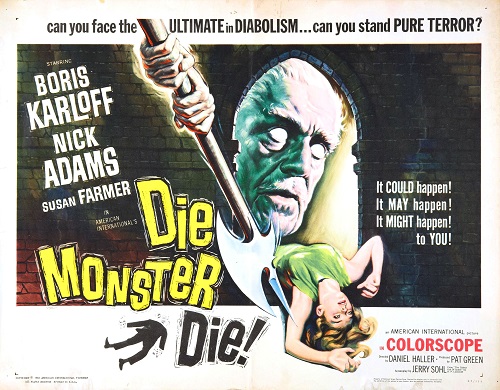
A Quickie with The King: Boris Karloff in DIE, MONSTER, DIE! (AIP 1965)


gary loggins's avatarcracked rear viewer

All you Cracked Rear Viewers know by now my affection for the King of Monsters, Boris Karloff . His Universal classics of the 30’s and RKO chillers of the 40’s hold an esteemed place in my personal Horror Valhalla. Karloff did his share of clunkers, too, especially later in his career. DIE, MONSTER, DIE! is one such film, it’s good intentions sunk by bad execution.

It’s the second screen adaptation of a story from the fertile mind of author  H.P. Lovecraft; the first, 1963’s THE HAUNTED PALACE, was a mash-up of Lovecraft and Edgar Allan Poe as part of the Roger Corman/Vincent Price series. Corman’s longtime Art Director Daniel Haller made his directorial debut, and the film certainly looks good. Veteran sci-fi writer Jerry Sohl contributed the screenplay, which was then tinkered with by Haller. Therein lies the problem; Haller’s changes drag down what could have been an exciting little…

View original post 383 more words

Cleaning Out The DVR: Picnic (dir by Joshua Logan)


Original_movie_poster_for_the_film_Picnic

Tonight, I continued to clean out the DVR by watching the 1955 film Picnic.

Now, Picnic is kind of a strange film.  It’s one of those films from 50s that takes place in a small town where everyone is obsessed with sex but, since it’s the 1950s, nobody can just come out and say that they’re talking about sex.  So, instead, all of the dialogue is very discreet.  For instance, when Madge Owen (Kim Novak) talks to her mother, Flo (Betty Owens), about her date with her boyfriend, Alan (Cliff Robertson), Madge confesses that they spent the night kissing.  Flo asks if Madge if they have done anything more than kiss but, of course, she never comes straight out and says what “more” would be.  The audience knows what she’s talking about but it’s as if the world would actually end if anyone actually uttered the word.  “Oh mom!”  an embarrassed Madge says before confirming that she and Alan haven’t done anything more than kiss.

Flo desperately wants Madge to marry Alan because Alan is rich and his father owns the town’s grain elevator.  Marrying Alan would allow Flo to move up in the town’s strict social hierarchy.  However, Madge isn’t sure that she loves Alan.  Certainly, Alan seems to be a good man with a good future but he’s not a romantic.  Instead, he is someone who has his entire life already mapped out for him.

On Labor Day, a stranger comes to town.  His name is Hal Carter and he shows up riding on a freight train.  He’s come into town to see his old friend, Alan.  It turns out that Hal and Alan went to college together and were members of the same fraternity.  Hal was a star football player but he eventually flunked out of school and has spent the last few years drifting around the country.  However, Hal is now ready to settle down and he wonders if his old roommate Alan can get him a job at the grain elevator.

Now, here’s the strange part.  Hal is played by William Holden.  When he made Picnic, William Holden was 38 years old and looked closer to being 45.  (By contrast, Cliff Robertson, in the role of his former college roommate, was 32 and looked like he was 25.)  Hal spends a lot of time talking about his traumatic childhood and how he is finally ready to settle down and start acting like an adult.  In short, Hal talks like a 30 year-old but he looks like he’s nearly 50.  It’s odd to watch.  But even beyond the age issue, William Holden was an actor who always came across as being both confident and cynical.  Hal is a secret romantic with a deep streak of insecurity.  As great an actor as he may have been, William Holden is so thoroughly miscast here that it actually becomes fascinating to watch.  It brings a whole new subtext to the film as you find yourself wondering why no one is town finds it strange that a middle-aged man is still struggling to deal with his childhood.  When all the town’s young women ogle that shirtless Hal, it’s as if he’s wandered into a town populated only by teenagers with daddy issues.

(Paul Newman played the role of Hal in a Broadway production of Picnic.  And really, that’s who the ideal Hal would have been, a young Paul Newman.)

The majority of the film takes place at the town’s Labor Day picnic, where almost every woman in town is driven to distraction by the sight of Hal dancing.  Even the spinster teacher, Rosemary (Rosalind Russell), is so turned on by Hal’s masculinity that she makes a pass at him and accidentally rips his shirt.  Of course, some of Rosemary’s behavior is due to the fact that she’s drunk.  Her date, the befuddled Howard Bevans (Arthur O’Connell), made the mistake of being whiskey to the picnic.

Hal also dances with Madge’s 13 year-old sister, Millie (Susan Strasberg).  I have to admit that, even though I related strongly to Madge, Millie was my favorite character in the film.  Millie wears glasses and can recite Shakespeare from memory.  She knows that everyone around her is full of it and she’s willing to call them on it.  Of course, Millie herself ends up with a crush on Hal and it’s a dream for her when she finally gets to dance with him.

(Strasberg was 17 years old but is believable as a 13 year-old.  At the same time, since Hal appears to be nearly 50, his sudden closeness to Millie carries an icky, if unintentional, subtext.)

But then Madge suddenly appears, wearing a pink dress and literally emerging from the black night.  She starts to sway to the music.  As she slowly approaches Hal, he forgets about Millie and soon is dancing with Madge.  It’s actually a rather striking scene, one that so full of dream-like sensuality that it almost seems more like it was directed by surrealist David Lynch as opposed to the usually workmanlike Joshua Logan.

(In the video below, the scene freezes about 12 seconds in, before starting up again at the 16 second mark.  This is a glitch with the upload and is not present in the actual film.)

Needless to say, a drifter can’t just come into town and steal his ex-roommate’s girlfriend without drama following.  Picnic starts out as a slightly overheated examination of small town morality and then, after about an hour, it goes the full melodrama route, complete with police chases, stolen cars, a fist fight in an ornate mansion, and a lot of big speeches about the importance of love.  Needless to say, it’s all a lot of fun.

Picnic was nominated for best picture of the year.  However, it lost to the far more low-key Marty.

Just plain Xilly: Nick Adams in MONSTER ZERO


I was never a big fan of kaiju eiga movies. I watched them as a 60s Monster Kid in good standing, but much preferred the Universal classics, Technicolor Hammer horrors, and AIP/Poe epics. Those badly dubbed, fake looking Toho flicks just weren’t my cup of gruel.

I was however a fan of Nick Adams. The actor had roles in major films of the late 50s (REBEL WITHOUT A CAUSE, PICNIC, NO TIME FOR SERGEANTS) and scored big as Johnny Yuma in TV’s THE REBEL (1959-1961). He was nominated for a Best Supporting Actor Oscar for 1963’s TWILIGHT OF HONOR. Yet a scant two years later, Adams found himself in Japan appearing in low budget nonsense like FRANKENSTEIN CONQUORS THE WORLD and MONSTER ZERO.

MONSTER ZERO begins with astronauts Glenn and Fuji landing on the newly discovered Planet X, just beyond Jupiter. A race known as the Xilians are being attacked by Monster Zero, their name for the fearsome Ghidrah. The Xilian Controller has a plan to import Godzilla and Rodan from Earth to combat  the three-headed beast. In exchange, the Xilians promise to give Earth a miracle drug that will “cure all diseases”!

Glenn and Fuji relay the message to Earth’s Supreme Counsel, who begin searching for the two monsters. Suddenly, three spaceships rise up from the lake which supposedly contains Godzilla. The Controller tells the Earthlings they’ve come in peace to help capture the monsters. They snatch up the creatures in their “nuclear bubbles” (or something) and invite Glenn, Fuji, and their boss to Planet X to observe.

Meanwhile, Fuji’s future brother-in-law, Terry, has invented a sonic disruptor devise. This draws the interest of some Xilian spies hiding on Earth, including Glenn’s girlfriend, Namikawa. The aliens capture Terry and hold him in their secret hideout.

Godzilla and Rodan are set on Ghidrah, and a mighty battle ensues. Well, as mighty as these things get. Ghidrah is sent packing, and the Xilians give our heroes a tape containing the formula for the wonder drug. When the Earthmen return, it’s discovered the tape is actually the voice of The Controller stating Earth must immediately surrender and become a Xilian colony or they’ll wipe us out. Those dirty rats!!

The monsters are brought back to Earth under the control of Xilian magnectic waves (or something) and begin doing their rampaging destruction thing, which consists of crushing a bunch of miniature sets. Glenn and Terry manage to escape the aliens clutches, and the Army uses his sonic distrupter to combat the fiends. The world’s citizens are told to crank up their radios, and the piercing noise causes the Xilians computers to malfunction. The alien spaceships blow up in mid-air! The three behemoths are freed from Xilian control, and Godzilla and Rodan vanquish Ghidrah, bringing peace back to our planet.

MONSTER ZERO is pretty bad as far as these things go. I know there are plenty of kaiju eiga who will vehemently disagree, but to me the movie’s just plain Xilly. Toho Studios had success with this one though, and continued to crank out more rubber suited epics well into the 80s.

As for Nick Adams, his life and career continued on a downward spiral. An ugly divorce, with rumors of infidelity and domestic violence, ruined is reputation. Adams found work only in TV guest shots and Grade-Z dreck like MISSION MARS and FEVER HEAT. Adams died of a drug overdose in 1968 at the age of 36. MONSTER ZERO wasn’t released in the US until 1970, as a double feature with WAR OF THE GARGANTUAS, featuring another American ex-pat, Russ Tamblyn. A sad ending for a once promising actormonster zero

Back to School #4: Rebel Without A Cause (dir by Nicholas Ray)


You may have heard of this one.

Traditionally, films about teenagers tend to age terribly.  The language, the clothes, the attitudes, and even the humor; it’s all usually out-of-date within five years or so.  One need only watch something like A Summer Place to both see how dated a film can become and to see how one generation’s idol can appear rather ludicrous to future generations.  (And yes, I am talking about Troy Donahue…)  What makes Rebel Without A Cause unique is that it’s a movie about teenagers that was released way back in 1955 and yet, nearly 60 years later, it still feels fresh and relatable.

Of course, it helps that the title character is played by James Dean who, to put it lightly, was no Troy Donahue.

Rebel Without A Cause tells the story of three alienated teenagers trying to survive in the suburbs of Los Angeles.  (“…and they all came from good homes!” the film’s poster informs us.)  Plato (Sal Mineo) is a painfully sensitive 15 year-old who has been abandoned by his parents and is being raised by the family’s maid.  (Since this movie was made in 1955, the fact that Plato is gay is obvious but never explicitly stated.)  Judy (Natalie Wood) is the girlfriend of Buzz (Corey Allen) and is acting out because she feels that’s the only way she can can get her father to pay attention to her.  And then there’s Jim Stark (James Dean), whose family has just moved to Los Angeles and who is constantly in the middle of the fights between his overbearing mother (Ann Doran) and his weak-willed father (Jim Backus).

Rebel Without A Cause 2

During Jim’s first day at high school, he not only manages to make an enemy when Buzz spots him attempting to flirt with Judy but he also gets to go on a field trip to the Griffith Observatory, where the students are told that the entire universe is going to end eventually.  After the field trip, Buzz challenges Jim to a knife fight.  Jim agrees only after the rest of Buzz’s gang (including a young Dennis Hopper) accuse him of being “chicken.”  However, after a security guard breaks up the fight, Buzz challenges Jim to a “chicken run.”

(People in the 50s were obsessed with chickens.)

That night, Jim and Buzz both drive stolen cars towards the edge of a cliff.  The first driver to jump out of his car loses.  Before they start their engines, Buzz smiles and tells Jim, “I like you.”  Yay!  Jim’s finally made a friend!  Uh-oh, Buzz just drove over the cliff and his car exploded!  Well, so much for that friendship.  Now, with Buzz’s gang swearing revenge and their parents incapable of understand what happened, Jim, Judy, and Plato are on the run.  They end up hiding out in an abandoned house and find a brief moment of happiness before the gang and the police show up to ruin everything.

NW-nataliewood-rebel-love

The challenge of reviewing Rebel Without A Cause is trying to find a new way to say what everybody already knows.  Rebel Without A Cause is a great film that’s distinguished by Nicholas Ray’s sensitive direction and James Dean’s iconic performance in the lead role.  Whenever I see Rebel Without A Cause, I’m always struck by just how much unexpected nuance there is Dean’s interpretation of Jim Stark.  We always think of James Dean as being the epitome of cool and I think we tend to forget that, at least in the beginning of the film, Jim is anything but that.  Instead, he’s awkward and shy.  His attempts to flirt with Judy lead to her calling him “a real yo-yo.”  As much as he tried to fit in with the rest of his classmates, he’s a permanent outsider.  (Just consider what happens with his infamous “moooo” during the presentation at the observatory.)  He has a lot to say but he doesn’t know how to say it and every time that he tries to express what he’s feeling, he’s ignored by adults who don’t have the patience to listen.  Dean brings such a raw intensity to these scenes that I always find myself wanting to reach out and hug him and tell him that everything’s going to be okay, even though I know that it’s not.  Even today, it’s still easy to see why every teenager in the 50s either wanted to be or to be with Jim Stark.

Also, whenever I watch the film, I’m reminded of how much I relate to the character of Judy.  I think that’s because, when I was 16, I might as well have been Judy.  Natalie Wood’s performance might not be as showy as James Dean’s but it’s equally effective.

Of course, one reason why Rebel Without A Cause has become iconic is because James Dean died shortly after filming ended.  (In fact, some of his scenes had to be redubbed by Dennis Hopper, who reportedly could do an exact imitation of Dean’s voice.)  It’s interesting to wonder what would have become of James Dean if he had lived.  Would he have continued to be one of our best actors or would he have eventually been forgotten or forced to appear on television?  Personally, I like to think that James Dean would have remained a great actor but he would have been too much of an iconoclast to remain in Hollywood.  Eventually, in my alternative universe, James Dean moved to Europe and teamed up with Klaus Kinski to star in a series of spaghetti westerns.  And they were great.

As for Rebel Without A Cause, it remains a great movie nearly 60 years after it was first made.  And really, what more needs to be said?

Rebel